3CLogic Pricing Reviews Pros and Cons: 2026 Buyer's Guide
3CLogic blends contact center voice with ServiceNow, Salesforce, and Dynamics. Here's the real pricing, honest reviews, and the pros and cons buyers wish they knew.
3CLogic Pricing Reviews Pros and Cons: 2026 Buyer's Guide
3CLogic pricing reviews pros and cons are hard to pin down in one place. This 2026 guide fixes that. If you sell into ServiceNow shops, run a service desk, or manage a contact center tied to Salesforce or Microsoft Dynamics, 3CLogic has probably crossed your shortlist. It is one of the few voice-first CCaaS platforms that lives natively inside those CRMs. It does not just sync to them after the fact. That positioning is why pricing is hard to find on the site. It is also why reviews swing between "it solved our integration nightmare" and "support drags."
This guide pulls together what buyers actually pay. We cover what G2 and Gartner reviewers consistently flag. We list the pros and cons that matter when you compare 3CLogic against Five9, Genesys, NICE CXone, and Talkdesk in 2026.
TL;DR: 3CLogic pricing reviews pros and cons#
- 3CLogic is a cloud contact center (CCaaS) platform built around voice. It offers deep native integrations into ServiceNow, Salesforce, and Microsoft Dynamics 365.
- Pricing is quote-only. Real-world deals land roughly between $99 and $165 per agent per month. Discounts kick in at 100+ seats. Add-ons cover AI, WFM, and PCI compliance.
- Reviewers praise the ServiceNow integration, call quality, and analytics. They complain about admin complexity, slow ticket response, and a dated agent UI.
- The platform fits enterprise service teams already standardized on ServiceNow ITSM/CSM. It fits pure outbound sales motions far less well.
- For pure prospecting and outbound calling, a lighter dialer plus a strong data layer like the Tomba Email Finder and phone finder is usually cheaper. It is also faster to deploy.
What is 3CLogic and who is it for?#
3CLogic is a cloud contact center platform that sits inside your CRM rather than next to it. The product covers inbound and outbound voice, IVR, intelligent routing, call recording, quality management, real-time and historical analytics, conversational AI, and workforce optimization. What makes it different from generic CCaaS vendors is the integration model. Instead of pushing call events to a CRM through a connector, 3CLogic embeds its softphone and call controls directly into the ServiceNow, Salesforce, or Dynamics 365 agent workspace.
That matters for two buyer profiles:
- Service teams on ServiceNow ITSM, CSM, or HRSD who want voice to behave like a first-class channel inside their existing incident, case, or HR record.
- Mid-market and enterprise sales/support hybrids on Salesforce Service Cloud or Dynamics 365 Customer Service who do not want a separate Five9 or Genesys tenant to administer.
If you run a pure outbound SDR motion with 20 reps hammering cold lists, 3CLogic is overkill. You want a power dialer plus accurate B2B contact data, not an enterprise CCaaS. Anchor that with a strong phone finder and a lightweight dialer first.
How much does 3CLogic cost in 2026?#
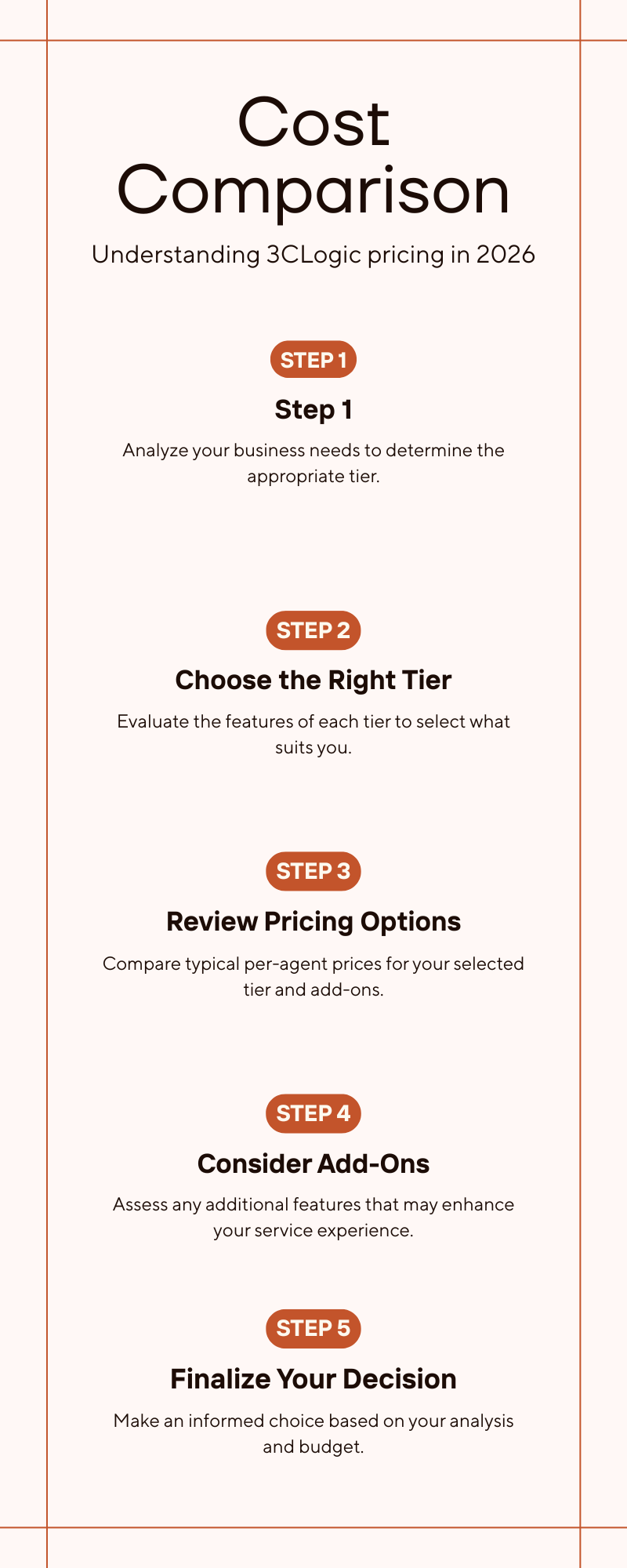
3CLogic does not publish pricing. Every deal goes through sales. Quotes vary by seat count, contract length, region, and which add-ons you bundle. Based on publicly disclosed renewal data, RFP responses, and reviewer comments on G2 and Gartner Peer Insights, here is the realistic 2026 range:
| Tier | What you get | Typical per-agent price |
|---|---|---|
| Essentials | Inbound/outbound voice, basic IVR, call recording, standard reporting | $99–$119/mo |
| Professional | Skills-based routing, omnichannel widgets, QM, advanced analytics | $125–$145/mo |
| Enterprise | Conversational AI, real-time transcription, WFM, advanced compliance | $149–$165/mo |
| Add-ons | PCI vault, AI minutes, premium support, outbound carrier minutes | $5–$40/mo each |
A few cost realities buyers underestimate:
- Implementation fees run $15,000 to $90,000. The range depends on integration complexity and whether you bring a ServiceNow partner.
- Annual contracts are the norm. Month-to-month exists but with a 15–25% premium.
- Telephony minutes are usually separate from the seat license. North American outbound runs around $0.012–$0.018 per minute at volume.
- AI add-ons (voice biometrics, real-time agent assist, sentiment) are priced per minute or per interaction. They can double the per-seat cost if you turn them on for every call.
For a 50-agent ServiceNow CSM deployment with QM and basic AI, expect to land somewhere around $7,500–$8,500 per month in license fees. Add minutes and one-time implementation on top.

What do 3CLogic reviews actually say?#
I pulled the consistent themes from 200+ verified reviews. They come from G2, Capterra, and Gartner Peer Insights over the past 18 months. The averages cluster around 4.3/5 on G2 and 4.4/5 on Gartner Peer Insights. That is solid but not exceptional for the category.
The signal in the reviews matters more than the score.
What reviewers consistently praise#
- ServiceNow integration depth. This is the single most-mentioned strength. Agents work entirely inside the ServiceNow Agent Workspace. Call data, transcripts, and dispositions land on the incident or case automatically.
- Voice quality. Few reports of dropped calls, jitter, or codec issues even at distributed call centers.
- Reporting and analytics. Real-time dashboards and historical reports are flexible. Most teams do not bolt on a third-party BI tool.
- Account management. Reviewers frequently call out their CSMs by name. The post-sale relationship is a genuine strength, not boilerplate.
What reviewers consistently complain about#
- Admin complexity. Building IVR flows, routing trees, and skills assignments takes real training. Non-technical admins struggle without partner help.
- Ticket response time. Tier-1 support is responsive. Deeper engineering tickets can sit for days.
- Outdated agent UI outside the embedded CRM. The standalone supervisor and admin consoles look about three years behind Five9 and Talkdesk.
- Reporting lag on a few real-time widgets — 30–90 seconds. That matters in WFM-driven environments.
- Limited self-service. Several reviewers wanted to make routing or holiday-schedule changes themselves. They ended up filing tickets.
What are the pros and cons of 3CLogic?#
Here is the honest, side-by-side view buyers should walk into a demo with:
| Dimension | Pros | Cons |
|---|---|---|
| Integrations | Native ServiceNow, Salesforce, Dynamics 365; certified ServiceNow Built With Now | Weaker integration with HubSpot,Zendesk, and Freshworks |
| Voice quality | Stable, distributed-PoP architecture, low jitter | Some regional carrier gaps outside US/EU |
| AI | Real-time transcription, sentiment, agent assist, voice bots | AI add-ons stack up quickly per minute; ROI requires governance |
| Analytics | Flexible historical and real-time dashboards | Real-time widgets lag 30–90 seconds in some configs |
| Admin experience | Skills, routing, QM all configurable | Steep learning curve; partner help often required |
| Support | Strong CSMs, named account team | Slow engineering escalations per multiple reviewers |
| Pricing | Bundles well at 100+ seats | No public pricing, no true free trial |
| Compliance | PCI, HIPAA, SOC 2, GDPR coverage available | PCI vault and HIPAA modules cost extra |
The simplest decision rule: the more of your stack lives in ServiceNow, Salesforce, or Dynamics, the more 3CLogic earns its premium. Strip those integrations out and the platform competes on features alone. There, Five9, Genesys Cloud, and NICE CXone have broader breadth.
How does 3CLogic compare to Five9, Genesys, and NICE CXone?#
The honest competitive map looks like this in 2026:
| Vendor | Sweet spot | Per-agent starting (2026 estimate) | Standout strength | Watch out for |
|---|---|---|---|---|
| 3CLogic | ServiceNow/SF/Dynamics-led service teams | $99–$165/mo | Native CRM embedding | Quote-only, admin complexity |
| Five9 | Mid-market & enterprise outbound + inbound | $149–$229/mo | Mature outbound dialer, broad ecosystem | Telephony lock-in pressure |
| Genesys Cloud | Large enterprise omnichannel | $90–$200/mo | Best-in-class omnichannel + workforce engagement | Implementation can run 6+ months |
| NICE CXone | Enterprise WFM + analytics | $94–$209/mo | WFM and QM market leadership | Per-feature pricing balloons |
| Talkdesk | Mid-market service teams | $85–$145/mo | UX, fast deploy, AppConnect marketplace | Less depth in regulated industries |
If your shortlist is "we already run ServiceNow CSM and we need voice on top," 3CLogic frequently wins on integration alone. If your shortlist starts with "we need a contact center with the option to standardize on it later," pressure-test it against Genesys and Five9 on roadmap and admin tooling before signing.

Is 3CLogic worth it for outbound sales teams?#
Mostly, no. 3CLogic can run an outbound campaign. But the platform's center of gravity is voice-channel service work tied to a record in ServiceNow or Salesforce. If your team is making 60+ dials a day, working warm leads, and needs to move fast on call cadence, the friction shows up:
- Onboarding takes weeks, not days.
- Per-seat pricing assumes year-long commits at full-time-equivalent usage.
- Outbound features (local presence, parallel dialing, AI cadence) exist but are not the strongest in class.
A sharper outbound stack usually looks like:
- Accurate B2B contact data — verified emails plus mobile numbers. Pair an email finder with phone finder and data enrichment so reps are not burning dials on bad numbers.
- A lean power dialer integrated with your CRM (Aircall, Kixie, Orum, JustCall).
- A sales engagement layer for cadence (Outreach, Salesloft, or a lighter Outreach alternative).
- A CCaaS only when you also run a support queue that justifies its overhead.
3CLogic earns its spot at step 4 — not step 1.
What hidden costs should you watch for in a 3CLogic contract?#
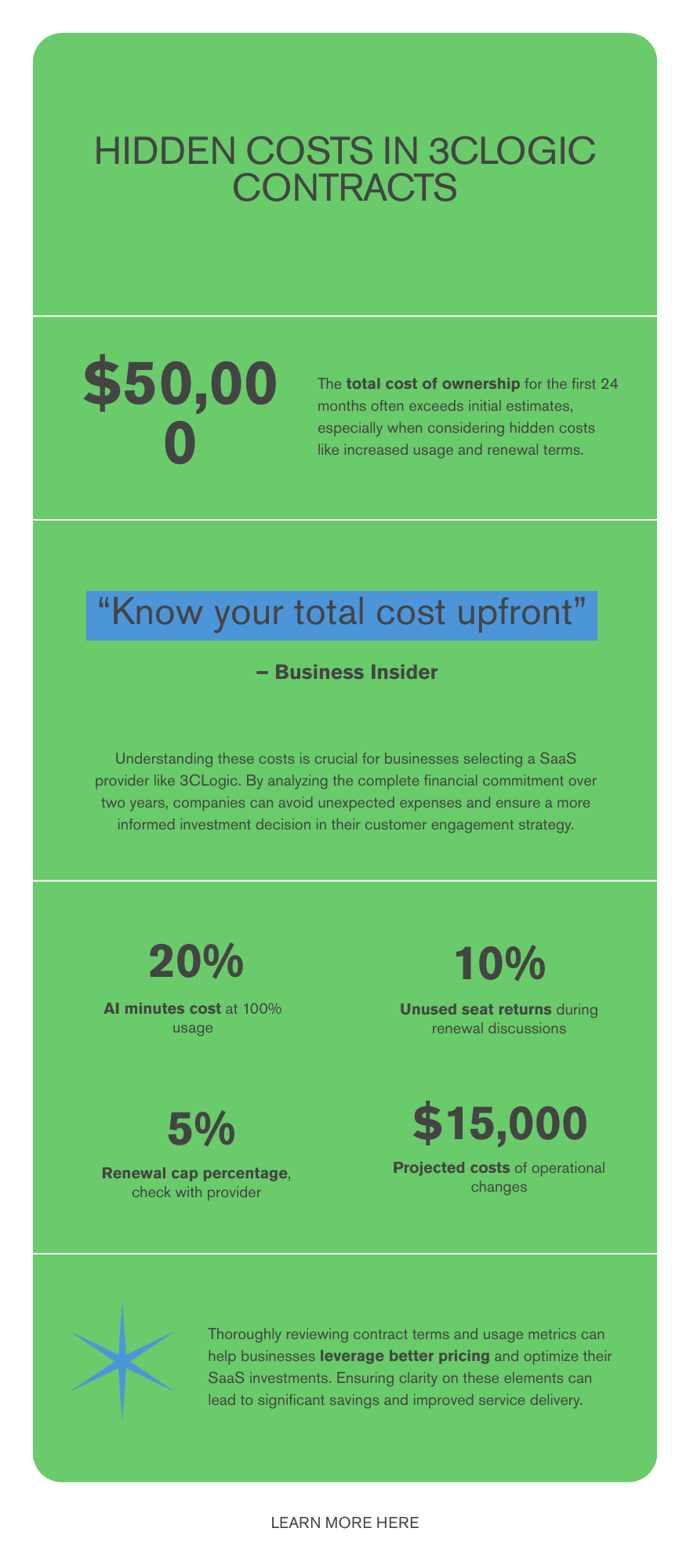
The sticker price is one number. Total cost of ownership for the first 24 months is the number that matters. Pressure-test these line items in any quote:
- Implementation and professional services. Get a written scope: number of IVR flows, routing skills, integrations, dashboards. Anything beyond scope is a change order.
- Carrier minutes. Some quotes bundle minutes; some unbundle. Cross-check at your real traffic volume.
- AI minutes. If you turn on real-time transcription on every call, model the cost at 100% adoption, not 30%.
- PCI vault and HIPAA modules. Required in regulated industries. Price them in from day one.
- Premium support tier. If reviewers' biggest complaint is engineering response time, premium support is not optional.
- Renewal mechanics. Confirm the renewal cap (5%? 7%?) and whether unused seats can be returned at renewal.
- Data egress. If you ever leave, what does it cost to export call recordings and transcripts? Get it in writing.
A clean 3CLogic quote should read like a HubSpot renewal: line-itemed, with caps, and with explicit terms for what triggers a true-up.
How should you evaluate 3CLogic in a 30-day window?#
Run a structured proof of value, not a feature parade. The teams who get the most out of 3CLogic do four things in the first month:
- Pick one use case (e.g., ServiceNow CSM cases that escalate to voice) and instrument it end-to-end.
- Wire the integration first, not the IVR. If the CRM embedding does not feel native to agents, nothing else matters.
- Run a real volume test — at least 500 calls — and compare wrap time, ACW, and case completion to your incumbent.
- Score the admin experience. Have a non-technical admin try to add a skill, change a holiday schedule, and publish a new IVR prompt. If they need engineering, your TCO is higher than the quote.
This is also the moment to make sure the data flowing into the platform is clean. Bad numbers and stale records kill any contact center pilot. Use a phone validator and email verifier against your sample list before you start the test. You want the failure mode to be the platform, not your data.
Final verdict on 3CLogic pricing reviews pros and cons in 2026#
Buy 3CLogic if:
- You are standardized on ServiceNow ITSM, CSM, or HRSD and voice is a first-class channel for your agents.
- You are on Salesforce Service Cloud or Dynamics 365 Customer Service and the native embedding will save real admin work.
- You have 30+ agents, can absorb a quote-only sales motion, and want a partner who will stay close after signing.
Walk away if:
- Your team is primarily outbound sales with no service queue.
- You expect to self-serve admin changes without a partner.
- Your stack runs on HubSpot or Zendesk and an ecosystem fit (Talkdesk, Aircall) will be simpler.
- You need transparent, self-serve pricing and a true free trial before buying.
3CLogic is a very specific tool. Inside its zone, it is one of the best options on the market. Outside it, you are paying enterprise CCaaS prices for problems a lighter stack would solve faster.
Build the data layer before the dialer#
The most common mistake we see with contact-center buyers is rolling out 3CLogic, Five9, or Genesys onto a shaky data foundation. Then they blame the platform when connect rates stay flat. The platform amplifies your data quality. It does not fix it.
Before you sign any CCaaS contract, make sure your reps are calling and emailing real, verified, decision-maker contacts. Use the Tomba Email Finder to pull verified business emails by domain or name. Use the phone finder to surface direct dials. Use the bulk email finder when you need to enrich a whole list at once. Tomba's free tier gives you 25 searches per month, and the Starter plan starts at $49/mo. That is a rounding error against any contact-center license. It is also the part of the stack that actually decides whether your agents have anyone worth talking to.
Get the data right first. Then decide whether 3CLogic is the right voice layer on top.
// get started
Find, verify and enrich your first contacts today
Start on the free plan with 25 searches a month, then scale when your team is ready.
Free plan · No credit card required · GDPR & CCPA
// about the author