3CX vs 8x8 in 2026: Which Business Phone System Wins?
3CX vs 8x8 in 2026: a pragmatic breakdown of pricing, call quality, contact center features, and which platform fits sales teams best.
TL;DR#
- 3CX is a self-hosted (or 3CX-hosted) PBX with a per-system license and bring-your-own SIP trunks. Cheap at scale, heavier to operate.
- 8x8 is a cloud UCaaS + CCaaS platform with per-user pricing, unlimited calling to 14-48 countries depending on tier, and a built-in contact center.
- Pick 3CX if you have IT bandwidth, want to keep your existing trunks, and care about a fixed annual cost.
- Pick 8x8 if you want one vendor for voice + video + SMS + contact center, integrated CRM dialing, and global PSTN included.
- Neither tool will fix bad lists. Pair whichever you choose with a real B2B database and verified mobile numbers from a phone finder.
What is 3CX and how does it work?#
3CX is a software PBX you install on your own Linux/Windows box, on a private VM, or on 3CX's hosted infrastructure. It speaks SIP, so you point it at any compliant SIP trunk provider (Twilio, Bandwidth, Telnyx, VoIP.ms, your local telco) and it handles routing, IVR, queues, recording, and softphone clients on top.
The license model is per system, not per user. You pay once a year based on simultaneous calls (SC), not seats. A 4SC license supports unlimited extensions but only 4 concurrent calls. That math gets very attractive once you have 20+ employees who rarely all dial at the same time.
The trade-off is operational. You own the upgrades, the SIP trunk contracts, the firewall rules, the SBC, the call recording storage, and the troubleshooting when a remote rep's audio cuts out. If you have a sysadmin who already runs your infrastructure, this is a cost win. If you don't, the "cheap" license becomes expensive in engineering hours.
What is 8x8 and what's in the X Series?#
8x8 is a pure-cloud unified communications platform. You buy a seat (X2, X4, X6, X7, X8), point users at the desktop app or desk phone, and 8x8 handles everything else — trunks, PSTN, SMS, video, voicemail, recording, analytics, and a contact center stack on the upper tiers.
The headline feature is the Global Reach plan: X2 includes unlimited calling to 14 countries, X4 jumps to 48. For sales teams calling internationally, that's a genuine line-item kill compared to paying Twilio per-minute rates plus a separate PBX license.
X6 and above bundle the 8x8 Contact Center: skills-based routing, omnichannel queues, supervisor dashboards, quality management, speech analytics. That's competitive with Genesys Cloud or NICE CXone — and it's the same login as your UCaaS, which matters when a sales rep needs to hand a call to support.

How does 3CX vs 8x8 pricing compare in 2026?#
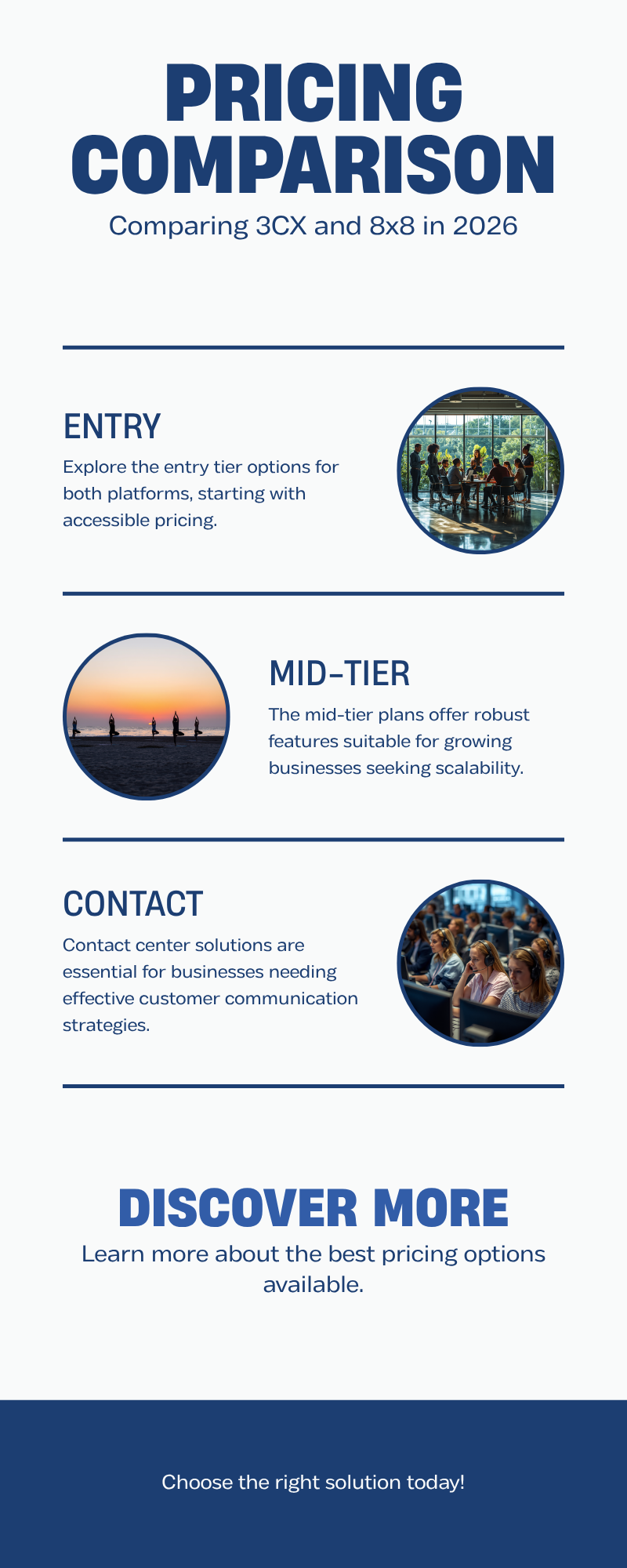
This is where the two products diverge hardest. 3CX charges per concurrent call. 8x8 charges per user per month.
| Plan | 3CX (annual, per system) | 8x8 (per user / month) |
|---|---|---|
| Entry tier | 3CX SMB (free, hosted, ≤10 users) | X2 — ~$28 |
| Mid tier | 3CX Pro 8SC — ~$295/yr (self-hosted) | X4 — ~$57 |
| Contact center | 3CX Enterprise 16SC — ~$1,180/yr | X6 — ~$85 |
| Outbound analytics | Add-on / 3rd party | X7 — ~$110 |
| Full omnichannel | Not native | X8 — ~$140 |
| Free trial | Free SMB tier | 30 days |
A 25-person sales team that needs simultaneous outbound capacity for ~10 reps would land near $1,200/yr on 3CX Pro 16SC vs roughly $17,100/yr on 8x8 X4 (25 × $57 × 12). 3CX wins the spreadsheet — until you add the cost of SIP trunks, hosting, an SBC, and the engineer who maintains all of it. Plug that into a real TCO and the gap narrows to roughly 2-3×, not 14×.
For deeper context on outbound infrastructure economics, the Gartner UCaaS Magic Quadrant and reviews on G2's UCaaS category are worth a skim before you commit.
Is 3CX or 8x8 better for call quality?#
Call quality on both is fine in the steady state. Both use Opus, both have HD voice, both have softphones that work on modern OSes. The difference is who owns the failure mode.
On 3CX, audio problems usually trace to:
- A SIP trunk provider you picked (latency, jitter, packet loss on their network)
- Your firewall (NAT traversal, missing SIP ALG disable)
- The remote rep's home network
You diagnose all of it. There's no support team that owns end-to-end MOS scores.
On 8x8, audio problems are 8x8's problem. They run the trunks, the media servers, the geo-routing, and they publish an SLA (99.999% uptime on X-series voice). When a rep complains, you open a ticket and they pull logs from the same stack that delivered the call.
For an outbound-heavy team that lives or dies on dial connect rates, the second model has real value. For an inside-sales team mostly on Zoom anyway with phones as backup, the first is fine.
Which integrates better with your sales stack?#
8x8 has the broader pre-built integration surface: native Salesforce, HubSpot, Dynamics, Zendesk, Zoho, Freshdesk, and ServiceNow connectors with click-to-dial, screen pops, and auto-logging. The Salesforce integration in particular is a real CTI, not a Chrome extension.
3CX has integrations too — Salesforce, HubSpot, Pipedrive, Zoho, MS365, Google Workspace — but several depend on a Pro or Enterprise license and the depth is shallower (click-to-dial and call journaling, less workflow automation).
If your reps live in HubSpot or Pipedrive and you want zero-friction logging, 8x8 X4+ wins. If you don't care about CRM integration depth, 3CX is fine.
Either way, the bottleneck for outbound sales isn't the dialer — it's the data going into it. Bad numbers waste both. Pair your phone system with a phone validator before you dial and you'll see immediate connect-rate lift. Reps doing account-based outbound also benefit from running a LinkedIn finder to grab the right contact's email and direct dial in one pass.
How do 3CX and 8x8 handle the contact center?#
This is the cleanest decision point.
3CX has a "Call Center" feature set on Pro and Enterprise: skills-based routing, queue strategies (round-robin, longest waiting, priority), wallboards, real-time supervisor barge/whisper/listen, and reporting. It's competent for sub-50-agent teams running mostly voice. It is not omnichannel — email, chat, and social need bolt-ons.
8x8 Contact Center (bundled from X6) is a real CCaaS:
- Omnichannel queues (voice, email, chat, SMS, social) in one routing engine
- Skills-based + attribute-based routing
- Real-time and historical analytics with custom dashboards
- Quality management with screen recording
- Speech analytics and sentiment scoring on X8
- WFM (workforce management) integrations with Calabrio, NICE WFM
- CRM integrations that bring case context to the agent screen
If you're running a 100-seat support or sales operation that needs SLAs by channel, 8x8 saves you from buying a separate CCaaS layer like Five9 or Genesys.
What about reliability and global coverage?#
8x8 publishes a 99.999% financially-backed SLA on voice across the X Series, with redundant geo-distributed data centers and a documented disaster recovery model. For multi-region sales orgs, this is the safer bet — your London office and your Austin office both hit a regional 8x8 edge with consistent quality.
3CX reliability depends entirely on how you deploy it. A single VM on a single cloud region with a single SIP trunk = a single point of failure. To match 8x8's resilience you need active-passive 3CX nodes, multiple trunks, and DNS failover — all of which you build and pay for yourself.
For pure SIP and standards reference, the Wikipedia entry on SIP is the cleanest neutral primer.
Which one is easier to deploy and admin?#
8x8 is faster to launch. Buy seats, ship the desktop app, provision numbers from the admin portal, done. A 20-rep team is dialing in under a day.
3CX takes longer because you're deploying software. Spin up the VM, configure the SIP trunk, set up STUN/TURN for remote workers, install softphones, configure DIDs, build the IVR, test failover. Two to five days of focused work for the same 20 reps, more if your network team is busy.
Ongoing admin: 8x8 is mostly portal clicks. 3CX rewards a sysadmin mindset — config files, system logs, occasional Linux patches, SBC management. Both have decent admin UIs, but 3CX's surface area is genuinely bigger.
When does 3CX still win?#
Three scenarios:
- You're already paying SIP trunk providers you trust (Twilio, Bandwidth, Telnyx) and don't want to re-paper carrier contracts. 3CX sits on top of what you have.
- You're a managed service provider reselling phone to small business customers. 3CX's per-system pricing makes white-label margins workable.
- You're a 200+ seat single-site operation with an IT team and predictable concurrency. The annual 3CX bill plus trunks lands well below per-seat UCaaS at that scale.
If you're a remote-first sales team of 10-100 with no dedicated telecom engineer, 8x8 will be cheaper once you count operational cost honestly.
When does 8x8 win?#
- Multi-country sales teams (unlimited international on X4 alone is a real budget item)
- Anyone who needs voice + contact center in one vendor
- Companies without an in-house telecom engineer
- Teams already buying point solutions for SMS, video, recording, and analytics — 8x8 collapses the bill
- Regulated industries (finance, healthcare) that need vendor-managed compliance — 8x8 has HIPAA BAA, FINRA, SOC 2
What do reviews say in 2026?#
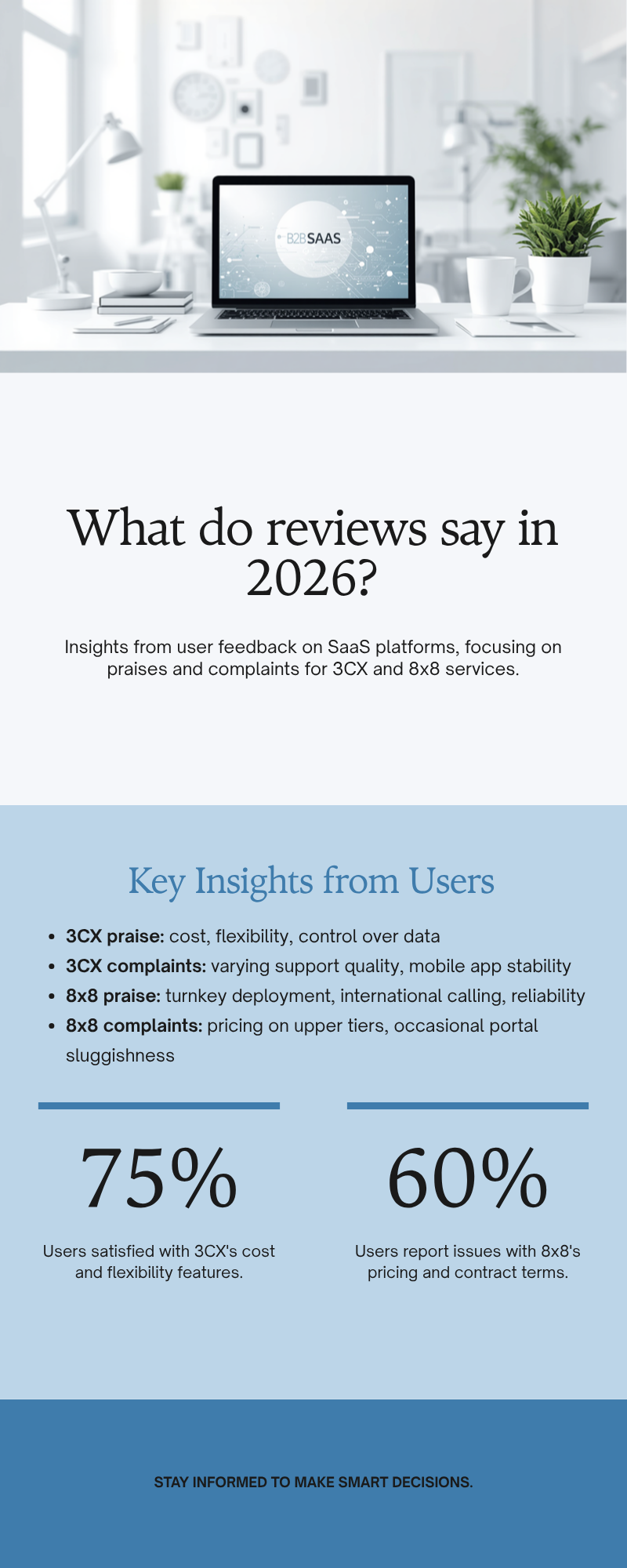
Both products sit in the leader quadrant for their respective categories on G2 and Capterra. Recurring themes:
- 3CX praise: cost, flexibility, control over data, no per-seat lock-in
- 3CX complaints: support quality from partners varies, mobile app stability, learning curve
- 8x8 praise: turnkey deployment, contact center depth, international calling, reliability
- 8x8 complaints: pricing on upper tiers, occasional admin portal sluggishness, contract terms
Read the recent reviews (last 6 months) rather than the top-of-page average — both vendors have shipped meaningful UX changes since 2024.
Final verdict on 3CX vs 8x8#
If you measure success by annual license line item, 3CX wins almost every time.
If you measure success by total cost of running outbound + support voice, including human time and downtime risk, 8x8 wins for most growing teams under 200 seats. The price gap closes more than the spreadsheet suggests.
The platform decision matters less than the inputs feeding it. A perfect phone system with bad data still produces 2% connect rates. Before you migrate either way, fix your contact data: verify the numbers, enrich the accounts, and confirm you're dialing the right person.
Power your dialer with verified contact data#
A new phone platform won't lift outbound numbers if your list is full of disconnected mobiles and gatekeeper switchboards. Use the Tomba Email Finder to pull direct contacts for decision-makers in your ICP, then run them through Tomba's data enrichment to attach verified phone numbers and job titles before they hit your 3CX queue or 8x8 dialer. Start free on the Tomba pricing page — 25 searches a month, no credit card, and your sales floor stops dialing dead lines.
Ready to find emails that actually work?
Join 150,000+ professionals who stopped guessing and started sending. Free credits on signup — no credit card required.
Get the Tomba newsletter
Practical outbound tactics and product updates — once every two weeks.
About the author