3CX vs Zoom 2026: Which Business Phone System Actually Wins?
3CX vs Zoom in 2026: a side-by-side breakdown of pricing, PBX features, video meetings, and which platform fits sales teams, support desks, and hybrid offices best.
TL;DR#
- 3CX is a self-hostable PBX built around SIP trunks, deep call routing, and a one-time-style annual license priced per system size — strongest for cost-conscious teams that want to own their phone stack.
- Zoom (specifically Zoom Phone + Zoom Workplace) is a fully cloud-managed UCaaS suite that bundles meetings, chat, whiteboard, and PBX — strongest for teams that already live in Zoom Meetings and want one vendor.
- Pick 3CX if you place high call volume, want to bring your own SIP trunk, and have a sysadmin who can manage the server.
- Pick Zoom if you need polished video-first collaboration, native AI Companion summaries, and zero infrastructure to maintain.
- The honest answer: most sub-50-seat sales teams pick Zoom for simplicity; most 100+ seat call centers and MSPs pick 3CX for unit economics.
What is 3CX?#
3CX is a software-based PBX that runs on Windows, Linux, a Raspberry Pi, or as a hosted instance in 3CX's cloud. It connects to any SIP trunk you choose — Twilio, Telnyx, your local carrier — and turns that connection into a full business phone system with extensions, IVR, queues, call recording, and softphone apps for desktop and mobile.
3CX is licensed per "simultaneous call" tier rather than per user. That pricing quirk is why it survives in 2026 against giants: a 100-person support team that only takes 16 calls at once pays for 16, not 100.
The platform added a web client, native browser-based softphone, WhatsApp and Facebook channels, and a built-in live chat widget for websites. It is still, at heart, a PBX — not a meetings tool.
What is Zoom?#
Zoom started as a video meetings product and is now a unified communications suite called Zoom Workplace. The relevant pieces for this comparison:
- Zoom Meetings — the video product everyone knows.
- Zoom Phone — a cloud PBX with carrier services in 47+ countries.
- Zoom Team Chat — persistent messaging.
- Zoom Contact Center — a CCaaS layer for support teams.
- Zoom AI Companion — meeting summaries, smart compose, call summaries, included in paid plans.
You do not host anything. Zoom runs the PBX on its own SBCs, ships you DIDs, and bills per user per month. The trade-off is total dependence on Zoom's pricing and roadmap.
How do 3CX and Zoom differ at their core?#
The core difference is architecture and ownership. 3CX gives you a PBX you can self-host;
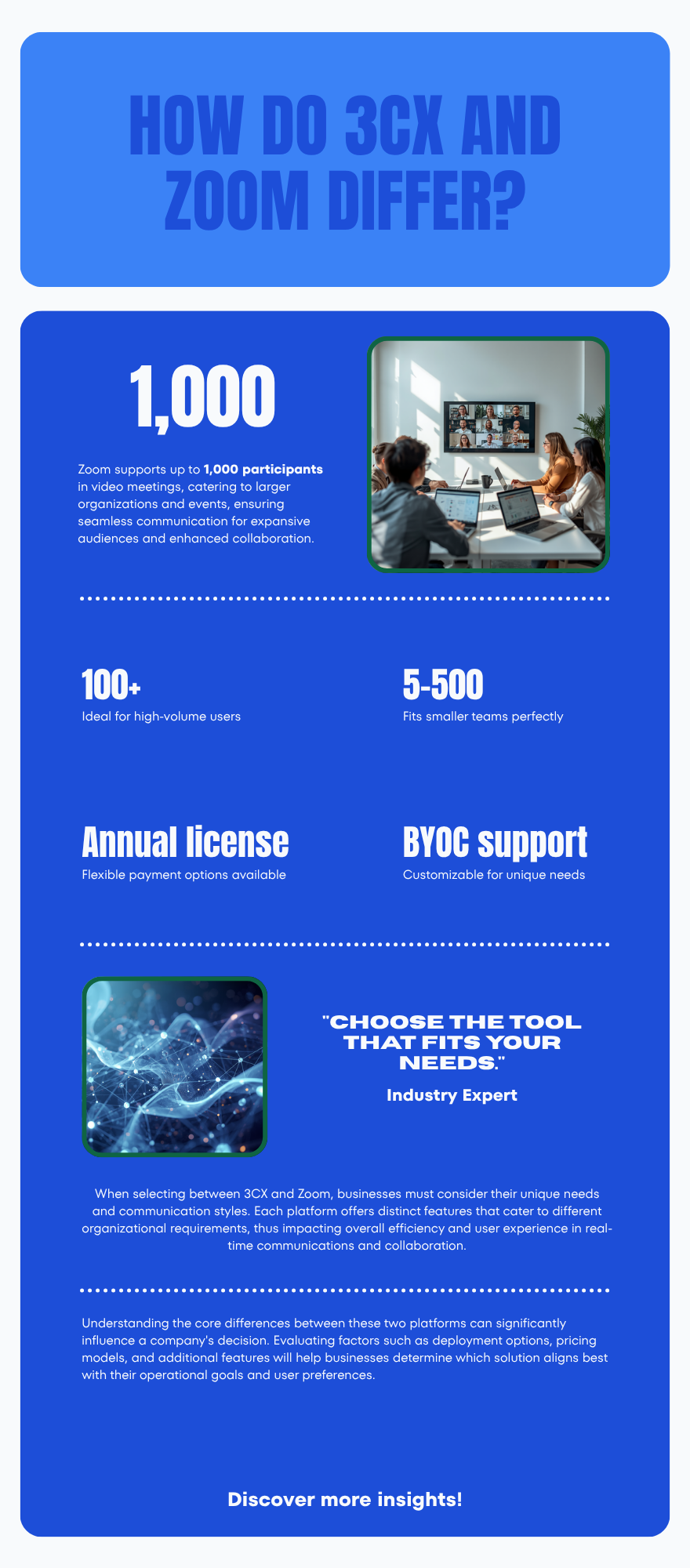
Zoom rents you a phone seat in their cloud.
That single split drives every other difference:
| Dimension | 3CX | Zoom |
|---|---|---|
| Deployment | Self-hosted, private cloud, or 3CX-hosted | Zoom-hosted only |
| Pricing model | Annual license per simultaneous call tier | Per user, per month |
| SIP trunk choice | Bring your own (BYOC) | Bring your own (BYOC) supported on Pro plans; otherwise Zoom carriage |
| Video meetings | Basic, embedded in web client | Best-in-class, 1,000-participant ceiling |
| AI features | Call recording transcription | AI Companion summaries, smart reply, real-time translation |
| Mobile app | iOS + Android softphone | iOS + Android, full Workplace suite |
| Admin model | One admin UI, full filesystem access | Admin web portal, no host access |
| Best fit | 100+ seats, high call volume, BYOC carriers | 5–500 seats, video-heavy, single-vendor preference |
If you already see your team as "video first, calls second," Zoom wins on day one. If you see them as "phones all day, occasional video," 3CX is the more honest fit.
What does each cost in 2026?#
Pricing is where the gap is widest — and most misleading without context.
3CX pricing in 2026#
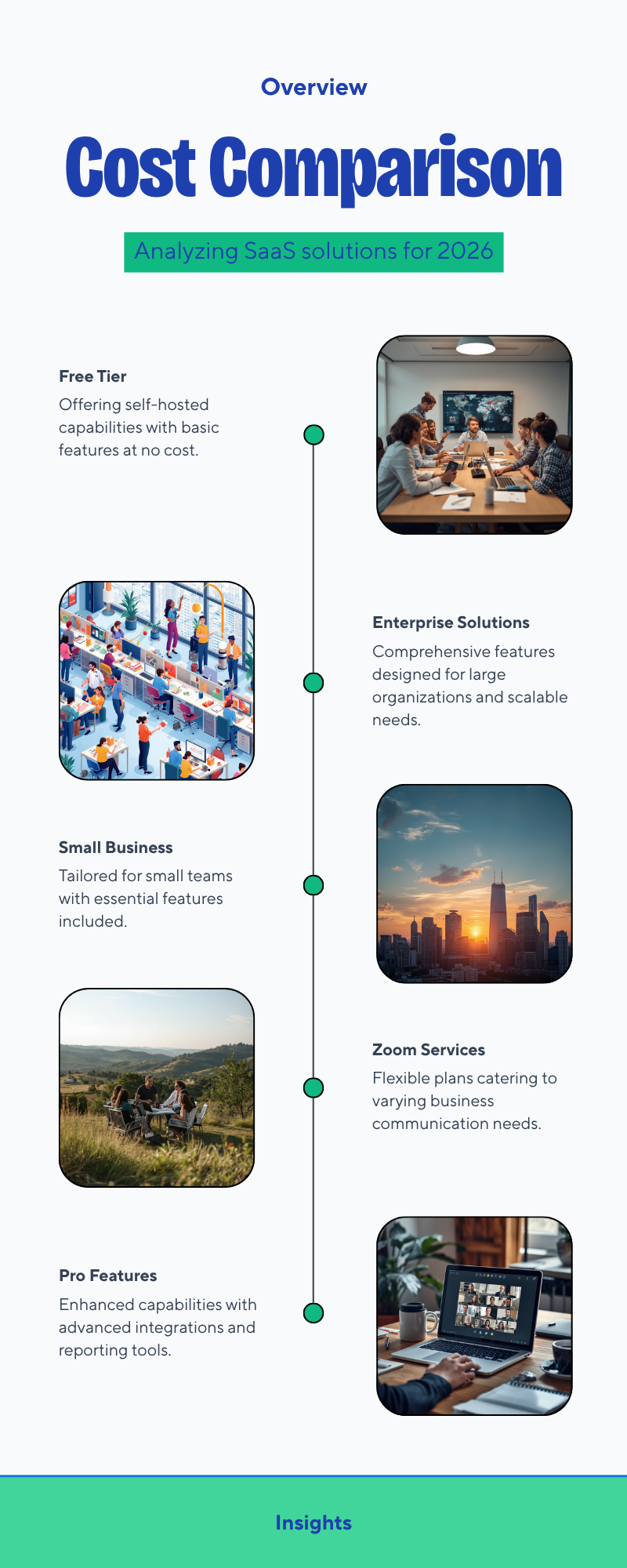
3CX charges per simultaneous call (SC) tier with an annual license:
| 3CX edition | SC tier | Approx. annual list | Included |
|---|---|---|---|
| Free | 10 users | $0 | Self-hosted only, basic queues, web client |
| Small Business (SMB) | 4 SC | ~$175/yr | Hosted by 3CX, voicemail, IVR, call recording |
| Pro | 4 SC | ~$295/yr | CRM integrations, Microsoft 365 sync, reporting |
| Pro | 8 SC | ~$590/yr | Same Pro features, more lines |
| Enterprise | 16 SC | ~$1,250/yr | Skill-based routing, standby instance |
| Enterprise | 32 SC | ~$2,300/yr | Multi-tenant, custom IP, no 3CX branding |
A 50-person sales team with 8 active calls at once typically lands on Pro 8 SC — under $600/year for the software, plus SIP trunk minutes from a carrier of your choice (often $0.005–$0.01/min in the US).
#
Zoom pricing in 2026
Zoom prices per user, per month:
| Zoom plan | Per user/mo | Highlights |
|---|---|---|
| Zoom Workplace Basic | $0 | 40-min meeting cap, no phone |
| Workplace Pro | $15.99 | 30-hour meetings, AI Companion, clips |
| Workplace Business | $21.99 | 300 attendees, SSO, managed domains |
| Zoom Phone Metered | $10 | PBX features, pay-per-minute outbound |
| Zoom Phone Unlimited | $15 | Unlimited US/Canada outbound |
| Zoom Phone Pro | $20 | Global Select dial plan, voicemail transcription |
A 50-seat team on Workplace Business + Zoom Phone Unlimited is roughly $37/user/mo, or ~$22,000/year. The same team on 3CX Pro 8 SC plus a $400/mo carrier bill is ~$5,500/year.
The trade is real: Zoom buys you AI Companion, video, chat, whiteboard, and zero infrastructure for that price gap. 3CX trades convenience for unit cost.

Which has better call quality and PBX features?#
On raw voice quality, both use Opus by default and both sound excellent on a healthy network. Differences show up at the edges:
3CX strengths
- Native SIP — no translation layer between your trunk and the PBX
- Granular call flow designer (visual IVR builder)
- Built-in WebRTC click-to-call widget
- Hot desking, BLF, custom call queues with priority routing
- Free desktop and web clients
Zoom Phone strengths
- Carrier-grade SBCs managed by Zoom
- Auto-failover between data centers
- Call-merge into Zoom Meetings with one click
- AI Companion can summarize a 30-minute call in 6 seconds
- 99.999% uptime SLA on Business and above
For pure call center work — 200 agents, queue overflow rules, post-call wrap-up codes, supervisor whisper — 3CX matched against Zoom Contact Center is a closer race. For "we mostly take inbound sales calls and need polish," Zoom wins on UX.
Want to feed those calls with qualified contacts? Pair either system with a phone finder and a basic data enrichment flow so reps stop hunting for direct lines.
Which has better video meetings?#
This is not close. Zoom owns this category.
- Participant ceiling: Zoom Business supports 300 attendees, Enterprise 1,000, Webinars up to 10,000. 3CX's web meetings cap at 25–250 depending on tier.
- Features: breakout rooms, polling, live transcription, AI Companion summary, Apple Vision Pro client, immersive scenes — all Zoom-only.
- Reliability: Zoom's adaptive bitrate on poor connections is still the industry benchmark.
3CX's video module exists. It works. Nobody picks 3CX for the video.
If your sellers run product demos, pricing calls, and exec briefings on video every day, Zoom is the safer pick even if you pay a premium.
Which is easier to deploy?#
| Stage | 3CX | Zoom |
|---|---|---|
| Initial setup | Spin up a VM (or Pi), run installer, point a domain, wire SIP trunk | Create Zoom admin account, assign licenses |
| First user added | ~15 min | <2 min |
| First DID provisioned | Configure on carrier, then on PBX | Click "buy number" in admin portal |
| Day-2 ops | Patch the OS, update 3CX, manage certs | Zoom handles everything |
| Disaster recovery | You own backups | Zoom owns failover |
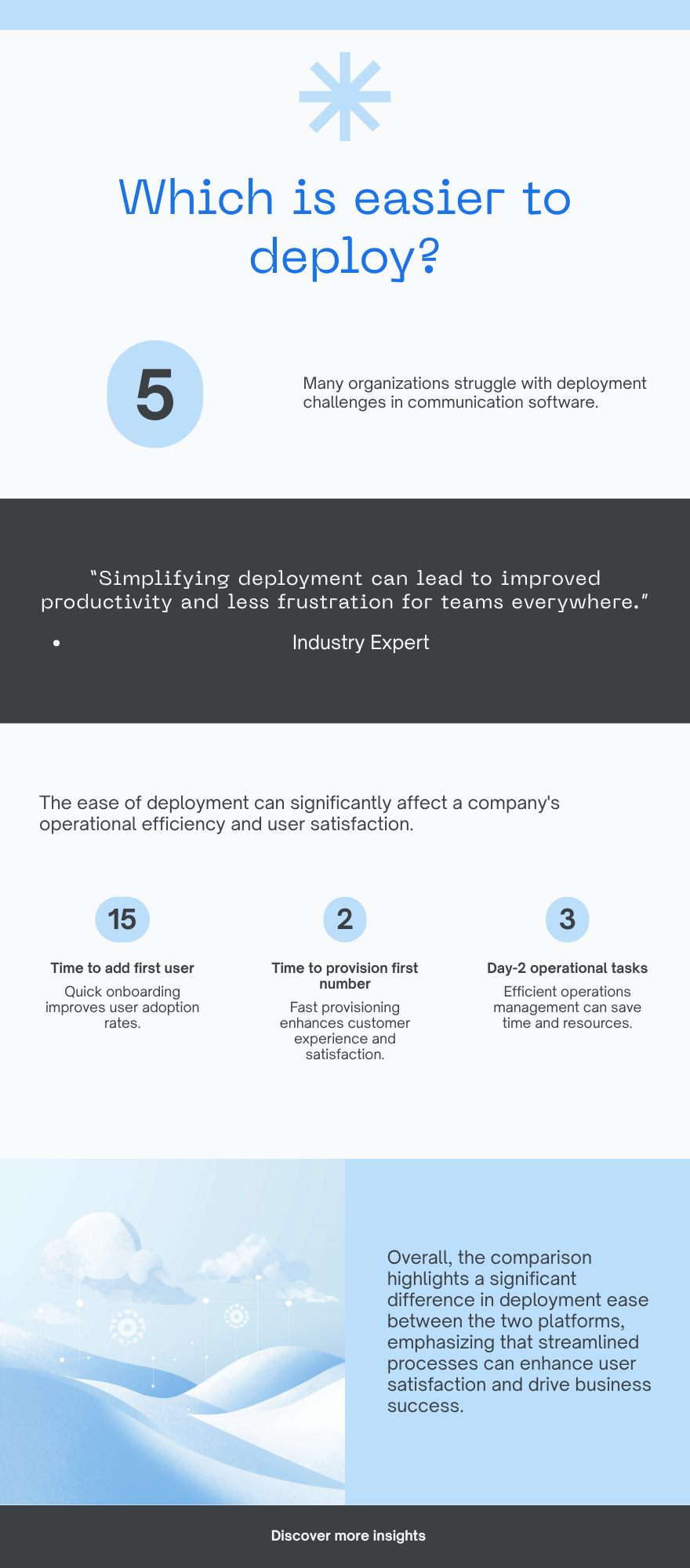
If you do not have a sysadmin, this is a real cost. Zoom hides the messiness; 3CX exposes it.
That said, 3CX has gotten dramatically friendlier — the StartUP cloud plan is essentially "give us a domain, we give you a PBX" — and most MSPs deploy in a day.
Which fits sales teams best?#
Sales teams care about three things: connect rates, call data flowing into the CRM, and reps not fighting their tools.
For high-volume outbound (50+ dials/rep/day):
- 3CX Pro with a click-to-call CRM extension, paired with cheap SIP minutes via Telnyx, is unbeatable on cost.
- Zoom Phone Power Pack adds parking, queues, and historical reporting, but you are still paying per seat.
For consultative sales (10–20 quality calls/day, video demos):
- Zoom wins. The "join my meeting" muscle memory matters. Phone-to-video escalation in one click matters.
- AI Companion writing the call summary into Salesforce or HubSpot is genuinely useful.
Either way, your reps are only as productive as the contact data feeding them. A working dialer over bad numbers still wastes hours. Tools like the Tomba phone finder and HubSpot integration close that gap by validating mobile and direct lines before the dial.
Which fits support teams best?#
Support teams need queues, skills routing, supervisor controls, and a clean reporting layer.
- 3CX: Pro tier includes call queues, skill-based routing, listen-in / whisper / barge, wallboard, and exportable historical reports. The Live Chat module lets the same agents take WhatsApp, Facebook, and website chats from the same client.
- **
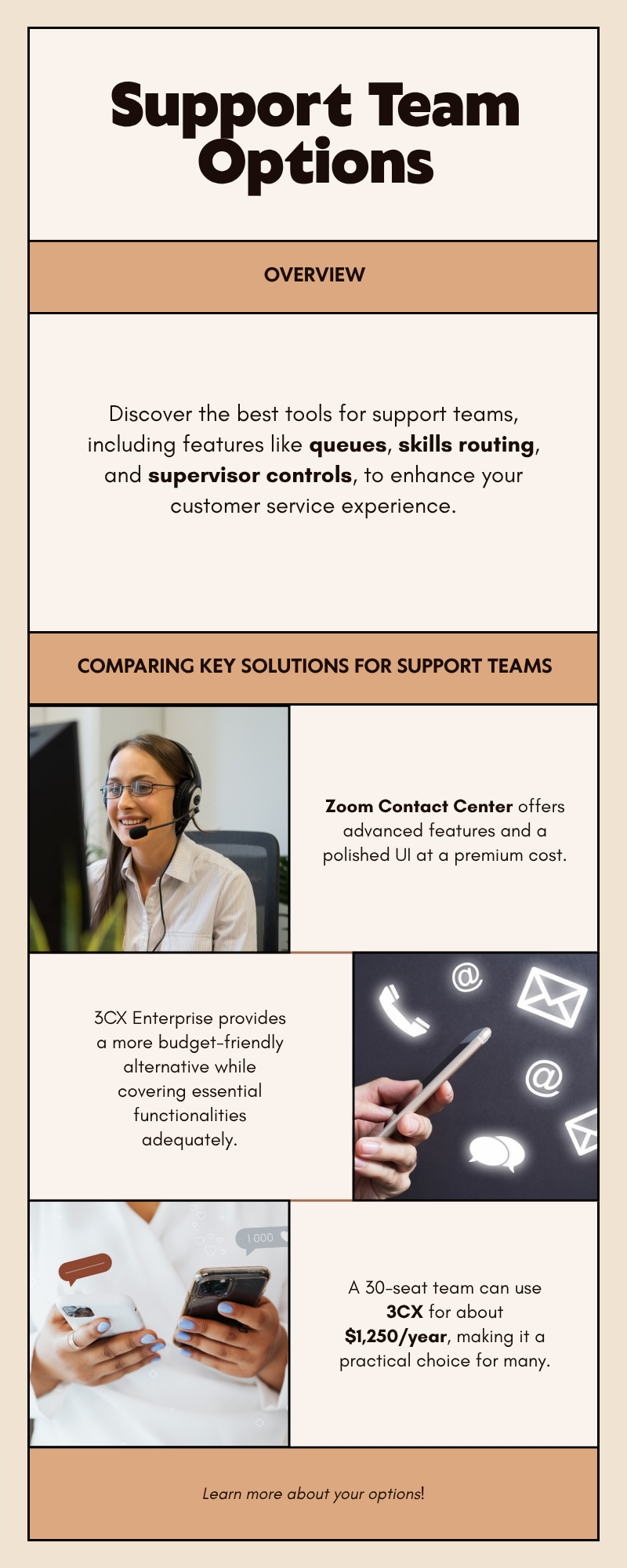
Zoom Contact Center**: separate SKU from Zoom Phone, priced ~$69/user/mo on the Premium tier. Cleaner UI, more AI (sentiment, intent routing), but materially more expensive.
A 30-seat support team can run 3CX Enterprise 16 SC for ~$1,250/year of software. The Zoom Contact Center equivalent is ~$24,000/year. The Zoom version is more polished. The 3CX version is good enough for most.
What about integrations and APIs?#
Both have respectable integration stories — but they cover different surface area.
3CX integrates with:
- Salesforce, HubSpot, Zoho, Pipedrive, MS Dynamics (call popups, click-to-call, logging)
- Microsoft 365 (calendar status, contact sync)
- WhatsApp, Facebook Messenger, SMS, live chat — all unified in one client
- REST API for call control, provisioning, and reporting
Zoom integrates with:
- 2,500+ apps in the Zoom Marketplace
- Native Slack, Microsoft Teams, Salesforce, HubSpot, ServiceNow connectors
- Zoom Apps SDK for in-meeting embedded experiences
- Mature webhook and event bus
If your stack lives in Slack, Notion, and HubSpot, Zoom slots in faster. If you are running a call-center-style outbound shop and want WhatsApp + Facebook + voice in one agent client, 3CX has the edge.
For the contact data layer, both phone systems play well with a third-party enrichment pipeline. You can move records out of HubSpot or Salesforce, enrich with mobile numbers, and push back — independent of which dialer your reps live in.
What do real reviewers say?#
Neither vendor is universally loved. Quick gut-check from public review platforms:
- G2 ratings (early 2026): 3CX 4.4/5, Zoom Phone 4.5/5, Zoom Meetings 4.6/5. Source — G2's Business Phone Systems category.
- Common 3CX complaints: dated admin UI, occasional certificate renewal pain, support quality varies by partner.
- Common Zoom complaints: price creep on add-ons (AI Companion Plus, Contact Center, Workforce Management all sold separately), occasional Phone outages in specific regions.
- Common 3CX praise: cost control, BYOC flexibility, "feels like a real PBX."
- Common Zoom praise: meeting quality, AI Companion, single-pane-of-glass admin.
For deeper feature checklists, 3CX's official feature list and the Zoom Workplace product page are the source of truth — vendor marketing, read accordingly.
3CX vs Zoom: which should you pick in 2026?#
A decision matrix that respects how teams actually buy:
| If you are… | Pick |
|---|---|
| A 5–50 seat startup that already lives in Zoom Meetings | Zoom |
| A 100+ seat call center with predictable concurrent volume | 3CX |
| An MSP reselling phones to multiple SMB clients | 3CX (multi-tenant) |
| A consulting firm doing daily client video | Zoom |
| A geographically distributed support team needing omnichannel | 3CX (or Zoom Contact Center if budget allows) |
| A regulated industry needing on-prem voice and data residency | 3CX (self-hosted) |
| A team that hates managing servers | Zoom |
| A bootstrapped business optimizing unit economics | 3CX |
The wrong way to choose is by feature list alone — both check the boxes you need. The right way is to honestly answer two questions: how much video do you actually do, and do you want to own the phone stack or rent it.
Where does sales productivity actually come from?#
Neither 3CX nor Zoom matters if your reps dial dead numbers and email bounce-prone addresses. The phone system is the last mile. What feeds it — clean direct dials, verified emails, decision-maker titles — is the work that moves connect rates.
That is where a contact intelligence layer earns its keep. Use Tomba's email finder to pull verified work emails for a target account, the phone finder to add direct-dial numbers, and the domain search to map the whole company before your first touch. Whether reps dial out from 3CX or Zoom Phone, the lift comes from better data upstream — not a different dialer.
Start free at Tomba — 25 searches a month on the free tier, $49/mo Starter when you need more, and an API that drops into either phone system's CRM connector. Your dialer just rings the right person more often.
// get started
Find, verify and enrich your first contacts today
Start on the free plan with 25 searches a month, then scale when your team is ready.
Free plan · No credit card required · GDPR & CCPA
// about the author