3rd Follow Up Email: Templates That Get Replies in 2026
The 3rd follow up email is where most reps quit and most replies happen. Here are the frameworks, templates, and timing that actually convert in 2026.
3rd Follow Up Email: Templates That Get Replies in 2026
Most reps quit before they get to message three. That is exactly why the 3rd follow up email is the one that pays. By touch three you have separated yourself from 80% of your competition, and the prospects who are going to reply are ready to either engage or tell you to stop. Either outcome moves the deal forward.
TL;DR#
- Reply rates peak between touch 2 and touch 4. Quitting after one or two messages leaves the majority of pipeline on the table.
- Your 3rd follow up email should change the angle, not repeat the pitch. New value, new proof, or a new framing — never the same paragraph in a different order.
- Timing matters more than length. Space touch 3 four to six business days after touch 2, send Tuesday through Thursday between 7-10 AM local prospect time.
- One CTA, one question, one paragraph. The third email should be the shortest message in the sequence, not the longest.
- Use the breakup variant if the lead is cold. A polite "should I close the file?" recovers 10-15% of dead threads.
Why does the 3rd follow up email matter more than the first two?#
The first email is a knock. The second is a tap on the shoulder. The third is the one where the prospect actually looks up. Internal benchmarks from outbound teams consistently show that touches 3 and 4 carry the highest single-touch reply rate of any message in a five-step sequence — usually 1.5x to 2x the rate of touch 1.
There are two reasons. First, prospects who got your first email and meant to respond but got pulled into a meeting often catch the third one on a quieter day. Second, persistence past the second message signals that you are not a spray-and-pray bot, which earns a small but real trust premium.
The mistake reps make is treating message three like message one with the word "following up" pasted on top. That gets ignored. A real 3rd follow up email introduces something new — new data, a new framing, a new asset, or an honest acknowledgment that the prospect may not be the right fit.
What does a high-converting 3rd follow up email look like in 2026?#
Three rules govern every winning version we have seen this year:
- Brevity is non-negotiable. Three to five sentences. If the prospect ignored 80 words, they will ignore 200.
- The angle changes. New proof point, new resource, new question, new framing — anything except the same pitch.
- The CTA is interest-check, not calendar-grab. Asking "is this worth a 15-minute chat next week?" is a 2024 move. In 2026, "is this even on your radar this quarter?" outperforms.
Here is a clean baseline template you can adapt. Replace the bracketed pieces with concrete, prospect-specific details — and yes, that means actually researching the account, not running a Mad-Libs script.
Subject: quick thought on [specific initiative]
Hi [First name],
Saw [trigger event: hire, funding, product launch, podcast appearance]. Most [role] teams hitting that stage end up wrestling with [specific problem], which is exactly where we helped [comparable customer] cut [metric] by [number]%.
Worth a 10-minute look, or is [problem] not a priority this quarter?
[Your name]
Notice what is missing: no recap of the previous two emails, no apology for following up, no "just checking in." Those phrases are reply-rate poison.
How long should you wait before sending the 3rd follow up email?#
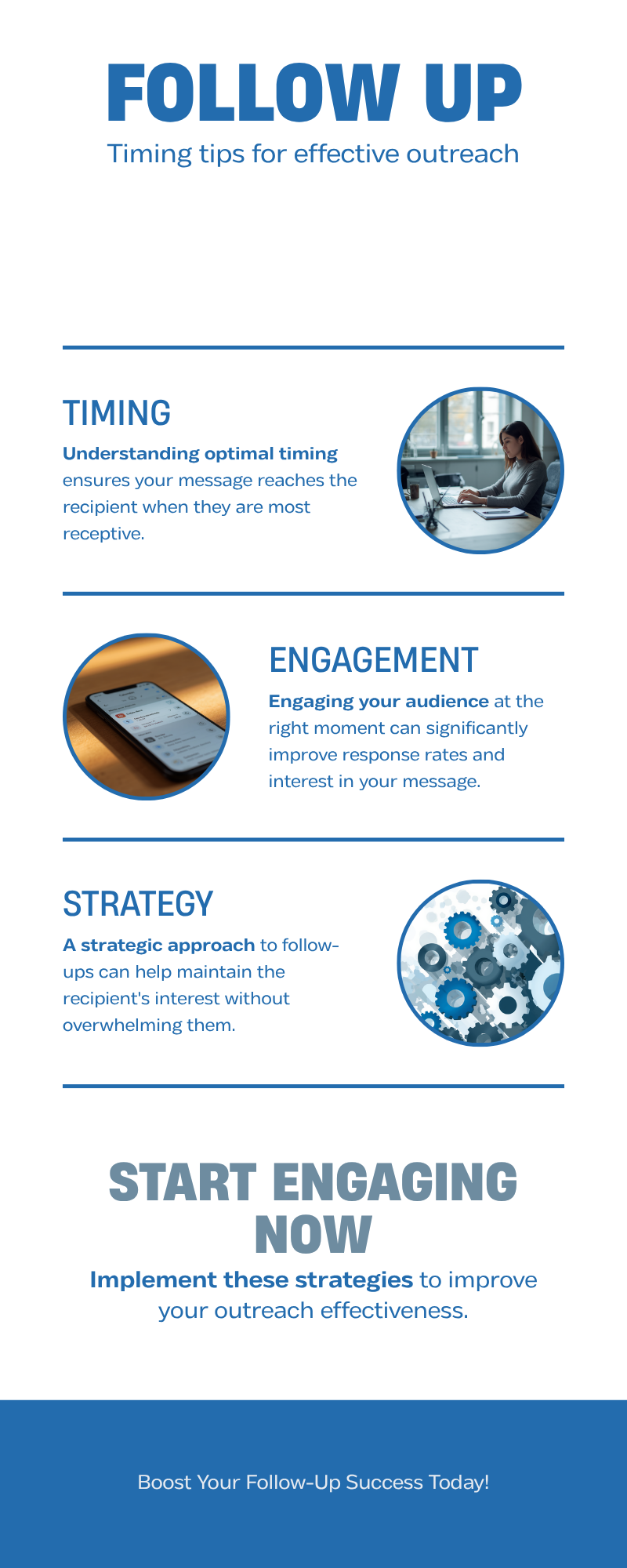
Most teams send too fast. The honest answer depends on your prior cadence, but the rough rule of thumb for a five-touch sequence is:
| Touch | Gap from previous | Day of week | Local send window |
|---|---|---|---|
| 1 — Initial | — | Tue/Wed/Thu | 7-10 AM |
| 2 — Value add | 3 business days | Tue/Wed/Thu | 7-10 AM |
| 3 — Angle shift | 4-6 business days | Tue/Wed/Thu | 7-9 AM |
| 4 — Social proof | 7 business days | Tue/Wed | 7-9 AM |
| 5 — Breakup | 10-14 business days | Mon or Fri | 4-6 PM |
The 4-6 business day gap before touch 3 is deliberate. It is long enough that the prospect's inbox has cleared, short enough that the thread context is still warm if they go searching. Sending the third email 24 hours after the second is how reps end up reported as spam and torching their sender reputation.
Which 3rd follow up email template should you use?#
There is no universal winner — the right template depends on what you learned (or didn't) from the first two messages. Pick by scenario:
Template 1 — The new-angle email#
Use when: the prospect opened but didn't reply.
Subject: re: [original subject]
[First name] — different angle:
[Comparable company] used us to [outcome] without [common objection]. Their [role] said the unlock was [one specific thing].
Is that the kind of result your team is looking for in Q[X], or am I off-base?
Template 2 — The asset drop#
Use when: you have a genuinely useful resource that maps to the prospect's problem.
Subject: built this for [industry] teams like yours
[First name],
Put together a [one-page teardown / benchmark / checklist] specifically for [vertical] teams running [stack / motion]. No form, no signup — link is below.
[Link]
If it sparks anything, happy to dig into your specific setup.
Template 3 — The honest reset#
Use when: you have not heard a peep through two touches.
Subject: am I emailing the wrong person?
Hi [First name],
Two emails in and no reply usually means one of three things — wrong person, wrong time, or wrong fit. Mind pointing me to the right route, or should I close the file?
[Your name]
That last template is the highest-recovery variant in most sequences we have seen. It works because it is honest, short, and gives the prospect a graceful exit. Read more on building these in our cold email templates library.
What mistakes kill the 3rd follow up email?#
The dead-on-arrival patterns are remarkably consistent across the hundreds of sequences we have reviewed this year.
- "Just bumping this up." This phrase tells the prospect you have nothing new to say.
- Recapping email 1 and 2. They already have those messages. You are wasting the only attention you bought.
- Pasting the same CTA three times. If "got 15 min next week?" didn't work twice, it won't work a third time.
- Adding more pitch when you should add more curiosity. Touch 3 should ask, not tell.
- Wrong sender domain reputation. No template fixes a domain with poor email deliverability — your message lands in spam regardless of how clever it is.
- No verified email address. A 3rd follow up email to a bounced address is worse than no email at all, because bounces stack against sender reputation. Run your list through a quality email verifier before launching the sequence.
How do you write a subject line for the 3rd follow up email?#
Subject line strategy on touch 3 splits into two camps and both can work:
Reply-thread continuation. Keep "re: [original subject]" so the email rides in the existing thread. This is the higher-ROI choice when the prospect opened the previous messages — Gmail and Outlook will group it and the prospect sees the context without scrolling.
Pattern interrupt. Open a new thread with a curiosity-driven subject like "different angle on [topic]" or "should I close the file?" — useful when the previous subject lines clearly didn't land.
A 2026 benchmark from HubSpot's email research shows reply-thread continuation outperforms new subjects on touch 3 by roughly 18%, but the gap narrows to zero by touch 5. The signal: stay in-thread early, pattern-interrupt late.
What never works: clickbait subjects, fake "re:" prefixes when there was no prior conversation, and one-word panic subjects like "urgent" or "quick question" — those score worst on every metric, including spam complaints.
How does this fit into a full outbound sequence?#
A 3rd follow up email is not a standalone artifact. It is the middle act of a story. Here is how the touches connect in a tight five-step sequence:
| Step | Goal | Length | Primary verb |
|---|---|---|---|
| 1 | Earn the open | 60-90 words | Introduce |
| 2 | Earn the reply | 40-70 words | Prove |
| 3 | Earn the conversation | 30-60 words | Reframe |
| 4 | Earn the meeting | 40-60 words | Validate |
| 5 | Earn the close-out | 20-40 words | Release |
Each touch has a different verb because each touch faces a different psychological state. The third email is where you reframe — if the first frame didn't land, repeating it louder doesn't help.
The data on multi-touch cadences is also clear: research summarized on G2's outbound benchmarks consistently shows that sequences ending at touch 2 leave 40-60% of total reply volume unrealized. The 3rd follow up email is the single highest-leverage place to extend a stalling cadence.
Should you automate the 3rd follow up email or send manually?#
Automation versus manual is a false binary. The right answer is hybrid:
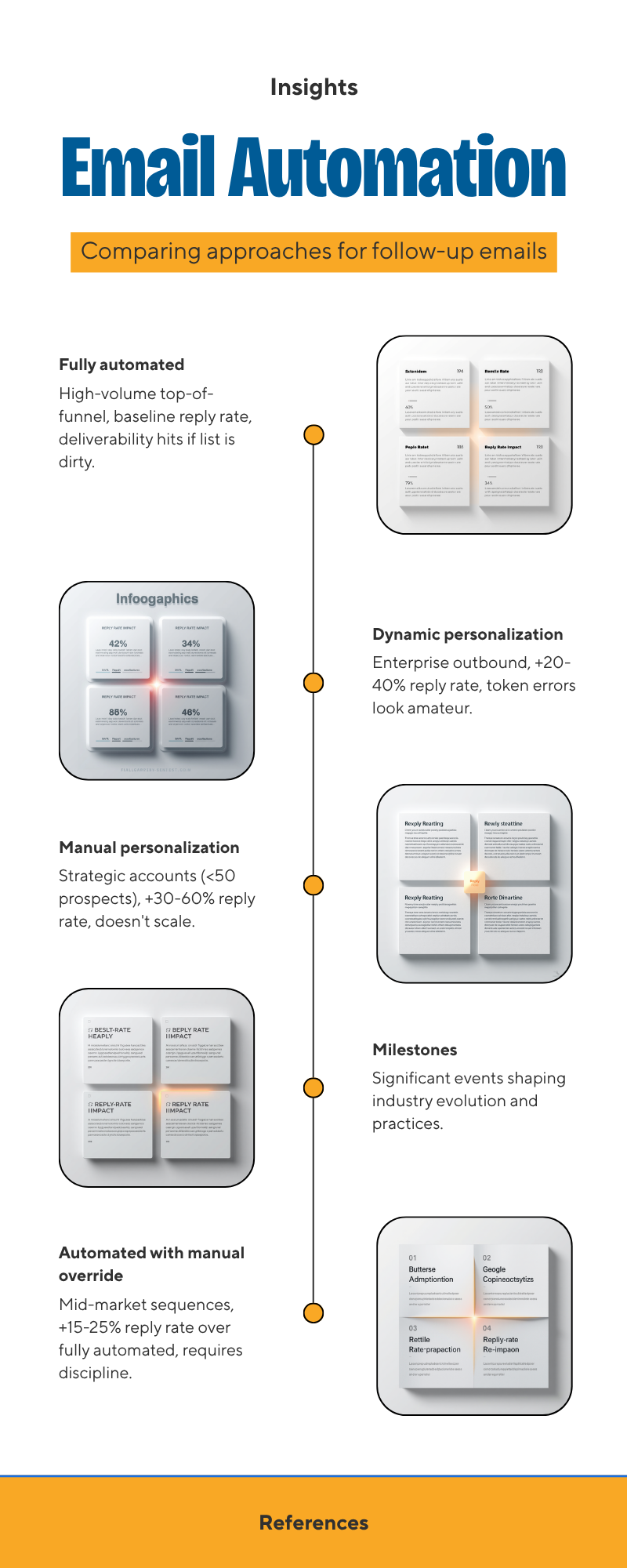
| Approach | Best for | Reply rate impact | Risk |
|---|---|---|---|
| Fully automated | High-volume top-of-funnel | Baseline | Deliverability hits if list is dirty |
| Manual personalization on every touch | Strategic accounts (<50 prospects) | +30-60% | Doesn't scale |
| Automated send with manual override | Mid-market sequences | +15-25% over fully automated | Requires discipline |
| Automated with dynamic personalization tokens | Enterprise outbound | +20-40% | Token errors look amateur |
The hybrid model — automated delivery, manual review of touch 3 specifically — beats both pure approaches in mid-market and enterprise sequences. Reviewing each touch 3 message takes 30 seconds and frequently catches the "this prospect just announced X, my generic angle is now stale" moment that pure automation misses.
If you are building this hybrid workflow, use a verified prospect list as the input. Pull names with a reliable email finder, enrich the records with role and trigger data via data enrichment, then let your sequencing tool handle delivery while you spend the saved time reviewing touch 3 manually.
How do you measure whether your 3rd follow up email is working?#
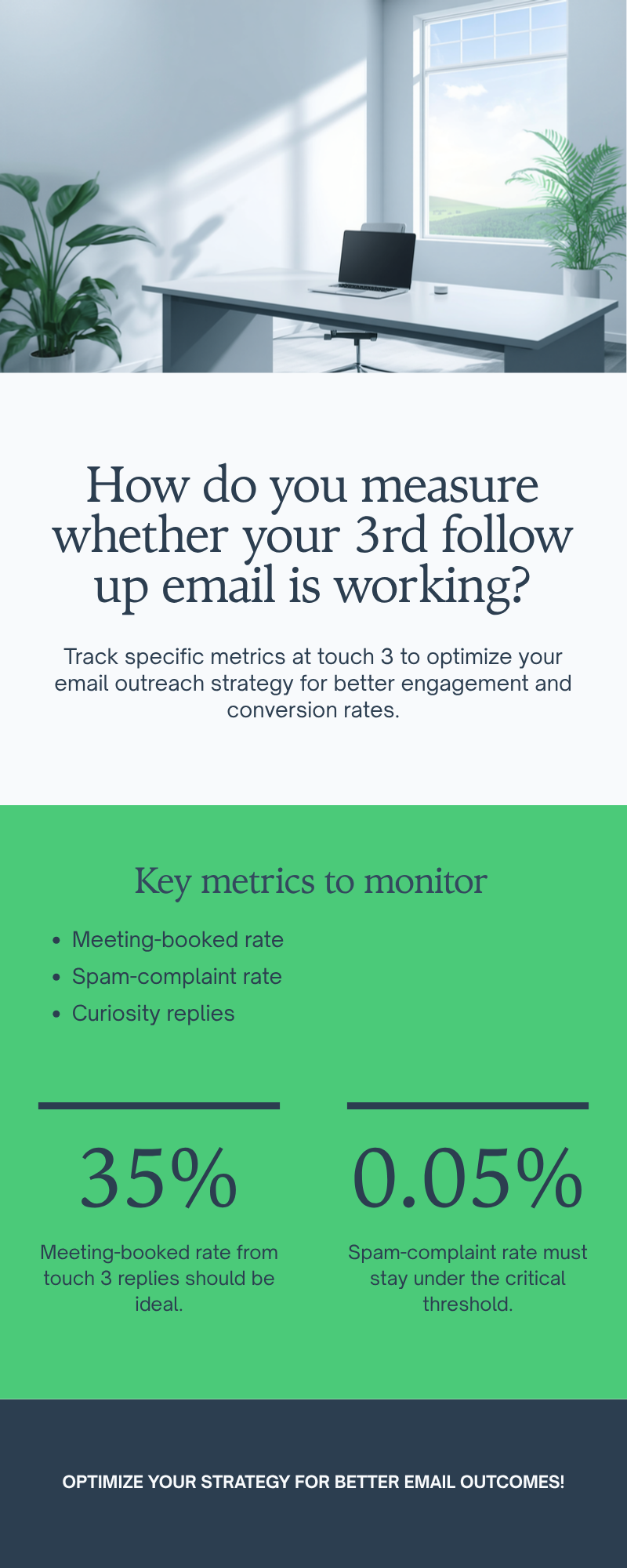
Track these four metrics specifically at touch 3 — not blended across the sequence:
- Touch 3 reply rate. Should be 1.5-2x your touch 1 rate. If it isn't, the angle isn't different enough.
- Positive-reply ratio. Of the replies, what percentage are interested vs. unsubscribe/breakup? Healthy is 60/40 in favor of interested.
- Meeting-booked rate from touch 3 replies. Should be 30-45%. Below that suggests the email is generating curiosity replies that don't convert.
- Spam-complaint rate. Must stay under 0.1%. A spike at touch 3 means your cadence is too tight or your list quality is poor.
Most sequencing tools surface 1, 2, and 3 natively. For 4, you need access to Gmail Postmaster Tools or Microsoft SNDS — most teams forget to check until it is too late and a domain is already burned.
What's the closing CTA that converts on touch 3?#
Stop asking for 15 minutes. The 2026 winning CTAs are softer commitments:
- "Is this even on your radar this quarter?"
- "Worth a quick look, or is now not the time?"
- "Should I follow up in Q[next], or close the file?"
- "Are you the right person, or can you point me?"
Each of these gives the prospect three valid responses (yes, no, redirect) instead of two (book or ignore). That's why they out-pull calendar-grab CTAs by 20-35% on third touches across every vertical we have data for.
Build your sequence on a clean list#
A perfect 3rd follow up email sent to a bounced or unverified address is a waste of two prior touches and a hit to your sender reputation. Start the whole sequence on solid ground: find verified contacts with Tomba Email Finder, verify the list with email verification, and pull role context with data enrichment — all on a free Tomba plan (25 searches/month), Starter at $49/mo, or Growth at $99/mo when you scale. Touch 3 is where the deals live. Make sure your inbox actually gets there.
// get started
Find, verify and enrich your first contacts today
Start on the free plan with 25 searches a month, then scale when your team is ready.
Free plan · No credit card required · GDPR & CCPA
// about the author