3x3 Research for Sales: Personalize Cold Outreach in 2026
The 3x3 research method gives reps 3 facts in 3 minutes to personalize cold outreach. Here's the framework, sources, and templates that actually book meetings in 2026.
3x3 Research for Sales: Personalize Cold Outreach in 2026
TL;DR
- 3x3 research sales is a time-boxed prospecting method: gather 3 relevant facts about a prospect in 3 minutes before sending any outreach.
- It was popularized by sales trainers like John Barrows as a forcing function against generic "Hi {{FirstName}}" spray.
- Done right, 3x3 lifts cold email reply rates from the 1–3% spray-and-pray range to 8–15% on tight ICPs.
- Sources stack: LinkedIn profile, company news, podcast/blog appearances, 10-K (if public), and signals from intent tools.
- It only works if step zero — finding the right verified email — is already solved. Bad data wastes the 3 minutes.
What is 3x3 research in sales?#
3x3 research is a personalization framework: spend three minutes finding three specific, recent, relevant facts about a prospect before you write a single line of outreach. Two of the facts should be about the person (role transition, podcast quote, LinkedIn post, shared connection) and one should be about the company (funding round, hiring spike, product launch, layoff, executive change).
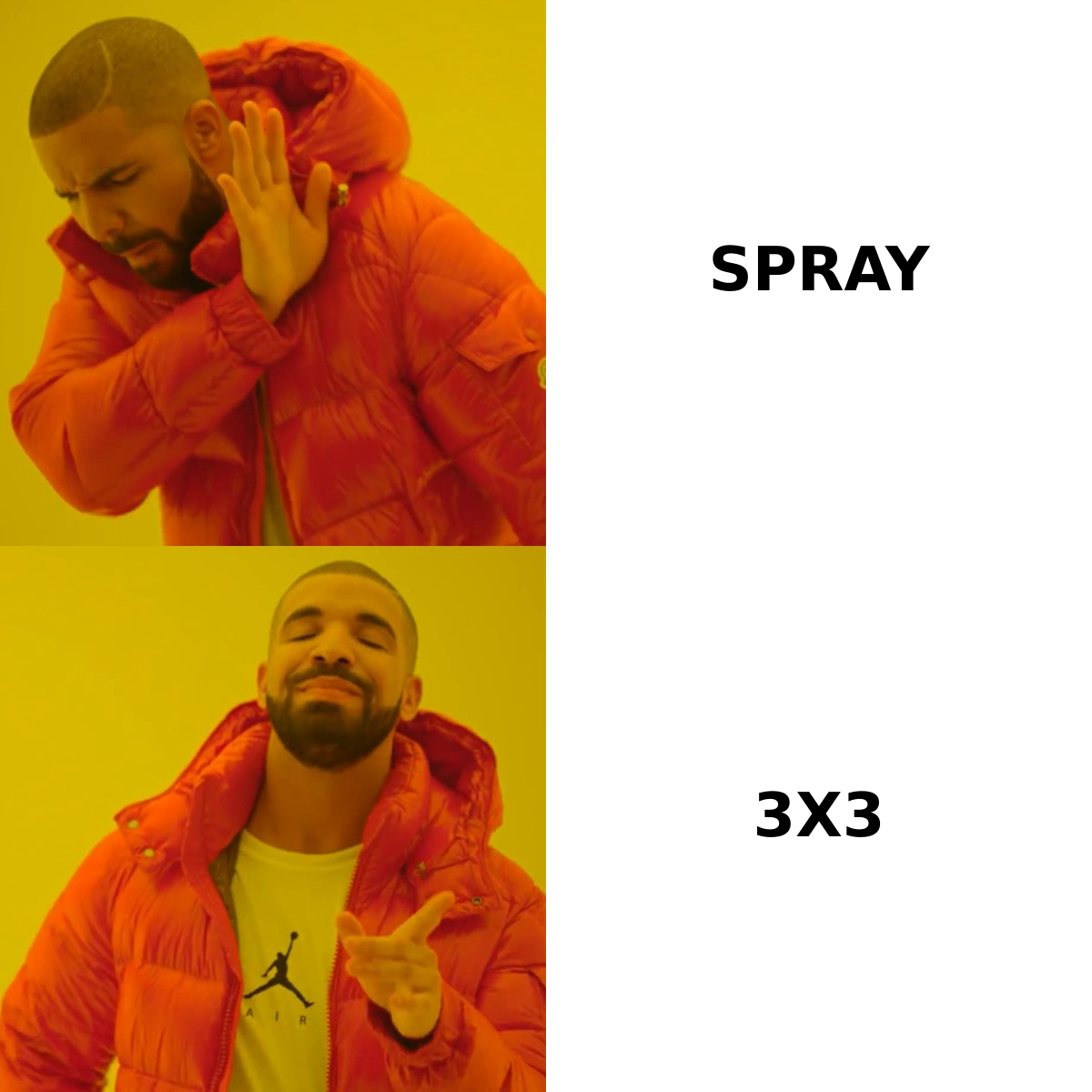
Think of it like a chef plating a dish. Anyone can dump rice on a plate — that's spray-and-pray outreach. A real chef garnishes with three ingredients chosen for this specific guest. Same calories, completely different reception.
The framework was codified by John Barrows and his team at JB Sales as a forcing function for SDRs who were drowning in quota and defaulting to generic templates. The discipline of 3 facts, 3 minutes keeps reps from rabbit-holing through a prospect's entire LinkedIn history and from skipping research entirely.
Why does 3x3 still matter in 2026?#
Inboxes are worse than ever. The average B2B buyer gets 121 emails a day, and Gmail's 2024 sender rules plus Microsoft's 2025 bulk-sender enforcement mean generic templates land in spam or get auto-archived. AI has made template generation a commodity — every rep on earth can produce 1,000 "personalized" emails in an hour. The result: buyers have built psychological filters that fire on any line that smells synthetic.
3x3 research is the antidote because it produces signal a model can't fabricate from training data alone. The fact that a VP of Engineering posted last Tuesday about a Kafka migration is fresh, specific, and checkable — exactly the texture that makes a buyer stop scrolling.
What are the 3 sources you should hit every time?#
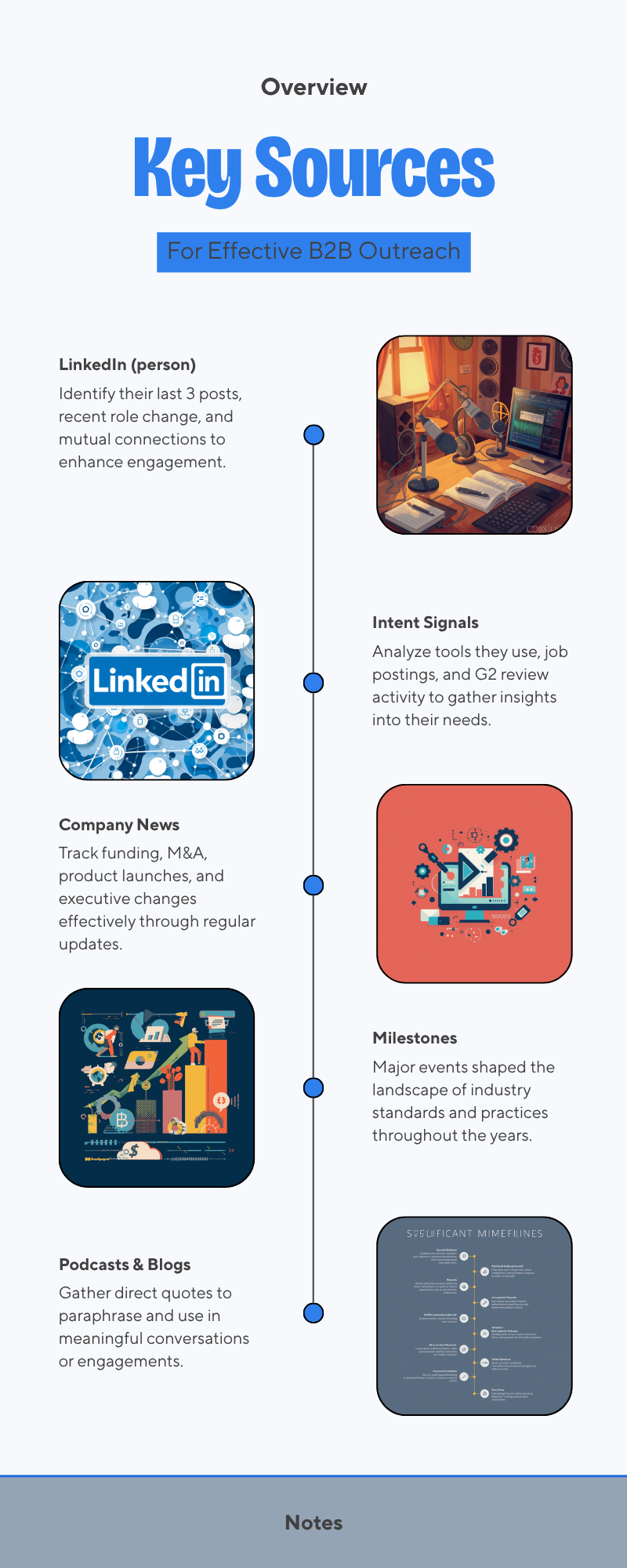
The mistake most reps make is treating "research" as an open-ended Google walk. 3x3 demands a tight checklist. Here's the canonical stack:
| Source | What you're looking for | Time budget |
|---|---|---|
| LinkedIn (person) | Last 3 posts, recent role change, mutual connections, skills they brag about | 60 sec |
| Company news / press | Funding, M&A, product launch, exec hire, layoffs, earnings highlights | 45 sec |
| Podcast / blog / conference talks | Direct quotes you can paraphrase back | 45 sec |
| Intent / tech stack signals | Tools they use, job postings, G2 review activity | 30 sec |
You won't hit every source on every prospect. The point is to have a known path so your brain doesn't freeze on the blank page.
For the email itself — the actual deliverable — you still need a verified address. Burning 3 minutes researching a prospect only to bounce on send rate is the most common 3x3 failure mode. Use a Tomba Email Finder pass on your list before you start the research clock so you're never personalizing a dead address.
How do you actually run a 3x3 session in 3 minutes?#
Set a timer. Yes, literally. The constraint is the feature.
Minute 1 — Person. Open the LinkedIn profile. Scan: current role tenure, previous company, last 3 posts, any "About" sentence that isn't boilerplate. Capture one fact in your notes (e.g., "Posted about hiring 5 SDRs in Q1, mentions 'pipeline coverage'").
Minute 2 — Company. Open the company LinkedIn page or domain search the company name in your prospecting tool. Look for: funding round, product launch, exec hire, news article from the last 90 days. Capture one fact (e.g., "Closed Series B last month led by Insight Partners, hiring 40 GTM roles").
Minute 3 — Bridge. Find one piece of connective tissue between fact 1 and fact 2 and your offer. This is the hardest minute and the one most reps skip. Write the one-sentence hypothesis: "Their B2 means pipeline coverage just became the CEO's #1 metric — perfect time to pitch a faster inbound qualification tool."
If you can't write that hypothesis in minute three, move on. Not every prospect is worth a personalized email. Most aren't.
3x3 research sales vs. spray-and-pray vs. deep-dive ABM#
Here's the honest comparison so you know when to use which approach:
| Approach | Time per prospect | Volume / week | Reply rate range | Best for |
|---|---|---|---|---|
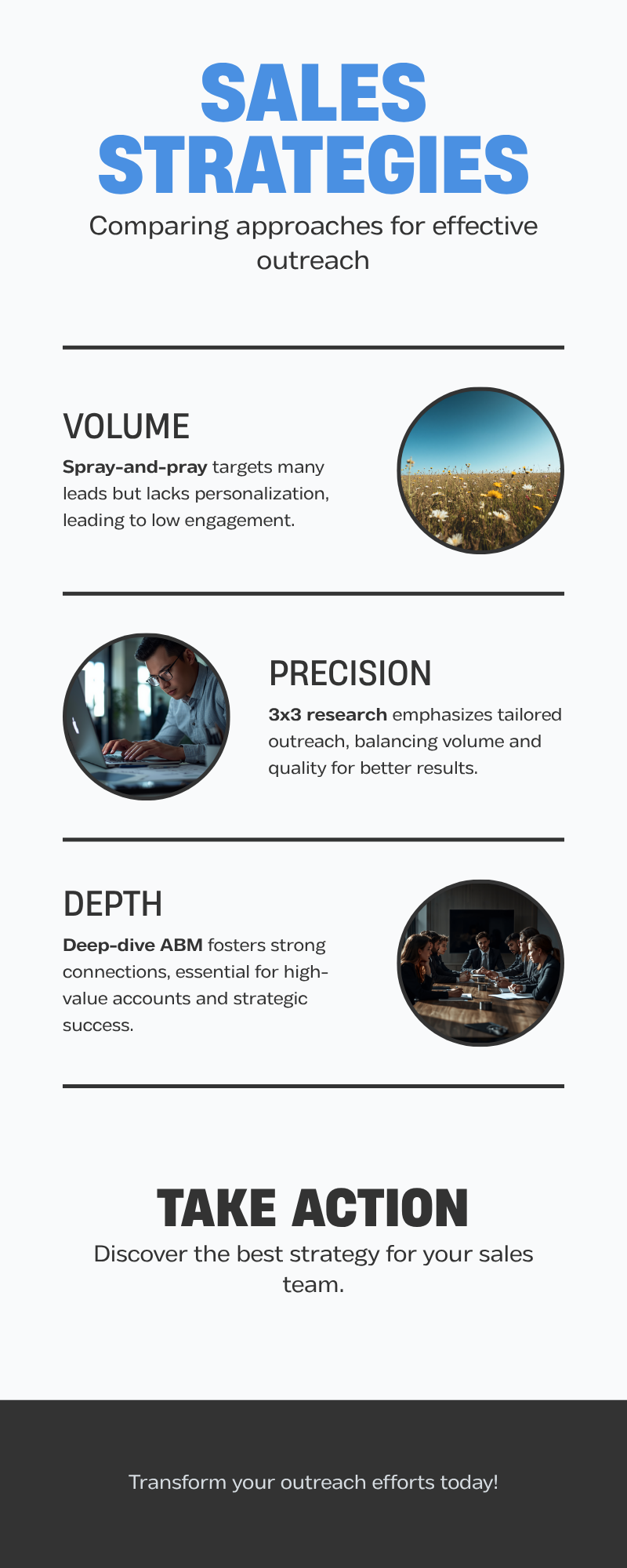
| Spray-and-pray | 0 min | 1,000+ | 0.5–2% | Top-of-funnel volume tests, never strategic accounts |
| 3x3 research | 3 min | 100–200 | 8–15% | Mid-market SMB, named-account SDR motions |
| Deep-dive ABM | 30–60 min | 10–20 | 20–35% | Enterprise, six-figure ACVs, multi-threaded buying committees |
| AI "personalization" (untouched) | 0 min (auto) | 1,000+ | 1–4% | Lazy ops; degrades fast as filters adapt |
3x3 is the sweet spot for the rep who has a real quota but isn't selling $500K deals. It's also the floor — once you accept that no email goes out without 3 facts and 3 minutes, your worst day still beats the team next door who skipped research.
What does a 3x3 cold email actually look like?#
Bad personalization sounds like AI: "I see you're the VP of Sales at Acme, which is impressive!" That's a fact, but it's lazy and unfalsifiable.
Good 3x3 personalization sounds like a colleague who did their homework. Template:
Subject: Your Kafka post + our migration playbook
Hey Maya,
Caught your LinkedIn post on the Kafka → Redpanda migration last Tuesday — the bit about "consumer lag in the rebalance window" hit close to home. We helped Datadog and Ramp run the same swap without the lag spike using a dual-write pattern for the first 30 days.
Saw Acme just closed your Series B and is staffing up the data platform team. If you're benchmarking infra spend before scale, would a 20-minute walk-through of the playbook be useful next Tuesday at 2pm ET?
— Jordan
Notice what's there: one person fact (the post), one company fact (the funding + hiring), and a bridge (infra spend pressure post-B). Notice what's not there: no "hope this finds you well," no "quick question," no fake compliment.
For more reusable framing — and 40+ vetted templates for SaaS, agency, and outbound — see the cold email templates library.
How do you scale 3x3 without burning out reps?#
The dirty secret: 3 minutes × 100 prospects = 5 hours of pure research per week per rep. That's why most teams quit after 2 weeks.
The fix isn't to skip the research — it's to industrialize it. Three moves work in practice:
- Pre-batch the data layer. Run a bulk email finder and data enrichment pass over your list before you start research. Phone, LinkedIn URL, company size, tech stack — all loaded into your CRM so the rep starts minute one with context, not with a blank Google tab.
- Use signal tools to pre-qualify. Tools like Tomba's website reveal tell you which target accounts already visited your pricing page. Researching prospects who are already in-market is 4–5x more productive than researching cold ICP fits.
- Snippet library. Reps build a personal Notion doc of "research patterns that worked." Over a quarter, this becomes a moat — they recognize the shape of a strong hook in seconds instead of staring at LinkedIn for 3 minutes.

What tools support a 3x3 research workflow?#
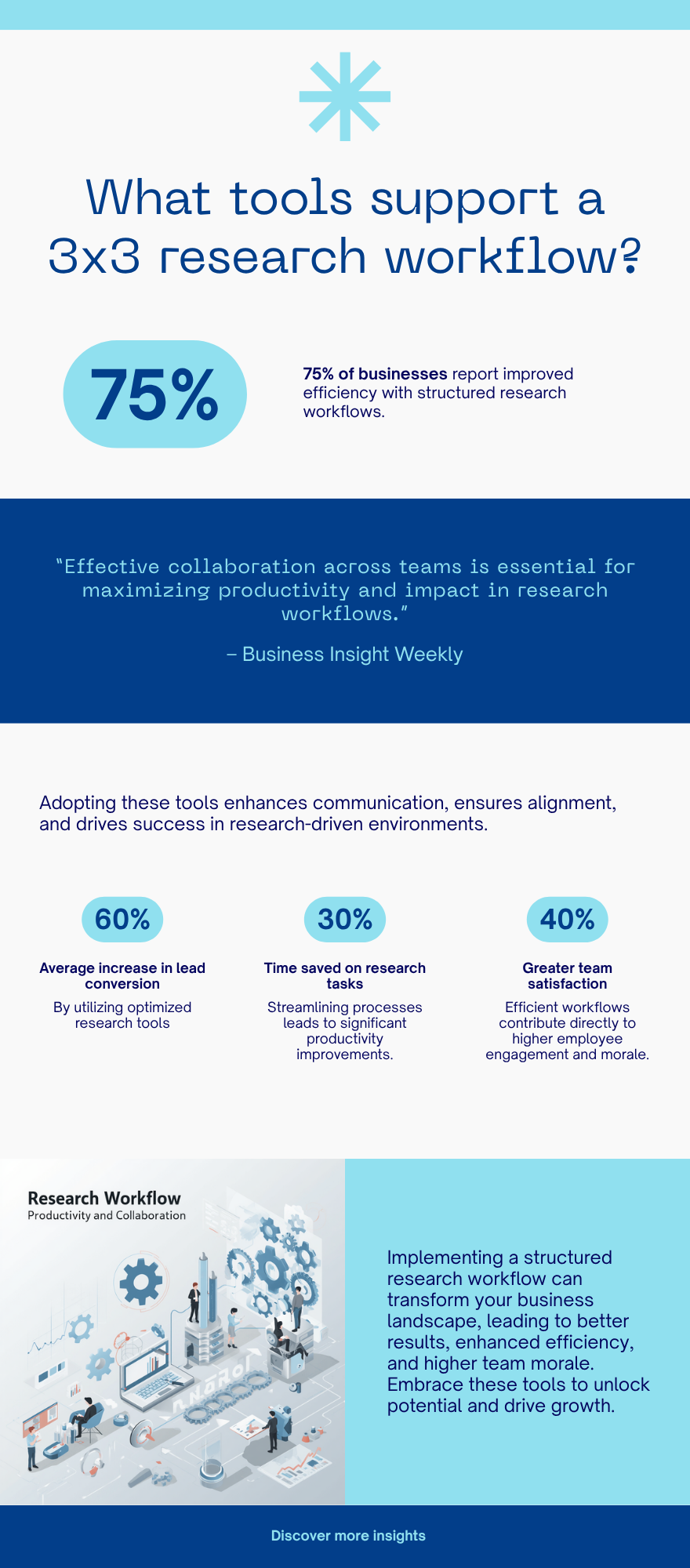
You don't need a 12-tool stack. You need a verified contact, a way to scan LinkedIn fast, and a news source. Most of the rest is noise.
| Layer | Purpose | Examples |
|---|---|---|
| Contact data | Verified email, phone, LinkedIn URL | Tomba, Apollo, RocketReach |
| Person research | Posts, history, mutual connections | LinkedIn Sales Navigator, LinkedIn finder |
| Company news | Funding, exec moves, launches | Crunchbase, Google News, company blog |
| Intent / signals | Visitor reveal, hiring signals, tech stack | Tomba Reveal, BuiltWith, LinkedIn jobs |
| Workflow glue | CRM, sequencer | HubSpot, Salesforce, Outreach |
Compare your current stack against this list. If you have more than two tools in one row, you have overlap, not coverage.
What are the most common 3x3 mistakes?#
After watching hundreds of reps attempt this, the same five failures show up:
- Rabbit-holing. "Three minutes" becomes 17 because you fell into a prospect's 2018 Twitter feed. Set a timer.
- Faking the fact. Citing "your company's mission to disrupt X" is not a fact. It's filler. Real facts have dates, names, numbers, or quotes.
- No bridge. You list three facts in the email with no connective tissue to your offer. Buyer thinks: "And? Why are you telling me this?"
- Researching the wrong person. 3x3-ing the SDR's manager instead of the actual decision-maker. Use a reverse email lookup if you're unsure who's behind a generic role inbox.
- Dead emails. All the research in the world doesn't matter if your send bounces. Run a bulk verify pass before research starts.
How do you measure if 3x3 is actually working?#
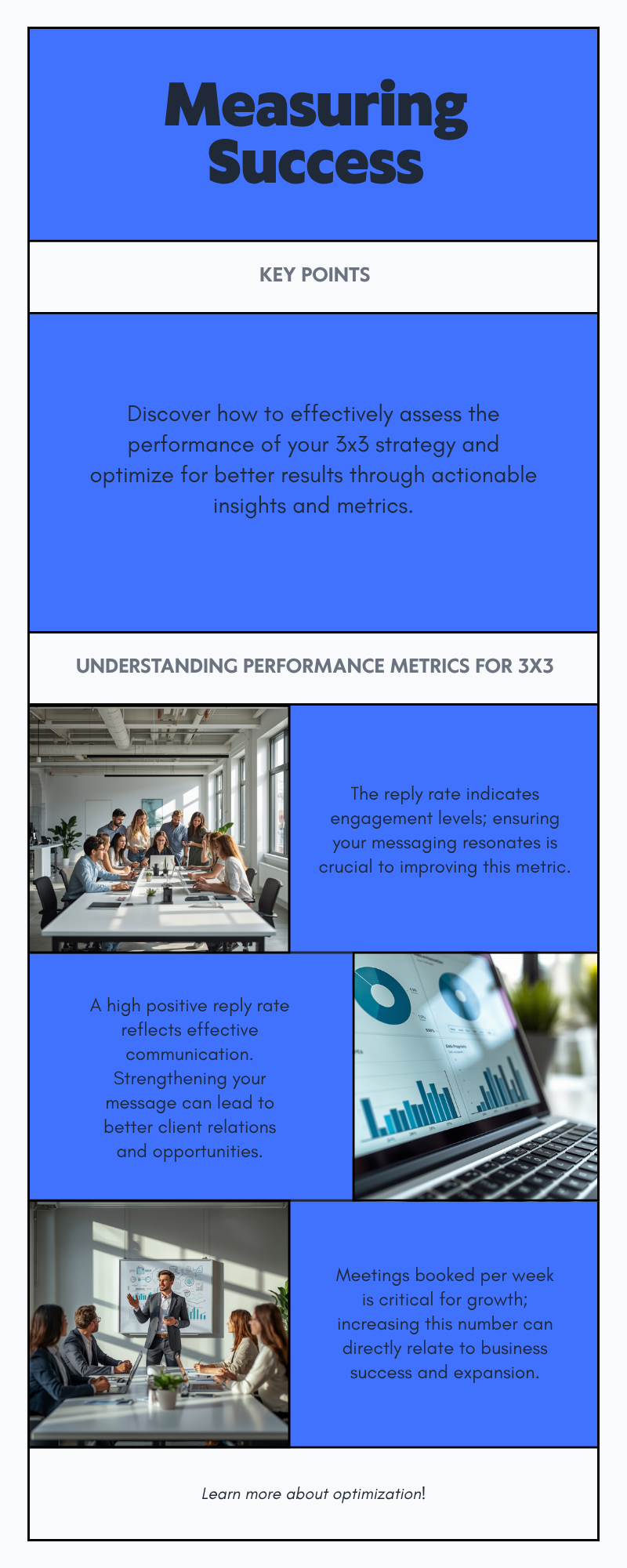
Don't just track reply rate. Track these four numbers and you'll know within 2 weeks whether the discipline is paying off:
| Metric | Spray baseline | Healthy 3x3 | Action if below |
|---|---|---|---|
| Reply rate | 1–3% | 8–15% | Audit personalization quality — are facts specific? |
| Positive reply rate | 0.3–0.8% | 3–6% | Bridge sentence weak — are you connecting fact → offer? |
| Meetings booked / week | 1–2 | 4–7 | Volume too low — pre-batch enrichment to speed research |
| Bounce rate | <5% | <2% | Email list quality is the bottleneck, not copy |
Track these in a simple sheet — no special tool needed. If positive reply rate isn't moving after 3 weeks of disciplined 3x3, the problem is your offer, not your research.
Does AI replace 3x3 research?#
No — and the reps who think it does are the ones still hitting 1% reply rates while they wonder why.
AI is a fantastic accelerator for 3x3. Give it the LinkedIn URL, the company name, and a recent news article, and ask it to extract the three highest-signal facts. That cuts minute one and minute two roughly in half. But the bridge — minute three — is where human judgment still wins. Connecting "they just raised a B" to "so their CFO is now obsessed with payback period, and our tool cuts that in half" is the kind of inference that needs domain knowledge an LLM doesn't reliably have.
The G2 sales engagement category is flooded with "AI personalization" products. Test them, but watch reply rates over 4 weeks — most lose effectiveness as inbox filters learn the patterns. 3x3, done by a thinking human, is durable.
Final word: 3x3 is a habit, not a hack#
The reps who win in 2026 aren't the ones with the best AI or the biggest list — they're the ones who refuse to send a single cold email without three real facts and a bridge. Most of your competition won't do it. That's the whole opportunity.
Start tomorrow: pick 20 prospects, set a 3-minute timer per name, write 20 emails. Compare reply rate to your last 20 generic sends. The math will decide for you.
Stop wasting research on bad emails. Tomba's Email Finder gives you verified contacts on the Free plan (25/mo) and scales through Starter ($49/mo), Growth ($99/mo), and Pro ($249/mo) — so the 3 minutes you spend researching each prospect actually lands in an inbox that exists.
// get started
Find, verify and enrich your first contacts today
Start on the free plan with 25 searches a month, then scale when your team is ready.
Free plan · No credit card required · GDPR & CCPA
// about the author