4Degrees Pricing Reviews Pros and Cons (2026 Guide)
Honest 2026 breakdown of 4Degrees CRM pricing tiers, real user reviews, plus the pros and cons relationship-driven teams need to know before buying.
4Degrees Pricing Reviews Pros and Cons (2026 Guide)
Need a clear-eyed take on 4degrees pricing reviews pros and cons? You're in the right spot. Your pipeline does not look like a SaaS pipeline. You run a private equity fund, a venture firm, an investment bank, or a commercial real estate shop. Deals take 18 months. Intros come from a partner's college roommate. The "lead" is a fund manager you met at a 2021 conference. 4Degrees was built for that world. But the price tag, the contract terms, and the day-to-day reality have caught more than a few buyers off guard.
This is a neutral 2026 breakdown of 4degrees pricing reviews pros and cons. It is written for people weighing it against Affinity, DealCloud, Salesforce, HubSpot, and the spreadsheets they are still secretly running on the side.
TL;DR — Should You Buy 4Degrees in 2026?#
- Pricing: Not public. Expect roughly $125–$200+ per user per month on an annual contract. Add implementation fees on top for bigger teams.
- Best fit: Small-to-mid private capital firms, boutique investment banks, and CRE teams that live or die by warm intros.
- Biggest pro: Auto contact and email enrichment plus a relationship-strength score. It shows who on your team knows whom.
- Biggest con: Reporting depth, native dial integrations, and admin customization trail enterprise tools like DealCloud and Affinity.
- Verdict: Worth a demo if you have 5–40 dealmakers and a relationship-driven motion. Overkill for transactional sales teams.
What Is 4Degrees and Who Is It For?#
4Degrees is a relationship-intelligence CRM built for deal teams. It does not treat contacts as faceless records in a database. Instead, it ingests every email and calendar event from your team's inboxes. Then it builds a relationship graph and scores how strong each person's tie is to a given target.
The core idea is simple. Your firm's most valuable asset is not your pipeline. It is the network behind the pipeline. 4Degrees turns that network into a searchable, sortable, auditable system of record.
Typical 4Degrees customers:
- Private equity and growth equity funds (10–50 investment pros)
- Venture capital partnerships
- Investment banks and M&A advisory shops
- Commercial real estate brokerages and developers
- Family offices managing direct deal flow
- Corporate development teams inside Fortune 500s
If you sell SaaS seats to mid-market buyers in 30-day cycles, 4Degrees is the wrong tool. If you spend 18 months tracking a single LBO target, it is exactly the right tool.
How Much Does 4Degrees Cost in 2026?#
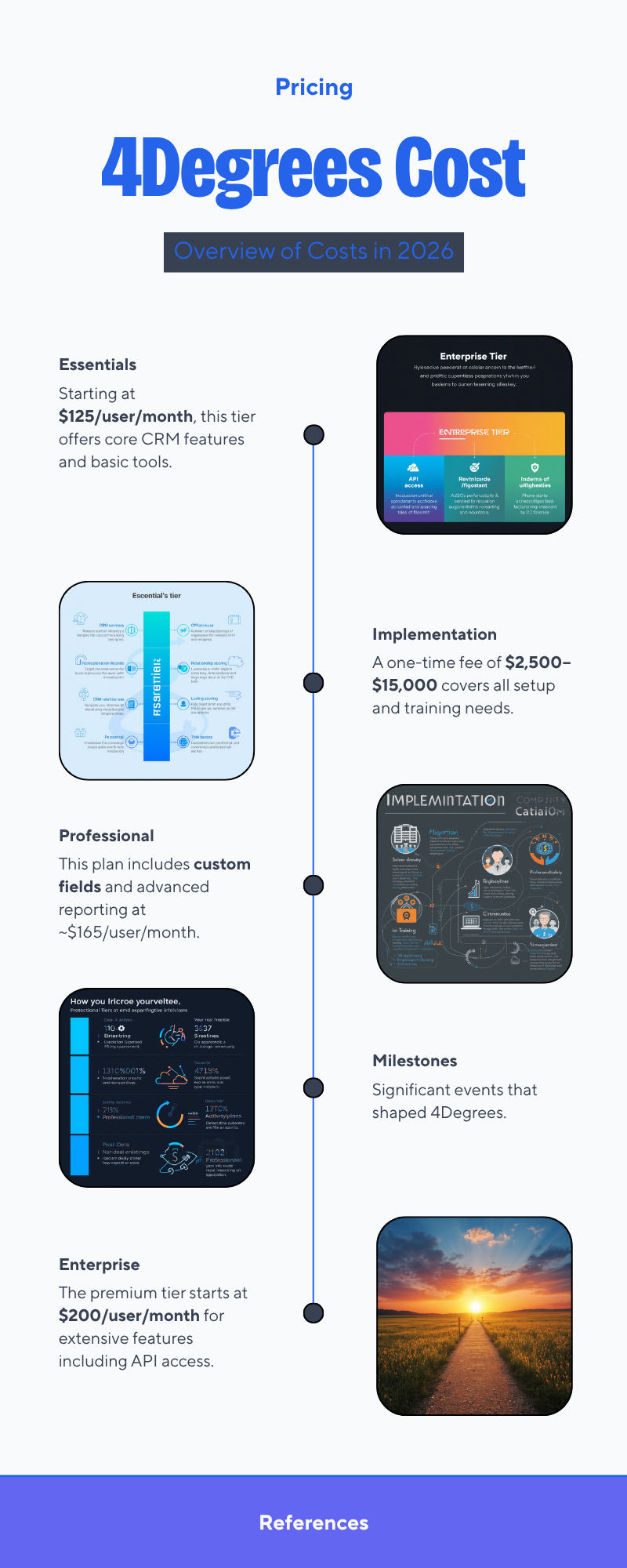
4Degrees does not publish pricing on its website. You have to book a demo and sit through a discovery call before you see a number. We pulled user-reported quotes from G2 and Capterra. We also pulled chatter from private investor Slack groups. Here is what real teams are paying in 2026:
| Tier (estimated) | Approx. cost | Seats | What you get |
|---|---|---|---|
| Essentials | ~$125/user/month | 3+ | Core CRM, relationship scoring, basic enrichment, email sync |
| Professional | ~$165/user/month | 5+ | Custom fields, deal pipelines, advanced enrichment, reporting |
| Enterprise | $200+/user/month | 10+ | API access, SSO, dedicated CSM, custom integrations |
| Implementation | $2,500–$15,000 one-time | n/a | Data migration, training, custom workflow setup |
Caveats worth taking seriously:
- Pricing is negotiable. That is true especially if you commit to 2-year terms or pay annually upfront.
- Most contracts are billed annually. Month-to-month is rarely offered.
- "Per user" usually means active seats with email-inbox sync. Read-only viewer seats may be discounted.
- Setup fees scale with how messy your data is. Migrating from a single Salesforce instance is cheaper than merging six legacy systems.
Now compare costs to a tool like Affinity (also opaque, also pricey) or DealCloud (enterprise-only, $200+/seat). Expect 4Degrees to land at the lower end of the relationship-CRM category. It still sits well above HubSpot or Pipedrive.

What Do 4Degrees Reviews Actually Say?#
We pulled verified reviews on G2, Capterra, and Gartner peer insights as of Q1 2026. 4Degrees holds an average rating in the 4.4–4.7 / 5 range. That is across roughly 60–80 reviews. The score is solid for a niche tool, but the volume is low. Read with care.
Recurring praise:
- "Saved us hours per week tracking who on the team had already met a target."
- "Best-in-class email and calendar sync — it just works."
- "Customer success team gets how a PE deal works, unlike our last CRM rep."
- "The relationship-strength score has changed how partners decide who makes the intro."
Recurring complaints:
- "Reporting is too rigid — we still export to Excel for board decks."
- "Mobile app feels like an afterthought. Investment pros live on planes."
- "Customization is shallower than DealCloud once you outgrow the templates."
- "Search is fast, but bulk-editing 200 contacts at once is painful."
The pattern is clear. Teams that map cleanly to the relationship-CRM use case love it. Teams that try to bend it into a transactional sales tool hit walls. So do teams that need DealCloud-level admin power.
What Are the Pros and Cons of 4Degrees?#
Here is the honest scorecard for 4degrees pricing reviews pros and cons at a glance.
Pros#
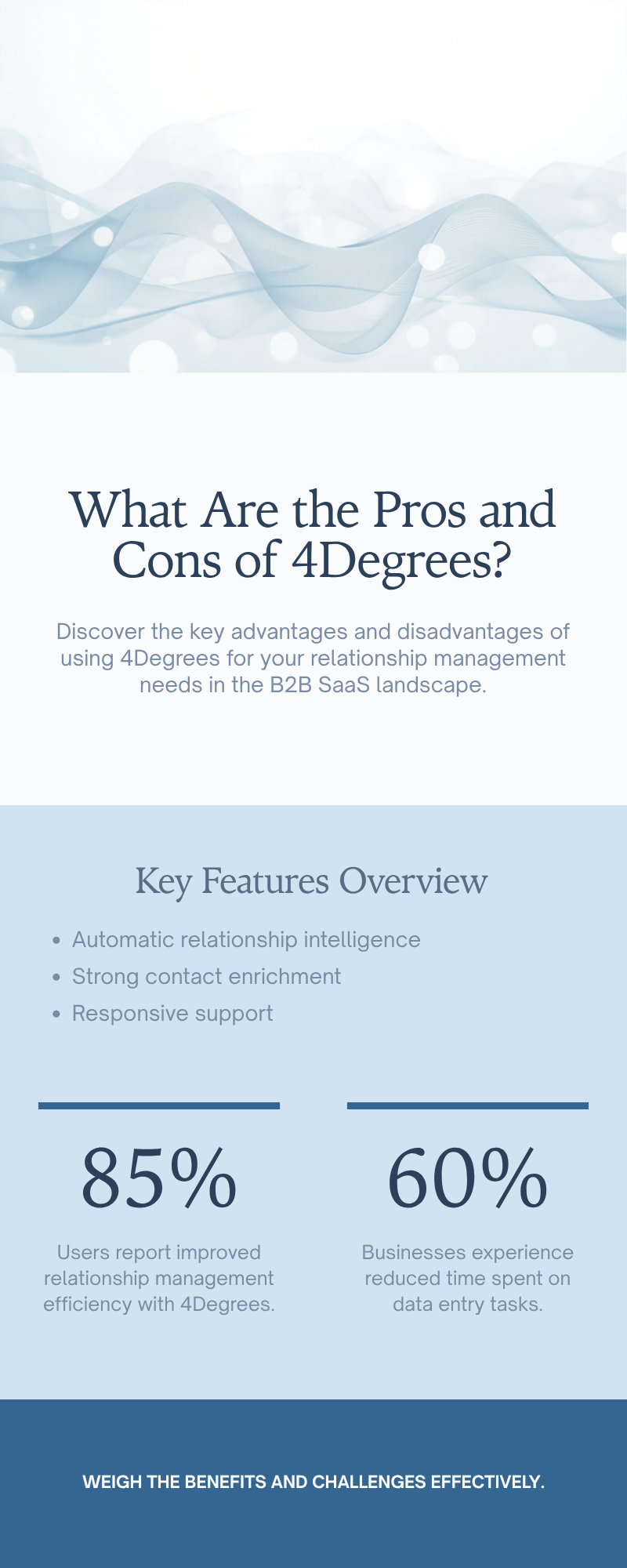
- Auto relationship intelligence. Email and calendar sync runs in the background. It builds a contact graph without anyone typing into a CRM. For partners who refuse to do data entry, this is the single biggest win.
- Built for private capital. Field names, pipeline stages, and reports are pre-modeled for funds, banks, and CRE. You do not fight the tool to make it fit.
- Strong contact enrichment. Job title, firm, LinkedIn, mutual connections — all auto-pulled and refreshed. If you also run data enrichment for outbound, the two stacks layer cleanly.
- Reasonable UX. The interface is closer to Notion than to Salesforce. New users get productive in days, not months.
- **API and
Zapier coverage**. Connect it to inbound forms, data rooms, and BI tools without a custom build.
- Responsive support. Mid-market customers report fast, sharp responses — a refreshing change from enterprise CRMs.
Cons#
- Pricing opacity. You cannot budget without a sales call. That alone rules it out for some procurement teams.
- Reporting ceiling. Pivot tables, custom calculated fields, and cohort analysis are weaker than Affinity or DealCloud. Heavy reporters end up in Looker or Excel anyway.
- Mobile gap. The iOS and Android apps cover basics but trail the web experience.
- No native dialer. If your associates also run cold calling workflows, you will bolt on a separate tool.
- Limited workflow automation. Conditional logic, multi-step automations, and approval chains are thinner than HubSpot Operations Hub.
- Smaller ecosystem. Fewer pre-built integrations and consultants than Salesforce or HubSpot. Niche means niche.
How Does 4Degrees Compare to Alternatives?#
If you are shortlisting, here is the real 2026 landscape.
| Tool | Best for | Approx. price/user/mo | Key strength | Key weakness |
|---|---|---|---|---|
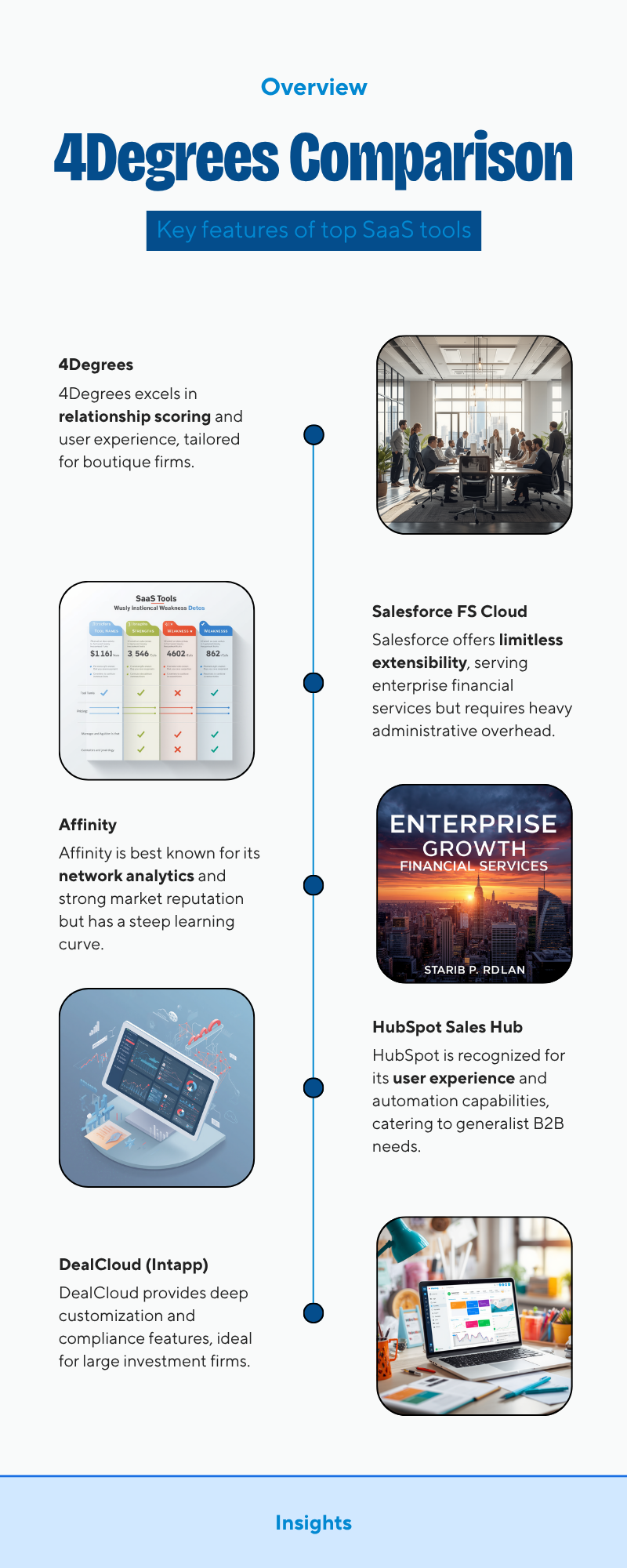
| 4Degrees | Boutique PE, VC, CRE, IB | $125–$200+ | Relationship scoring + ease of use | Reporting depth |
| Affinity | Mid-large VC, growth equity | $150–$300+ | Network analytics, market reputation | Steep learning curve |
| DealCloud (Intapp) | Large PE, IB, advisory | $200–$500+ | Deep customization, compliance | Implementation cost & time |
| Salesforce Financial Services Cloud | Enterprise FS | $175–$300+ | Limitless extensibility | Heavy admin overhead |
| HubSpot Sales Hub | Generalist B2B | $100–$150 | UX, automation, ecosystem | Not relationship-graph native |
| Spreadsheets + Tomba enrichment | Sub-5-person teams | <$50 | Lowest cost, total control | No relationship intelligence |
A simple rule of thumb:
- Under 5 dealmakers: a tidy Google Sheet plus an email finder and an enrichment layer often beats a $40K/year CRM.
- 5–40 dealmakers in private capital: 4Degrees or Affinity. Pick on demo feel and integration fit.
- 40+ dealmakers, complex compliance, multi-strategy firm: DealCloud or Salesforce FSC.

Is 4Degrees Worth the Price?#
The honest answer: it depends on three variables.
1. How relationship-driven is your deal flow? Does more than half your closed deal volume trace back to a warm intro? Then the relationship graph pays for itself in the first reallocated intro. Are you cold-prospecting product-market-fit founders instead? Then a generalist CRM plus a domain search workflow is cheaper and faster.
2. How allergic are partners to data entry? 4Degrees' superpower is that senior people do not have to type into it. Does your culture already enforce clean CRM hygiene? That is rare. If it does, the gap to a generalist tool narrows.
3. How much reporting muscle do you need? LPs want quarterly deal-flow dashboards, sourcing heatmaps, and cohort breakdowns. 4Degrees covers 80% of this natively. The last 20% — custom metrics, board-grade visuals — usually moves to BI. If you need it native, look at Affinity or DealCloud.
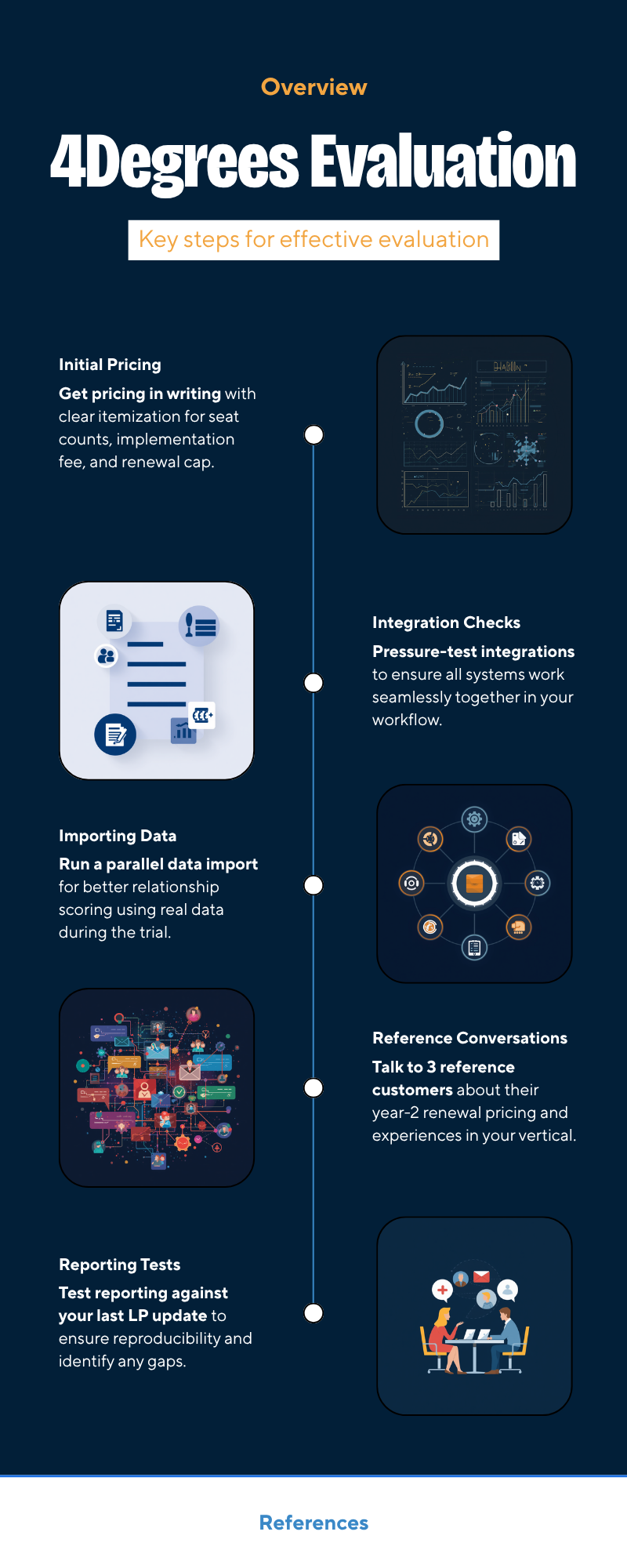
How Should You Run a 4Degrees Evaluation?#
A practical 30-day evaluation playbook:
- Get pricing in writing. Spell out seat counts, annual commit, implementation fee, and renewal cap.
- Run a parallel data import. Load 90 days of email and a sample contact list into the trial. The relationship scoring only impresses on real data.
- Test reporting against your last LP update. Can you reproduce it natively? If not, list every gap.
- Pressure-test integrations. That means Outlook/Gmail sync, your data room (Datasite, Intralinks), your BI tool, and your stack of enrichment APIs.
- Talk to 3 reference customers in your exact vertical. Ask specifically about year-2 renewal pricing.
- Verify data hygiene. Pipe a known-good contact list through their enrichment. Compare it to your existing source. For email-specific accuracy checks, run the same list through a dedicated email verifier and see whose data wins.
If 4Degrees survives that gauntlet, the price tag stops feeling like a stretch.
When Should You Skip 4Degrees Entirely?#
Walk away if any of the following apply:
- You are a pure-outbound sales team measured on weekly meetings booked. Use HubSpot or Salesforce with a bulk email finder on top.
- You are under 5 people and pre-revenue. Buy time, not seats. A spreadsheet and a free email checker will carry you for 12 months.
- You need SOC 2 Type II plus custom audit logs plus on-prem deployment. That is DealCloud or Salesforce territory.
- Your deal flow is purely transactional with no relationship layer (marketplaces, transactional brokerage). The relationship graph will not earn its keep.
How Does Tomba Fit Alongside 4Degrees?#
4Degrees is the system of record for your relationships. It does not, however, find new contacts at firms you have not met yet. That is not its job.
That is where a focused contact-discovery layer earns its place. Use Tomba's email finder to surface verified contacts at target portfolio companies, LPs, co-investors, or M&A targets. Pipe verified results into 4Degrees via the API or a Zapier integration. The relationship graph then starts working on people you did not previously know.
Pricing starts free (25 searches/month). Paid plans start at $49/month. That is a fraction of a 4Degrees seat, and complementary rather than competitive. See current Tomba pricing for the full breakdown.
Final Verdict: 4Degrees Pricing Reviews Pros and Cons in 2026#
4Degrees is a strong, focused product for a clearly defined audience. That audience is relationship-driven deal teams between 5 and 40 seats. They hate data entry. They live in their inbox. The pricing is fair for the value when the use case fits. It is not the right tool for transactional sales, sub-5-person startups, or enterprise firms that need DealCloud-grade compliance and customization.
If you fit the bullseye, demo it. If you do not, save the $40K — and put it toward a tighter prospecting stack instead.
Ready to build the prospecting layer that feeds your CRM, whether it is 4Degrees, Affinity, or a spreadsheet? Start free with the Tomba Email Finder — 25 verified contact lookups per month, no credit card, and APIs that drop straight into the deal-team workflow you already run.
// get started
Find, verify and enrich your first contacts today
Start on the free plan with 25 searches a month, then scale when your team is ready.
Free plan · No credit card required · GDPR & CCPA
// about the author