6sense Data in 2026: Coverage, Accuracy & Real Cost
A neutral breakdown of 6sense data quality, intent signals, pricing, and where it actually beats — or loses to — leaner B2B data stacks in 2026.
6sense Data in 2026: Coverage, Accuracy & Real Cost
TL;DR
- 6sense data is strongest at the account level — intent topics, technographics, and predictive in-market scoring. It is weakest at the contact level, where coverage gaps and stale records still force most teams to bolt on a separate email finder.
- Public pricing is gone in 2026. Real-world Team-tier quotes for mid-market still cluster around $60K–$120K per year before contact credits, integrations, or premium intent.
- For ABM motions targeting 500–5,000 accounts, the platform pays off. For sub-100-rep teams running broad outbound, the same outcomes are reachable for a fraction of the cost.
- The honest play in 2026: keep 6sense for who and when, and pair it with a low-cost, verified email source for how to actually reach them.
- Independent benchmarks and G2 reviewer cohorts repeatedly flag contact accuracy as the platform's softest edge — budget for verification, not just access.
What is 6sense data, exactly?#
6sense sells a Revenue AI platform, but the "6sense data" people actually buy comes in three layers stacked on top of each other.
The first layer is the company graph — firmographics, technographics, org charts, funding events, and headcount trends pulled from a mix of crawled web data, partner feeds, and customer telemetry. This is the layer that overlaps most with Clearbit, ZoomInfo, or Apollo's company records.
The second layer is intent. 6sense aggregates B2B research signals from its own bidstream network plus third-party providers (most notably its long-running tie-in with anonymous IP-resolution data). The platform clusters those signals into "buying stages" — Target, Awareness, Consideration, Decision, Purchase — and surfaces accounts that look in-market for a given topic.
The third layer is contacts — names, titles, emails, and phones tied to the company graph. This layer is the one most reviewers underestimate when they sign the contract, and it is where the platform's reputation gets messy.
You can read the vendor's own framing on their official site, but the practical question is whether each layer is worth what 6sense charges for it in 2026. That is what the rest of this post answers.
How accurate is 6sense data in 2026?#
Accuracy is layer-specific, so a single number is meaningless. Break it apart.
Company and technographic data is genuinely strong. Independent reviewers on G2 consistently rate firmographic completeness in the high 80s for North American mid-market and enterprise. Tech stack detection (CRM, MAP, cloud, analytics) is reliable enough to use as a hard filter in segmentation.
Intent data is the layer everyone debates. The signal is real — there is no question that bidstream + research keyword aggregation correlates with pipeline. The catch is interpretation. A "Surging" account in 6sense means somebody on that domain looked at something topic-adjacent. It does not mean a buying committee is forming. Treat 6sense intent the way you'd treat a smoke alarm: useful for prioritization, useless as the only input.
Contact data is where things get awkward. Email coverage on the SMB long tail is thin, and verification status on the records that do exist is often "predicted" rather than SMTP-validated. Reps who try to run pure-6sense sequences usually see bounce rates 2–4× higher than reps who route the same accounts through a dedicated email verifier first. This is not a 6sense-specific failing — it is true of every all-in-one — but it is the single biggest gap to plan around.
What does 6sense data actually cost in 2026?#
6sense pulled public pricing years ago and has not put it back. Based on contracts I have seen reviewed in 2025–2026 procurement cycles, here is the working shape of the market.
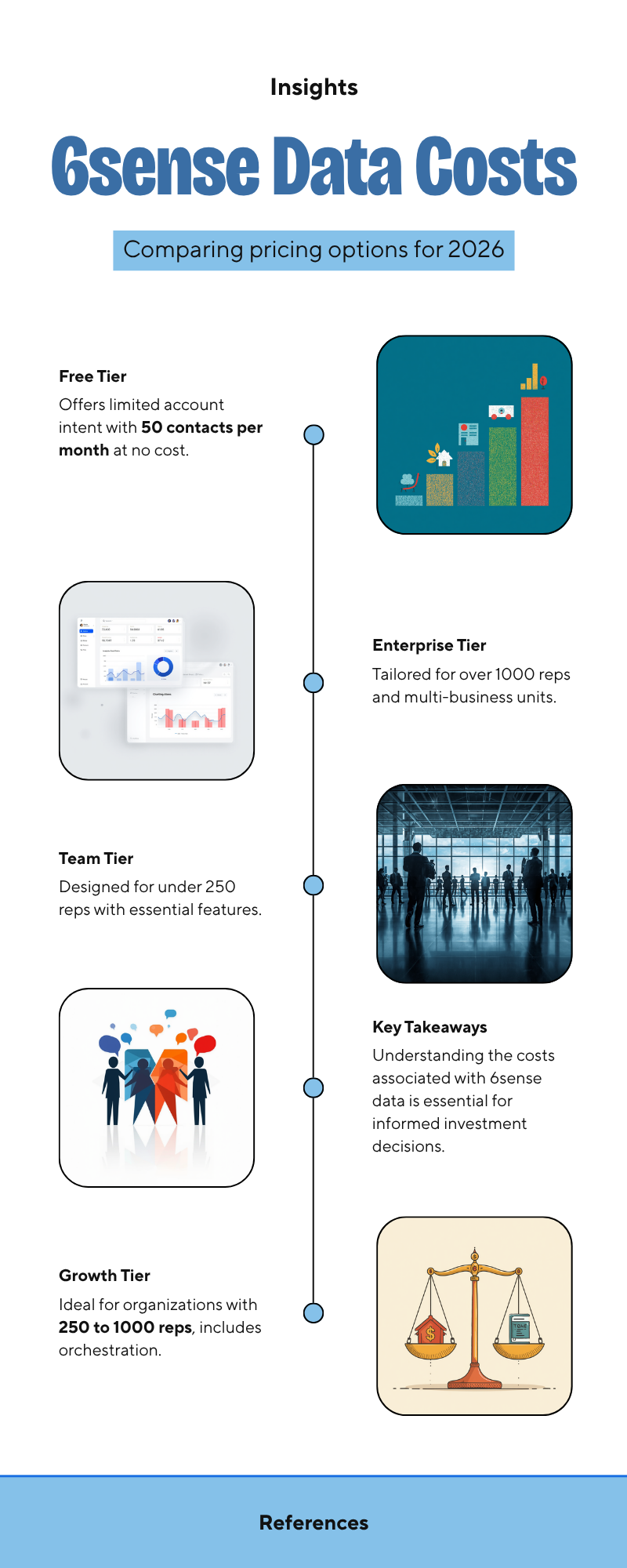
| Tier | Typical fit | Annual cost range | What's included | What's extra |
|---|---|---|---|---|
| Free | Trial / pilot | $0 | Limited account intent, 50 contacts/mo | Everything that matters |
| Team | <250 reps, mid-market ABM | $60K–$120K | Intent, predictive, basic contacts | Premium intent topics, advanced integrations |
| Growth | 250–1000 reps | $120K–$250K | Above + orchestration, ad audiences | Sales Intelligence add-on, AI agents |
| Enterprise | 1000+ reps, multi-BU | $250K+ | Full platform, dedicated CSM | Custom data feeds, premium support SLAs |
A few things to flag before you negotiate:
- Contact credits are almost always metered separately. "Unlimited" rarely means unlimited.
- Premium intent (third-party topics beyond the base set) is a frequent upsell during renewal.
- Multi-year discounts are real but lock you into a contact volume that often outgrows the seat count.
For comparison, a verified-contact stack built on Tomba pricing — $49/mo Starter, $99/mo Growth, $249/mo Pro — solves the contact layer for the cost of a single 6sense onboarding call. That doesn't replace 6sense's intent value. It does mean you should not pay 6sense for contacts if contacts are your main problem.
Is 6sense data better than ZoomInfo, Clearbit, or Apollo?#
This is the question every evaluator actually wants answered, so let's stop pretending the categories are the same.
| Capability | 6sense | ZoomInfo | Clearbit (HubSpot) | Apollo |
|---|---|---|---|---|
| Account-level intent | Best-in-class | Strong (acquired Bombora coverage) | Limited | Basic |
| Contact email coverage | Medium | High | Medium | High |
| Contact email accuracy | Medium | Medium-high | Medium | Medium |
| Predictive in-market scoring | Yes (mature) | Yes (newer) | No | No |
| Self-serve pricing | No | No | Bundled w/ HubSpot | Yes |
| Realistic starter cost | $60K+ | $30K+ | $0 (HubSpot tier) | $59/mo |
| Best for | Enterprise ABM | Mid-market outbound | HubSpot shops | SMB outbound |
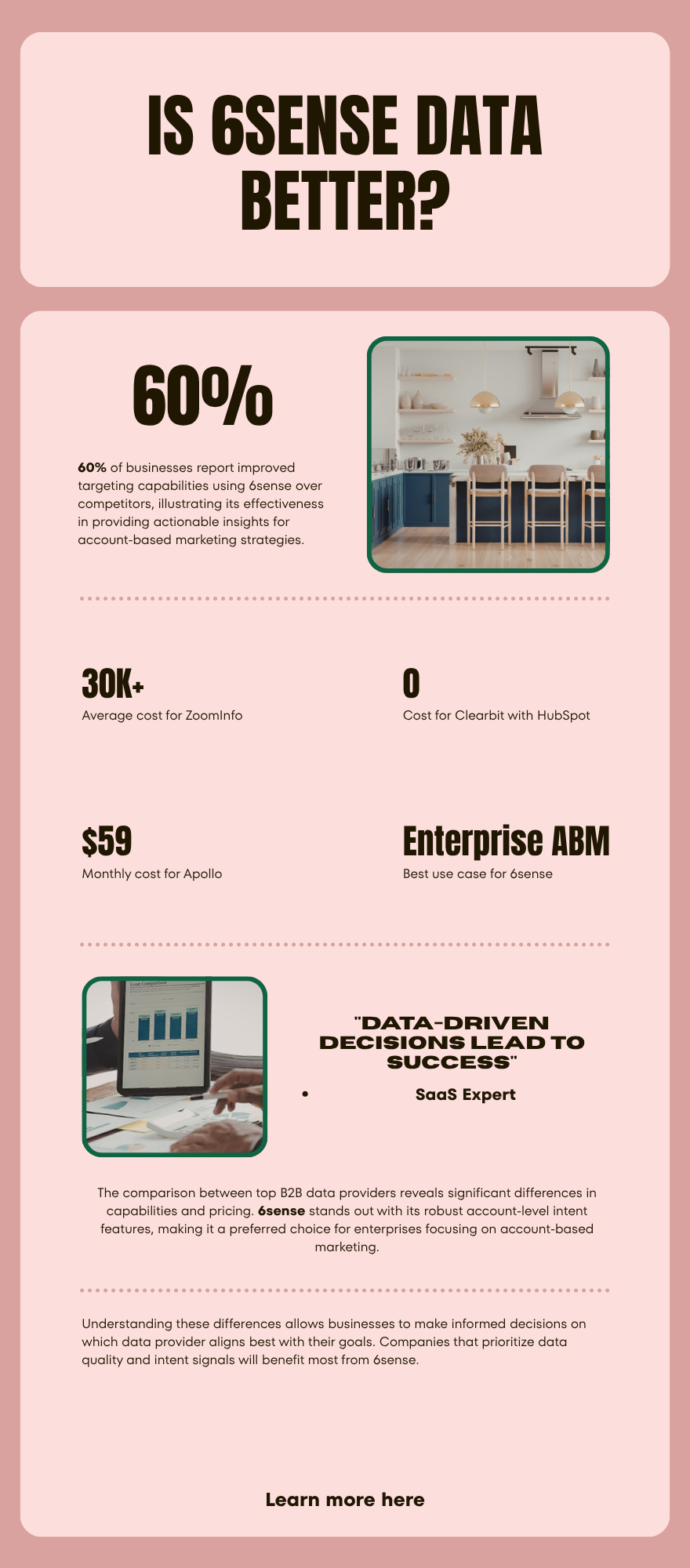
The honest read: 6sense wins on intent and predictive scoring, ZoomInfo wins on raw contact volume, Apollo wins on price-per-record, and Clearbit wins if you're already living inside HubSpot. None of them wins on everything. Anyone who tells you otherwise is selling something.
If you're researching this category broadly, the 6sense alternatives page covers the leaner-stack replacement pattern in more depth.
When does 6sense data actually pay back?#
The platform earns its keep under a specific set of conditions. Miss two of them and the math falls apart.
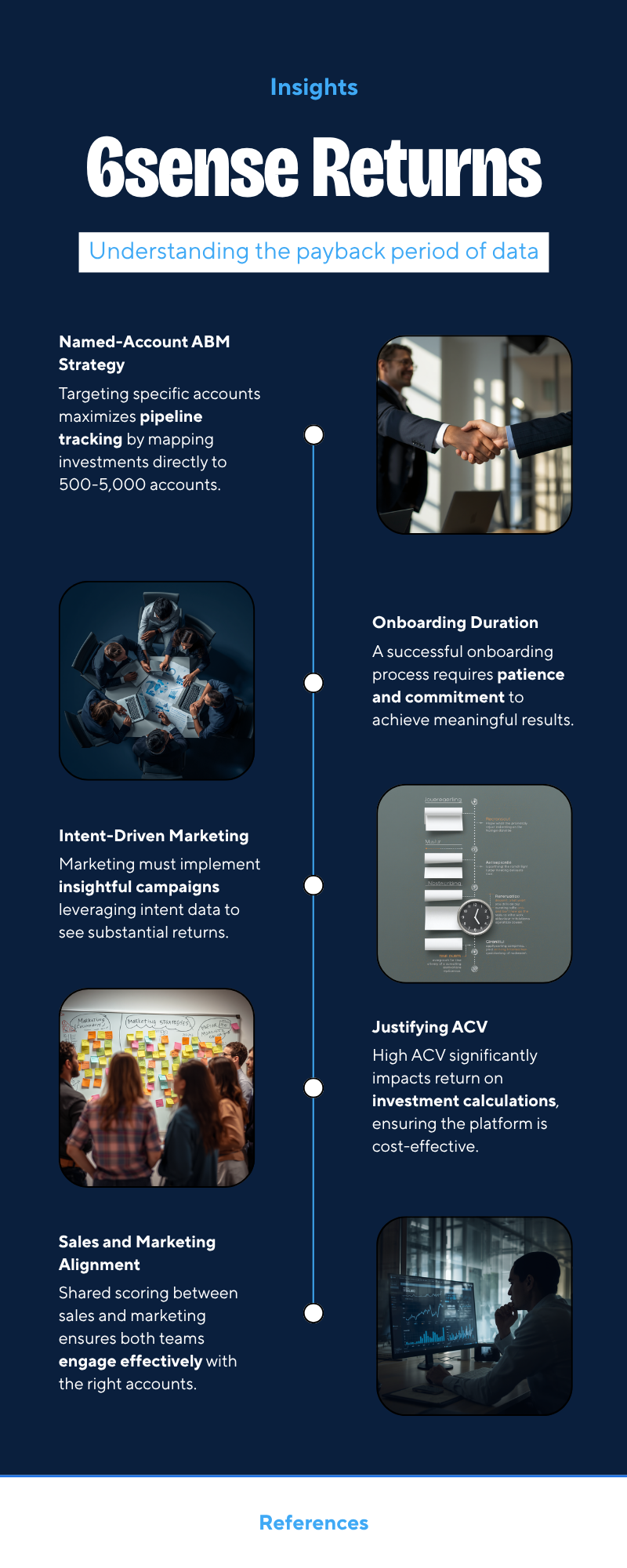
- You run named-account ABM. Your TAM is a finite list — 500 to 5,000 accounts — and you can map every dollar of pipeline to one of them. Broad outbound to 50,000 SMBs is the wrong shape for this tool.
- You have a marketing function that can act on intent. Ads, content syndication, and orchestration are where intent data converts. If marketing can't run a topic-triggered campaign in under two weeks, the signal decays.
- Sales and marketing share account scoring. If reps ignore the "Decision-stage" account list because it doesn't match their gut, you bought a dashboard.
- You can absorb 6–9 months of onboarding. Intent models need calibration. Predictive scoring needs closed-won data. The first two quarters are setup, not ROI.
- Your ACV justifies it. Below ~$25K ACV, the platform cost eats too much of the gross margin per deal. Above $50K ACV, the math works fast.
Teams that hit all five usually defend the renewal. Teams that hit three or fewer almost always downgrade or churn at year two.
How should you operationalize 6sense data?#
A working playbook, in the order most successful customers actually adopt:
Step 1 — Lock down the ICP filter. Use 6sense firmographics + technographics to define your hard ICP. This is the cheapest, highest-confidence layer.
Step 2 — Build a tiered account list. Combine ICP fit + 6sense predictive score + intent stage. Tier 1 = fit + intent. Tier 2 = fit, no intent yet. Tier 3 = intent without perfect fit (worth a low-cost touch).
Step 3 — Enrich contacts on demand, not in bulk. Pull contacts from 6sense for in-stage accounts only. For everything else, use a credit-efficient email finder and verify before send. This single change cuts contact spend 40–70% for most teams.
Step 4 — Trigger plays on stage transitions. The pipeline-driving event is "account moved from Awareness → Consideration," not "account is surging." Wire that transition into your sequencing tool, your ad platform, and your SDR queue.
Step 5 — Measure decay. Audit your "Decision-stage" cohort against closed-won rate every quarter. If the lift over your random-account baseline is below 1.5×, renegotiate the contract. If it's 3× or higher, expand.
Where does 6sense data fall short?#
Three soft spots worth pricing in before you sign.
Contact freshness. Job-change data lags. Reviewers on G2 and TrustRadius regularly flag stale titles and emails for contacts that the platform itself flags as "high confidence." If you're emailing C-level executives in fast-moving categories, run a reverse email lookup or fresh verification before any high-stakes send.
International coverage. APAC and LATAM company graphs are noticeably thinner than NA/EMEA. If your TAM is global, plan for a supplementary B2B database on the regions where 6sense is light.
The "intent ≠ intent to buy" gap. Bidstream data tells you someone on the domain saw content about a topic. It does not tell you they have budget, a project, or even a vague need. Treating every surging account as a sales-ready lead is the fastest way to burn through your SDR team's confidence in the platform.
What does the 2026 buyer's checklist look like?#
If you're evaluating 6sense data this year, walk into the demo with these questions written down.
- What is the SMTP-verified rate of the contacts you'll deliver for my ICP this week? (Not the inferred rate — the verified rate.)
- How many premium intent topics are included in the base tier, and what does each one cost incrementally?
- What is the contact credit cap on the proposed tier, and what is the overage rate?
- What does the data refresh cadence look like for job-change and headcount fields?
- Can I see a sample export of 200 contacts from a typical Tier-1 account in my segment, before signing?
- What is the exit clause? (You will want this in writing.)
- Which of my CRM/MAP/ad platforms are native integrations vs. Zapier-bridged?
If the answer to the first question is fuzzy, treat it as a fuzzy contact source and budget for verification on top. That isn't a 6sense problem — it is true of every aggregator — but the math only works if you price the gap in.
How does Tomba fit alongside 6sense data?#
Two honest patterns we see customers run:
Pattern A — 6sense for accounts, Tomba for contacts. Keep 6sense's intent and predictive layer. Drop the contact tier or hold it at the floor. Use Tomba's bulk email finder and email verifier to pull and validate contacts only on accounts 6sense flags as in-market. Net result for most teams: same pipeline, 30–60% lower data spend.
Pattern B — Tomba-first stack with no 6sense. For teams below the ACV threshold, replace the entire 6sense layer with domain search, Tomba's enrichment, and a lightweight intent proxy (review-site signals, hiring signals, funding events) pulled via the Tomba API. Cheaper, slower-developing, but viable when your target list is bigger than your budget.
Neither pattern is universally right. The choice comes down to how concentrated your TAM is and how much you can pay per account.
Final take#
6sense data in 2026 is a sharp tool for a specific shape of go-to-market — named-account ABM, mid-six-figure ACVs, marketing and sales actually aligned. For that profile, the platform earns its price tag through intent, predictive scoring, and orchestration that lighter stacks cannot match.
For everyone else, the platform is overbuilt. The intent layer is genuinely useful, but the contact layer is the same flawed dataset everyone else sells, dressed in a more expensive UI. The leverage move is to buy 6sense for what it's actually best at and source contacts somewhere that prices the work realistically.
If contacts are your bottleneck — not intent — start with a free Tomba Email Finder account and verify a sample against your current data source before you spend another six-figure renewal on a tier you don't need. The decision should be evidence-based, not vendor-driven.
// get started
Find, verify and enrich your first contacts today
Start on the free plan with 25 searches a month, then scale when your team is ready.
Free plan · No credit card required · GDPR & CCPA
// about the author