6sense vs Common Room 2026: Which GTM Platform Wins?
6sense leans on intent-based ABM signals while Common Room mines community and product-led activity. Here is the honest 2026 breakdown of pricing, data, and fit.
6sense vs Common Room 2026: Which GTM Platform Wins?
TL;DR
- 6sense is built for traditional ABM: anonymous intent data, predictive scoring, and account-based advertising aimed at enterprise demand-gen teams.
- Common Room is built for product-led and community-led GTM: it unifies signals from Slack, Discord, GitHub, Docs, product usage, and CRM into a single person-level view.
- Pricing is opaque on both sides — 6sense typically lands in the $60K–$120K/year range for mid-market, while Common Room offers a free tier and paid plans starting in the low five figures annually.
- Pick 6sense if you sell six-figure deals to defined target accounts. Pick Common Room if your funnel starts with a free signup, an open-source repo, or a community lurker.
- Neither tool finds verified work emails on its own — pair them with Tomba Email Finder to convert anonymous signals into reachable contacts.
What does 6sense actually do?#
6sense is an ABM and revenue-AI platform. Its core promise is that it can tell you which accounts are quietly researching solutions like yours — before they ever fill out a form. It does this by stitching together third-party intent data (Bombora-style topic surges), reverse-IP de-anonymization, technographic data, and predictive AI models that score each account's stage in the buying journey: Target, Awareness, Consideration, Decision, Purchase.
If you have ever sat through a demo where someone pointed at a heatmap and said "these 47 accounts are in the Decision stage right now," that was almost certainly 6sense or a direct competitor.
6sense plugs into Salesforce, HubSpot, Marketo, LinkedIn Ads, Google Ads, and the major sales engagement tools. Its sweet spot is enterprise demand gen, where marketing operations teams already think in terms of revenue operations playbooks and account scoring.
What does Common Room actually do?#
Common Room is a customer intelligence platform built for the modern PLG and community-led motion. Instead of starting from "which logo should we hunt?", it starts from "who is already touching our orbit?" — and turns those signals into a person-level timeline.
Sources it ingests natively include Slack and Discord communities, GitHub stars and issues, npm and PyPI downloads, documentation page views, Zendesk tickets, product usage events, LinkedIn engagement, podcast listens, and webinar attendance. It then resolves those signals to a real person and their company, scoring them against an Ideal Customer Profile you define.
Common Room calls this concept "signals" and "person360." For founders and PLG GTM teams, the killer use case is catching a user who starred your repo at midnight, downloaded the SDK at 2 a.m., and joined Slack three days later — and getting that surfaced to a rep before the trial cools.
Both companies are listed on G2, where the reviews skew differently: 6sense reviewers tend to be marketing ops at companies above 1,000 employees; Common Room reviewers skew toward DevTool, infrastructure, and PLG SaaS.
How do 6sense and Common Room compare on features?#
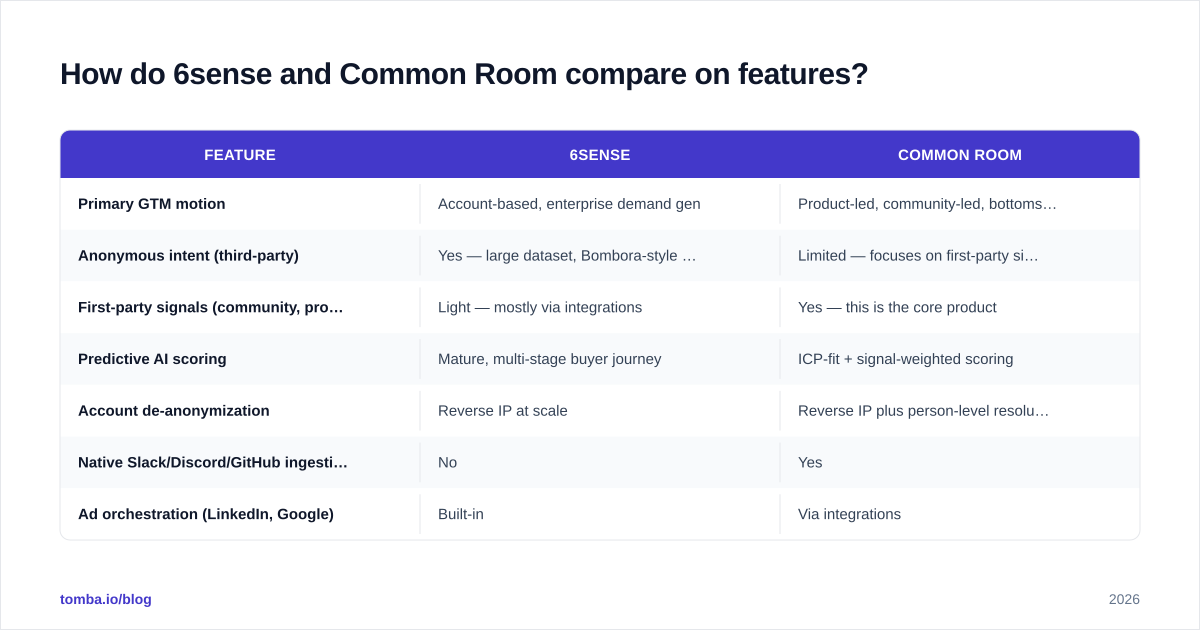
The two products solve adjacent — not identical — problems. Here is the honest side-by-side.
| Feature | 6sense | Common Room |
|---|---|---|
| Primary GTM motion | Account-based, enterprise demand gen | Product-led, community-led, bottoms-up |
| Anonymous intent (third-party) | Yes — large dataset, Bombora-style topics | Limited — focuses on first-party signals |
| First-party signals (community, product, docs) | Light — mostly via integrations | Yes — this is the core product |
| Predictive AI scoring | Mature, multi-stage buyer journey | ICP-fit + signal-weighted scoring |
| Account de-anonymization | Reverse IP at scale | Reverse IP plus person-level resolution |
| Native Slack/Discord/GitHub ingestion | No | Yes |
| Ad orchestration (LinkedIn, Google) | Built-in | Via integrations |
| CRM enrichment | Salesforce, HubSpot, Dynamics | Salesforce, HubSpot |
| Free tier | No | Yes — generous free plan |
| Typical buyer | CMO, demand-gen lead, RevOps director | Head of Growth, DevRel, PLG GTM lead |
| Time to first value | 30–60 days (integration heavy) | 1–3 days (free tier instant) |
The pattern: 6sense answers "which cold accounts should we wake up?" Common Room answers "who is already warm and we missed them?"
How do their pricing models compare?#
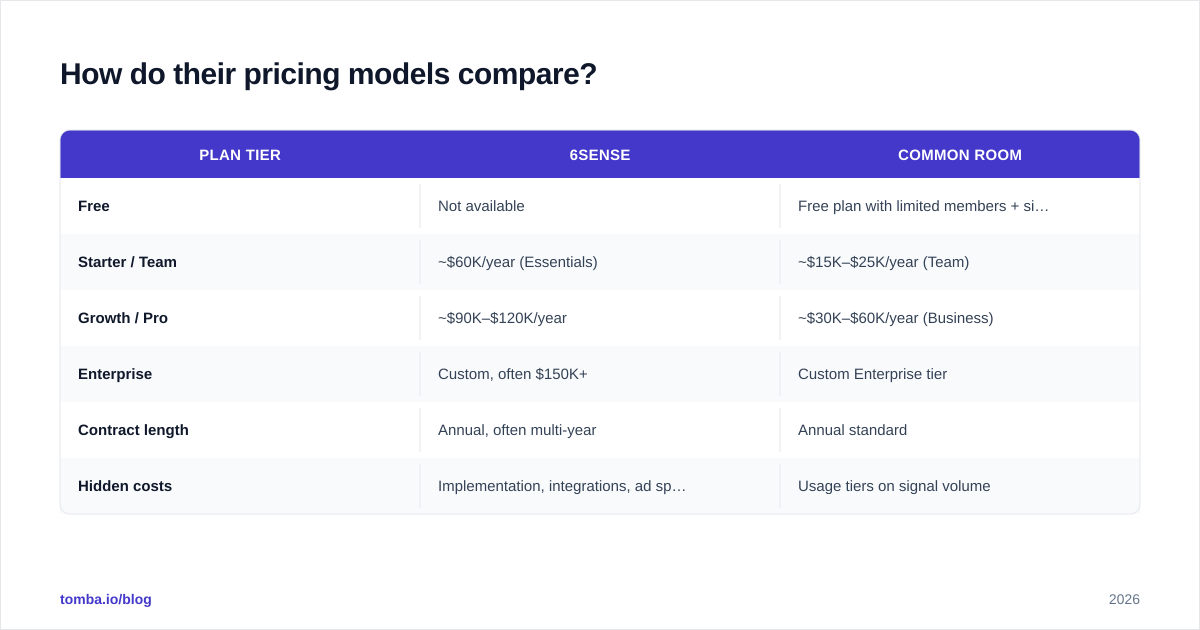
Both companies are private and neither publishes a public price list, so figures below come from G2 reviews, Vendr, and publicly available customer reports. Treat them as ranges, not quotes.
| Plan tier | 6sense | Common Room |
|---|---|---|
| Free | Not available | Free plan with limited members + signals |
| Starter / Team | ~$60K/year (Essentials) | ~$15K–$25K/year (Team) |
| Growth / Pro | ~$90K–$120K/year | ~$30K–$60K/year (Business) |
| Enterprise | Custom, often $150K+ | Custom Enterprise tier |
| Contract length | Annual, often multi-year | Annual standard |
| Hidden costs | Implementation, integrations, ad spend pass-through | Usage tiers on signal volume |
6sense is the heavier check. Common Room's free tier alone is enough to run a small PLG operation if you are just trying to catch GitHub stargazers and Slack joiners.
Is 6sense better than Common Room?#
Not universally — it depends on how your pipeline forms. If your revenue comes from a defined list of 500 named accounts and your reps run outbound plays through Salesforce and LinkedIn Ads, 6sense is purpose-built for that. The intent dataset is broader, the predictive models are more mature, and the ad orchestration saves real ops time.
But if your pipeline comes from people who star a repo, download a CLI, lurk in a community, then maybe-someday convert — 6sense will mostly be quiet. It can't see GitHub stargazers natively. It can't tell you that the same Discord user who asked a question last Tuesday is now scrolling your pricing page.

For PLG and DevTool companies, Common Room often wins not on features but on relevance: it's surfacing the signals that actually correlate with their pipeline.
Is Common Room better than 6sense?#
Better for some — but Common Room is not a replacement for traditional ABM. If you sell to non-technical buyers at large enterprises and your community is a quarterly webinar, Common Room's signal density will be thin. You'll get value from the CRM enrichment and LinkedIn engagement signals, but you won't get the intent-surge view that 6sense gives you across 5,000+ B2B topics.
The realistic framing: Common Room is excellent for the top of funnel for PLG/community motions and the expansion play for existing customer communities. 6sense is excellent for cold-account demand creation and paid-media targeting.
Some enterprise teams run both. Common Room captures who is warming up in product and community. 6sense captures who is researching across the wider web. The CRM is the join key.
What problems does each tool not solve?#
This is the part vendors don't put on the slide. Both 6sense and Common Room give you signals — neither gives you the email address of the human attached to that signal.
- 6sense will tell you the company is in-market. You still need to find the right buyer's contact info.
- Common Room will tell you "Sarah from Acme Corp" engaged in your Slack. You still may not have her work email or phone number.
- Both rely on you to do the actual outreach — they are not sequencers like Outreach or Salesloft.
- Neither verifies email deliverability before you send. Bouncing on a 6sense-prioritized account at 22% bounce rate will torch your sender reputation faster than the deal can close.
This is where pairing them with a verified contact source matters. A typical stack: 6sense (or Common Room) identifies the account or person → an email finder resolves the verified work email → an email verifier confirms deliverability → a sequencer sends.
What about data accuracy and refresh rates?#
6sense's intent data refresh runs weekly for most signals and daily for high-priority topics. Anonymous-to-known match rates vary by industry and traffic volume — public benchmarks land around 40–60% for B2B sites with steady traffic.
Common Room refreshes signals from connected sources continuously. A GitHub star or a Slack join appears in the timeline within minutes. Person-level resolution is stronger when the signal source already has identity (Slack email, GitHub email, Salesforce contact); weaker for purely anonymous web visitors.
If you care about data sources and accuracy in your stack, ask vendors three things: where the raw signal originates, how often it refreshes, and what their false-positive rate looks like on a known control set.
Which integrations matter most?#
Both tools live or die by how cleanly they push into Salesforce or HubSpot. If a rep has to leave the CRM to see the signal, the signal won't get worked.
| Integration | 6sense | Common Room |
|---|---|---|
| Salesforce | Native, deep | Native |
| HubSpot | Native | Native |
| LinkedIn Ads | Native ad orchestration | Engagement signals only |
| Slack | Alerts | Native community ingestion |
| GitHub | No | Native (stars, issues, follows) |
| Outreach / Salesloft | Native | Native |
| Zapier / Make | Limited | Yes |
| Data warehouse export | Snowflake, BigQuery | Snowflake, BigQuery (paid tiers) |
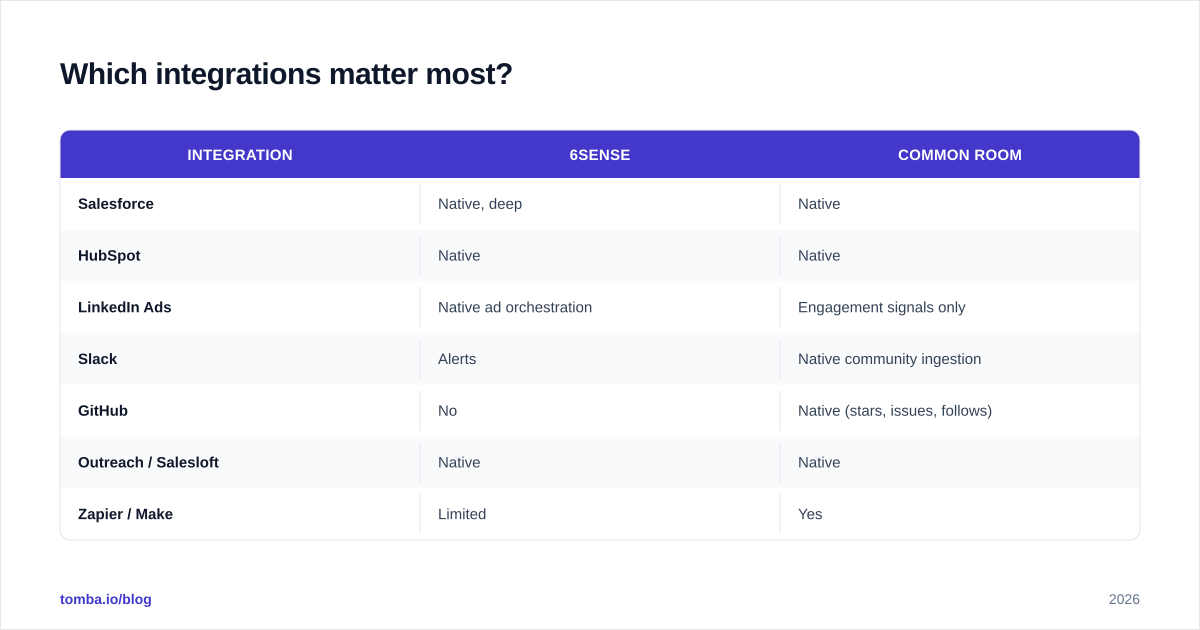
Common Room's deeper community integrations are the strongest single reason a DevTool company picks it. 6sense's deeper ad-platform integrations are the strongest single reason an enterprise demand-gen team picks it.
If you live in spreadsheets first and CRM second, also look at simpler workflows like a Google Sheets email finder plus a HubSpot integration — sometimes that lighter stack is all a 5-person team needs before committing to a six-figure platform.
Which platform should you choose in 2026?#
A short decision tree, applied honestly:
- Pick 6sense if: you have a fixed target account list, sell to enterprise, run paid LinkedIn/Google campaigns, and have a mature RevOps function that can absorb a 60-day onboarding.
- Pick Common Room if: you have a free tier, an open-source component, an active Slack/Discord, or a developer audience — and your reps need to know who in those spaces is showing buying intent.
- Pick both if: you're a hybrid PLG+sales motion above ~$10M ARR, have budget for both line items, and have a RevOps team that can keep CRM identity clean as the join key.
- Pick neither yet if: you have fewer than 500 net-new visitors a week or no community at all. At that stage, a verified contact database plus a tight outbound motion will get you further than a signal-intelligence platform.
For early-stage and bootstrapped teams in the last bucket, the realistic starting stack is a CRM, a verified B2B database, and a deliverability-aware sender setup — not an enterprise ABM platform.
How does Tomba fit alongside 6sense or Common Room?#
Tomba is not an intent platform. It's the contact layer underneath one. Wherever 6sense or Common Room ends — "this account is in-market," "this person engaged in Slack" — Tomba picks up.
- Use Tomba's domain search to pull verified emails for the 6sense target list before you push to a sequencer.
- Use the LinkedIn finder to resolve a Common Room community member's LinkedIn into a verified work email.
- Use bulk processing to enrich a CSV of 6sense priority accounts overnight.
- Verify every contact through the email verifier before sending — this is the single biggest deliverability lever most teams ignore.
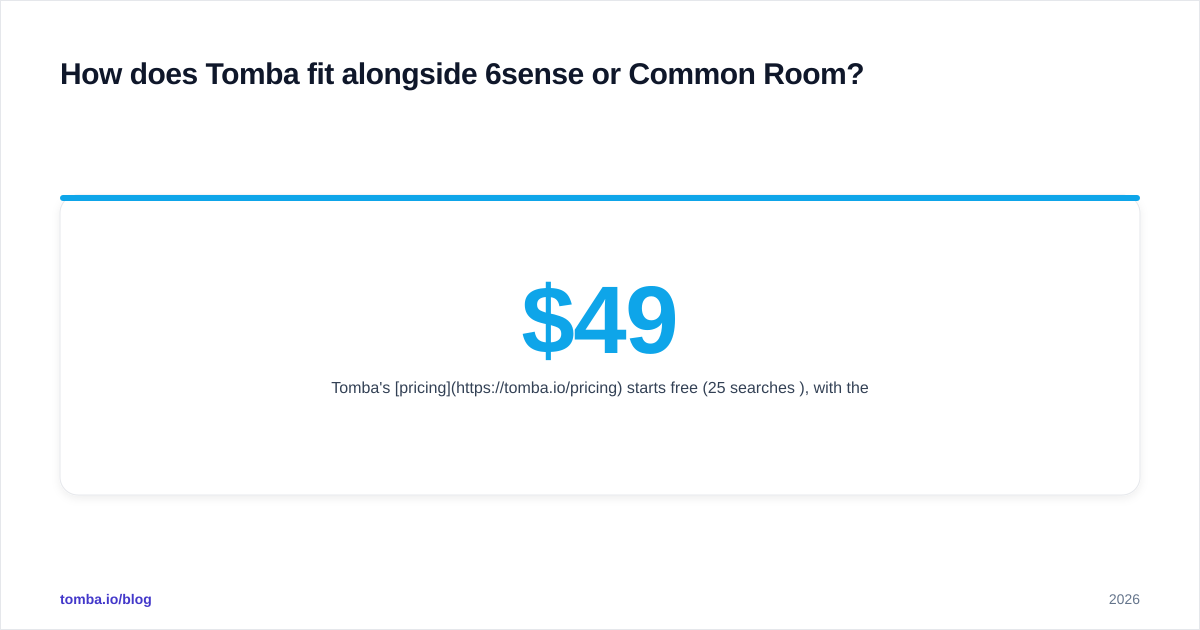
Tomba's pricing starts free (25 searches/month), with the Starter plan at $49/month, Growth at $99/month, Pro at $249/month, and Enterprise custom. Compared to either platform discussed here, it's a rounding-error line item — but it's the one that turns signals into actual sent emails that actually land.
Final verdict: 6sense vs Common Room#
There isn't a single winner. 6sense and Common Room are answering different halves of the same question. 6sense is for sales-led enterprise GTM; Common Room is for product-led and community-led GTM. The interesting teams in 2026 are the ones who realize their motion is some mix of both, and pick the tool that matches the half where most of their pipeline actually originates.
What both teams should fix first, before either platform: a clean CRM, a verified contact source, and a sender reputation that doesn't sabotage every signal the platform delivers.
Ready to turn intent signals into verified outreach? Start with Tomba Email Finder — find professional email addresses by domain, name, or company, verify deliverability, and feed clean contacts straight into the sequencer behind your 6sense or Common Room workflows. The free plan covers 25 searches/month so you can wire it up before you commit a dollar.
// get started
Find, verify and enrich your first contacts today
Start on the free plan with 25 searches a month, then scale when your team is ready.
Free plan · No credit card required · GDPR & CCPA
// about the author