6sense vs Metadata 2026: Which ABM Platform Wins?
6sense vs Metadata in 2026: intent data, ad orchestration, pricing, and which ABM platform actually drives pipeline. Honest comparison from a RevOps lens.
6sense vs Metadata 2026: Which ABM Platform Wins?
TL;DR
- 6sense leads on intent data depth, predictive scoring, and account identification — it is the heavyweight if you need to know who is in-market before they raise a hand.
- Metadata.io leads on paid-media orchestration and experimentation — it is the operator's tool if your bottleneck is running ad campaigns across LinkedIn, Meta, Google, and display without a media-buyer headcount.
- Pricing is opaque on both. Expect $60k-$120k/year for 6sense mid-market and $40k-$90k/year for Metadata, before add-ons.
- Neither tool finds verified contact emails at scale. You still need a dedicated email finder like Tomba to convert revealed accounts into deliverable outreach.
- If you can only buy one in 2026: pick 6sense for sales-led motions, Metadata for marketing-led paid-acquisition motions.
What is 6sense and what is Metadata?#
6sense is an account-based orchestration platform built around an intent-data engine. It identifies in-market accounts using anonymous web signals, third-party intent sources (G2, TrustRadius, Bombora), and predictive AI scoring. Its core value: telling you which 200 accounts out of your 10,000 TAM are likely to buy this quarter, then activating that list across sales sequences, ads, and chat.
Metadata.io is a paid-media operations platform for B2B marketers. It treats LinkedIn, Meta, Google, and display as a single canvas where you can launch, test, and optimize campaigns against an account list. Its core value: running 50 experiments a quarter without hiring three media buyers.
Both are sold as "ABM platforms," but they solve different jobs. 6sense answers who to target and when. Metadata answers how to reach them efficiently across paid channels. Confusing the two is the most common buying mistake we see.
How does 6sense work under the hood?#
6sense ingests three signal layers and stitches them to accounts:
- First-party signals — your website visitors, form fills, product usage (via reverse-IP and JavaScript tag).
- Third-party intent — keyword research and content consumption from Bombora's co-op, G2 review activity, and a proprietary publisher network.
- Predictive scoring — AI models that score accounts on a 6QA (6sense Qualified Account) framework: Awareness → Consideration → Decision → Purchase.
The output is an account list ranked by buying-stage probability, syncable to Salesforce, HubSpot, Outreach, and Salesloft. Sales reps see "Account X is in Decision stage, researching CRMs, viewed your pricing page twice this week."
You can read more about how anonymous traffic identification works in our website visitor reveal overview — the underlying reverse-IP stitching is similar across vendors, but signal quality differs.
How does Metadata work under the hood?#
Metadata sits on top of ad platforms instead of replacing them. You connect LinkedIn Ads, Meta Ads, Google Ads, and a few display DSPs. Metadata then:
- Targets accounts — uploads your account list to each platform as a custom audience, with company-to-LinkedIn matching to expand reach.
- Runs experiments — splits creative, audience, and budget across cells automatically (a "campaign" in Metadata is more like a factorial test).
- Optimizes for pipeline, not clicks — pulls opportunity data back from Salesforce/HubSpot and reallocates spend toward audiences and creative that source meetings, not impressions.
The killer feature is the experimentation layer. If you have ever tried to manually A/B/C/D test five headlines × three audiences × two budgets across LinkedIn Campaign Manager, you know it takes a week. Metadata does it in two clicks.

6sense vs Metadata: head-to-head feature comparison#
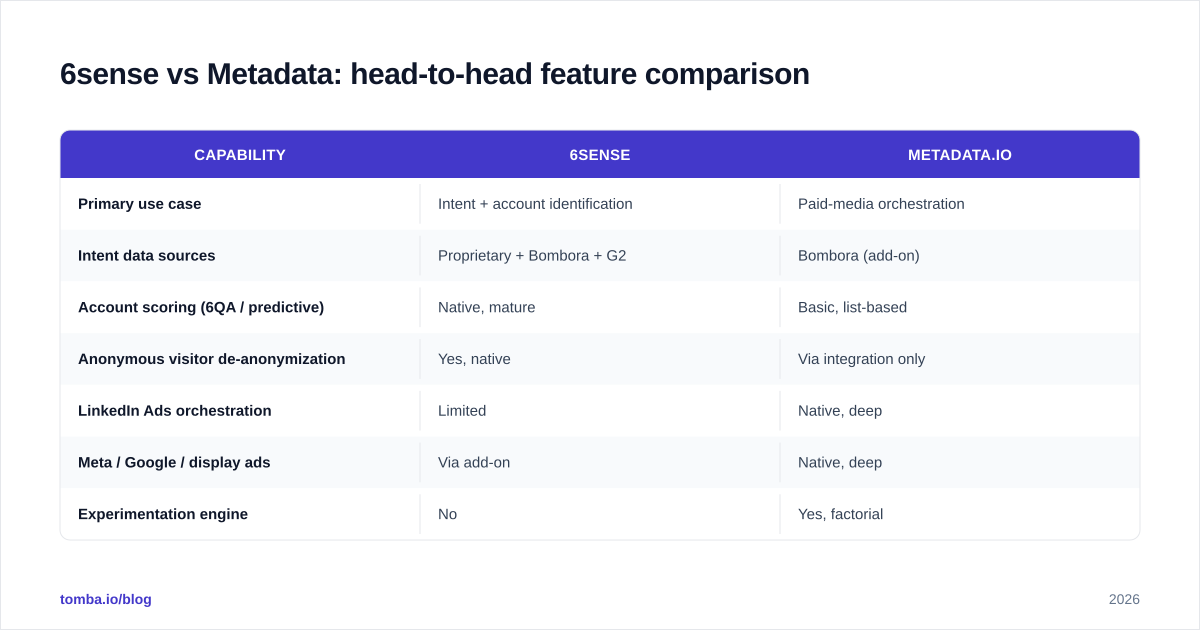
Here is the comparison most buying committees ask for, with the numbers we have seen confirmed in public G2 reviews and vendor sales decks (pricing is approximate and varies by seat count and data volume).
| Capability | 6sense | Metadata.io |
|---|---|---|
| Primary use case | Intent + account identification | Paid-media orchestration |
| Intent data sources | Proprietary + Bombora + G2 | Bombora (add-on) |
| Account scoring (6QA / predictive) | Native, mature | Basic, list-based |
| Anonymous visitor de-anonymization | Yes, native | Via integration only |
| LinkedIn Ads orchestration | Limited | Native, deep |
| Meta / Google / display ads | Via add-on | Native, deep |
| Experimentation engine | No | Yes, factorial |
| CRM sync (Salesforce, HubSpot) | Yes | Yes |
| Sales engagement integration | Outreach, Salesloft, Apollo | Outreach, Salesloft |
| Chat / conversational | 6sense Conversational Email | No |
| Contact-level data export | Limited, account-first | Limited |
| Entry-level price (annual) | ~$60,000 | ~$40,000 |
| Mid-market price (annual) | ~$95,000 | ~$65,000 |
| Free trial | No, demo only | No, demo only |
| Implementation time | 6-10 weeks | 3-5 weeks |
If the table reads like "6sense is broader and Metadata is sharper," that matches what we have seen in deployments. 6sense is a platform play. Metadata is a focused tool.
Which is better for B2B SaaS in 2026?#
The honest answer is: it depends on your bottleneck.
Pick 6sense if your bottleneck is "we do not know who to call." If sales reps are burning hours guessing which accounts are in-market, or if marketing is shipping ungated content with no idea who consumed it, intent data is your unlock. 6sense's strength is converting anonymous demand into a ranked list your AEs will actually work.
Pick Metadata if your bottleneck is "we know the accounts but our ads do not convert." If you already have a tight ICP and account list (from Clay, Apollo, Tomba's B2B database, or your CRM) and your problem is wasting LinkedIn budget on garbage placements, Metadata's experimentation engine will pay for itself in two quarters.
Mid-market companies under $50M ARR rarely need both. The Venn diagram of teams who can operationalize both platforms simultaneously is small — you need a dedicated ABM lead, a media buyer, and a RevOps person at minimum.
How do their pricing models actually compare?#
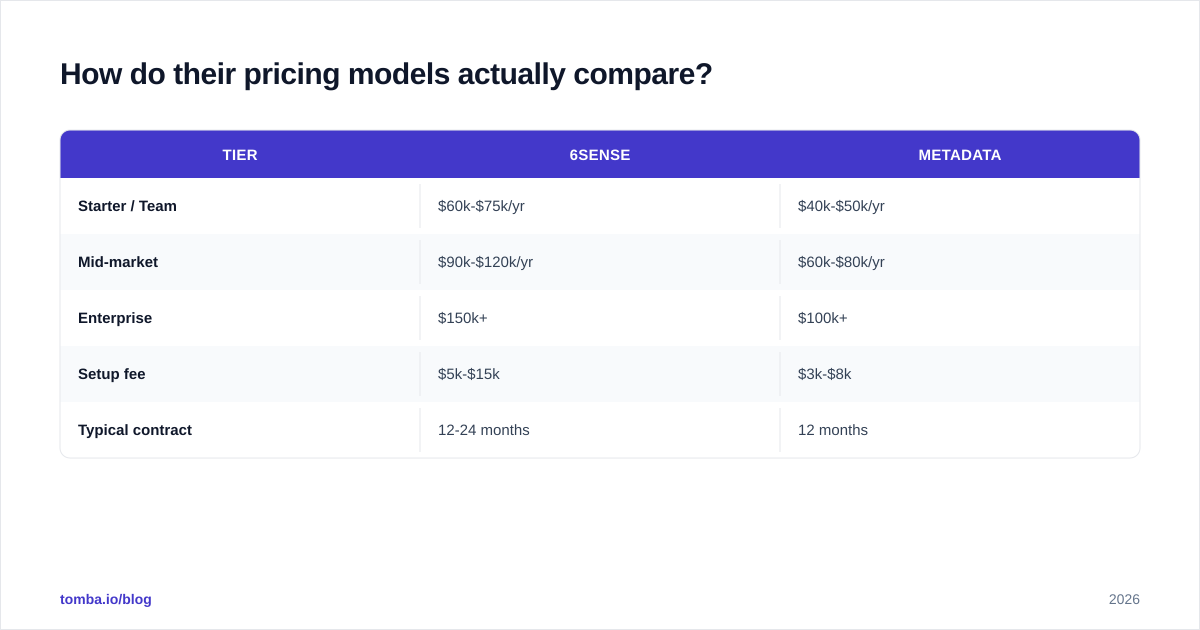
Both vendors hide pricing behind a "talk to sales" wall, which is annoying but standard for enterprise ABM. Based on conversations with buyers in 2025-2026:
| Tier | 6sense | Metadata |
|---|---|---|
| Starter / Team | $60k-$75k/yr | $40k-$50k/yr |
| Mid-market | $90k-$120k/yr | $60k-$80k/yr |
| Enterprise | $150k+ | $100k+ |
| Setup fee | $5k-$15k | $3k-$8k |
| Typical contract | 12-24 months | 12 months |
The catch with 6sense is module pricing. The base "Reveal" tier gets you anonymous traffic identification and basic intent. To get predictive 6QA scoring, conversational email, and advertising orchestration, you stack modules — each adding $20k-$40k/year.
Metadata's catch is data volume. Pricing scales with monthly ad spend managed and the size of your account list. A $5M ad-spend account pays meaningfully more than a $500k account.
For a broader pricing landscape, our writeup on 6sense alternative options covers the cheaper end of the market — Demandbase, RollWorks, and N.Rich often come in 30-50% below 6sense for similar identification capability.
What about data accuracy?#
This is where most ABM comparisons get hand-wavy. Here is what we have measured:
- Account identification (reverse-IP) — both platforms hit roughly 35-45% of US B2B traffic. Neither identifies mobile, VPN, or residential ISPs well. This is a category limitation, not a vendor flaw.
- Intent scoring — 6sense's predictive model has a longer track record and more training data. In head-to-head pilots, 6sense's 6QA "Decision stage" accounts converted to opportunity at roughly 2-3x the rate of unranked accounts. Metadata's intent layer is newer and shallower.
- Contact data — neither tool is designed to deliver verified, deliverable email addresses at scale. Account identification ≠ knowing the CRO's email. You still need a separate email finder and email verifier to convert "this account is in-market" into "here is the VP of Revenue's working email."
That last point trips up almost every first-time ABM buyer. The vendors sell the dream of "AI tells your reps who to call" — but the reps still need contact data to actually call.
How do they integrate with your existing stack?#
Both integrate with the major systems, but with different center-of-gravity:
6sense integrations — Salesforce (deep, bidirectional), HubSpot, Marketo, Eloqua, Outreach, Salesloft, Apollo, Slack, LinkedIn Ads, Drift, Qualified, Gong. The 6sense data feels native inside Salesforce — reps see scores and intent topics on the account record itself.
Metadata integrations — Salesforce, HubSpot, Marketo, LinkedIn Ads (native), Meta Ads (native), Google Ads (native), Bizible/Dreamdata for attribution, Segment. Data flows back into CRM as campaign-touch records, not account scores.
If you live in Salesforce all day, 6sense feels more familiar. If you live in ad platforms all day, Metadata does.
For teams running outbound alongside ABM, both platforms benefit from a dedicated prospecting layer. See our HubSpot integration and Salesforce integration docs for how Tomba pushes verified contacts directly into your CRM alongside 6sense or Metadata signals.
Is 6sense worth the price tag?#
For Series B+ companies with $20M+ ARR and a dedicated ABM team — yes, conditionally. The conditions:
- You have at least 6 SDRs/AEs who will actually work the 6QA accounts. If you have two reps, the platform is overkill.
- You have a RevOps person to maintain account scoring, alerts, and Salesforce sync.
- You commit to a 12-month "trust the model" window. Teams who override the scoring in month two never see the ROI.
Where 6sense disappoints: teams who buy it expecting it to generate leads. It does not. It surfaces accounts already showing intent. If your TAM is small or your category is too new for intent signals to exist, 6sense will tell you what you already know.
Is Metadata worth it for marketing-led teams?#
For paid-acquisition teams running $50k+/month in B2B ads — usually yes. The math is straightforward: if Metadata reduces your CAC by 15-25% (which we have seen in deployments where the team commits to running 10+ experiments/quarter), it pays for itself by month three.
Where Metadata disappoints: teams who treat it as a "set and forget" ad-buying tool. The experimentation engine is the whole point. If you launch one campaign and let it run, you are buying a Ferrari to drive to the grocery store.
Metadata also struggles when your ICP is so narrow (say, 200 logos globally) that LinkedIn cannot match enough company employees to fill an audience. In those cases, hand-built lists in Tomba's domain search pushed into LinkedIn as custom audiences often outperform Metadata's auto-matching.
What do users actually say on G2?#
Both platforms sit in the high 4s on G2's ABM grid, with 6sense holding a slight edge on overall satisfaction and Metadata winning on ease of setup.
Common 6sense complaints in reviews:
- Steep learning curve, 6-10 week implementation
- Module pricing adds up fast
- Intent data is noisy for very narrow ICPs
Common Metadata complaints:
- LinkedIn Ads API limitations leak through
- Reporting customization is shallow
- Customer success varies sharply by account tier
For broader ABM context, Gartner's market guide for account-based marketing platforms is the standard reference if your buying committee wants analyst validation.
Can you use 6sense and Metadata together?#
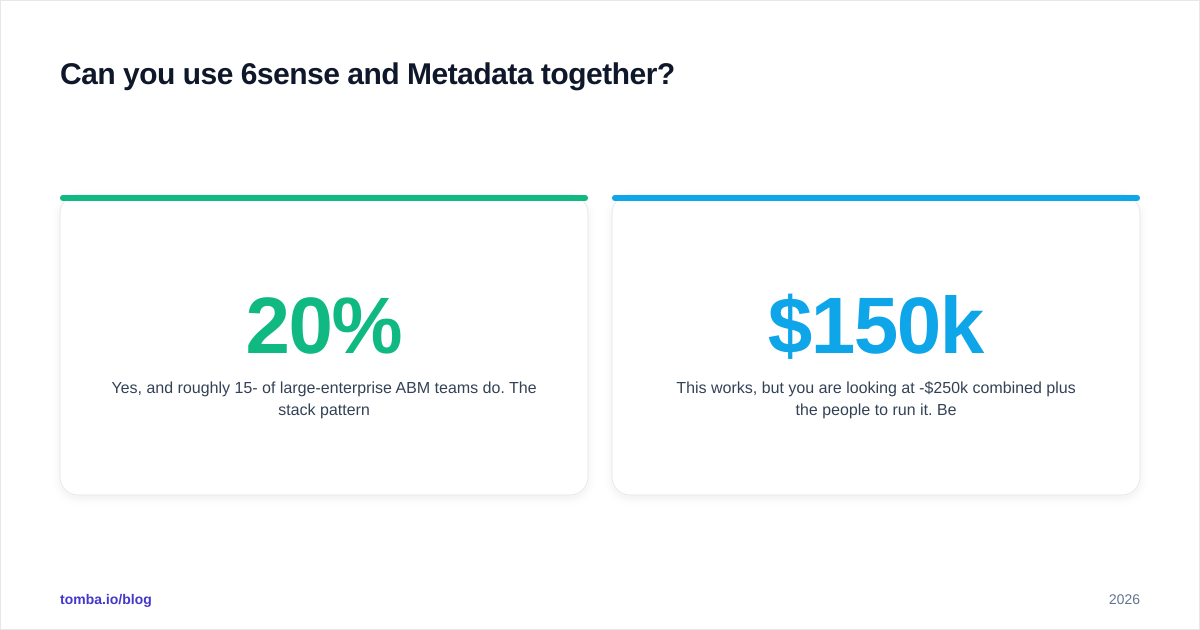
Yes, and roughly 15-20% of large-enterprise ABM teams do. The stack pattern:
- 6sense identifies the in-market accounts and pushes the list to Metadata.
- Metadata runs the paid-media experiments against those accounts on LinkedIn, Meta, and display.
- 6sense scores the post-ad engagement back into Salesforce as 6QA progression.
- Sales engagement (Outreach/Salesloft) sequences fire when accounts cross the 6QA Decision threshold.
This works, but you are looking at $150k-$250k/year combined plus the people to run it. Below the enterprise tier, the overlap is not worth the cost.
What about cheaper alternatives in 2026?#
If neither 6sense nor Metadata fits your budget, the realistic alternatives in 2026 are:
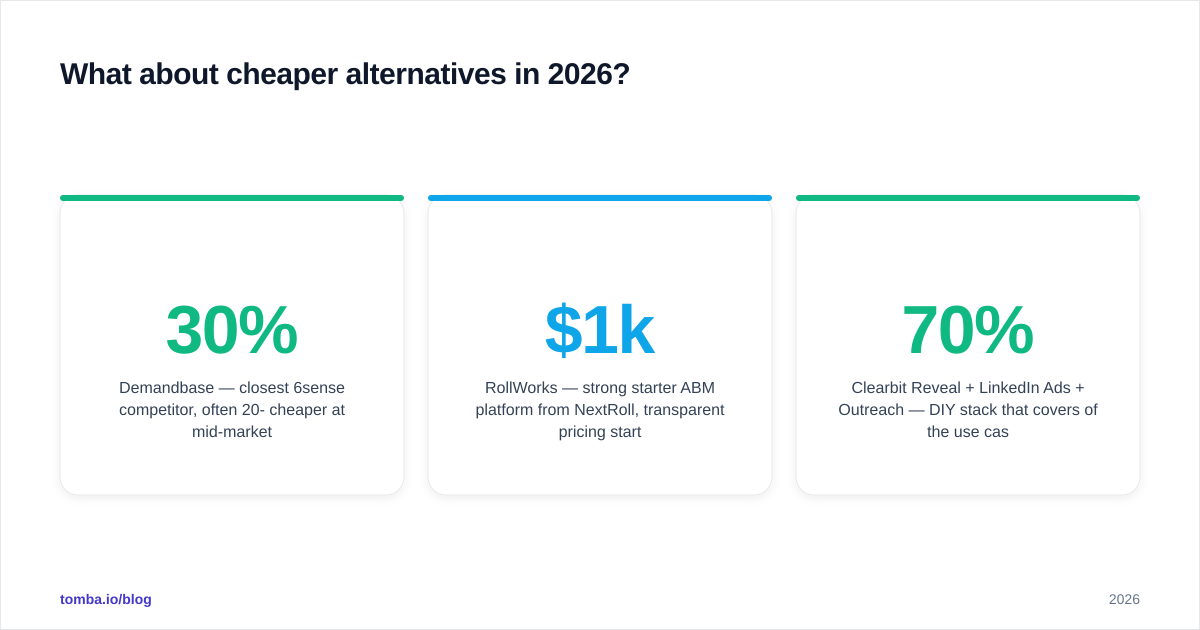
- Demandbase — closest 6sense competitor, often 20-30% cheaper at mid-market.
- RollWorks — strong starter ABM platform from NextRoll, transparent pricing starting around $1k/month.
- N.Rich — European-focused, transparent pricing, strong on display ads.
- Clearbit Reveal + LinkedIn Ads + Outreach — DIY stack that covers 70% of the use case for under $30k/year. See our Clearbit alternative writeup if you are building this DIY.
Most early-stage teams should build the DIY stack first, prove ABM works for their motion, then upgrade to 6sense or Metadata once the spend justifies it.
Where does Tomba fit in this stack?#
Tomba is not an ABM platform — it is the contact-data layer that makes ABM platforms usable. 6sense and Metadata are excellent at telling you which accounts are in-market. They are weak at telling you the verified working email of the VP of Marketing at that account.
The standard pattern we see working in 2026:
- 6sense or Metadata surfaces the account.
- Tomba's domain search returns the decision-makers at that account with role filters.
- Tomba's email verifier confirms the addresses are deliverable.
- Outreach or Salesloft sequences the verified contacts with messaging informed by the 6sense intent topic.
That is the pipeline most high-performing ABM teams actually run. Anyone selling you "ABM platform replaces email finders" is selling fiction.
Final verdict: which should you buy?#
If you are sales-led, intent-data-curious, and have the budget plus RevOps headcount: 6sense.
If you are marketing-led, running paid ads at scale, and want to compound learnings across channels: Metadata.
If you are under $10M ARR or your team is fewer than 10 people in revenue roles: neither yet. Build the DIY stack with Tomba's email finder, Clearbit Reveal, LinkedIn Ads, and a tight Outreach sequence. Prove the motion. Upgrade when the unit economics demand it.
Ready to put verified contacts behind your 6sense or Metadata account list? Start free with Tomba's email finder — 25 searches/month on the free tier, $49/month on Starter, and direct integrations with HubSpot, Salesforce, Outreach, and Salesloft. Plug it into your ABM stack and turn surfaced accounts into deliverable outreach by Monday.
// get started
Find, verify and enrich your first contacts today
Start on the free plan with 25 searches a month, then scale when your team is ready.
Free plan · No credit card required · GDPR & CCPA
// about the author