7 Elements Of Go-To-Market Strategy That Actually Work (2026)
Most GTM plans collapse because they skip 2 or 3 of these seven elements. Here is the 2026 framework, with the trade-offs and metrics that matter.
7 Elements Of Go-To-Market Strategy That Actually Work (2026)
TL;DR
- A go-to-market (GTM) strategy is the operating system that connects who you sell to, what you sell, how you reach them, and how you keep score.
- The seven elements are: ICP, value proposition and positioning, market and competitor map, pricing and packaging, channel and sales motion, GTM operations and tech stack, and metrics and feedback loops.
- Most plans collapse because they skip two or three elements — usually pricing, ops, or measurement — and then blame "lead quality."
- In 2026 the bar is higher: signal-based outbound, product-led trials, and AI-assisted research are table stakes, not differentiators.
- Build the seven elements in order. Each one constrains the next. Skipping the order is the most expensive mistake founders and CROs make.
What is a go-to-market strategy in 2026?#
A go-to-market strategy is the documented plan for how a company takes a specific offer to a specific buyer through specific channels at a specific price. It is not a marketing plan. It is not a sales playbook. It is the layer above both, and it forces marketing, sales, product, and finance to agree on a single answer to the question: who are we selling what to, and how does the money actually flow in?
The 2026 version of GTM looks different from the 2021 version in three ways. First, buying committees are larger and slower — Gartner now pegs the average B2B committee at 6 to 10 people. Second, cold outbound volume has collapsed in effectiveness, so signal-based prospecting and product-led trials are doing more of the work. Third, AI tooling has compressed the time between "I have an idea" and "I have a sequenced campaign" from weeks to hours, which means the strategic layer matters more, not less.
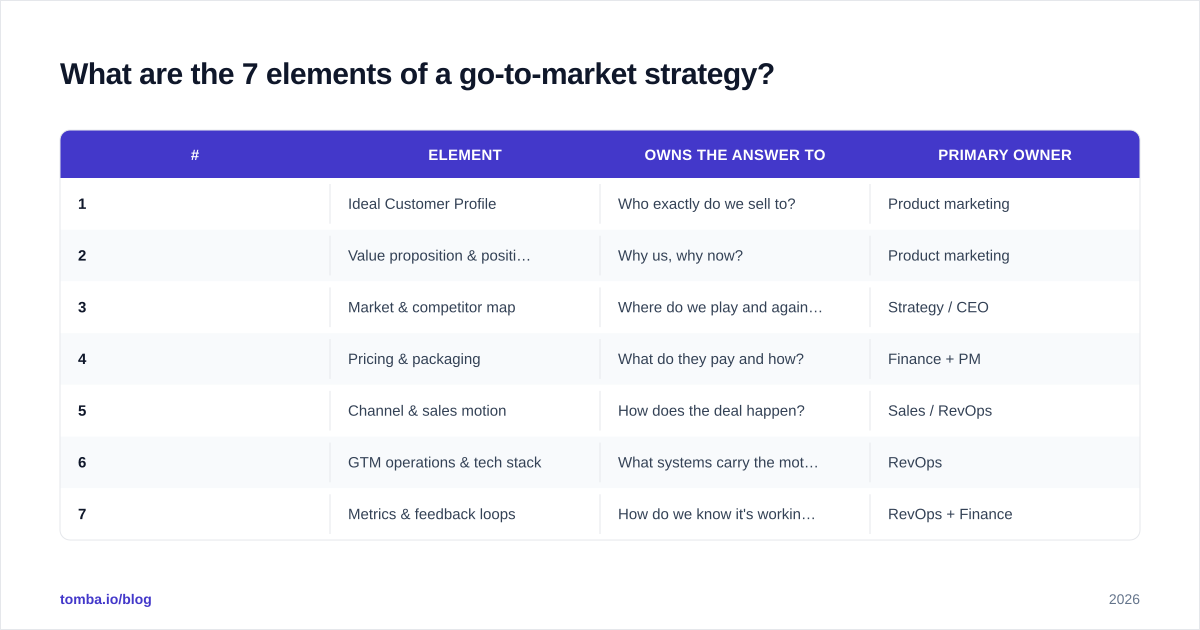
What are the 7 elements of a go-to-market strategy?#
| # | Element | Owns the answer to | Primary owner |
|---|---|---|---|
| 1 | Ideal Customer Profile | Who exactly do we sell to? | Product marketing |
| 2 | Value proposition & positioning | Why us, why now? | Product marketing |
| 3 | Market & competitor map | Where do we play and against whom? | Strategy / CEO |
| 4 | Pricing & packaging | What do they pay and how? | Finance + PM |
| 5 | Channel & sales motion | How does the deal happen? | Sales / RevOps |
| 6 | GTM operations & tech stack | What systems carry the motion? | RevOps |
| 7 | Metrics & feedback loops | How do we know it's working? | RevOps + Finance |
The order matters. Pricing without an ICP is a guess. A sales motion without pricing is a script. Metrics without a sales motion are vanity. Build them in sequence.
Element 1 — Who is your Ideal Customer Profile?#
The ICP is the firmographic and behavioural fingerprint of the accounts most likely to buy, expand, and refer. It is not a persona — personas describe humans inside the account. The ICP describes the account itself.
A useful 2026 ICP names five things: industry vertical, revenue or employee band, technographic signals (what they already use), trigger events (hiring, funding, product launches), and disqualifiers. The disqualifiers matter more than people think. "We don't sell to companies under 20 employees" saves more pipeline hours than any new sequence ever will.
Most teams write the ICP once and never revisit it. Treat it as a living document. Pull a list of your last 50 closed-won deals every quarter and check whether their fingerprint still matches the doc. If 40% of recent wins came from outside your stated ICP, the ICP is wrong, not the wins. To operationalise it, feed the fingerprint into your prospecting stack — an email finder plus a B2B database lets you turn the ICP definition into a list of contactable accounts in minutes instead of weeks.
Element 2 — What is your value proposition and positioning?#
Positioning is the answer to "compared to what?" April Dunford's frame is still the cleanest one in the field: you choose a market category, you pick the alternatives buyers are weighing you against, and you define the unique attributes that produce the value only you can deliver.
A good value proposition fits on one line and survives translation by a junior SDR on a cold call. If your CEO can't say it in 12 seconds without notes, the positioning is broken. Test it the way HubSpot tests landing pages — show two variants to ten prospects and ask which one describes what you do.
Three positioning failure modes to avoid:
- Positioning against everyone ("the all-in-one platform for every team")
- Positioning on a feature competitors will copy in six months
- Positioning on price alone — a strategy with a one-quarter shelf life
Element 3 — How do you map your market and competitors?#
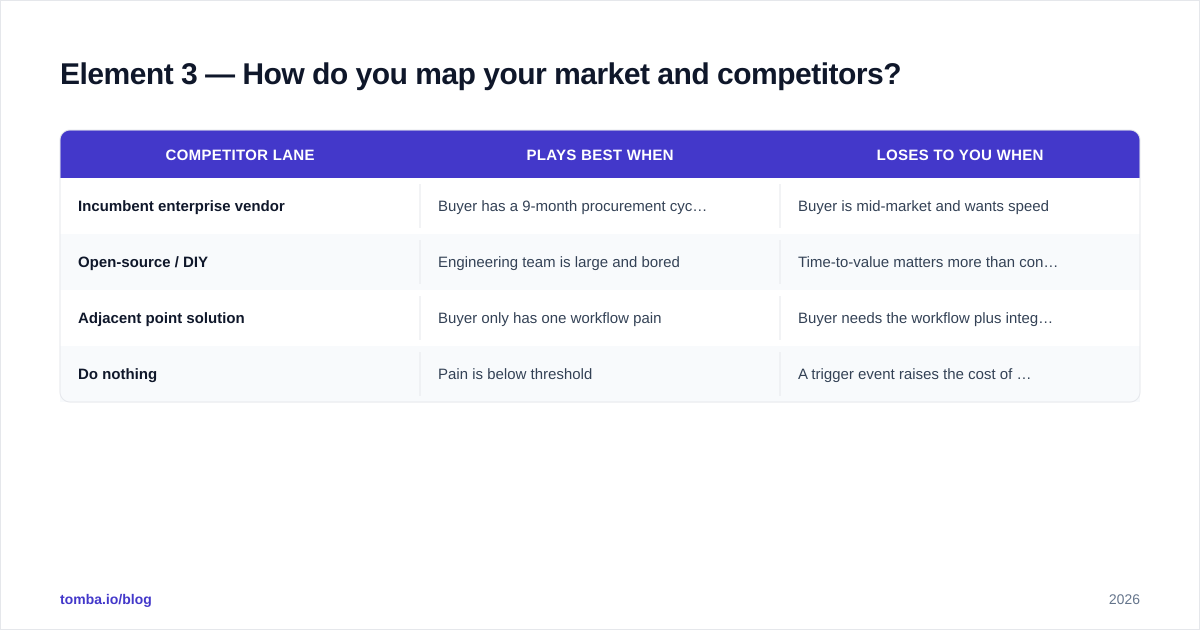
Market map work answers two questions: where do you play (segments, geos, verticals) and against whom (direct, indirect, and "do nothing" alternatives). The do-nothing competitor wins more deals than any vendor — pretending otherwise inflates win-rate forecasts.
The deliverable is a single matrix scoring 6 to 10 competitors on the attributes that matter to your ICP: price tier, deployment model, primary buyer, signature feature, and where they typically lose. G2 and Capterra review patterns are gold here — read 200 reviews of the top three competitors and you'll find the exact phrases their customers use when complaining. Those phrases become your wedge.
| Competitor lane | Plays best when | Loses to you when |
|---|---|---|
| Incumbent enterprise vendor | Buyer has a 9-month procurement cycle | Buyer is mid-market and wants speed |
| Open-source / DIY | Engineering team is large and bored | Time-to-value matters more than control |
| Adjacent point solution | Buyer only has one workflow pain | Buyer needs the workflow plus integrations |
| Do nothing | Pain is below threshold | A trigger event raises the cost of inaction |
Element 4 — How should you price and package?#
Pricing is the most under-invested element in most GTM plans. Founders spend six months on positioning and one afternoon on pricing, then wonder why deals stall in legal.
In 2026 you choose between four primary models: per-seat (still the default for SaaS), usage-based (dominant in AI infrastructure and APIs), hybrid platform fee plus consumption (the model most growth-stage SaaS is migrating to), and outcome-based (rare, hard to operate, lucrative when it lands). The packaging question is separate — how many tiers, what gates each tier, and which features anchor the price.
A grounded example: Tomba publishes Tomba pricing at four public tiers — a Free tier with 25 searches/month, Starter at $49/mo, Growth at $99/mo, and Pro at $249/mo, plus custom Enterprise. The structure is deliberate: free for evaluation, Starter as the credit-card-self-serve entry point, Growth as the team plan, Pro as the agency tier. Each gate is observable from the dashboard, which is how you keep a sales-assisted upgrade path open.
Three pricing rules that survive contact with reality:
- Publish prices unless you sell exclusively to enterprises. Hidden pricing is a tax you pay in shortened evaluation pipelines.
- Annual contracts should cost roughly 17–20% less than monthly. Below 10% nobody upgrades, above 25% your cash flow gets weird.
- Re-price every 12 to 18 months. The market moves, your costs move, your value moves.
Element 5 — Which sales motion and channels fit?#
The sales motion is the shape of how a deal closes. There are four canonical motions and most companies run a hybrid of two:
- Product-led (PLG) — user signs up, finds value, upgrades. Works when time-to-value is under 10 minutes and the buyer is the user.
- Sales-led inbound — marketing creates demand, BDRs qualify, AEs close. The classic SaaS motion.
- Sales-led outbound — SDRs source, BDRs qualify, AEs close. Effective when the ICP is narrow and high-ACV.
- Channel / partner-led — resellers, system integrators, or marketplaces carry the deal. Lower margin, higher reach.
The 2026 shift is that pure outbound is no longer enough. Signal-based outbound — triggered by hiring, funding, tech adoption, or job-change events — outperforms cold spray by 3 to 5× in reply rate based on benchmark data from Salesforce and several public industry reports. To run signal-based outbound at scale you need three things: a clean source of contact data (an email finder and email verifier together get you 95%+ deliverability), a signal layer feeding your CRM, and SDRs trained to write to the signal rather than to a generic ICP.
Element 6 — What does your GTM tech stack and operations look like?#
GTM ops is the wiring. Tools without a documented motion is the most common money pit in B2B — companies pay six figures a year for a stack their reps don't actually use.
The minimum viable 2026 stack has six layers:
| Layer | Job | Example categories |
|---|---|---|
| CRM | System of record | Salesforce, HubSpot, Pipedrive |
| Data & enrichment | Who exists, how to reach them | Tomba, Apollo, Clay |
| Engagement | Send sequences, dial, track | Outreach, Salesloft, Instantly |
| Signal & intent | Trigger events, intent data | 6sense, Bombora, custom scrapers |
| Analytics & attribution | What works, what doesn't | Looker, Hex, native CRM reports |
| Workflow automation | Glue between systems |
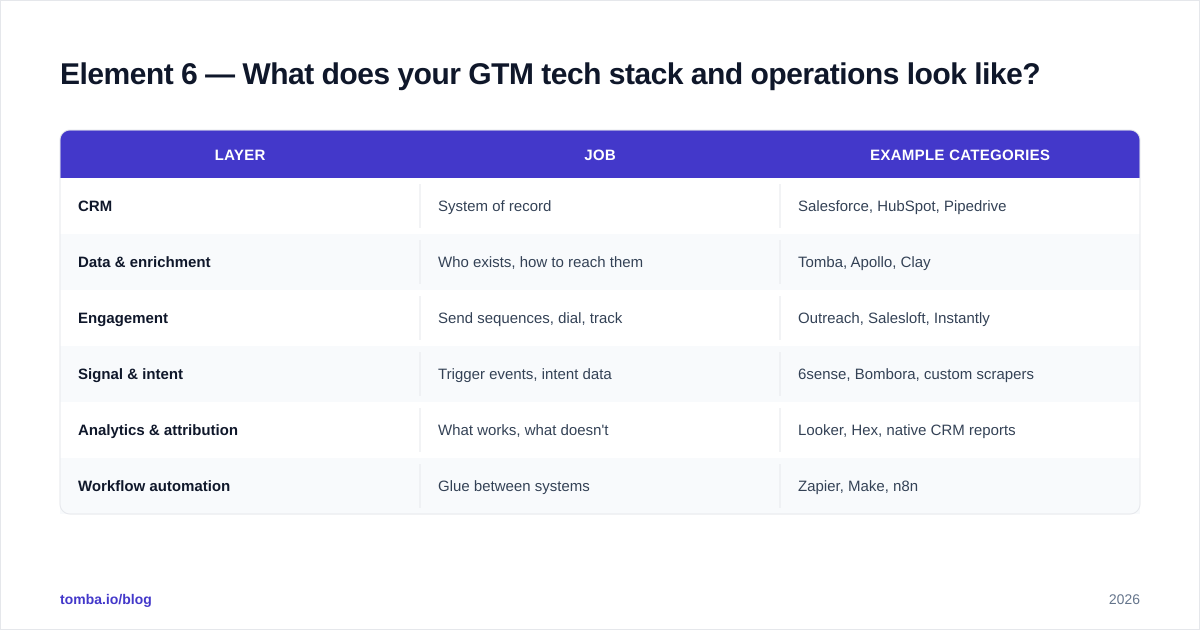
Zapier, Make, n8n |
Two anti-patterns to avoid. First, buying the engagement tool before fixing the data layer — you will send beautiful sequences to bad emails. Second, treating RevOps as a junior admin function. RevOps owns the seam between marketing, sales, and finance and should report to a senior leader. For lean teams, Tomba's HubSpot integration and Salesforce integration cover the data-into-CRM seam without a custom build.
Element 7 — Which metrics and feedback loops actually matter?#
Most GTM dashboards measure activity. Activity correlates weakly with revenue. The 2026 metric stack measures four things: pipeline quality, conversion velocity, retention economics, and channel mix.
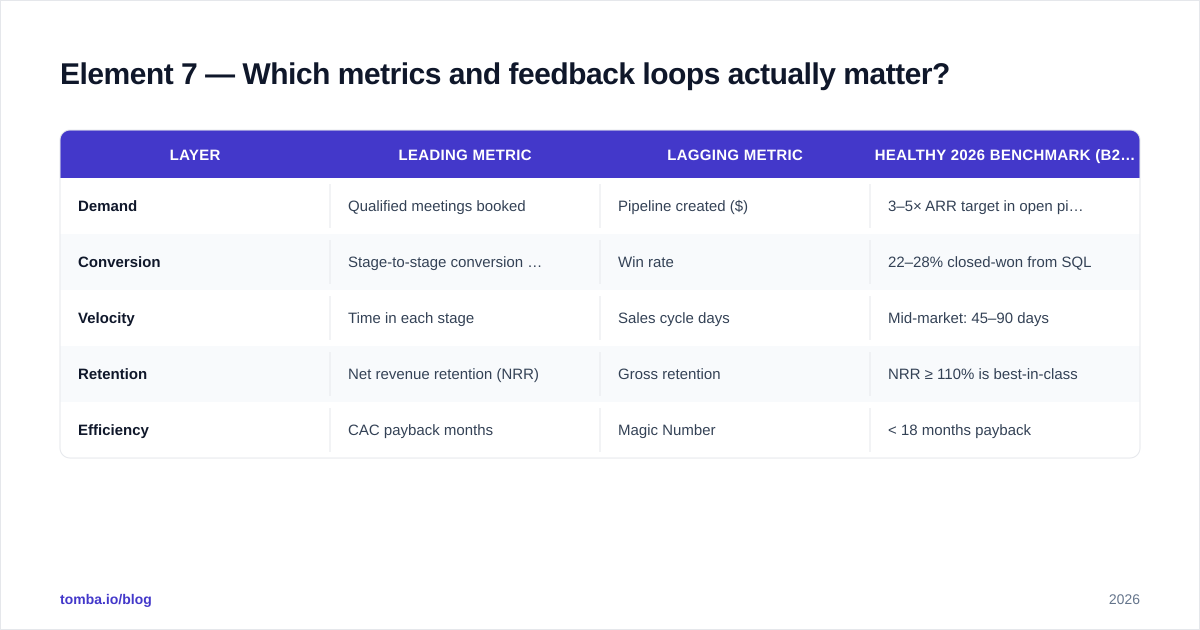
A defensible metric layer looks like this:
| Layer | Leading metric | Lagging metric | Healthy 2026 benchmark (B2B SaaS) |
|---|---|---|---|
| Demand | Qualified meetings booked | Pipeline created ($) | 3–5× ARR target in open pipe |
| Conversion | Stage-to-stage conversion rate | Win rate | 22–28% closed-won from SQL |
| Velocity | Time in each stage | Sales cycle days | Mid-market: 45–90 days |
| Retention | Net revenue retention (NRR) | Gross retention | NRR ≥ 110% is best-in-class |
| Efficiency | CAC payback months | Magic Number | < 18 months payback |
Feedback loops are what turn the metrics into action. Run a weekly pipeline council, a monthly win/loss review, and a quarterly ICP review. Skip any of the three for two quarters and the strategy drifts.
How should you sequence and ship the strategy?#
You build the seven elements in the order they were presented, then you ship in three phases.
Phase 1 — Define (weeks 1–4). Lock the ICP. Write the positioning. Set the price. Pick one primary sales motion. Anything more is wishful thinking at this stage.
Phase 2 — Instrument (weeks 5–8). Stand up the stack. Connect the data. Build the dashboards. Train the team on the motion, not the tools. Document the playbook in writing — a revenue operations function lives or dies by written process.
Phase 3 — Iterate (weeks 9+). Run the motion for one full sales cycle without changing it. Then review with evidence, not opinion. Kill the bottom-performing channel. Double the top-performing one. Re-price if NRR or win rate are off-benchmark.
What are the most common GTM mistakes in 2026?#
- Treating "GTM" as marketing's job. GTM is a cross-functional operating system; if only marketing owns it, sales and product will quietly run their own.
- Building the stack before the motion. Tools accelerate a working motion and amplify a broken one.
- Cold outbound at 2021 volumes. Mailbox providers and buyers have moved on. Switch to signal-based prospecting and protect deliverability with verified data and a reputation checker.
- Hidden pricing on a self-serve product. It costs you the buyers who Google-screen vendors before booking a call.
- No written ICP disqualifiers. Reps will sell to anyone with a pulse if you don't tell them who not to chase.
- Measuring activity, not pipeline quality. Dials and emails sent are inputs; qualified meetings and closed-won are outputs.
Frequently asked questions about GTM strategy#
How long should it take to build a GTM strategy from scratch? Four to eight weeks for the document, one full sales cycle (60 to 120 days) before you can judge whether it's working.
Who owns the GTM strategy — CEO, CRO, or CMO? The CEO owns the strategy in companies under ~50 people. After that the CRO owns execution and the CMO owns positioning, with the CEO arbitrating trade-offs.
Is a GTM strategy different for product-led companies? The seven elements are the same; the weight changes. PLG companies invest more in element 2 (positioning) and element 4 (pricing/packaging) and less in element 5 (outbound motion).
How often should you revisit the GTM plan? Light review quarterly, full rebuild every 18 to 24 months or after any of: major product expansion, geographic expansion, or a 20%+ swing in close rate.
Where to start this week#
Pick one element and stress-test it before you touch the others. Most teams discover their ICP is too wide or their pricing is too low, and fixing either one is worth more than a new tool. Once your ICP is sharp, contact-data quality becomes the next constraint — that's where Tomba fits. Use the Tomba Email Finder to convert your tightened ICP into verified, contactable accounts, plug it into your CRM through the HubSpot integration or Salesforce integration, and start your next sales cycle with a list you can actually trust. Strategy without contactable accounts is theatre; contactable accounts without strategy is noise. The seven elements above are how you get both.
// get started
Find, verify and enrich your first contacts today
Start on the free plan with 25 searches a month, then scale when your team is ready.
Free plan · No credit card required · GDPR & CCPA
// about the author