800.com Pricing, Reviews, Pros and Cons (2026 Guide)
A neutral 2026 breakdown of 800.com pricing, real user reviews, and the pros and cons of running your toll-free number through their virtual phone platform.
800.com Pricing, Reviews, Pros and Cons (2026 Guide)
TL;DR#
- 800.com is a virtual toll-free number provider built around 1-800, 1-888, 1-877 and other vanity numbers — not a full-stack sales dialer.
- Plans run from roughly $19/mo (Basic) to $59/mo (Pro), with a separate one-time fee for premium vanity numbers and per-minute overage rates after your included pool.
- Strengths: easy vanity number search, clean web dashboard, call recording, SMS on toll-free, and SOC-friendly call logs.
- Weaknesses: limited outbound calling features, no power dialer, weak CRM depth, and overage costs that surprise high-volume teams.
- For B2B sales teams that do real outbound, 800.com works as a front door number but is rarely enough on its own — pair it with a real prospecting stack.
What is 800.com and who is it for?#
800.com is a virtual phone service focused on toll-free numbers in the United States and Canada. You pick a 1-800, 1-888, 1-877, 1-866, 1-855, 1-844, or 1-833 number — vanity or random — and route incoming calls and SMS to your existing cell phones, VoIP apps, or call centers.
It is not a cold-calling dialer like Aircall or JustCall, and it is not a full UCaaS suite like RingCentral. Think of it as the digital version of renting a memorable phone number and a smart receptionist that sits in front of your real lines.
Typical buyers:
- Small businesses that want a national-feel number without a PBX.
- E-commerce brands handling inbound customer service.
- Local service businesses (HVAC, legal, dental) using vanity numbers in radio/TV ads.
- B2B teams that need an inbound toll-free for marketing campaigns while their outbound runs elsewhere.
If your day is 100+ outbound dials, keep reading — but know the verdict in advance: 800.com is a complement, not a replacement.
How much does 800.com cost in 2026?#
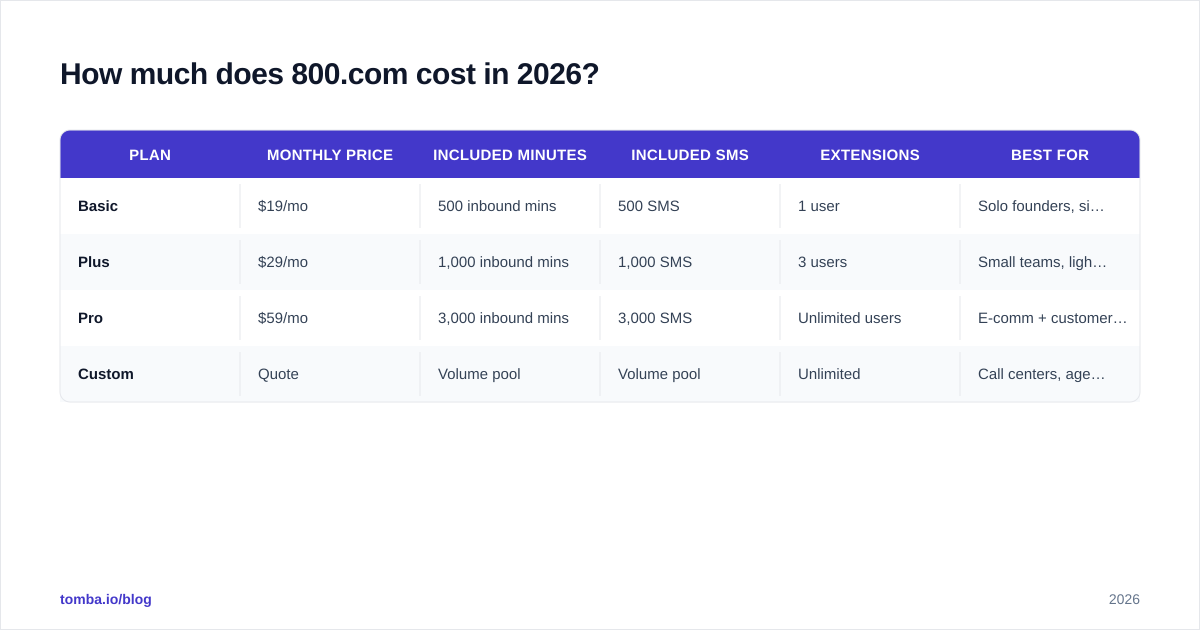
Public pricing on 800.com is structured around three monthly plans plus a one-time vanity number fee. Below is the current published structure, verified against their pricing page as of early 2026.
| Plan | Monthly price | Included minutes | Included SMS | Extensions | Best for |
|---|---|---|---|---|---|
| Basic | $19/mo | 500 inbound mins | 500 SMS | 1 user | Solo founders, single hotline |
| Plus | $29/mo | 1,000 inbound mins | 1,000 SMS | 3 users | Small teams, light inbound |
| Pro | $59/mo | 3,000 inbound mins | 3,000 SMS | Unlimited users | E-comm + customer support |
| Custom | Quote | Volume pool | Volume pool | Unlimited | Call centers, agencies |
Two costs catch teams off-guard:
- Vanity number setup fee. A random toll-free number is usually free with any plan. A true vanity number (1-800-FLOWERS-style) can range from $25 to several thousand dollars one-time, depending on how memorable the digits are.
- Overage minutes and SMS. Once you cross your monthly pool, billing flips to per-unit rates (commonly $0.039–$0.059 per minute and ~$0.02 per SMS segment). A single viral TV ad can blow through a Pro plan's allowance in an afternoon.
There is a free trial on the inbound number itself, but call minutes are typically not free during evaluation. Always confirm the exact rates on the 800.com pricing page the day you sign up — toll-free origination rates fluctuate with FCC fees.
What do 800.com reviews actually say?#
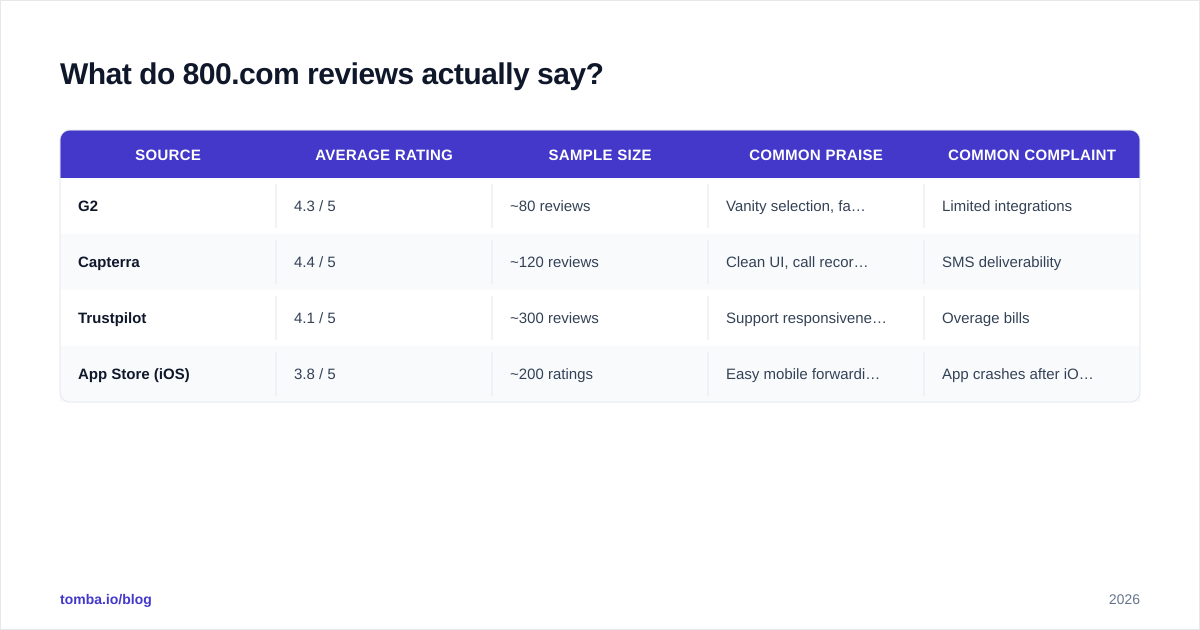
Aggregating verified reviews from G2, Capterra, Trustpilot, and the Apple/Google app stores, the pattern is consistent:
| Source | Average rating | Sample size | Common praise | Common complaint |
|---|---|---|---|---|
| G2 | 4.3 / 5 | ~80 reviews | Vanity selection, fast setup | Limited integrations |
| Capterra | 4.4 / 5 | ~120 reviews | Clean UI, call recording | SMS deliverability |
| Trustpilot | 4.1 / 5 | ~300 reviews | Support responsiveness | Overage bills |
| App Store (iOS) | 3.8 / 5 | ~200 ratings | Easy mobile forwarding | App crashes after iOS updates |
Reviewers who give 5 stars almost always describe the same scenario: they wanted a memorable toll-free number for marketing, they got it activated within an hour, and forwarding-to-cell "just worked." Reviewers who give 1–2 stars almost always describe overage surprises or expectations that 800.com would behave like a full call center platform.
A representative positive G2 quote (paraphrased for length): "We needed a 1-877 for a radio buy. Picked it on a Tuesday, ran ads on Friday, calls hit our reps' cells. Couldn't be simpler."
A representative negative Trustpilot quote: "Bill went from $29 to $410 because a campaign drove more calls than expected. The minutes weren't clearly capped."
Translation: 800.com is great at being a toll-free number. It is mediocre when teams expect it to be a contact center.
What are the pros of 800.com?#
1. Vanity number inventory is genuinely strong. The search tool is one of the better ones on the market. You can search by word, digits, or pattern (e.g., "888-PLUMBER"). For brand-driven marketers, this alone is the reason to use them.
2. Activation in minutes, not days. Unlike legacy carriers, you can buy a number, point it at a cell phone, and receive calls before lunch.
3. Toll-free SMS support. 800.com supports two-way SMS on toll-free numbers — useful for review requests, appointment reminders, and lightweight support. Note the FCC's toll-free SMS verification process still applies; expect a 1–3 week review for high-volume sending.
4. Call recording and transcripts. All paid plans include call recording. Pro adds searchable transcripts, which most small toll-free competitors charge extra for.
5. Predictable for inbound-only. If you do not have a sales dialer and you only need an inbound funnel, the price-to-feature ratio is good.
6. Decent mobile and web apps. The Android app is rated higher than the iOS one, but both let reps answer toll-free calls from their own devices without exposing personal numbers.
What are the cons of 800.com?#
1. It is not an outbound dialer. There is no power dialer, no parallel dialing, no local presence routing, and no sequence integration. If your team makes 80+ outbound calls a day, you need something else for that motion. The 800.com number stays as your inbound brand line.
2. CRM integrations are shallow. Compared to Aircall or Dialpad, 800.com's integrations are limited — basic Zapier hooks, light HubSpot/Salesforce push, and webhooks. Power users often build their own bridge.
3. Overages are the #1 review complaint. The marketing emphasizes the $19 entry price; the financial reality is overage rates plus vanity fees. Always model your worst month, not your average.
4. Toll-free SMS deliverability has gotten harder. Industry-wide, U.S. carriers now require verification for toll-free SMS. 800.com handles the paperwork, but the throughput cap (typically 3 messages/second on a verified toll-free) is a hard ceiling for marketing blasts.
5. International calling is limited. 800.com is a U.S./Canada toll-free play. If you need DIDs in EMEA or APAC, look elsewhere.
6. No native AI features. In 2026, competitors are shipping AI call summaries, objection-spotting, and automated CRM logging. 800.com offers transcripts but little on top.
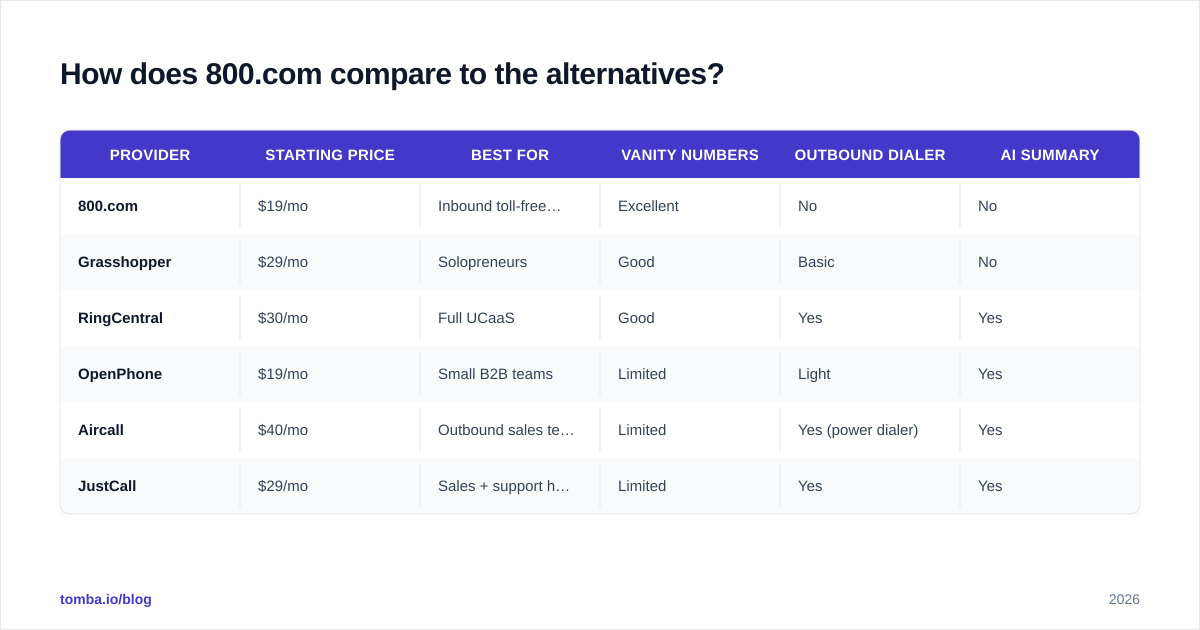
How does 800.com compare to the alternatives?#
| Provider | Starting price | Best for | Vanity numbers | Outbound dialer | AI summary |
|---|---|---|---|---|---|
| 800.com | $19/mo | Inbound toll-free, vanity | Excellent | No | No |
| Grasshopper | $29/mo | Solopreneurs | Good | Basic | No |
| RingCentral | $30/mo | Full UCaaS | Good | Yes | Yes |
| OpenPhone | $19/mo | Small B2B teams | Limited | Light | Yes |
| Aircall | $40/mo | Outbound sales teams | Limited | Yes (power dialer) | Yes |
| JustCall | $29/mo | Sales + support hybrid | Limited | Yes | Yes |
If your buyer mental-model is "I want a memorable toll-free number on radio/TV/podcast", 800.com wins. If your mental-model is "I want to run a sales team that dials 5,000 prospects a week", every other vendor in that table beats it.
Is 800.com worth it for B2B sales teams?#
For most B2B sales teams, 800.com is not a standalone solution — but it is a reasonable building block.
A working stack we see in mid-market B2B:
- 800.com for the published toll-free number on the website, in case studies, and on outbound mail pieces.
- A real outbound dialer (Aircall, JustCall, Dialpad, or Orum) for the SDR floor.
- A prospecting layer for contact data — the email finder and phone finder handle the actual lookups so your reps aren't guessing direct lines.
- A CRM (HubSpot or Salesforce) wired to both.
The 800.com number becomes a trust signal and a campaign-attribution anchor, not the dialer itself. That separation also keeps your outbound caller ID clean — toll-free numbers get worse pickup rates than local numbers in cold outbound, which is why no serious SDR team dials cold from a 1-800.
How should you decide if 800.com fits your stack?#
Use this five-question gut check before pulling out a credit card:
- Do you need a memorable number for paid media? If yes, 800.com is in the running.
- Will inbound minutes exceed 1,500/month? If yes, price out Pro or Custom — not Basic.
- Do you need outbound calling features? If yes, treat 800.com as additive, not primary.
- Do you need deep CRM/sequence integration? If yes, budget time to build webhooks or pick a competitor with native HubSpot/Salesforce apps.
- Do you need toll-free SMS at scale? If yes, start the verification process week one and assume a 3 msg/sec ceiling.
If you answered "yes" to questions 1, 2, and "no" to 3, 4, and 5 — 800.com is a solid pick. Any other combination, audit the alternatives in the table above.
How do you build a sales motion around a toll-free number?#
A toll-free number on its own does not generate pipeline. The pattern that works:
- Outbound starts with research, not dialing. Build the list, enrich it, and qualify before any rep touches a phone. Use a B2B database to define the ICP slice.
- Direct dials > toll-free for cold outbound. Local-presence routing lifts answer rates 2–3x versus a 1-800 caller ID. Use direct dials from a phone finder for outbound.
- Toll-free for inbound + brand. Publish the 800.com number where buyers go looking for you — site footer, signature lines, content offers, podcast ads.
- Email + phone as a pair. Most B2B buyers won't pick up cold. Email-first sequences with a phone follow-up convert better than phone-first. Validate that contact data with an email verifier before sending anything.
- Track everything in one CRM. Both 800.com call logs and outbound dialer logs should flow into the same opportunity record, or attribution dies.
For a deeper read on the data layer that feeds this motion, see Tomba's data sources page — it covers how phone and email records are validated before they hit a sales rep's screen.
How do you negotiate or downgrade 800.com pricing?#
Three levers most teams ignore:
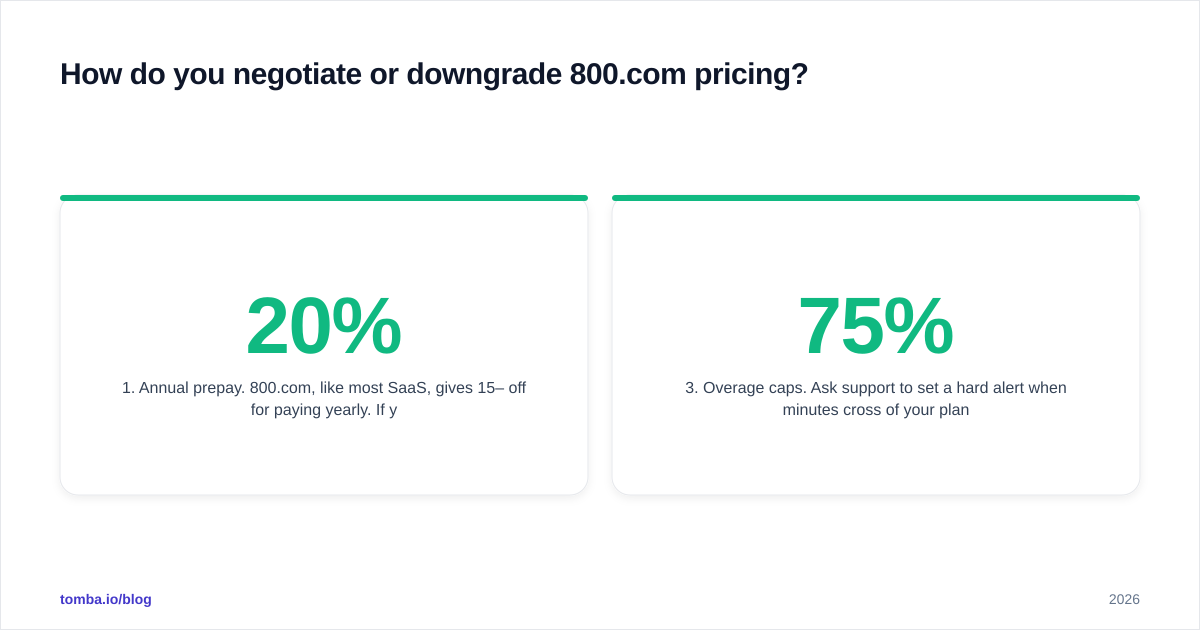
- Annual prepay. 800.com, like most SaaS, gives 15–20% off for paying yearly. If you've used the number for 90 days and it's working, switch.
- Vanity-only plans. If you only need to own the number for brand reasons and forwarding volume is tiny, ask about a parked-number rate. It is not advertised but often available.
- Overage caps. Ask support to set a hard alert when minutes cross 75% of your plan. This will not stop the bill, but it prevents the 10x surprise.
Cancellation is self-serve, but port-out of a vanity number can take 5–10 business days and may incur a fee — plan for it.
Frequently asked questions#
Is 800.com free? No. There is a free trial of the platform, but every plan has a monthly fee starting at $19/mo, and premium vanity numbers carry a one-time fee.
Can I keep my number if I cancel? Yes — you can port a toll-free number to another carrier (RespOrg change). Allow 5–10 business days and confirm any port-out fees with 800.com support.
Does 800.com support call centers? Lightly. There's IVR, extensions, and call routing, but no agent workforce-management or advanced queueing. For >10 agents, pick a contact-center platform.
How does 800.com compare to Google Voice for business? Google Voice is cheaper but does not offer true 1-800 toll-free, vanity selection, or business-grade call recording with retention controls. 800.com wins for branded toll-free; Google Voice wins on price for non-toll-free needs.
Will a 1-800 number help cold outbound pickup rates? No. The data is consistent across studies from Orum, Gong, and SalesLoft: local caller ID outperforms toll-free for cold outbound by 2–3x. Use toll-free for inbound, local for outbound.
Closing recommendation#
If you want a memorable, professional, easy-to-publish toll-free number with clean inbound features, 800.com is a defensible pick at $19–$59/mo. Just don't expect it to run your outbound sales motion.
The bigger lever for B2B teams in 2026 isn't the phone number — it's the data feeding the sequences. Pair whatever inbound number you choose with verified outbound contact data so your reps are dialing real direct lines and emailing real inboxes. Start with the Tomba Email Finder on the free plan, layer in the phone finder for direct-dial coverage, and let the 800.com number do what it's actually good at: being the front door.
// get started
Find, verify and enrich your first contacts today
Start on the free plan with 25 searches a month, then scale when your team is ready.
Free plan · No credit card required · GDPR & CCPA
// about the author