8x8 vs RingCentral 2026: Which UCaaS Platform Wins?
8x8 vs RingCentral in 2026: pricing, calling quality, CCaaS depth, and global reach compared. A neutral teardown for sales and RevOps buyers.
TL;DR#
- RingCentral wins on integrations, ecosystem maturity, and pure UCaaS polish — but pricing starts at $30/user/month and climbs fast once you add SMS, video, and contact center modules.
- 8x8 wins on global calling (unlimited calling to 14-48 countries depending on tier), bundled CCaaS, and analytics depth — but the admin UI is dated and the sales motion is enterprise-heavy.
- For outbound sales teams under 50 reps in North America, RingCentral RingEX is the safer default.
- For global support orgs or any team that needs voice + contact center in one license, 8x8 XCaaS is materially cheaper at scale.
- Neither replaces a dedicated dialer — pair whichever you pick with your prospecting stack (find verified phone numbers before the dialer touches them).
What is the real difference between 8x8 and RingCentral?#
Both vendors sell what Gartner calls UCaaS — Unified Communications as a Service — meaning cloud PBX, video meetings, team chat, SMS, and (for enterprise tiers) integrated contact center. On paper the feature lists rhyme. The differences show up in three places: global PSTN coverage, contact center depth, and price-per-seat at scale.
RingCentral's pitch is breadth and polish. It's the platform IT directors recommend when nobody wants to argue. The desktop and mobile apps are clean, the admin console is approachable, and the integration marketplace covers everything from Salesforce to HubSpot to Microsoft Teams native embedding. You pay for that polish — list pricing is among the highest in the category.
8x8's pitch is XCaaS — eXperience Communications as a Service — its branding for combining UCaaS and CCaaS in a single license. If your sales floor doubles as a support floor, or if you make outbound calls to 20+ countries, 8x8's bundled international plans are hard to beat. The trade-off: the admin experience feels like it was designed in 2017 and last refreshed in 2021.
How do 8x8 and RingCentral pricing tiers compare in 2026?#
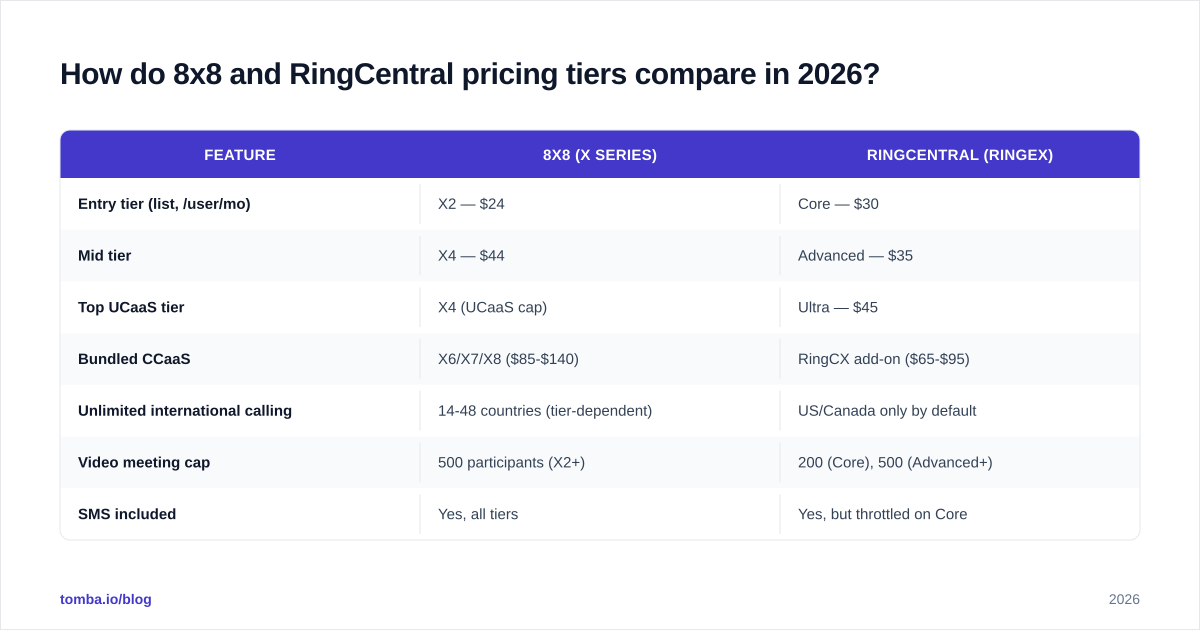
Both vendors publish list prices that almost nobody actually pays — enterprise deals routinely land 30-50% below MSRP once you commit annually for 100+ seats. Still, list pricing tells you the relative positioning.
| Feature | 8x8 (X Series) | RingCentral (RingEX) |
|---|---|---|
| Entry tier (list, /user/mo) | X2 — $24 | Core — $30 |
| Mid tier | X4 — $44 | Advanced — $35 |
| Top UCaaS tier | X4 (UCaaS cap) | Ultra — $45 |
| Bundled CCaaS | X6/X7/X8 ($85-$140) | RingCX add-on ($65-$95) |
| Unlimited international calling | 14-48 countries (tier-dependent) | US/Canada only by default |
| Video meeting cap | 500 participants (X2+) | 200 (Core), 500 (Advanced+) |
| SMS included | Yes, all tiers | Yes, but throttled on Core |
| HD voice + E911 | All tiers | All tiers |
| Free trial | 30 days | 14 days |
| Annual contract required for best pricing | Yes | Yes |
The headline: 8x8 is cheaper on entry UCaaS, RingCentral is cheaper on entry CCaaS, and 8x8 is dramatically cheaper if your team makes outbound calls to Europe, LATAM, or APAC. RingCentral's international add-ons stack per-minute and can quadruple your monthly bill if reps dial outside North America regularly.

Is RingCentral better than 8x8 for sales teams?#
For a pure North American outbound sales team using HubSpot or Salesforce, RingCentral has three advantages that matter:
- Salesforce native integration is genuinely good. Click-to-dial, auto-log, screen pop, conversation intelligence routing — all work without third-party connectors. 8x8's Salesforce integration exists but feels bolted on.
- RingSense (their conversation intelligence layer) is included in Advanced and above, while 8x8 still positions analytics as a separate Engagement Management module.
- The mobile app is the best in the category. Reps actually use it. 8x8's mobile app works but doesn't.
Where 8x8 closes the gap or pulls ahead:
- Power dialer behavior. 8x8's dialer queues calls more aggressively and handles drop/retry logic without the manual nudging RingCentral requires.
- Speech analytics. 8x8's analytics covers 100% of calls by default; RingSense samples by default unless you upgrade.
- Global SDR teams. If your SDRs call EMEA from a US base, 8x8's international bundle saves real money — we've seen $4k/mo bills cut to $900/mo on identical call volumes.
Neither replaces a purpose-built sales engagement platform. If you're running structured sequences with 6+ touches across email, LinkedIn, and phone, look at an Outreach alternative or Salesloft alternative that sits on top of your UCaaS dialer.
How do 8x8 and RingCentral handle contact center (CCaaS)?#
This is where the platforms genuinely diverge.
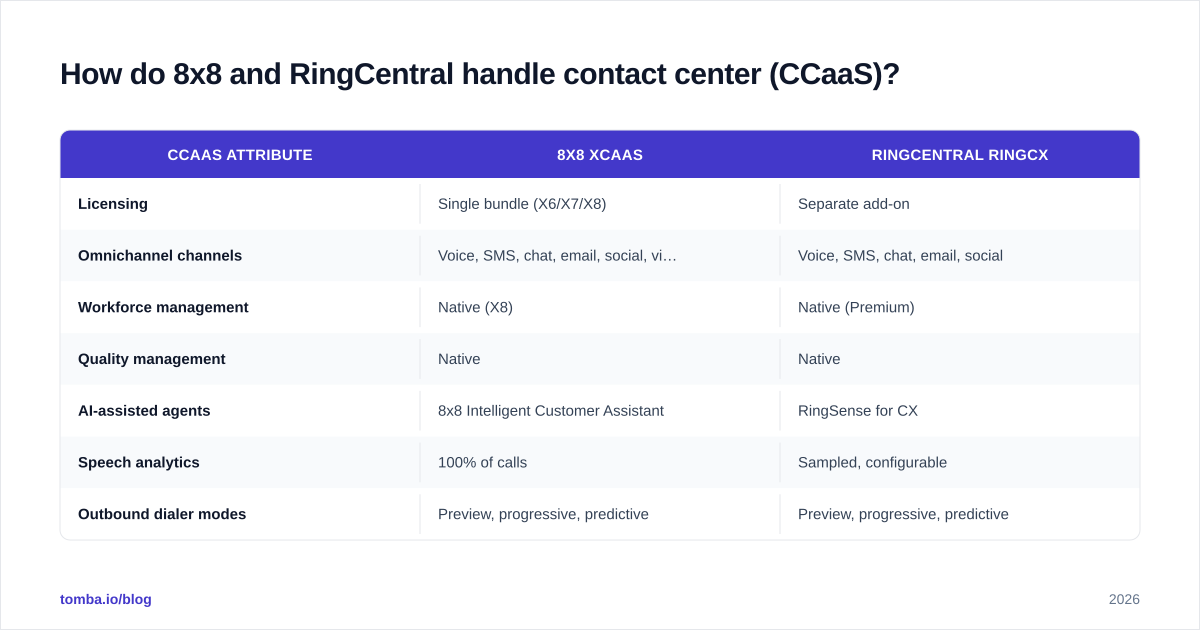
8x8 XCaaS treats UCaaS and CCaaS as one product. A supervisor monitors an agent's queue in the same console where IT manages the CFO's softphone. Skills-based routing, IVR, omnichannel (voice/SMS/webchat/email), workforce management, and quality management ship in the X6+ tiers without separate licensing. For a 30-agent support team that also has 80 office users, this is operationally simpler and usually cheaper than buying RingEX + RingCX separately.
RingCentral ships RingCX, their cloud contact center, as a separate add-on. RingCX is technically capable — it inherited a lot from the Engage Voice acquisition and now leans on a partnership with Nice — but the cross-product integration with RingEX still feels like two products stapled together. Pricing per agent is competitive ($65 essential / $95 premium list), but you're licensing two SKUs.
| CCaaS attribute | 8x8 XCaaS | RingCentral RingCX |
|---|---|---|
| Licensing | Single bundle (X6/X7/X8) | Separate add-on |
| Omnichannel channels | Voice, SMS, chat, email, social, video | Voice, SMS, chat, email, social |
| Workforce management | Native (X8) | Native (Premium) |
| Quality management | Native | Native |
| AI-assisted agents | 8x8 Intelligent Customer Assistant | RingSense for CX |
| Speech analytics | 100% of calls | Sampled, configurable |
| Outbound dialer modes | Preview, progressive, predictive | Preview, progressive, predictive |
| Best fit | Mid-market + enterprise blended teams | Standalone CC ops at any size |
If you're a SaaS company where the "contact center" is really 8 CSMs handling renewals and inbound support, RingCX is overkill — just use RingEX with call queues. If you're running 50+ agents across sales and support with hard SLAs, XCaaS is the cleaner architecture.
What about international calling and global presence?#
For any team with reps outside the US, this is the question that decides it.
RingCentral covers 45+ countries with local DID numbers and PSTN replacement, but unlimited calling is gated to US/Canada on standard plans. International calling beyond that bills per-minute against a separate add-on (rates roughly $0.02-$0.30/min depending on destination). Decent for inbound, painful for outbound SDRs.
8x8 covers 55+ countries with local PSTN and bundles unlimited international calling into X2 (14 countries), X4 (47 countries), and the CCaaS tiers (48 countries). The list of included countries covers all major European markets, most of LATAM, India, Australia, Japan, and Singapore. For SDR teams that genuinely cold-call internationally, this is a multi-thousand-dollar/month difference.
Both vendors handle toll-free DIDs, vanity numbers, number porting, and e911/eCNAM compliance to roughly the same standard. Both offer STIR/SHAKEN attestation, which matters more than ever now that US carriers aggressively label unattested calls as spam — pair this with a sender reputation mindset for outbound channels too.
Which one integrates better with your stack?#
RingCentral has the wider marketplace — over 300 prebuilt integrations including deep Salesforce, HubSpot, Microsoft Dynamics, ServiceNow,
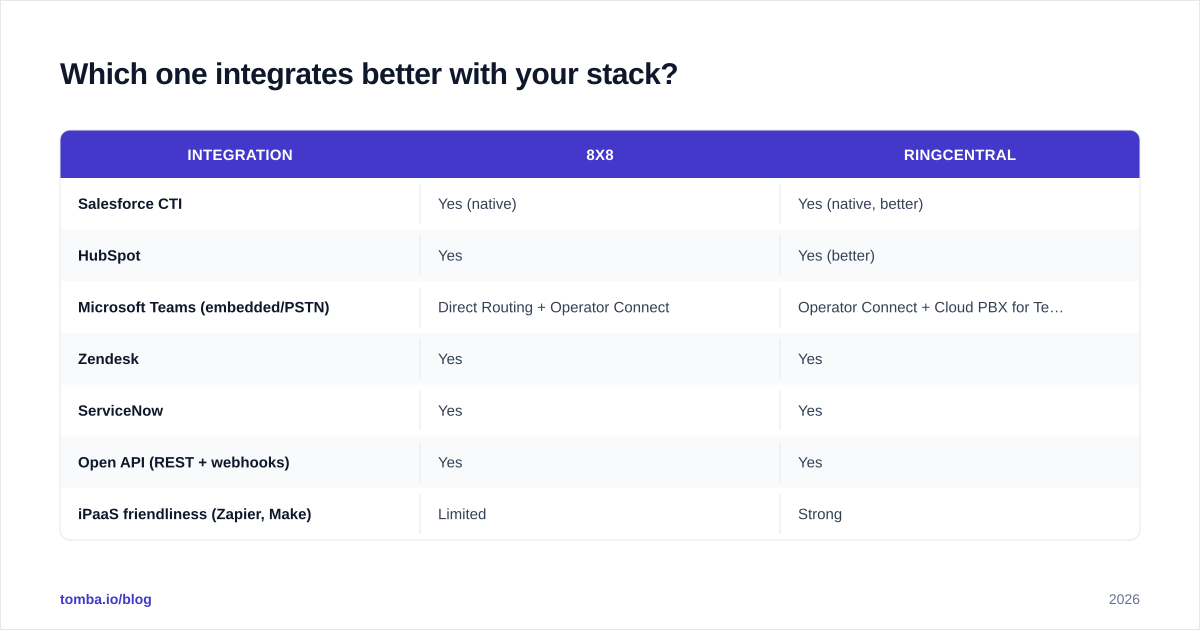
Zoho, and Zendesk connectors. The Microsoft Teams embedded option lets RingCentral act as the PSTN backbone for a Teams-first organization without the user installing a second app.
8x8 has the integrations you need (Salesforce, HubSpot, MS Teams, Zendesk, Freshdesk, NetSuite, ServiceNow) but the marketplace is shallower and several integrations require professional services to deploy cleanly.
| Integration | 8x8 | RingCentral |
|---|---|---|
| Salesforce CTI | Yes (native) | Yes (native, better) |
| HubSpot | Yes | Yes (better) |
| Microsoft Teams (embedded/PSTN) | Direct Routing + Operator Connect | Operator Connect + Cloud PBX for Teams |
| Zendesk | Yes | Yes |
| ServiceNow | Yes | Yes |
| Open API (REST + webhooks) | Yes | Yes |
| iPaaS friendliness (Zapier, Make) | Limited | Strong |
| Total marketplace count | 60+ | 300+ |
If you're stitching workflows together with Zapier, Make, or HubSpot Operations Hub, RingCentral is easier. If you're an enterprise that buys professional services anyway, the gap closes.
For inbound enrichment — turning a caller's number into a CRM contact — neither platform handles this natively. You'll want a data enrichment layer or a reverse email lookup workflow on inbound to map numbers to people.
How do reliability, support, and security compare?#
Both vendors publish 99.999% availability SLAs, both run multi-region active-active architectures, and both have had public outages in the last 24 months. Status pages tell the real story:
- 8x8 has historically been more transparent about RCAs and tends to post detailed post-mortems within a week.
- RingCentral had a notable multi-hour outage in 2022 that hit Salesforce CTI customers especially hard. They've since invested heavily in regional failover.
Compliance:
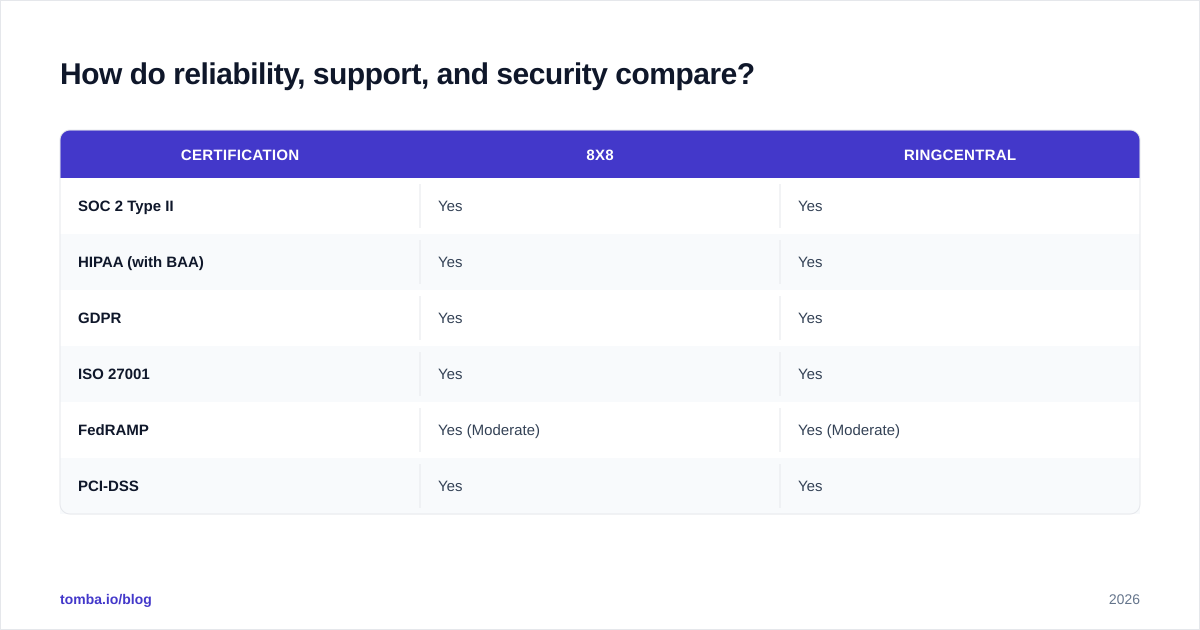
| Certification | 8x8 | RingCentral |
|---|---|---|
| SOC 2 Type II | Yes | Yes |
| HIPAA (with BAA) | Yes | Yes |
| GDPR | Yes | Yes |
| ISO 27001 | Yes | Yes |
| FedRAMP | Yes (Moderate) | Yes (Moderate) |
| PCI-DSS | Yes | Yes |
Support:
- RingCentral's standard support is solid but tiered — premium support is an upcharge.
- 8x8 includes 24/7 support across all paid tiers without separate SKUs.
For details on each vendor's own roadmap and recent changes, check the RingCentral product updates page and 8x8 release notes. For peer-reviewed sentiment, G2's UCaaS category is the least biased aggregator we've found.
When should you choose 8x8 over RingCentral (and vice versa)?#
A simple decision matrix:
| Scenario | Recommended |
|---|---|
| US-only SMB, < 25 seats, CRM-heavy | RingCentral RingEX Core/Advanced |
| US-only mid-market, sales-led GTM | RingCentral Advanced + RingSense |
| Global SDR team calling EMEA/APAC | 8x8 X4 |
| Blended sales + support, 30-150 agents | 8x8 X6 (XCaaS) |
| Standalone enterprise contact center | RingCX (or evaluate Genesys/Nice) |
| Microsoft Teams shop needing PSTN | RingCentral for Teams (slightly cleaner) |
| Healthcare with strict HIPAA + BAA | Either (both compliant) |
| Lowest possible UCaaS entry price | 8x8 X2 ($24) |
| Best-in-class mobile + UX | RingCentral |
| Best analytics included by default | 8x8 |
There's no universally "better" platform. The wrong question is "which is better?" The right question is "which is better for our call mix, headcount, and geography?"
How do you actually pilot both before committing?#
Three weeks, two parallel pilots, real reps. The cost of switching UCaaS providers 18 months in is a quarter of pain — do the upfront work.
- Week 1: Provisioning + integration. Stand up 10 seats on each. Wire up Salesforce/HubSpot. Port two test numbers. Measure time-to-first-call and IT lift.
- Week 2: Live calling. Run 5 reps on each platform. Track connect rates, dropped calls, CRM logging accuracy, dialer latency. Pull MOS scores from both admin consoles.
- Week 3: CCaaS scenario (if relevant). Simulate inbound queue load. Test skills-based routing and supervisor barge.
Then run the math on 3-year TCO, not month-one pricing. Include the international per-minute charges, RingSense or 8x8 Intelligence upgrades, and the integration professional services you'll actually need.
The one piece neither platform solves: getting accurate phone numbers into the dialer in the first place. Dialing wrong numbers wrecks your STIR/SHAKEN attestation, eats agent time, and trains carrier filters to mark your DIDs as spam. Verify before you dial.
Get the right numbers into whichever dialer you pick#
Whether you land on 8x8 or RingCentral, the platform is only as good as the contact data feeding it. Tomba's phone finder returns verified B2B mobile and direct-dial numbers, our phone validator checks line type and deliverability before they hit your dialer, and the Tomba API wires both into your provisioning workflow alongside email enrichment.
Free tier covers 25 lookups/month so you can test data quality against your existing list before you commit. See Tomba pricing for plan details — starter is $49/mo, Growth is $99/mo, and the API is included on every paid tier.
// get started
Find, verify and enrich your first contacts today
Start on the free plan with 25 searches a month, then scale when your team is ready.
Free plan · No credit card required · GDPR & CCPA
Get the Tomba newsletter
Product and data updates
// about the author