8x8 vs Vonage 2026: Which Business Phone Wins?
8x8 vs Vonage in 2026: pricing, features, reliability, and integrations compared. See which UCaaS platform fits sales teams, contact centers, and global ops.
8x8 vs Vonage in 2026: Which Business Phone System Actually Wins?
Choosing between 8x8 and Vonage feels like picking between two well-worn jackets that look almost identical on the rack. Both are unified communications (UCaaS) veterans. Both promise voice, video, messaging, and contact center in one bundle. Both have been around long enough to outlast most of their early competitors. The differences only show up once you put them on and walk around the block.
This is a side-by-side breakdown of how 8x8 and Vonage compare in 2026: pricing, calling features, contact center depth, integrations, reliability, and the trade-offs that actually matter when sales and support teams pick a platform.
TL;DR — 8x8 vs Vonage at a glance#
- 8x8 wins on global calling and contact center depth. Unlimited calling to 14-48 countries on higher tiers, plus a native CCaaS that doesn't feel bolted on.
- Vonage wins on flexibility and APIs. The Vonage Communications Platform (CPaaS) lets developers embed voice, SMS, and video into custom apps — a different shape of value.
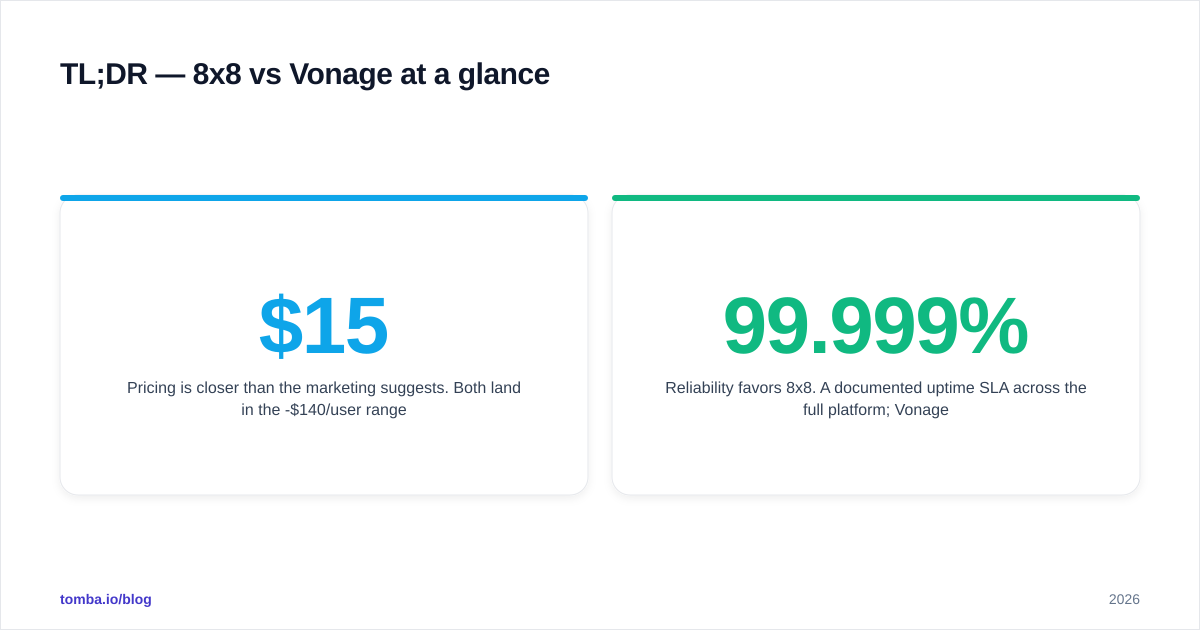
- Pricing is closer than the marketing suggests. Both land in the $15-$140/user/month range depending on tier and contact center add-ons.
- Reliability favors 8x8. A documented 99.999% uptime SLA across the full platform; Vonage publishes 99.999% on voice but the rest is less explicit.
- Neither is a lead-generation tool. You still need an email finder, prospecting layer, and CRM enrichment on top — that's where Tomba fits in the stack.
What are 8x8 and Vonage, and why are they compared?#
8x8 and Vonage both sell cloud-based business phone systems, but they grew up answering slightly different questions.
8x8 (publicly traded as EGHT) has spent the last decade consolidating voice, video, team chat, and contact center into a single product line called 8x8 XCaaS (eXperience Communications as a Service). The pitch: one vendor, one platform, one SLA, one analytics layer covering both employees and customers.
Vonage, owned by Ericsson since 2022, runs two distinct businesses. Vonage Business Communications (VBC) is the UCaaS product — desk phones, softphone, video meetings, SMS, basic contact center. Vonage Communications Platform (VCP) is the developer-facing CPaaS — APIs for voice, SMS, video, verification, and AI. Many teams pick Vonage specifically for the API side.
They're compared because both target mid-market and enterprise buyers, both bundle voice + meetings + messaging, and both sit on most UCaaS shortlists from Gartner and G2 reviewers. The decision usually comes down to whether you need a polished out-of-the-box experience (8x8) or a programmable platform (Vonage).
How do 8x8 and Vonage compare on pricing in 2026?#
Both vendors moved to a tiered pricing model years ago and have refined it since. Pricing below is published list pricing as of early 2026 — most buyers negotiate 10-25% off at annual commit for 50+ seats.
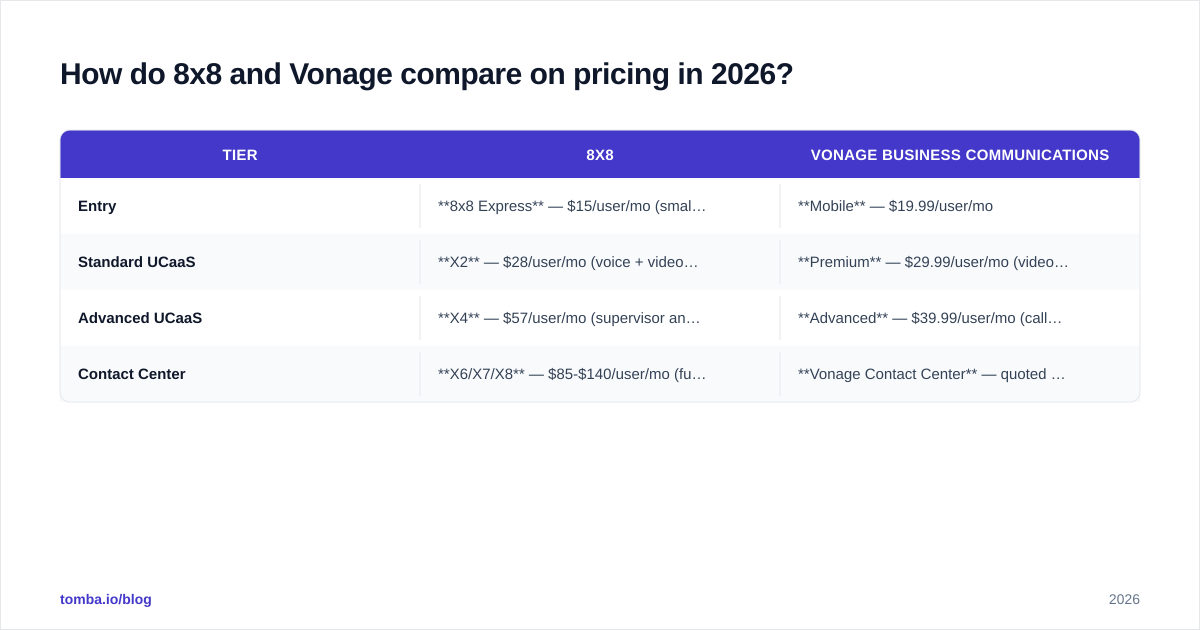
| Tier | 8x8 | Vonage Business Communications |
|---|---|---|
| Entry | 8x8 Express — $15/user/mo (small business, up to 10 users) | Mobile — $19.99/user/mo |
| Standard UCaaS | X2 — $28/user/mo (voice + video + chat, 14 countries unlimited) | Premium — $29.99/user/mo (video meetings, CRM integrations) |
| Advanced UCaaS | X4 — $57/user/mo (supervisor analytics, 48 countries unlimited) | Advanced — $39.99/user/mo (call recording, visual voicemail) |
| Contact Center | X6/X7/X8 — $85-$140/user/mo (full CCaaS, AI, WFM) | Vonage Contact Center — quoted separately, ~$125+/user/mo |
A few honest observations:
- 8x8's X2 is the sweet spot for most sales orgs under 200 seats. Unlimited calling to 14 countries on a $28 plan is hard to beat if any portion of your team calls outside the US.
- Vonage Premium at $29.99 undercuts X2 on the headline number, but you pay extra for international minutes and contact center features that 8x8 bundles.
- Contact center pricing is where the gap widens. 8x8's X8 includes workforce management, quality management, and Speech Analytics natively. Vonage Contact Center (formerly NewVoiceMedia) prices comparably but the integration with VBC is looser.
For deeper unit economics, Vonage's pricing page and 8x8's plan comparison are the canonical sources — both update quarterly.
Which platform has better calling and meeting features?#
The core voice features are at parity. Both offer HD voice, call forwarding, auto-attendants, IVR, voicemail-to-email, call recording, hot desking, and softphone clients for Windows, macOS, iOS, and Android.
The differences live at the edges.
8x8's strengths:
- Unlimited international calling to 14 countries (X2) or 48 countries (X4) is a genuine differentiator. Vonage charges per minute outside the US/Canada on most plans.
- 8x8 Meetings supports up to 500 participants on X4 with native dial-in numbers in 55+ countries.
- Persistent team chat is built in and threads survive across web and mobile.
- Single global SLA covering voice, video, chat, and contact center.
Vonage's strengths:
- Vonage Meetings is now powered by the same engine that runs Vonage Video API — meaning meeting features get the upstream CPaaS roadmap.
- AI Virtual Assistant (built on Vonage AI Studio) is more configurable for custom IVR flows because it's built on the same CPaaS primitives developers use.
- SMS is metered but flexible — useful for high-volume A2P messaging.
- Strong APIs for building custom calling experiences inside your own product.
If your team is "phone first, everything else second," 8x8 has the cleaner UCaaS experience. If your team wants to embed calling or messaging inside a custom workflow, Vonage's developer surface is more mature.
Is 8x8 or Vonage better for contact centers?#
This is where the two diverge most sharply.
8x8 Contact Center is part of XCaaS. It's the same login, the same admin console, the same analytics layer as the UCaaS product. Supervisors can see agent state, call quality, and customer journey metrics without leaving the platform. The advanced tiers include:
- Omnichannel routing (voice, chat, email, SMS, social)
- Conversation IQ — AI-powered transcription, sentiment, and topic detection
- Workforce management (forecasting, scheduling, adherence)
- Quality management with screen recording
- 99.999% uptime SLA across the full stack
Vonage Contact Center (VCC, originally NewVoiceMedia) is a strong product on its own but lives somewhat parallel to Vonage Business Communications. It's tightly integrated with Salesforce — historically its biggest selling point — and supports omnichannel routing, AI-powered conversation analytics, and quality management. The catch: VCC and VBC are still two products with two admin consoles, even if Vonage continues to converge them.
For Salesforce-native organizations that already run a CCaaS on Service Cloud, Vonage Contact Center is genuinely best-in-class. For everyone else, 8x8's unified platform is less work to operate.
How do integrations and CRM connectivity compare?#
Both platforms integrate with the usual suspects: Salesforce, HubSpot, Microsoft Teams, Microsoft Dynamics 365,
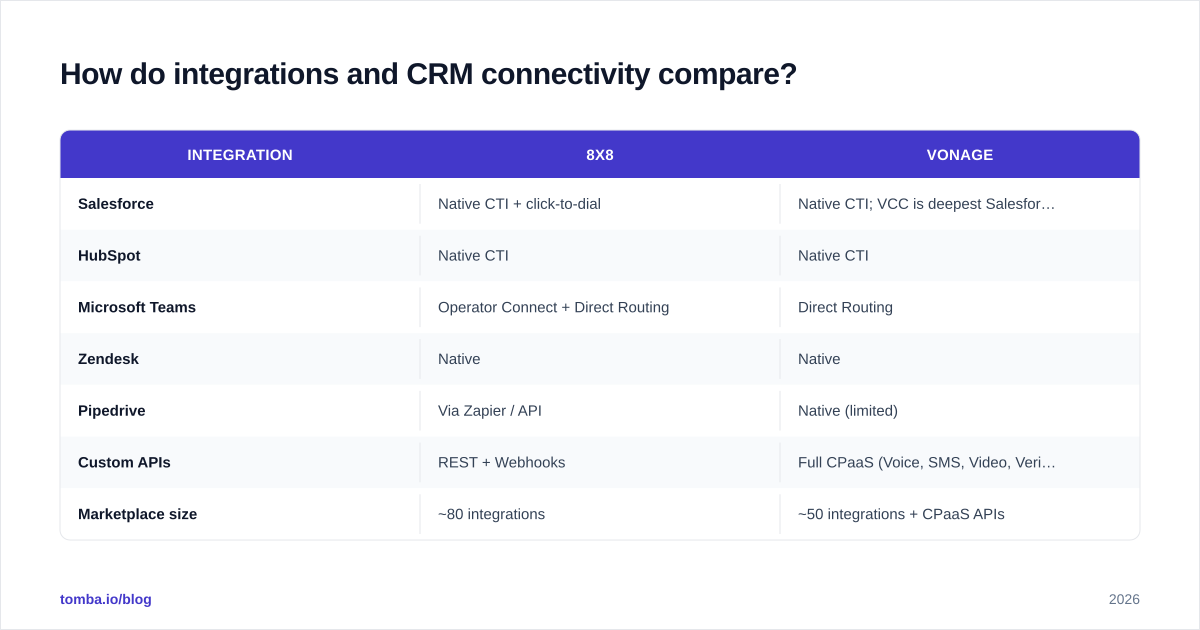
Zendesk, ServiceNow, Slack, Google Workspace, and Microsoft 365.
| Integration | 8x8 | Vonage |
|---|---|---|
| Salesforce | Native CTI + click-to-dial | Native CTI; VCC is deepest Salesforce CCaaS |
| HubSpot | Native CTI | Native CTI |
| Microsoft Teams | Operator Connect + Direct Routing | Direct Routing |
| Zendesk | Native | Native |
| Pipedrive | Via Zapier / API | Native (limited) |
| Custom APIs | REST + Webhooks | Full CPaaS (Voice, SMS, Video, Verify) |
| Marketplace size | ~80 integrations | ~50 integrations + CPaaS APIs |
For most sales orgs, the integration that matters is the CRM dialer. Both handle Salesforce and HubSpot natively. If you run on a more niche CRM, 8x8's Zapier coverage is broader, while Vonage's CPaaS lets you build a custom integration from scratch.
The bigger gap: neither tool surfaces verified contact data. Both will dial whatever number is in your CRM. Garbage in, garbage out. That's why most outbound sales teams pair their dialer with a B2B database and a phone validator to clean numbers before they hit the dialer queue.
Which is more reliable — 8x8 or Vonage?#
8x8 publishes a 99.999% uptime SLA that covers voice, video, chat, and contact center — a single number across the platform. They also publish a public uptime report at status.8x8.com.
Vonage publishes 99.999% on voice infrastructure, but the platform-wide SLA is less explicit; meetings and messaging have separate status pages. The CPaaS side maintains its own SLA tied to specific API endpoints.
In practice, both have had outages — every UCaaS provider does. What matters is mean time to recovery and how the vendor communicates during an incident. Both publish incident retros; both have had multi-hour regional issues in the past 24 months. If five-nines across the full stack is contractually critical, 8x8 has a cleaner story.
What do real users say about 8x8 vs Vonage?#
Pulling signal from G2, Capterra, and TrustRadius reviews from the last 18 months, the patterns are consistent.
8x8 — common praise:
- Reliable call quality
- Strong international calling value
- Clean unified admin console
- Solid mobile app
8x8 — common complaints:
- Onboarding can drag if you have complex hunt groups
- Reporting UI is dense for new admins
- Pricing changes between quoted and renewal sometimes catch buyers off guard
Vonage — common praise:
- Flexible APIs and developer experience
- Salesforce Contact Center integration is industry-leading
- SMS reliability
Vonage — common complaints:
- Two-product structure (VBC + VCC) confuses buyers
- Mobile app polish lags 8x8
- International calling costs add up
When should you pick 8x8?#
Choose 8x8 if:
- You want one vendor for UCaaS and contact center with one SLA
- You make significant international calls (14-48 countries unlimited on X2/X4)
- You're standardizing on a unified analytics layer for both employees and customers
- You're a mid-market company (100-5,000 seats) that doesn't want to glue products together
- Reliability across the entire stack is contractually critical
When should you pick Vonage?#
Choose Vonage if:
- You're a Salesforce-first contact center org and want the deepest native CTI
- You need CPaaS APIs (voice, SMS, video, verification) embedded in your own product
- Your call volume is mostly domestic US/Canada and you want a lower headline UCaaS price
- You're already standardized on the Vonage AI Studio for conversational AI
- Your developer team will build custom workflows on top of communications APIs
What goes on top of 8x8 or Vonage? The data layer#
Here's the part the dialer vendors don't talk about. A phone system is a pipe. It moves voice and messages between two endpoints. It does not:
- Find decision-maker contact info
- Verify that an email or phone number is real before you dial
- Enrich a record with company data, tech stack, or LinkedIn URL
- Suggest which leads to call first based on intent
That's the data layer. And no matter which dialer you pick, you'll need to feed it clean, verified data — or your $39/seat dialer becomes a $39/seat way to leave voicemails for disconnected numbers.
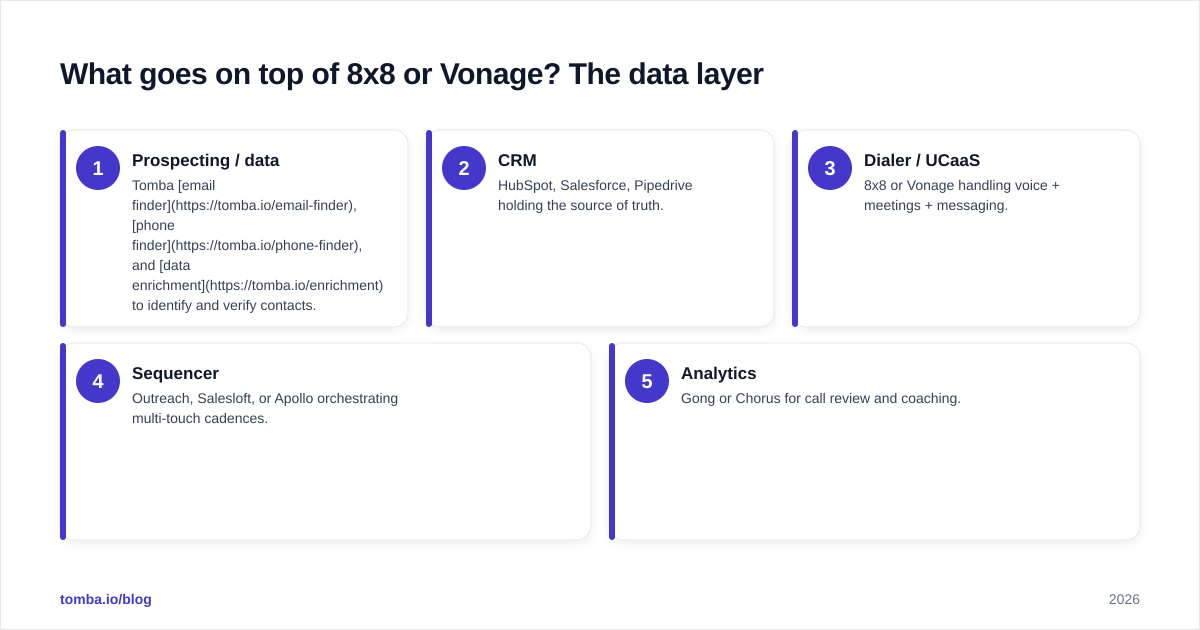
This is where Tomba fits. A typical outbound stack in 2026 looks like:
- Prospecting / data — Tomba email finder, phone finder, and data enrichment to identify and verify contacts.
- CRM — HubSpot, Salesforce, Pipedrive holding the source of truth.
- Dialer / UCaaS — 8x8 or Vonage handling voice + meetings + messaging.
- Sequencer — Outreach, Salesloft, or Apollo orchestrating multi-touch cadences.
- Analytics — Gong or Chorus for call review and coaching.
Tomba sits at the front of that pipeline. Without verified contact data, the rest of the stack works harder for worse results.
8x8 vs Vonage: head-to-head verdict#
| Decision factor | Winner |
|---|---|
| Lowest entry price | Vonage (Mobile $19.99) |
| Best value for sales teams under 200 seats | 8x8 (X2 unlimited 14 countries) |
| Contact center depth | 8x8 (XCaaS unified) |
| Salesforce contact center | Vonage (VCC) |
| Developer APIs / CPaaS | Vonage |
| Global calling | 8x8 |
| Reliability SLA | 8x8 (99.999% full platform) |
| Mobile app polish | 8x8 |
| Microsoft Teams integration | Tie |
| CRM dialer integrations | Tie |
If forced to a single recommendation: 8x8 wins for most sales and support orgs in 2026, especially those wanting one platform, one SLA, and meaningful international coverage. Vonage wins when Salesforce-native CCaaS or CPaaS APIs are non-negotiable.
Stop dialing dead numbers — verify contacts before they hit the queue#
Whichever phone system you pick, the cost of bad data shows up the same way: wasted dial attempts, low connect rates, and reps who burn through lists twice as fast as they should. Tomba's email finder, phone validator, and data enrichment put verified, deliverable contact info into your CRM before your team ever picks up a headset.
Start free with 25 searches a month, or jump to the Starter plan at $49/mo. Compare full Tomba pricing and stop letting your dialer dial ghosts.
Ready to find emails that actually work?
Join 150,000+ professionals who stopped guessing and started sending. Free credits on signup — no credit card required.
Get the Tomba newsletter
Practical outbound tactics and product updates — once every two weeks.
About the author