The 95-5 Rule in B2B Marketing: Why 95% of Buyers Aren't Ready in 2026
Only 5% of your market is ready to buy right now. The 95-5 rule explains why most B2B pipelines fail — and how to fix yours in 2026.
TL;DR#
- The 95-5 rule, popularized by the Ehrenberg-Bass Institute, says only 5% of B2B buyers are in-market in any given quarter — 95% are not.
- Most demand-gen budgets target the 5% with bottom-funnel ads, lead forms, and SDR sequences. That's why CAC keeps climbing while pipeline shrinks.
- Winning teams in 2026 build mental availability with the 95% through brand, content, and category education, then convert the 5% with sharp activation.
- The 95-5 rule does not kill outbound. It reframes it: outbound must serve future buyers, not just chase today's hand-raisers.
- You need clean contact data to do either job. A reliable email finder is the connective tissue between brand reach and direct activation.
What is the 95-5 rule?#
The 95-5 rule states that at any given moment, roughly 95% of B2B buyers are not in the market for what you sell, and only 5% are actively looking. The figure comes from research published by Professor John Dawes at the Ehrenberg-Bass Institute and has reshaped how serious B2B marketers plan budgets since 2021.
The implication is uncomfortable. If you spend your entire budget chasing the 5%, you are competing with every other vendor for the same shrinking pool of in-quarter buyers. Worse, when that 5% rotates out next quarter, the new 5% has never heard of you — because you spent nothing building memory with them while they were dormant.
The 95-5 rule is not a hot take. It echoes consumer-marketing principles Byron Sharp documented in How Brands Grow, applied to a category (B2B SaaS, services, infrastructure) that historically over-indexed on lead capture and under-invested in salience.
Why does the 95-5 rule matter in 2026?#
Three forces made the 95-5 rule the defining B2B marketing idea of the mid-2020s:
1. Buying committees got bigger and slower. Gartner now pegs the average B2B buying committee at 6 to 10 stakeholders, with deals lasting 6 to 18 months. By the time someone fills out your demo form, the real decision started months ago — when one stakeholder remembered (or did not remember) your brand.
2. Outbound deliverability collapsed. Gmail and Yahoo's 2024 sender requirements, Apple Mail Privacy Protection, and aggressive spam filters have crushed unprimed cold email. A cold sequence to a buyer who has never seen your brand converts a fraction of a sequence to a buyer who already recognizes you.
3. AI-generated outbound flooded inboxes. When every SDR uses the same LLM to write the same "loved your post on LinkedIn" opener, recognition becomes the only signal that cuts through. Brand built with the 95% is now the unfair advantage at the moment the 5% activates.
The 95-5 rule is the diagnosis. The treatment is rebalancing budget toward future demand without abandoning current pipeline.
How is the 95-5 rule different from the 80-20 rule?#
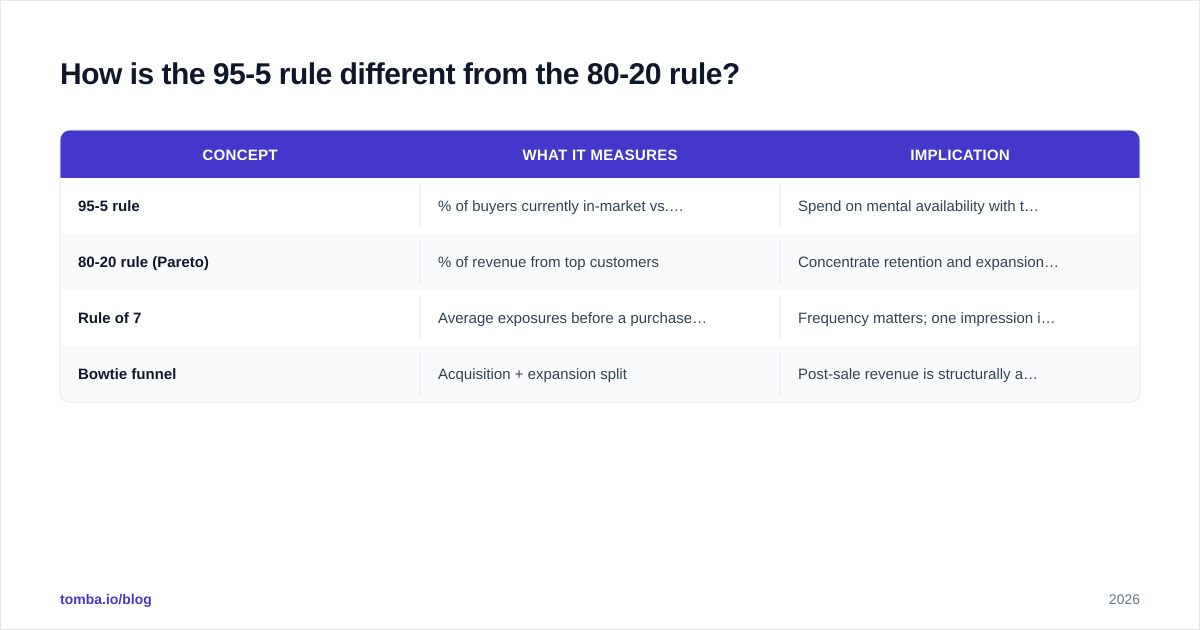
Marketers confuse these constantly. They describe different things.
| Concept | What it measures | Implication |
|---|---|---|
| 95-5 rule | % of buyers currently in-market vs. out-of-market | Spend on mental availability with the 95% so they remember you when they enter the 5% |
| 80-20 rule (Pareto) | % of revenue from top customers | Concentrate retention and expansion on the high-value 20% |
| Rule of 7 | Average exposures before a purchase decision | Frequency matters; one impression is not enough |
| Bowtie funnel | Acquisition + expansion split | Post-sale revenue is structurally as important as new logos |
The 95-5 rule operates at the top of the funnel. The 80-20 rule operates at the bottom. They are complementary, not competing.
What does the 95% actually look like in your category?#
In a typical B2B SaaS category with a 5-year average customer lifetime, the math is brutal but clean:
- 100% of your addressable market = every account that could ever buy
- ~20% are renewing existing contracts each year (the 80-20 customers)
- ~5% are in active evaluation this quarter
- ~95% are doing something else: hiring, integrating, firefighting, ignoring your category entirely
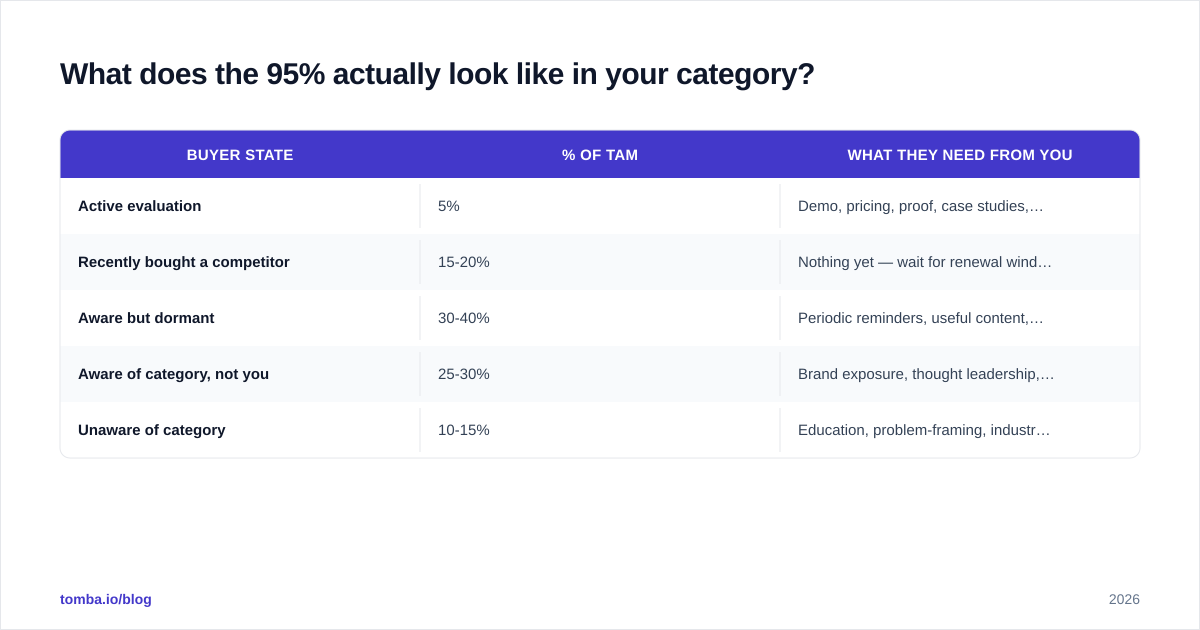
A useful way to picture the 95%:
| Buyer state | % of TAM | What they need from you |
|---|---|---|
| Active evaluation | 5% | Demo, pricing, proof, case studies, fast response |
| Recently bought a competitor | 15-20% | Nothing yet — wait for renewal window |
| Aware but dormant | 30-40% | Periodic reminders, useful content, category POVs |
| Aware of category, not you | 25-30% | Brand exposure, thought leadership, search presence |
| Unaware of category | 10-15% | Education, problem-framing, industry events |
If 90% of your spend lands on the 5%, you are leaving the entire memory-building job to your competitors.
How do you apply the 95-5 rule to budget allocation?#
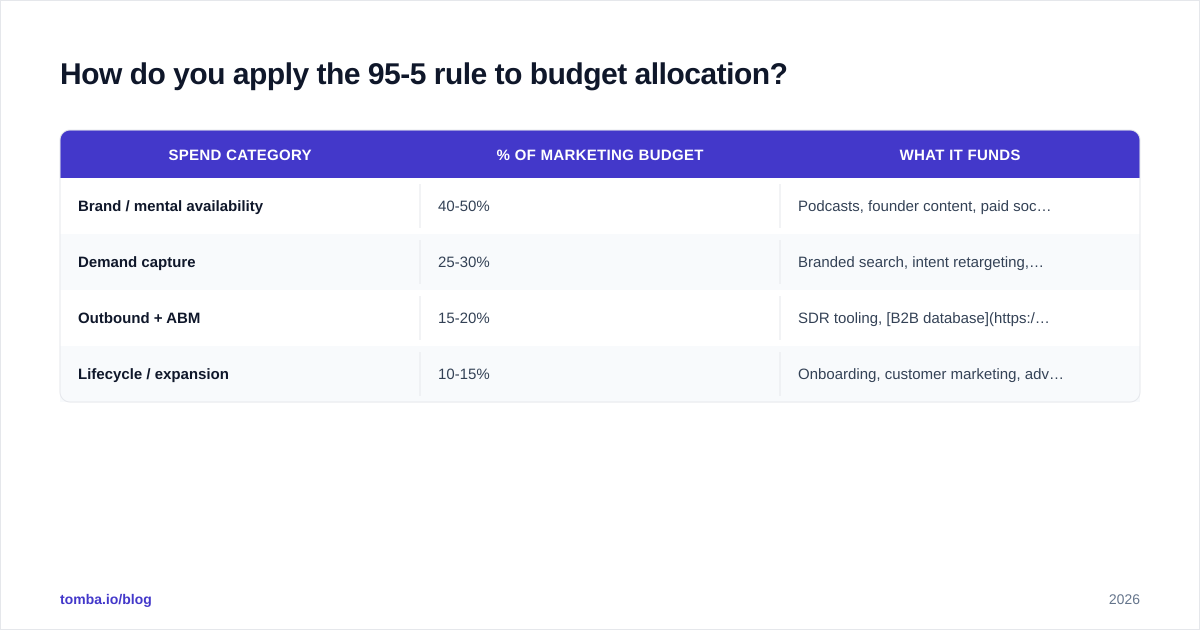
The Ehrenberg-Bass team and practitioners like Peter Field have converged on a rough 60/40 brand-to-activation split for B2B over a multi-year horizon. Activation alone gets diminishing returns past 12 months. Pure brand spend with no activation leaves money on the table.
A practical 2026 allocation for a Series A-to-C B2B SaaS company:
| Spend category | % of marketing budget | What it funds |
|---|---|---|
| Brand / mental availability | 40-50% | Podcasts, founder content, paid social reach, category POV, sponsorships |
| Demand capture | 25-30% | Branded search, intent retargeting, comparison-page SEO, review sites |
| Outbound + ABM | 15-20% | SDR tooling, B2B database, sequences, account-based plays |
| Lifecycle / expansion | 10-15% | Onboarding, customer marketing, advocacy programs |
The hardest part is not the math. It is convincing a CFO that brand spend with no attributable MQL is not waste. The honest answer: brand shows up in CAC payback and win rate, not in MQL count.
How does outbound fit into the 95-5 rule?#
Some commentators read the 95-5 rule as "stop doing outbound." That is wrong, and Ehrenberg-Bass has never said it. The correct reading: outbound has two jobs, not one.
Job 1 — Activate the 5%. Standard SDR plays: identify in-market signals (job changes, funding, hiring, intent data), prioritize accounts, run sharp multi-channel sequences. This is where most teams already operate.
Job 2 — Build awareness with the 95%. Treat outbound as a brand touch. A well-written cold email to a buyer who is not ready is a brand impression with a real human, often more memorable than a banner ad. The metric is not reply rate — it is whether your name shows up in the prospect's mental shortlist 9 months later.
To do either job, you need accurate contact data. Bad data turns brand-building outbound into spam complaints and turns activation outbound into bounced sends and torched domains. This is where tooling matters: a strong email verifier protects sender reputation across both motions, and a Tomba Chrome extension gives reps clean contacts pulled from real sources rather than scraped guesses.

What metrics actually track the 95-5 rule?#
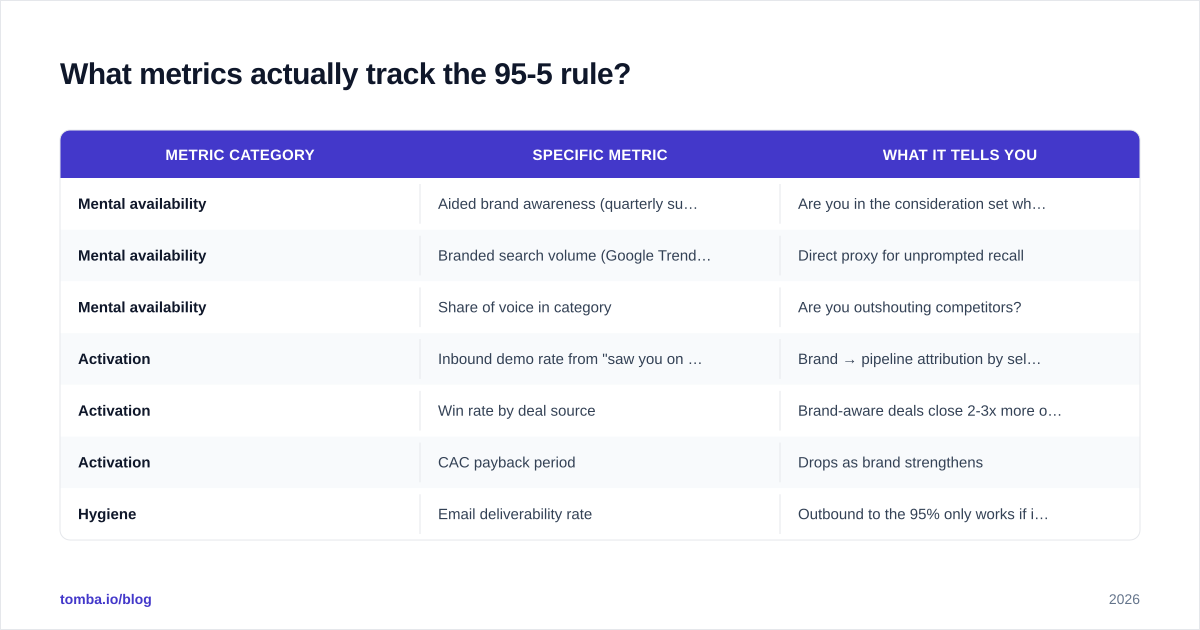
If you only watch MQLs and SQLs, you will never see the brand half working. You need a second dashboard.
| Metric category | Specific metric | What it tells you |
|---|---|---|
| Mental availability | Aided brand awareness (quarterly survey) | Are you in the consideration set when buyers enter-market? |
| Mental availability | Branded search volume (Google Trends, GSC) | Direct proxy for unprompted recall |
| Mental availability | Share of voice in category | Are you outshouting competitors? |
| Activation | Inbound demo rate from "saw you on X" | Brand → pipeline attribution by self-report |
| Activation | Win rate by deal source | Brand-aware deals close 2-3x more often |
| Activation | CAC payback period | Drops as brand strengthens |
| Hygiene | Email deliverability rate | Outbound to the 95% only works if inboxes accept you |
The lagging indicator that ties it together is CAC payback. As brand investments compound, the cost to acquire a customer from the 5% drops because more of them recognize you on first contact.
What does a 95-5 content strategy look like?#
Content for the 5% and content for the 95% are different products.
5% content (activation):
- Comparison pages ("Tool A vs Tool B")
- Pricing breakdowns and ROI calculators
- Implementation guides and integration docs
- Case studies with specific metrics
- Free trials and interactive product tours
95% content (mental availability):
- Category POVs that name a problem before naming a product
- Founder and exec narrative content (podcasts, LinkedIn essays)
- Industry research and original data
- Strong opinions on where the category is heading
- Memorable formats: a recurring newsletter, a signature framework, a conference talk that becomes a quote
Notice what is missing from the 95% list: gated whitepapers, generic blog posts optimized for long-tail keywords, "5 tips for X" listicles. That content satisfies an SEO scorecard but builds zero memory.
The teams winning in 2026 publish less, but each piece is sharper, more branded, and more distributed. They use the Tomba newsletter approach: build an owned audience instead of renting attention from algorithms.
What are the common mistakes when applying the 95-5 rule?#
Mistake 1: Treating it as permission to abandon performance marketing. The 95-5 rule says rebalance, not surrender. If you kill paid search on your own brand terms, competitors will buy them.
Mistake 2: Assuming brand has no measurement. It does. Brand lift studies, branded search trends, and aided awareness surveys all exist. They are noisier than click-attribution but not optional.
Mistake 3: Underinvesting in distribution. A great podcast no one hears builds zero mental availability. Spend at least 30% of content cost on distribution — paid amplification, syndication, partnerships.
Mistake 4: Confusing thought leadership with thought repetition. Saying "AI is changing sales" 47 different ways is not a POV. A POV picks a fight, names winners and losers, and is memorable enough to be quoted.
Mistake 5: Skipping data hygiene. Brand spend gets wasted when activation infrastructure leaks. Bad CRM data, bounced sequences, and decayed contact lists turn warmed-up brand awareness into nothing. Tools like data enrichment and bulk verify keep the bottom of the funnel sealed so brand investment can flow through.
How does the 95-5 rule change SDR and BDR work?#
Outbound teams need to stop measuring on raw demo-set count. Under the 95-5 rule, the SDR's job expands:
- In-market accounts (the 5%): standard sequences with sharp value props, fast follow-up, multithread the buying committee. Target: demos that convert.
- Future-market accounts (the 95%): lighter-touch nurture, optional content shares, no aggressive asks. Target: brand familiarity. Re-engage when buying signals fire.
This requires segmenting outreach lists by signal strength, not just title and company size. It also requires longer-horizon comp plans — paying SDRs partly on accounts they touched 6 months before close, not only on the meeting that converted.
Final word: build for next quarter, not this Tuesday#
The 95-5 rule is a discipline, not a tactic. It forces you to spend money on people who will not give you a meeting this month, on the bet that they will remember you in nine. Most marketing leaders cannot hold that line under quarterly pressure. The ones who do compound an advantage their competitors cannot copy without rebuilding their playbook from scratch.
When you are ready to act on the 5% who are in-market right now, start with clean data. The Tomba Email Finder gives you verified contacts at companies showing buying signals, so your activation spend lands in real inboxes and your brand spend gets a fair chance to convert. Pair it with the Tomba API to automate enrichment across your CRM, and the 5% becomes pipeline instead of guesswork.
// get started
Find, verify and enrich your first contacts today
Start on the free plan with 25 searches a month, then scale when your team is ready.
Free plan · No credit card required · GDPR & CCPA
// about the author