The ABCs of Selling in 2026: Always Be Closing Reimagined
The ABCs of selling started as 'Always Be Closing' in 1992. In 2026, the framework has evolved into something far more effective for modern B2B sales — here's what actually works.
The ABCs of Selling in 2026: Always Be Closing Reimagined
TL;DR
- The original ABCs of selling — "Always Be Closing" — came from the 1992 film Glengarry Glen Ross and was already outdated by the time most reps quoted it.
- The modern ABCs framework expands the acronym into a full sales operating system: Always Be Connecting, Helping, Diagnosing, and Earning trust.
- Closing rates in 2026 correlate more strongly with discovery quality and multi-threading than with closing technique itself.
- The reps hitting 130%+ of quota run a structured ABC playbook backed by clean data, accurate contact info, and tight follow-up — not pressure tactics.
- This guide breaks down what each letter means today, the tools that support each stage, and the comparison data you need to pick the right stack.
What are the ABCs of selling, really?#
The phrase "ABCs of selling" entered the sales lexicon through Alec Baldwin's monologue in Glengarry Glen Ross: "A — Always. B — Be. C — Closing. Always be closing." It was meant as satire of high-pressure real-estate boiler rooms. Sales managers heard it as gospel.
Three decades later, the buyers have changed. B2B buyers complete an average of 70% of their purchase research before talking to a rep, according to Gartner. Pushing a close on someone who hasn't finished diagnosing their own problem is the fastest way to lose a deal.
The modern ABCs of selling keep the discipline implied by the original — being consistent, being intentional in every touchpoint — but redirect the energy from closing to the activities that actually produce closes.
What does the modern ABCs framework look like?#
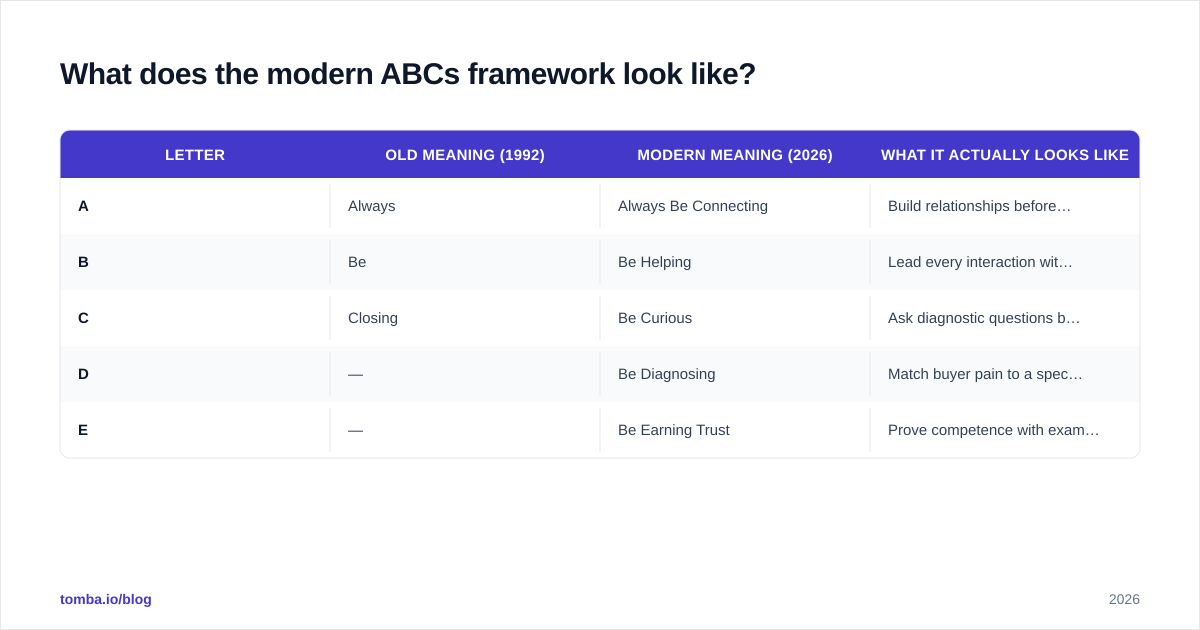
Here's the version most top-performing B2B sales teams now run, expanded letter by letter:
| Letter | Old Meaning (1992) | Modern Meaning (2026) | What It Actually Looks Like |
|---|---|---|---|
| A | Always | Always Be Connecting | Build relationships before you need them — comments, intros, value drops |
| B | Be | Be Helping | Lead every interaction with something useful to the buyer's job |
| C | Closing | Be Curious | Ask diagnostic questions before pitching anything |
| D | — | Be Diagnosing | Match buyer pain to a specific, measurable outcome |
| E | — | Be Earning Trust | Prove competence with examples, references, and follow-through |
The old version was one verb (closing). The new version is five behaviors that compound. A rep who runs all five lands roughly 2-3x the win rate of a rep who only runs the last one.
Why did "Always Be Closing" stop working?#
Three structural shifts killed the original ABC:
1. Information asymmetry collapsed. In 1992, the seller knew more than the buyer. The close was about leveraging that asymmetry — getting the buyer to commit before they could research alternatives. In 2026, the buyer has G2, Reddit, Capterra, your competitors' demo videos, and an AI that will summarize all of it in 30 seconds. They will not commit on the call.
2. Buying committees got bigger. The average B2B deal now involves 6-10 stakeholders. You cannot close a committee with one phone call. Multi-threading — building relationships with multiple people in the account — replaces single-point closing.
3. Subscription economics changed the incentive. When a SaaS contract auto-renews monthly, a forced close produces a fast churn six months later. The deal becomes negative-margin. Reps who run "Always Be Closing" generate revenue their own CS team has to refund.
What replaced closing as the central skill?#
Discovery. Done well, discovery makes the close almost mechanical.
A rep running modern discovery does four things in every conversation:
- Surface the current state — what's happening today, with concrete numbers
- Surface the desired state — what "fixed" looks like, with concrete numbers
- Quantify the gap — what the delta costs the buyer per month or per quarter
- Identify the blocker — what's stopping them from solving it themselves
If you can articulate all four back to the buyer in their own words, you have earned the right to propose a solution. If you can't, no closing technique will save the deal.
This is also where contact data quality matters more than reps realize. Half of failed discoveries are failed because the rep was talking to the wrong person — a stakeholder who couldn't sign, couldn't budget, or didn't own the problem. A clean prospecting workflow that surfaces the real economic buyer before the first call (using tools like an email finder and a LinkedIn finder) eliminates that whole failure mode.
How do the new ABCs map to a sales process?#
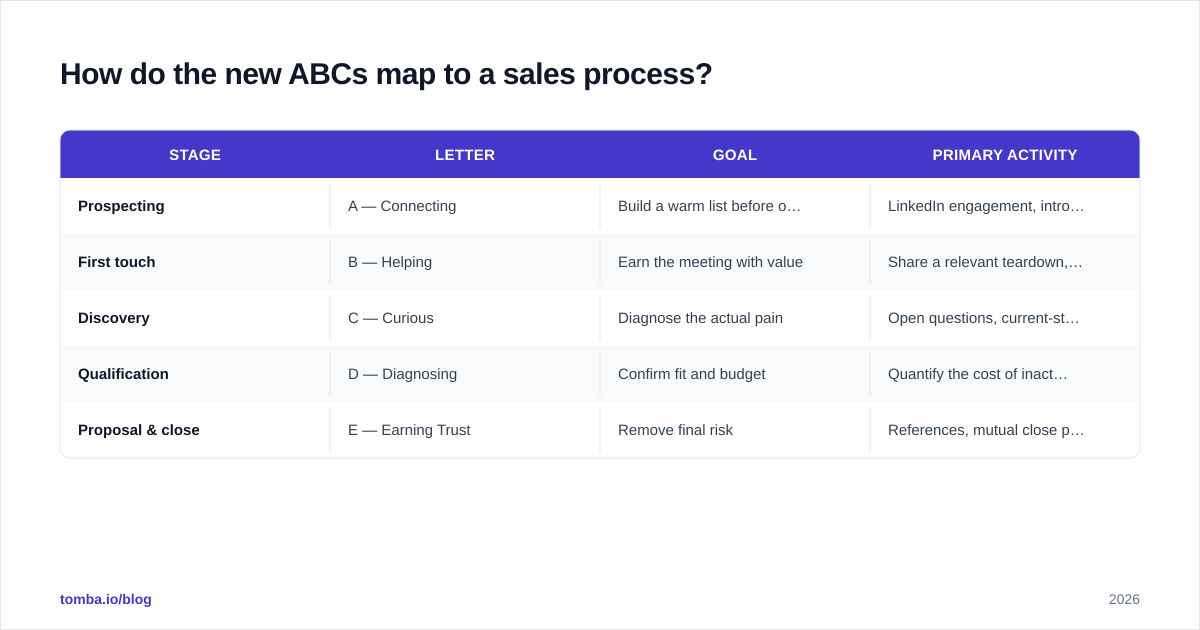
Each letter slots into a specific stage of the pipeline:
| Stage | Letter | Goal | Primary Activity |
|---|---|---|---|
| Prospecting | A — Connecting | Build a warm list before outreach | LinkedIn engagement, intro requests, content drops |
| First touch | B — Helping | Earn the meeting with value | Share a relevant teardown, benchmark, or intro |
| Discovery | C — Curious | Diagnose the actual pain | Open questions, current-state mapping |
| Qualification | D — Diagnosing | Confirm fit and budget | Quantify the cost of inaction |
| Proposal & close | E — Earning Trust | Remove final risk | References, mutual close plan, written terms |
Notice the close doesn't have its own letter anymore. That's intentional. The close is the natural outcome of the first four letters being done well — not a separate skill.
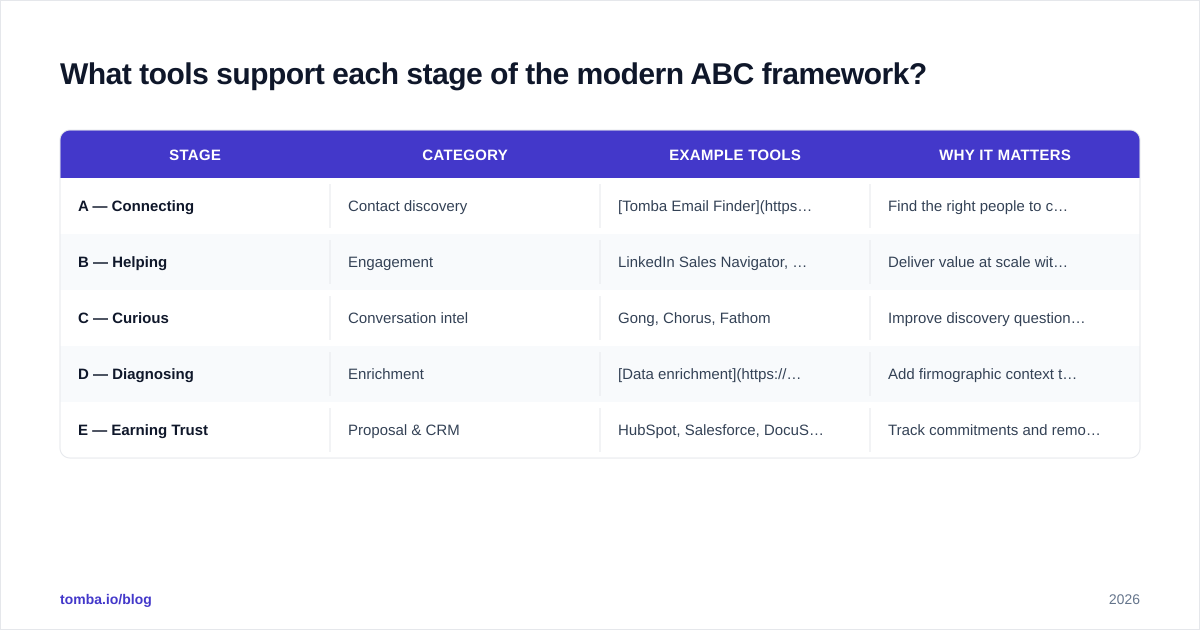
What tools support each stage of the modern ABC framework?#
A modern sales stack maps roughly one-to-one with the letters. Here's a typical setup:
| Stage | Category | Example Tools | Why It Matters |
|---|---|---|---|
| A — Connecting | Contact discovery | Tomba Email Finder, Apollo, ContactOut | Find the right people to connect with |
| B — Helping | Engagement | LinkedIn Sales Navigator, Lemlist, Smartlead | Deliver value at scale without spamming |
| C — Curious | Conversation intel | Gong, Chorus, Fathom | Improve discovery question quality |
| D — Diagnosing | Enrichment | Data enrichment, Clearbit,ZoomInfo | Add firmographic context to qualify faster |
| E — Earning Trust | Proposal & CRM | HubSpot, Salesforce, DocuSign | Track commitments and remove friction |
You don't need one tool per stage. A small team can compress this into 3-4 tools. The stack matters less than the discipline of running each stage with intent.
Is "Always Be Closing" ever still useful?#
Yes — in two narrow contexts.
Transactional, high-velocity sales. Inbound SDRs working a 100-leads-per-day inbound queue for a low-ACV product still benefit from closing discipline. The buyer has self-qualified by reaching the form. The rep's job is to remove friction and ask for the order. Pressure isn't appropriate, but urgency and confidence are.
Late-stage deal velocity. Once a deal has passed discovery, qualification, and proposal, a rep absolutely should be closing — asking for the signature, proposing a date, removing obstacles. The mistake the original ABC made was applying that energy to every stage. Apply it only to the final 10%.
Outside those contexts, the close-first mindset trains reps to skip discovery, ignore objections, and burn pipeline. It's a tax on win rate.

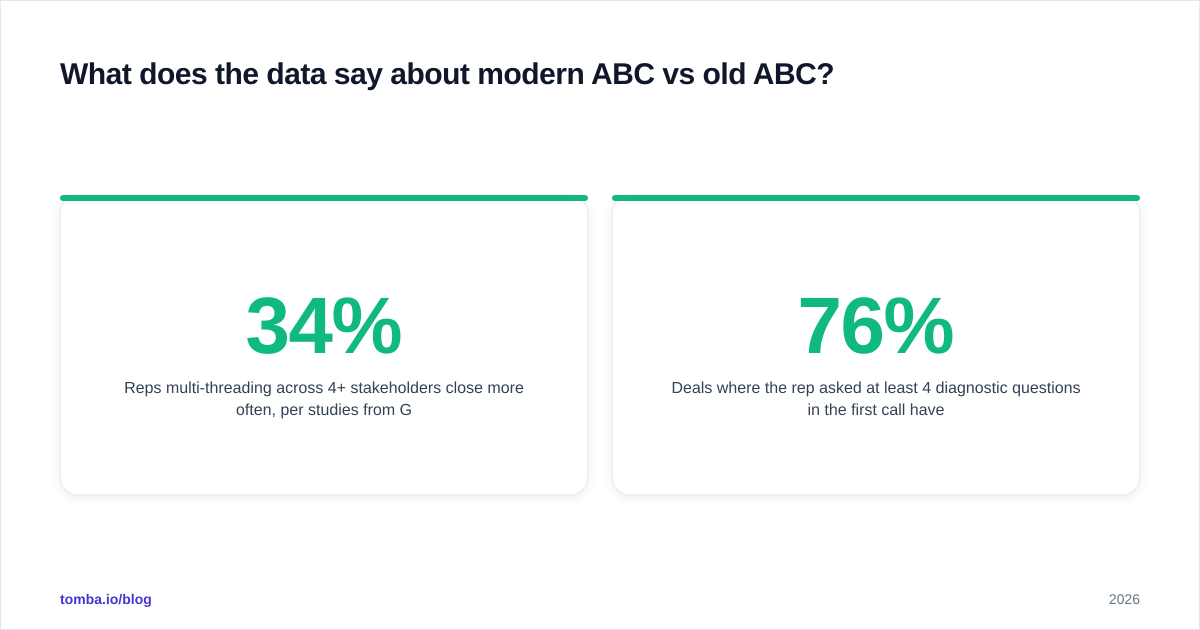
What does the data say about modern ABC vs old ABC?#
A few benchmarks worth knowing if you're picking a methodology:
- According to HubSpot's sales research, reps who run structured discovery close at roughly 2x the rate of reps who jump to demo.
- Reps multi-threading across 4+ stakeholders close 34% more often, per studies from Gong and Forrester.
- The average buyer wants to be contacted 8 times before a meeting; most reps stop at 2. Persistence beats pressure.
- Deals where the rep asked at least 4 diagnostic questions in the first call have a 76% higher progression rate than deals where the rep asked fewer than 2.
The pattern is consistent: activity quality dominates activity volume, and discovery dominates closing technique. The reps hitting quota in 2026 are not the ones reading Glengarry Glen Ross scripts — they're the ones running structured ABC playbooks with clean data underneath.
How do you train a team on the new ABCs?#
Pick one letter per quarter and drill it. Don't try to install all five at once — reps will revert to whatever was working for them before.
Quarter 1 — A (Connecting). Run a weekly LinkedIn engagement standup. Every rep brings 5 prospects they engaged with that week and what the response was. Reward warm meetings, not cold dials.
Quarter 2 — B (Helping). Build a value library: 10 industry-specific teardowns, benchmarks, or templates reps can drop into outreach. Track which assets generate replies.
Quarter 3 — C (Curious) and D (Diagnosing). Record every discovery call. Pick one call per rep per week to review with the team. Score on question quality, not airtime.
Quarter 4 — E (Earning Trust). Build a mutual close plan template. Every deal in proposal stage gets one. Track which deals have a signed close plan vs which don't — the win-rate delta usually justifies the policy by itself.
This sequencing also matches how the sales process and pipeline actually flows, so the training compounds with the work itself rather than competing with it.
What about AI-driven selling — does it change the ABCs?#
AI changes the speed at which each letter executes, not the letters themselves.
- A (Connecting) — AI suggests warm intros and writes opening lines, but a human still has to mean what they send.
- B (Helping) — AI summarizes research and drafts assets, but the buyer still notices when "helpful" is generic.
- C (Curious) — AI transcribes and scores discovery calls, surfacing missed questions. This is where AI adds the most leverage today.
- D (Diagnosing) — AI enriches lead records automatically, surfacing budget, headcount, and tech-stack signals.
- E (Earning Trust) — AI cannot fake follow-through. This stays human.
The teams that misuse AI try to automate the entire ABC. The teams that win use AI to do the boring parts of each letter faster — so reps can spend more time on the parts that require judgment.
Final framework: the one-pager version#
If you only remember one thing from this article, remember this:
The best closers don't think about closing. They think about being so useful and so well-informed that the buyer asks them to close.
That's the modern ABCs of selling in one sentence. Everything else — frameworks, tools, training plans — exists to make that sentence true for your team consistently.
Closing CTA#
The single biggest unlock for any rep running the modern ABC framework is contact data they can trust. You can't connect with the wrong person, help the wrong person, or diagnose with someone who can't sign. Tomba's Email Finder pulls verified work emails for the decision-makers in your target accounts so you spend your time selling, not guessing addresses. Start free with 25 searches per month, or grab the Starter plan at $49/mo and feed your modern ABC pipeline with prospects worth working. See Tomba pricing for the full breakdown.
Ready to find emails that actually work?
Join 150,000+ professionals who stopped guessing and started sending. Free credits on signup — no credit card required.
Get the Tomba newsletter
Practical outbound tactics and product updates — once every two weeks.
About the author