ABM 1:Few in 2026: The Mid-Funnel Play That Beats 1:1 and 1:Many
ABM 1:Few sits between hyper-personalized 1:1 and broad 1:Many. Here's how to cluster accounts, build a play, and beat both extremes in 2026.
TL;DR#
- ABM 1:Few targets 5-50 lookalike accounts grouped by industry, tech stack, or trigger — not one giant whale, not a 5,000-account blast.
- It works because true 1:1 ABM is too expensive for most pipelines and 1:Many is too generic to move enterprise buying committees.
- The unlock is cluster design: accounts inside a 1:Few play must share a problem you can articulate in one sentence.
- Expect 3-5x higher reply rates than 1:Many and 60-80% lower cost-per-meeting than 1:1 when executed properly.
- The 2026 stack is lighter than people think: an account list, contact data, an outbound sequencer, and intent signals. Most teams over-tool this.
What is ABM 1:Few and why does the middle tier matter in 2026?#
ABM 1:Few is the practice of running coordinated marketing and sales plays against small clusters of similar accounts — typically 5 to 50 companies grouped because they share a vertical, a tech footprint, a funding event, or a measurable pain point. Each cluster gets a tailored message, a shared landing page, and a sequence built around the cluster's specific problem rather than each individual buyer.
The middle tier matters because the extremes have broken. Pure 1:1 ABM, the kind where you build a custom microsite and run a six-figure direct-mail play for a single Fortune 500 logo, has a cost-per-meeting that only works for $500K+ ACV deals. Pure 1:Many — generic nurture sequences dumped on thousands of contacts — has reply rates collapsing below 1% as inboxes get smarter and buyers get noisier.
1:Few is where most B2B revenue teams should spend their time in 2026. It keeps the personalization that makes ABM work, but spreads the research and creative cost across a cluster of accounts that look enough alike to share a message.
If you want the conceptual baseline, ITSMA's original ABM framework defined the three tiers two decades ago. What's new in 2026 is the data infrastructure that makes 1:Few actually executable at speed.
How is ABM 1:Few different from 1:1 and 1:Many?#
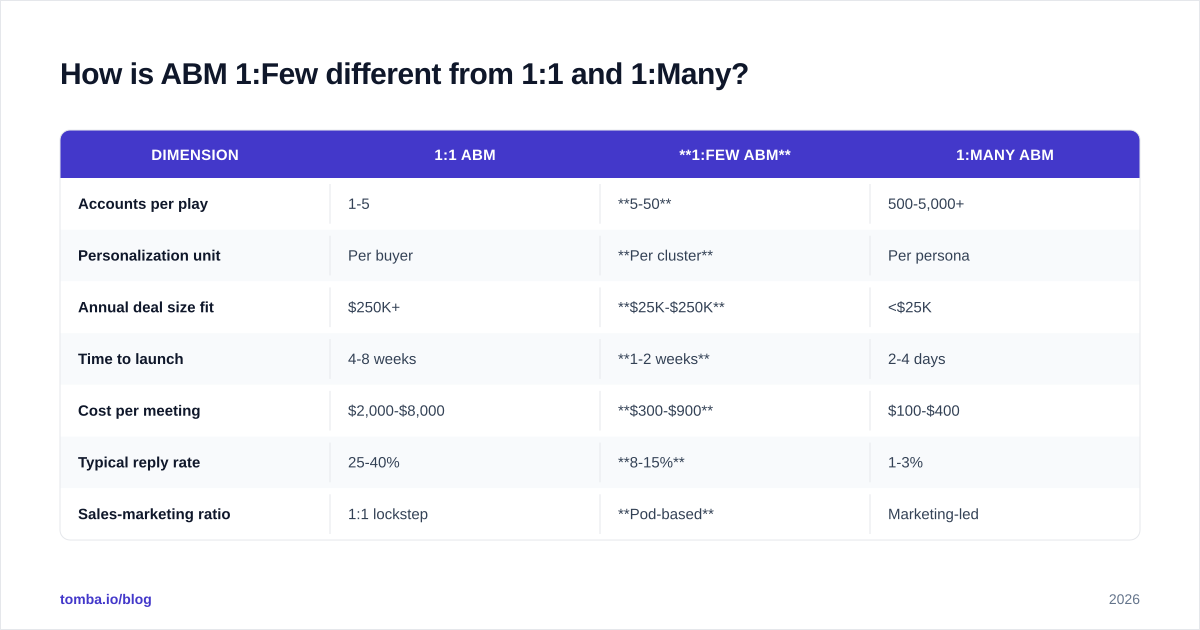
The differences come down to three variables: account count per play, depth of personalization, and the unit of message creation.
| Dimension | 1:1 ABM | 1:Few ABM | 1:Many ABM |
|---|---|---|---|
| Accounts per play | 1-5 | 5-50 | 500-5,000+ |
| Personalization unit | Per buyer | Per cluster | Per persona |
| Annual deal size fit | $250K+ | $25K-$250K | <$25K |
| Time to launch | 4-8 weeks | 1-2 weeks | 2-4 days |
| Cost per meeting | $2,000-$8,000 | $300-$900 | $100-$400 |
| Typical reply rate | 25-40% | 8-15% | 1-3% |
| Sales-marketing ratio | 1:1 lockstep | Pod-based | Marketing-led |
| Reusability of assets | Single-use | Across cluster | Mass-reusable |
The 1:Few sweet spot is teams running $25K-$250K ACV deals into buying committees of three to seven stakeholders. Below that, you can't justify the cluster research time. Above that, you should be running 1:1 plays on your top 20 logos and using 1:Few as the supporting tier.
What does an ABM 1:Few cluster actually look like?#
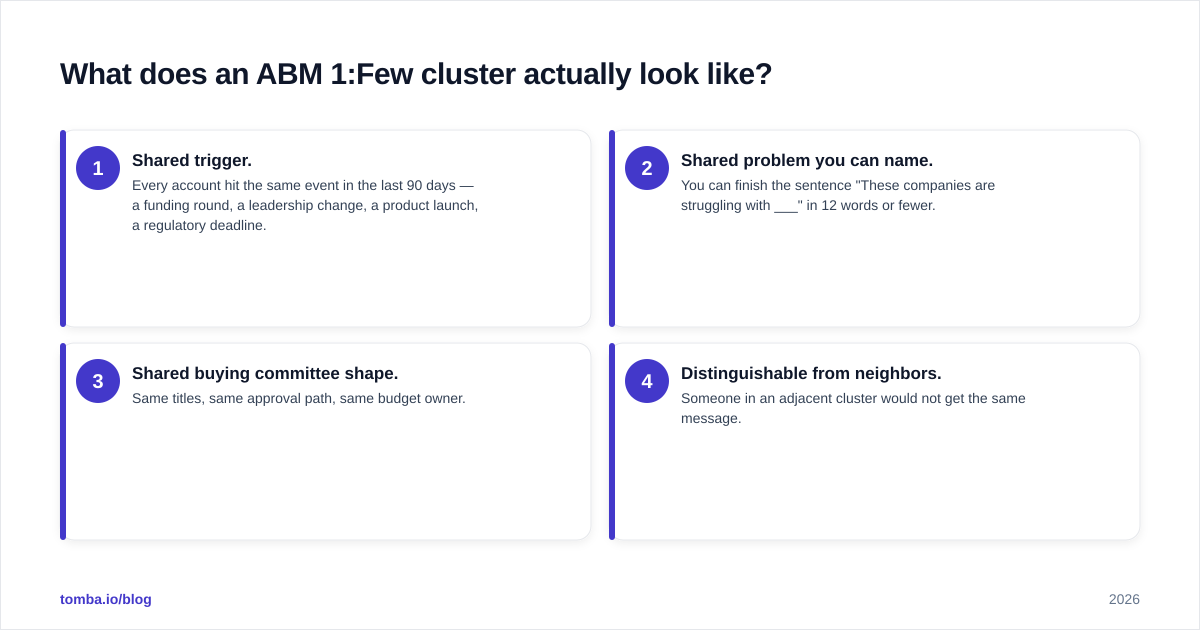
A cluster is not just "mid-market SaaS companies." That's a segment, not a play. A real 1:Few cluster passes four tests:
- Shared trigger. Every account hit the same event in the last 90 days — a funding round, a leadership change, a product launch, a regulatory deadline.
- Shared problem you can name. You can finish the sentence "These companies are struggling with ___" in 12 words or fewer.
- Shared buying committee shape. Same titles, same approval path, same budget owner.
- Distinguishable from neighbors. Someone in an adjacent cluster would not get the same message.
Example clusters that work:
- Series B fintech companies in the EU adapting to PSD3 — cluster of 22 accounts, all hit by the same regulatory clock, all need the same compliance tooling.
- US healthcare networks that just adopted Epic — 14 accounts, predictable integration pain, identical buying committee (CMIO + IT director + compliance).
- D2C brands on Shopify Plus running TikTok Shop pilots — 31 accounts, all trying to solve the same attribution problem.
The wrong way to cluster: "SaaS companies, 50-500 employees, US-based." That's an ICP filter, not a play. You'll write generic copy because the only thing the accounts share is firmographics.
How do you build the account list for a 1:Few play?#
The pipeline is short but each step has to be right.
Step 1: Define the trigger. Pick one observable event — funding, hiring, tech adoption, news, regulatory shift. A weak trigger ("they're growing fast") produces a weak cluster.
Step 2: Source the accounts. This is where most teams over-spend. You don't need a $30K/year data platform. Combine:
- A trigger feed (Crunchbase, BuiltWith, job-posting scrapes, news APIs)
- A firmographic filter (size, geography, industry)
- A negative filter (existing customers, competitors, accounts already in active plays)
Step 3: Enrich contacts. Pull the buying committee — typically 3-7 titles per account. Use a bulk email finder to resolve contact emails at the cluster level rather than one account at a time. Skip accounts where you can't reach two or more committee members; they won't convert.
Step 4: Verify deliverability. Bounce rates above 3% will tank your domain reputation across the whole sequence. Run the list through an email verifier before any send.
Step 5: Stack rank. Even inside a tight cluster, score accounts by fit and intent. Run the top third first, learn, then expand.
What does the 1:Few play itself look like?#
A play has three coordinated layers running for 6-8 weeks against the same cluster.
Layer 1 — Air cover (marketing). A cluster-specific landing page, two to three pieces of content addressing the cluster's named problem, and paid social retargeting against the contact list. Ads do not run cold; they reinforce the outbound touch.
Layer 2 — Direct outreach (sales). A 5-7 touch sequence per contact, with the cluster's shared problem named in the first line of the first email. The opening sentence should be unusable for any other cluster — that's the test.
Layer 3 — Sales-marketing pod. One AE, one SDR, and one marketer share the cluster. They run a weekly 30-minute standup. The marketer adjusts content based on what the AE hears on discovery calls. This is the single biggest execution lever and the one most teams skip.
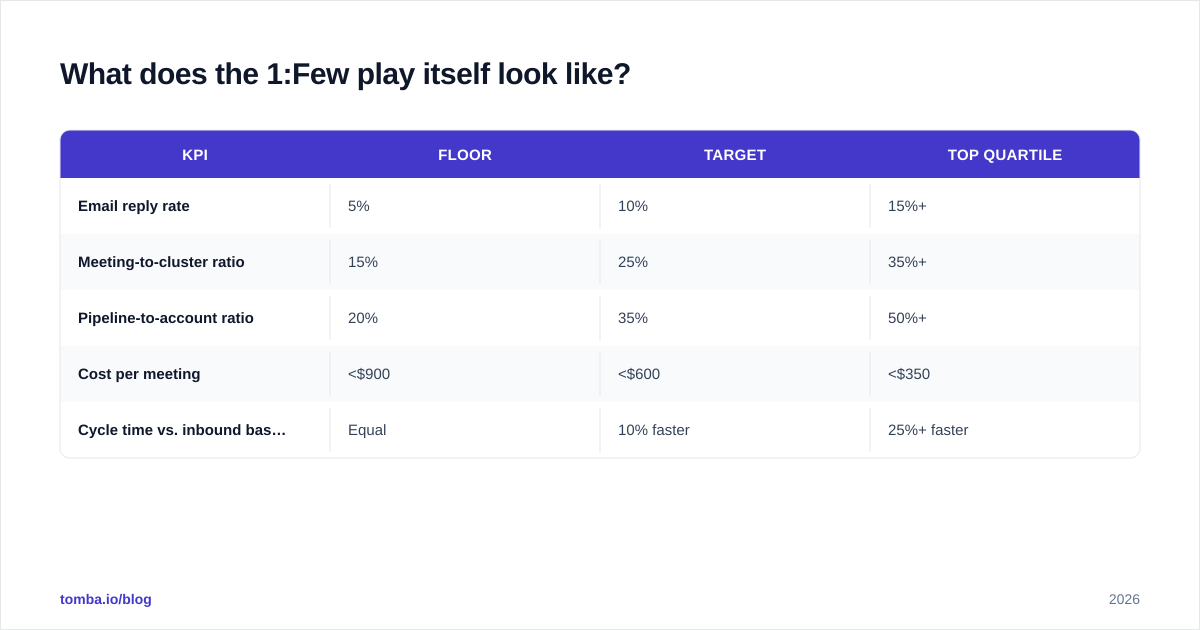
A working 1:Few play hits these benchmarks in 60 days:
| KPI | Floor | Target | Top quartile |
|---|---|---|---|
| Email reply rate | 5% | 10% | 15%+ |
| Meeting-to-cluster ratio | 15% | 25% | 35%+ |
| Pipeline-to-account ratio | 20% | 35% | 50%+ |
| Cost per meeting | <$900 | <$600 | <$350 |
| Cycle time vs. inbound baseline | Equal | 10% faster | 25%+ faster |
If you're below the floor after 60 days, the cluster is the problem, not the tactics. Re-cluster.
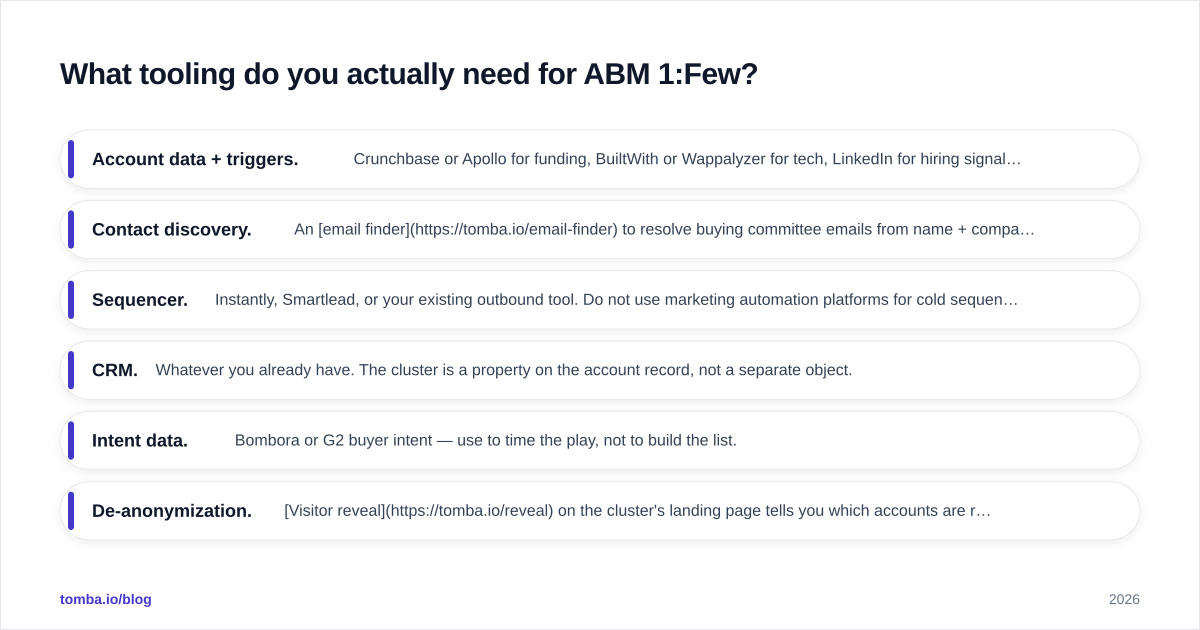
What tooling do you actually need for ABM 1:Few?#
Less than vendors will tell you. Most teams in 2026 are running 1:Few on a stack that costs under $2,000 a month for a five-person pod.
Required:
- Account data + triggers. Crunchbase or Apollo for funding, BuiltWith or Wappalyzer for tech, LinkedIn for hiring signals.
- Contact discovery. An email finder to resolve buying committee emails from name + company. Verify before sending.
- Sequencer. Instantly, Smartlead, or your existing outbound tool. Do not use marketing automation platforms for cold sequences — deliverability is incompatible.
- CRM. Whatever you already have. The cluster is a property on the account record, not a separate object.
Optional but high-leverage:
- Intent data. Bombora or G2 buyer intent — use to time the play, not to build the list.
- De-anonymization. Visitor reveal on the cluster's landing page tells you which accounts are reading without converting.
- LinkedIn automation. Useful for the AE layer; risky at scale.
Skip:
- Full ABM platforms (DemandBase, 6sense, Terminus) until you have 5+ active clusters and have proven the model. They're operating-system bets, not starter kits.
- Dedicated ABM landing-page builders. Your existing CMS works.
G2's 2026 ABM software grid is useful for comparing platforms once you've outgrown the starter stack, but don't anchor on it before you have a working play.
How do you measure ABM 1:Few without lying to yourself?#
Three metrics matter and the rest are noise.
Cluster pipeline coverage. Total pipeline generated from the cluster divided by total ARR target for that segment. A working cluster covers 3x its segment quota in the first quarter.
Cluster velocity multiplier. Average cycle time for cluster-sourced deals divided by your overall cycle time. Target: <0.75. If 1:Few deals close as slowly as inbound, you're not actually personalizing.
Cluster win rate uplift. Win rate on cluster-sourced deals minus baseline win rate. Target: +10 percentage points. Below that, the cluster wasn't tight enough.
What to ignore in the first 90 days: open rates (broken since iOS 15), individual email reply rates (cluster-level is what counts), and engagement scoring across mixed touches.
For a deeper background read on revenue operations metrics that pair with this, Forrester's RevOps research is the cleanest source.
What are the most common ABM 1:Few mistakes?#
After watching dozens of teams ship 1:Few in 2025-2026, the same four mistakes show up:
Cluster too broad. "Mid-market SaaS" is not a cluster. If your opening line could be sent to any account in the list with no edit, you've built a segment, not a cluster. Re-cluster until the opening line is unusable outside the group.
Sales and marketing on different timelines. Marketing launches the landing page in week one, sales starts outreach in week four. By the time prospects click the ad, the AE has already burned the warm intro. Run them concurrently or don't run them.
No exit criteria. Plays drag on for six months because no one defined what "done" looks like. Set a 60-day window, measure against the KPI table above, then either renew, re-cluster, or kill.
Treating 1:Few as a campaign instead of an operating model. The pod structure — AE + SDR + marketer + analyst — is the unit of work, not the campaign. Teams that revert to "marketing hands off to sales" lose the velocity advantage.
A useful sanity check: if you removed the cluster framing, would the play still look different from your generic outbound? If no, it's not actually 1:Few.
How does ABM 1:Few connect to broader revenue operations practice?#
1:Few is the operational expression of account-based RevOps. It forces sales, marketing, and CS to align around the account cluster as the unit of measurement, not the contact or the campaign. That alignment is what most "RevOps transformations" claim to deliver and rarely do.
The teams getting this right in 2026 use 1:Few clusters as their planning unit. Quarterly capacity planning looks like: "We can run 8 clusters in Q3 with the pod we have, each targeting 25 accounts, expected output 60 meetings and $1.8M in pipeline." That's a forecast you can defend. "We'll do more ABM" is not.
If you're building this from scratch, start with one cluster, one pod, 60 days. Don't try to convert the whole org. Prove the unit economics on one play, then scale the pod count.
Final take#
ABM 1:Few wins in 2026 because the data infrastructure finally caught up to the strategy. You can build a tight 20-account cluster, find every buying committee member's email, verify deliverability, and ship a sequenced play in under two weeks — work that took a quarter in 2020.
The leverage point is contact data. A cluster without resolved, verified emails for the full buying committee is a list, not a play. Start there: get the contact data right, get the cluster tight, then let the pod run for 60 days.
Ready to build your first 1:Few cluster? Tomba's Email Finder resolves buying committee emails by domain and name with 95%+ accuracy on the data sources that matter for B2B clusters — funding-staged companies, mid-market SaaS, regulated industries. Start free with 25 searches, then scale into Tomba pricing when your cluster cadence demands it. Your first cluster is two weeks away.
// get started
Find, verify and enrich your first contacts today
Start on the free plan with 25 searches a month, then scale when your team is ready.
Free plan · No credit card required · GDPR & CCPA
// about the author