ABM Account Selection in 2026: A Practical Framework
ABM account selection makes or breaks pipeline. Here's the 2026 framework — ICP scoring, intent signals, tier modeling, and the data stack — used by RevOps teams that hit quota.
TL;DR#
- ABM account selection is the single highest-leverage decision in any account-based motion — get the list wrong and no amount of personalization saves the quarter.
- The 2026 playbook combines firmographic fit, technographic signals, intent data, and rep-level capacity into a tiered list (Tier 1 / 2 / 3) rather than one flat target list.
- Start with 50-150 Tier 1 accounts per rep maximum. Pipeline math, not ambition, sets the ceiling.
- Refresh the list quarterly. Intent decays, funding rounds happen, champions move — a static list rots in 90 days.
- Pair selection with a clean contact layer (titles, verified emails, direct dials) or your "ABM" devolves into spray-and-pray with prettier slides.
What is ABM account selection?#
ABM account selection is the process of choosing which specific companies your sales and marketing teams will pursue with coordinated, personalized programs — and, just as importantly, which ones they will ignore. It is the gatekeeper of the entire account-based motion. Every downstream activity (1:1 ads, custom landing pages, AE outreach, executive gifting, field events) is gated on whether the right name made the list.
The opposite of ABM account selection is "post-and-pray" inbound or sequence-blasted outbound. ABM swaps volume for precision: fewer accounts, deeper coverage per account, more touches across more personas.
Done well, ABM account selection answers four questions:
- Who fits? Firmographic and technographic match to your ideal customer profile.
- Who's ready? Intent, hiring, funding, tech-stack, and engagement signals.
- Who can we serve? Geographic, segment, language, and capacity constraints.
- Who can we close? Honest assessment of competitive position and reference power.
If your current account list answers only #1, you're running a target list, not an ABM list.
Why does ABM account selection matter more in 2026?#
Three forces have made the selection decision more consequential than it was three years ago.
Budgets shrank, win rates didn't. Forrester's 2025 B2B buying study showed average deal cycles up 22% year-over-year for purchases over $100K, while AE headcount in most SaaS orgs is flat or down. You cannot afford to chase the wrong logo for nine months.
AI flattened the outreach layer. When every competitor's SDR has Claude or GPT writing their cold emails, the differentiator is no longer the email — it's who you sent it to. Selection is the new copywriting.
Buying committees grew. Gartner pegs the average enterprise B2B committee at 11+ stakeholders. Hitting them requires research, data, and budget per account. You can only afford that depth on a list you've earned the right to call narrow.
How do you build an ICP that actually drives selection?#
An ICP is not a paragraph in a Notion doc. It's a set of measurable filters that a SQL query (or a B2B database query) can return rows against. Start with closed-won data from the last 18 months.
The five non-negotiable ICP dimensions:
| Dimension | What to measure | Where to get it |
|---|---|---|
| Firmographics | Industry (NAICS/SIC), employee count, revenue, geography | LinkedIn,ZoomInfo, Crunchbase, Tomba |
| Technographics | Current stack (CRM, MAP, data warehouse, billing) | BuiltWith, HG Insights, website tech stack |
| Buying triggers | Funding, hiring, exec changes, M&A, product launches | Crunchbase, LinkedIn Jobs, news APIs |
| Org structure | Has the role you sell to, reporting line, team size | LinkedIn Sales Nav, Tomba LinkedIn finder |
| Behavioral fit | Visits to pricing page, demo requests, content downloads | Your MAP + reveal tools |
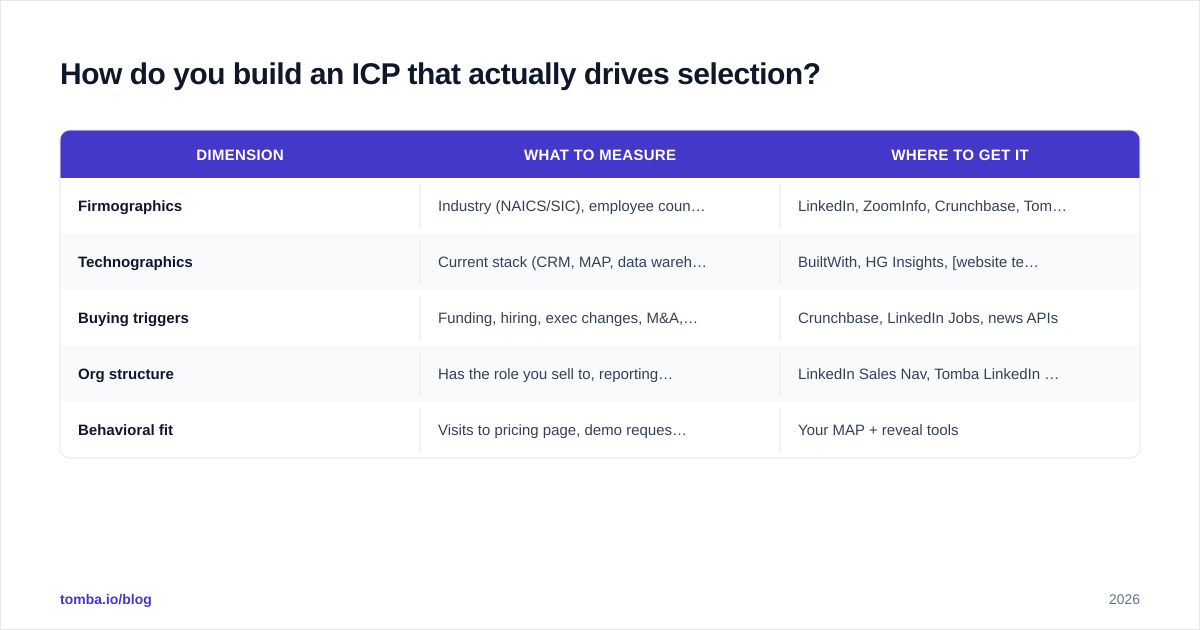
Pull your closed-won list, score each of these on a 1-5 scale, and look for the cluster. If 80% of your wins came from Series B SaaS companies with 150-500 employees running Salesforce + Hubspot, that's not your ICP "lean" — that's your ICP, full stop. Don't pad it with aspirational logos.
What is the right ABM account selection framework?#
The 2026 framework most high-performing teams converge on is a four-layer scoring stack. Each layer either filters the list smaller or re-ranks what survived.
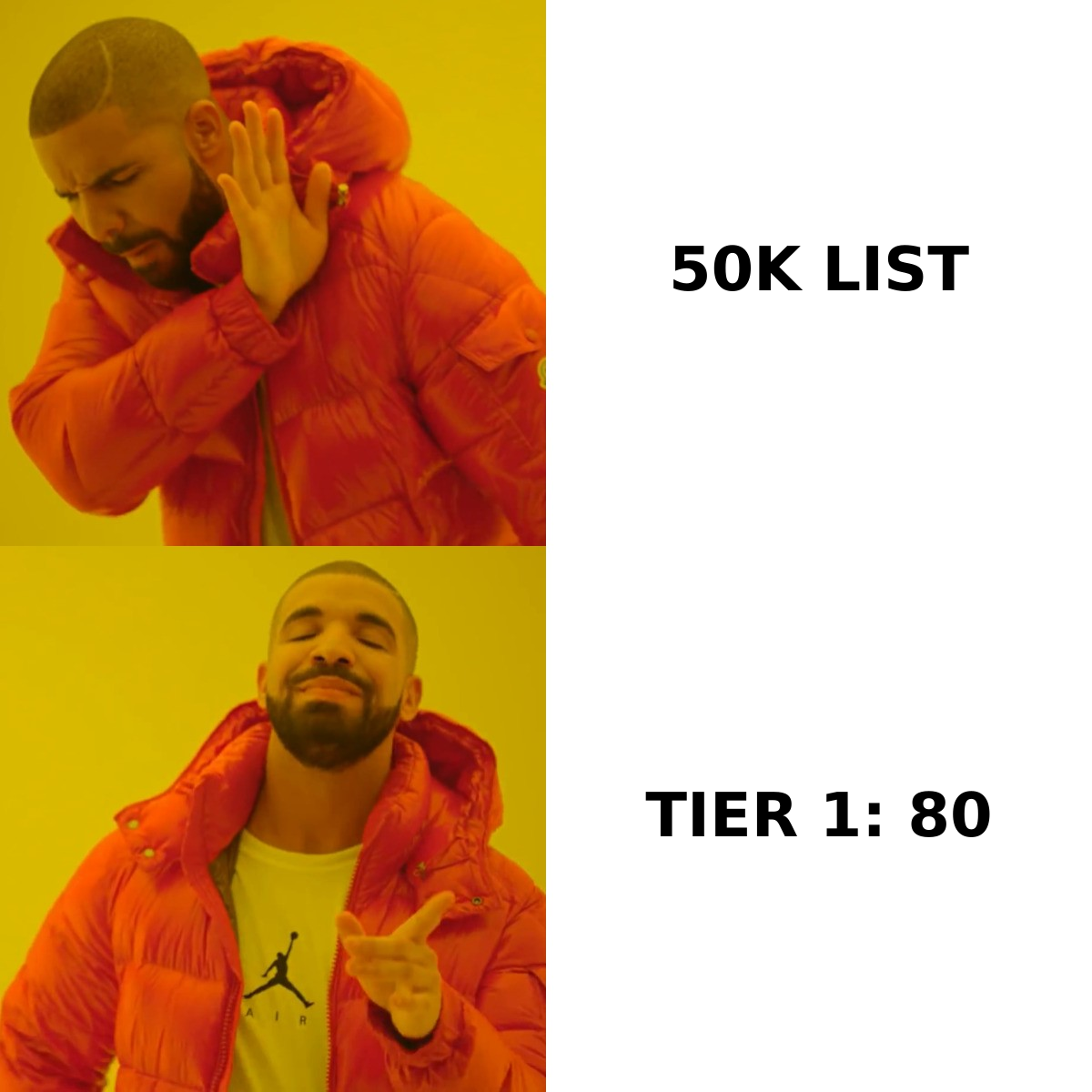
Layer 1 — Fit score (firmographic + technographic). A 0-100 score on hard ICP attributes. Anything below 60 drops out. This usually takes a list of ~50,000 named companies down to ~3,000-5,000.
Layer 2 — Capacity score (org + role coverage). Does the account have the personas you sell to? Are they reachable? Use data enrichment to pull verified titles, team sizes, and contact methods. Anything below 5 reachable buying-committee contacts is a coverage problem.
Layer 3 — Intent score (signal stack). Layer in 3-5 intent sources: Bombora topic surges, Gartner Digital Markets, G2 buyer intent, your own first-party site visits via visitor identification, and hiring signals from job boards. Score weekly, not quarterly.
Layer 4 — Win-probability score. Honest rep input + competitive context. Do you have a reference customer in their industry within 50 miles or one tier larger? Is the incumbent vendor renewable in the next 12 months? Are you on their stack's approved-vendor list?
Multiply, don't average. A 95 fit score with a 10 win-probability is not a Tier 1 account — it's a daydream.
How many accounts should each rep get?#
Pipeline math, not gut feel, decides this. A practical formula:
Target accounts per rep =
  (annual quota / average deal size)
  / (target win rate × target opportunity-creation rate)
For a rep with a $1.2M quota, $60K ACV, a 25% win rate, and a 20% account-to-opp rate:
- Deals needed: 20
- Opps needed: 80
- Accounts to actively work: 400
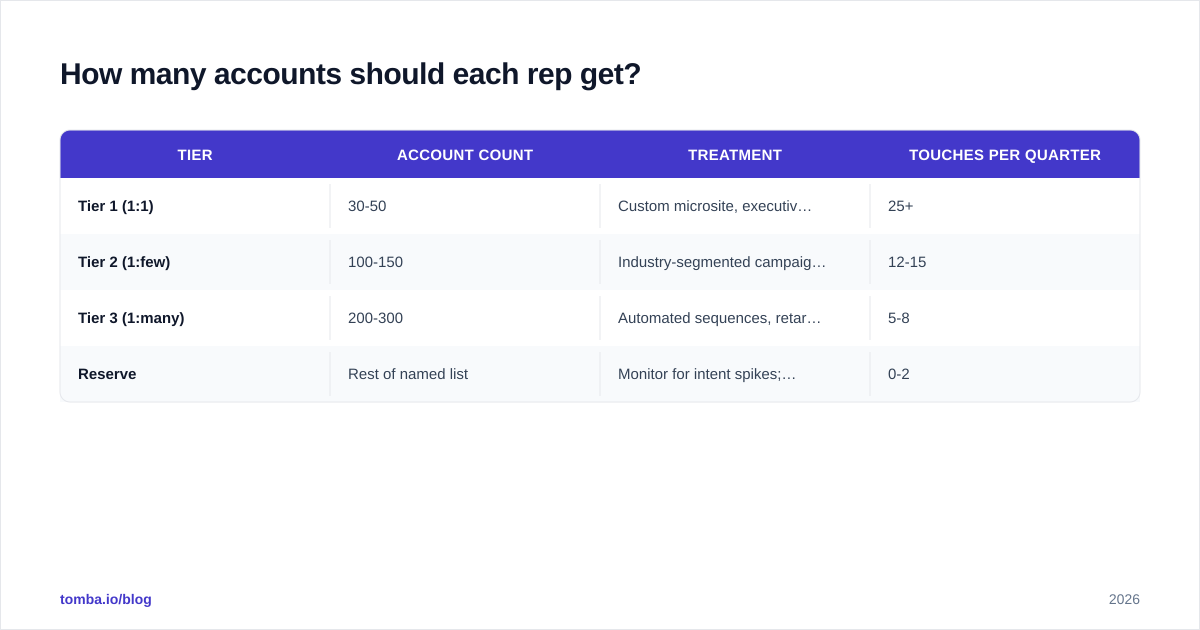
But 400 is the active pool, not the deep-personalization pool. Split it across tiers:
| Tier | Account count | Treatment | Touches per quarter |
|---|---|---|---|
| Tier 1 (1:1) | 30-50 | Custom microsite, executive gifting, ABM ads, AE-owned plan | 25+ |
| Tier 2 (1:few) | 100-150 | Industry-segmented campaigns, AE + SDR coverage | 12-15 |
| Tier 3 (1:many) | 200-300 | Automated sequences, retargeting, content nurture | 5-8 |
| Reserve | Rest of named list | Monitor for intent spikes; promote on signal | 0-2 |
The mistake teams make is treating Tier 1 like Tier 3 — running 50 accounts on a generic sequence and calling it ABM. The opposite mistake is treating Tier 3 like Tier 1 and spending two hours of AE prep on a logo with a 5% chance of buying.
What data sources power the selection engine in 2026?#
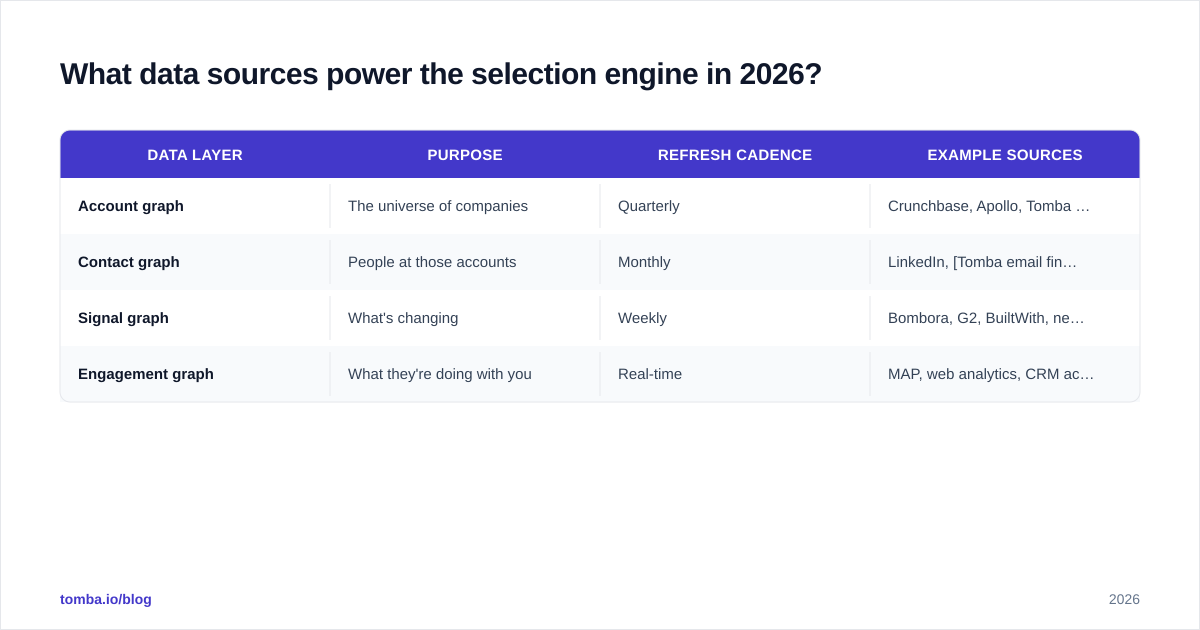
You need four data layers, and they must reconcile to a single account record.
| Data layer | Purpose | Refresh cadence | Example sources |
|---|---|---|---|
| Account graph | The universe of companies | Quarterly | Crunchbase, Apollo, Tomba domain search |
| Contact graph | People at those accounts | Monthly | LinkedIn, Tomba email finder, Lusha |
| Signal graph | What's changing | Weekly | Bombora, G2, BuiltWith, news |
| Engagement graph | What they're doing with you | Real-time | MAP, web analytics, CRM activity |
The two pitfalls: relying on a single vendor (every database has blind spots), and never reconciling duplicates (Acme Inc vs Acme, Inc. vs acme.com creates three accounts and three half-coverage attempts). De-dupe on root domain, not on company name.
For contact-layer accuracy, public benchmarks from G2 consistently rank verified-on-demand providers (rather than static databases) at the top of the freshness leaderboard. The Tomba domain search and email verifier sit in that verified-on-demand camp.
How do you score and tier accounts week to week?#
The tiering itself is just math. The hard part is keeping it fresh. A rough operational rhythm:
- Daily: ingest first-party signals (site visits, demo requests, content downloads) and re-rank Tier 1 within itself.
- Weekly: pull intent surges, refresh tiering on the top 500 accounts, promote/demote based on a 2-point change.
- Monthly: refresh contact and title data, re-run reachability scoring, flag accounts where your champion moved.
- Quarterly: re-baseline the full ICP against the last quarter of closed-won/closed-lost, prune dead accounts, add new ones from the universe.
Treat the list as a living asset. If your "target accounts" tab in Salesforce hasn't been updated since Q4, you don't have an ABM program — you have a spreadsheet.

What are the most common mistakes in ABM account selection?#
Five failure modes show up repeatedly in account-based programs that miss number:
- Logo lust. Picking F500 names because they look good on slides, ignoring that the win rate is 2%. Symptom: your "Tier 1" is your CEO's wish list.
- No exclusion criteria. Every ABM list needs a "do not pursue" filter — wrong geography, sanctioned entities, existing competitor partnerships, regulatory blockers. If your list has no exclusions, you haven't selected, you've just listed.
- Marketing and sales pick different lists. Marketing runs ads to one set, sales calls another. The result is wasted spend and lost attribution. One list. One CRM. One tiering schema.
- No intent layer. A fit score without intent tells you who could buy in five years, not who's evaluating now. Intent is what makes ABM time-sensitive.
- Stale contact data. You picked the perfect 100 accounts, then your AEs find that 40% of the contact records bounce. Run the list through a bulk email verifier before the campaign launches, not after.
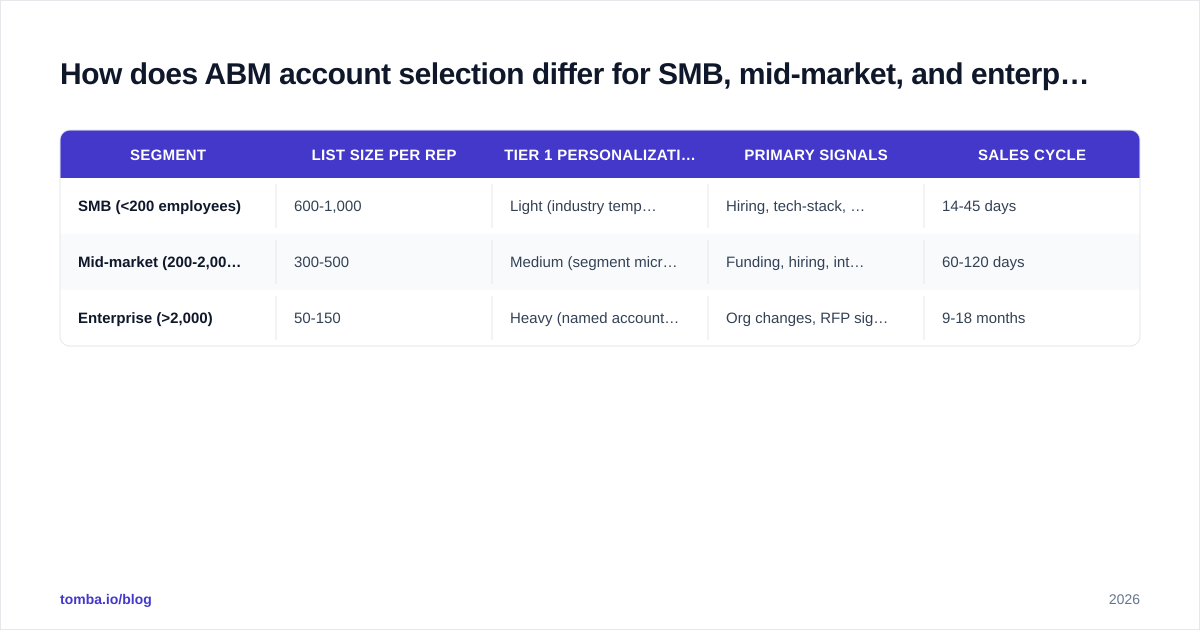
How does ABM account selection differ for SMB, mid-market, and enterprise?#
| Segment | List size per rep | Tier 1 personalization | Primary signals | Sales cycle |
|---|---|---|---|---|
| SMB (<200 employees) | 600-1,000 | Light (industry templates) | Hiring, tech-stack, web visits | 14-45 days |
| Mid-market (200-2,000) | 300-500 | Medium (segment microsites, role-based) | Funding, hiring, intent topics, G2 reviews | 60-120 days |
| Enterprise (>2,000) | 50-150 | Heavy (named account plans, custom assets, exec sponsors) | Org changes, RFP signals, partner intros | 9-18 months |
The enterprise game is depth. The SMB game is throughput. Mid-market is where most teams mis-calibrate — running an enterprise list size with SMB personalization, getting the worst of both.
Where does Tomba fit in the ABM account selection stack?#
Tomba's role in the selection workflow is the contact and verification layer underneath the account graph. Once you've picked the accounts, you still need verified emails, direct LinkedIn profiles, phone numbers, and pattern-matched company contacts to actually run plays against them.
| Use case | Tomba surface |
|---|---|
| Map every contact at a target account | Domain search |
| Find specific buying-committee personas | Email finder and LinkedIn finder |
| Get direct dials for Tier 1 executives | Phone finder |
| Bulk verify a 500-row Tier 2 list | Bulk email verifier |
| Enrich CRM accounts with firmographics | Data enrichment |
| Drop verified contacts into the CRM | HubSpot integration or Salesforce integration |
Tomba does not replace account-intent vendors (Bombora, G2, 6sense). It sits next to them — the moment intent fires, you need to know exactly who to contact, with confidence the email won't bounce.
Pricing reference: Tomba starts at a free tier (25 searches/month), with paid plans from $49/month — see full Tomba pricing. For larger enterprise lists, the Tomba API and bulk tools keep cost-per-verified-contact predictable.
How do you measure if your ABM account selection is working?#
Selection quality isn't measured in account count — it's measured in conversion through the funnel. Track these four ratios at 60, 90, and 180 days post-launch:
- Engagement rate per tier — Tier 1 should hit 60%+ engagement (any meaningful interaction) within 90 days. If Tier 1 looks like Tier 3, the personalization isn't landing or the accounts aren't actually fit.
- Meeting-set rate per tier — Tier 1 should run 3-5x Tier 3. Otherwise tiering is theater.
- Opportunity-creation rate — across all tiers, you want 15-25% of target accounts to become opps within two quarters. Below 10% means selection is broken (or coverage is).
- Win rate on ABM accounts vs control — pull a matched cohort of non-ABM accounts and compare close rates. If ABM doesn't outperform by at least 30%, the program isn't earning its cost.
Use a tool like the HubSpot account-based marketing dashboard or a custom CRM report to track these. Don't take vendor case studies at face value — measure with your own pipeline.
Conclusion: pick fewer, cover deeper#
If you take one thing away: ABM account selection rewards restraint. The teams that hit quota in 2026 are not the ones with the biggest target lists — they're the ones whose Tier 1 is 40 accounts deep on contacts, signals, exec sponsorship, and competitive context.
Get the list right. The rest of the motion gets easier.
Run your shortlist through Tomba. Once you've tiered your accounts, use the Tomba Email Finder to map every persona on each Tier 1 account, verify the addresses in bulk, and sync the result straight to your CRM. Start free — no credit card required — and only upgrade once the pipeline math justifies it.
// get started
Find, verify and enrich your first contacts today
Start on the free plan with 25 searches a month, then scale when your team is ready.
Free plan · No credit card required · GDPR & CCPA
// about the author