ABM Advertising Platform: The 2026 Buyer's Guide
Choosing an ABM advertising platform in 2026 means cutting through identity graphs, intent data, and CTV hype. Here's how the top tools actually compare on targeting accuracy, attribution, and price.
ABM Advertising Platform: The 2026 Buyer's Guide
TL;DR
- An ABM advertising platform serves paid media to a defined list of target accounts and the buying group inside each account, not to anonymous cookies or broad lookalikes.
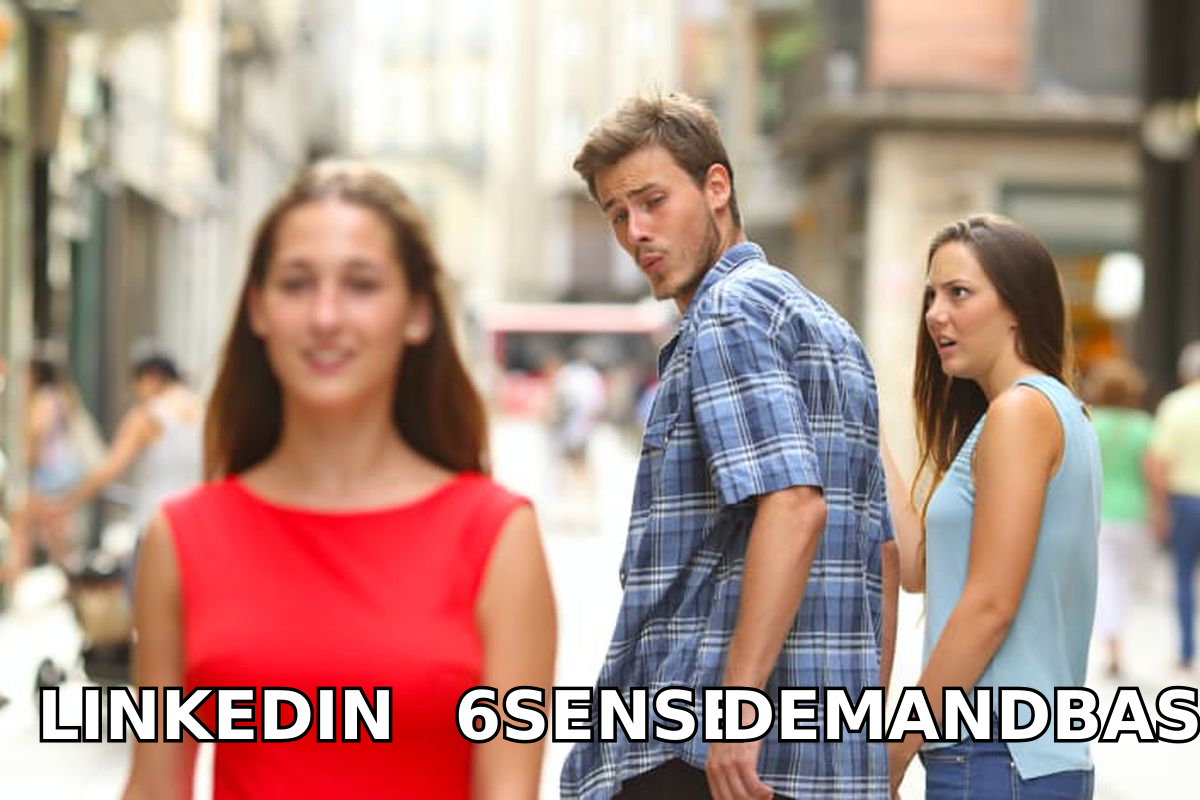
- The 2026 category has consolidated into three buckets: identity-first platforms (6sense, Demandbase), workflow-first platforms (RollWorks, Terminus), and channel-native tools (LinkedIn ABM, Meta).
- The right pick depends on whether your bottleneck is account identification, ad delivery, or attribution — not on which vendor has the loudest analyst report.
- Expect to pay $40K-$150K/year for a real platform plus a 12-week ramp. Anything cheaper is either a media-buying tool with ABM branding or a list builder.
- The platform is only as good as the account list and contact data feeding it. Bad inputs make the most expensive ABM stack underperform a clean LinkedIn campaign.
What is an ABM advertising platform?#
An ABM advertising platform is a paid-media system designed to target named accounts (and the specific buying-committee members inside them) across display, video, social, and connected TV — instead of the anonymous, interest-based segments traditional ad platforms reach.
The mechanical difference comes down to identity. A normal DSP buys impressions against cookies, device IDs, or contextual signals. An ABM advertising platform buys impressions against a list of companies, resolved through an identity graph that maps IPs, deterministic device matches, B2B cookie pools, and CRM data back to a specific employer.
That identity layer is what you're really paying for. Everything else — the campaign builder, the reporting dashboard, the intent feeds — is built on top of it.
A modern ABM ad platform typically includes:
- An account identification engine (firmographics + IP reverse-lookup + third-party identity graphs)
- An intent-data layer (Bombora, G2, native first-party signals)
- A media-buying engine (programmatic display, LinkedIn, sometimes CTV and audio)
- Account-level reporting (impressions, engagement, opportunities, pipeline by account, not by cookie)
- CRM/MAP integrations to sync target lists in and engagement data out
Skip any one of those and you're back to running B2B campaigns in a B2C tool.
Why has ABM advertising replaced traditional B2B display?#
Traditional B2B display died for three reasons, and ABM platforms exist to fix all three.
Cookies broke. Chrome's phase-out, Apple's ITP, and Firefox tracking protection mean cookie-based audiences leak 30-60% of the desktop traffic they used to capture. B2B buyers — who skew toward Mac, Chrome, and corporate VPNs — leak the most. ABM platforms shifted to deterministic identity (IP + reverse DNS + verified B2B graphs) years ago and weather the deprecation better than retargeting tools that still depend on third-party cookies.
Targeting got noisy. "Marketing manager at 100+ employee SaaS company" sounds tight until you run the campaign and discover LinkedIn shows it to 14 million people. Account-list targeting cuts that to your actual TAM — usually 500 to 5,000 companies — which means every impression has a chance of moving a real deal.
Attribution caught up. B2B sales cycles are 6-18 months. By the time a deal closes, the original click is long forgotten. ABM platforms report at the account level, so a display impression in February can still get credit when the opportunity opens in August. That changes how CFOs grade the channel.
For a primer on the broader category, see Gartner's Account-Based Marketing research and the G2 ABM platform grid.
What are the top ABM advertising platforms in 2026?#
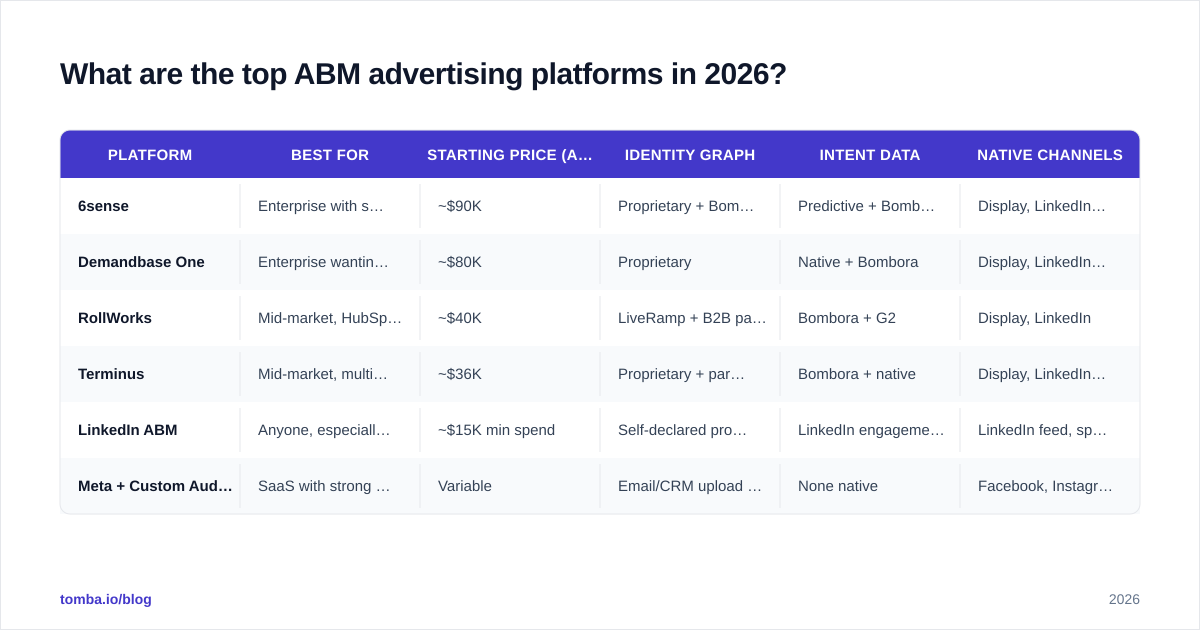
The market has consolidated. Five platforms own the serious enterprise share, with LinkedIn's native ABM tooling pulling SMB and mid-market budgets that used to flow into smaller point tools.
| Platform | Best for | Starting price (annual) | Identity graph | Intent data | Native channels |
|---|---|---|---|---|---|
| 6sense | Enterprise with strong RevOps team | ~$90K | Proprietary + Bombora | Predictive + Bombora | Display, LinkedIn, CTV |
| Demandbase One | Enterprise wanting all-in-one | ~$80K | Proprietary | Native + Bombora | Display, LinkedIn, CTV, audio |
| RollWorks | Mid-market, HubSpot-native | ~$40K | LiveRamp + B2B partners | Bombora + G2 | Display, LinkedIn |
| Terminus | Mid-market, multi-channel coverage | ~$36K | Proprietary + partners | Bombora + native | Display, LinkedIn, chat, email |
| LinkedIn ABM | Anyone, especially seed → Series B | ~$15K min spend | Self-declared profile data | LinkedIn engagement | LinkedIn feed, sponsored InMail |
| Meta + Custom Audiences | SaaS with strong PLG signal | Variable | Email/CRM upload only | None native | Facebook, Instagram |
Two notes on pricing. First, vendor sticker prices climb fast with target-account count and channel add-ons — the numbers above reflect entry-level annual commits, not realistic mid-market totals. Second, LinkedIn's "ABM" is technically Matched Audiences uploaded as company lists. It works, but it lacks the identity graph that lets you target unknown visitors from those companies.
If you're stress-testing the analyst rankings, Forrester's ABM platform wave and G2's ABM grid are the two reports worth reading end to end.
How do you choose the right ABM advertising platform?#
Start with the bottleneck, not the feature list. Most ABM platform failures trace back to buying a tool that solves a problem you don't have.
Bottleneck 1: You don't know who to target. You need account identification and predictive scoring. 6sense and Demandbase win here. Both ship with prebuilt intent topics, lookalike models, and TAL (target-account-list) builders that pull from firmographic + technographic data. RollWorks' predictive model is solid for mid-market but thinner on enterprise signals.
Bottleneck 2: You have the list but can't reach the buying committee. You need a strong identity graph and multi-channel reach. Look at coverage rates — what percentage of your target accounts the platform can actually serve ads to. Anything under 70% is a dealbreaker. Run a coverage test before signing: hand over your TAL and demand a written match-rate report.
Bottleneck 3: You can deliver ads but can't prove they worked. You need account-level attribution and CRM-deep integration. Demandbase and Terminus have the most mature reporting against opportunity stages. If your CRM is HubSpot, RollWorks integrates more cleanly than the enterprise options.
Bottleneck 4: You have the data but contact records are stale. The platform won't fix bad data. You'll need a contact-enrichment layer feeding clean records into the TAL. This is where pairing an ABM platform with a dedicated data enrichment tool pays for itself within a quarter — wrong emails and missing job titles silently degrade every other layer of the stack.
For the underlying definitions, the revenue operations and marketing qualified lead glossary entries are worth a skim before vendor calls.
What features actually matter in an ABM advertising platform?#
Vendor demos optimize for what looks impressive in a deck. Here's what actually moves pipeline.
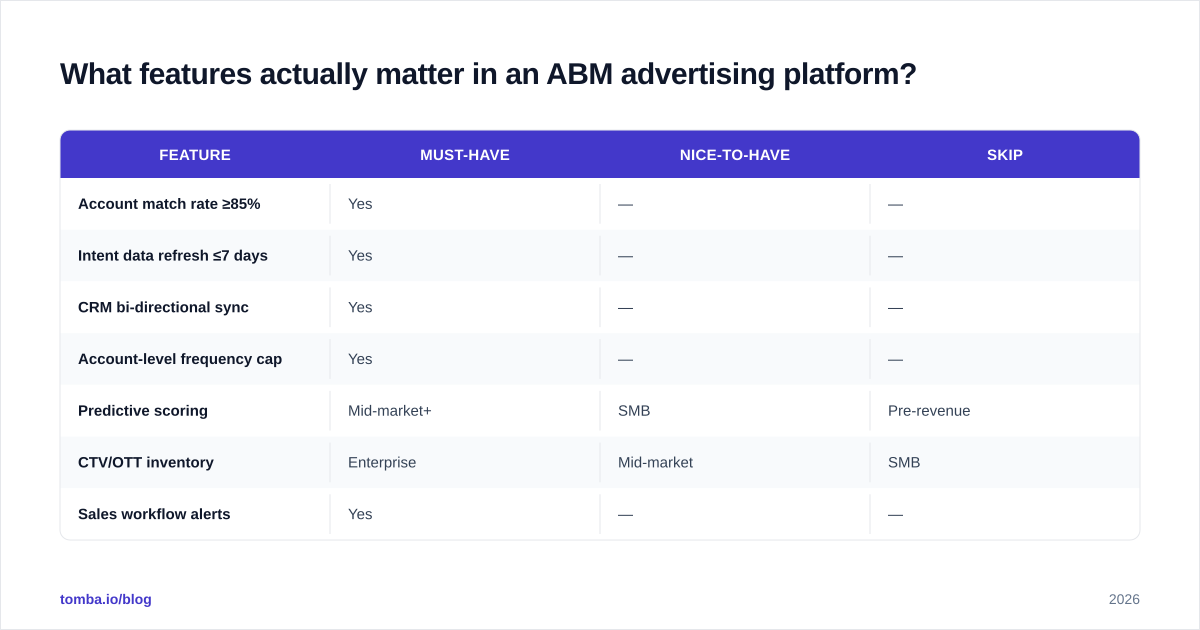
Account match rate. When you upload 1,000 accounts, how many can the platform serve ads to within 30 days? Below 70% is broken. Above 90% means the identity graph is doing its job. Always negotiate this into the contract as an SLA.
Buying-group expansion. Does the platform identify additional contacts at the same account beyond your seed list? A target-account list of 500 companies should expand to thousands of in-market contacts. If it doesn't, you're paying enterprise prices for what amounts to a contact uploader.
Intent freshness. Weekly intent updates are the floor in 2026. Daily is the standard for top platforms. Anything refreshed monthly is a static report dressed up as a signal.
CRM write-back depth. Engagement signals should write back to the opportunity, not just the contact. This is what lets sales know that the CFO viewed three ads last week — the kind of context that changes a call-script in real time.
Frequency capping at the account level. Most B2C tools cap by cookie. ABM tools should cap by company, so a target account doesn't get hit 80 times because eight people share an office.
| Feature | Must-have | Nice-to-have | Skip |
|---|---|---|---|
| Account match rate ≥85% | Yes | — | — |
| Intent data refresh ≤7 days | Yes | — | — |
| CRM bi-directional sync | Yes | — | — |
| Account-level frequency cap | Yes | — | — |
| Predictive scoring | Mid-market+ | SMB | Pre-revenue |
| CTV/OTT inventory | Enterprise | Mid-market | SMB |
| Sales workflow alerts | Yes | — | — |
| Native chat | — | Yes | — |
| Built-in webinar tools | — | — | Skip |
How do you measure ABM advertising performance?#
Forget CTR. Click-through rate is a useless metric for ABM because the goal isn't a click — it's lifting awareness, intent, and meeting acceptance across a buying committee that may never click your ad and still buy.
The metrics that matter:
Account engagement score. A weighted blend of impressions served, site visits, content consumed, ad clicks, and rep meetings. Each platform calculates it differently; what matters is the trend per account over time.
Lifted opportunity rate. Compare opportunity creation rate among accounts the platform served ads to versus a matched holdout. Anything under 1.5x lift suggests the campaign isn't working — or the matched holdout was set up wrong.
Pipeline influenced. Dollar value of opportunities where at least one decision-maker saw N impressions before the opp opened. Most platforms default to a 90-day attribution window; 180 days is more honest for enterprise sales cycles.
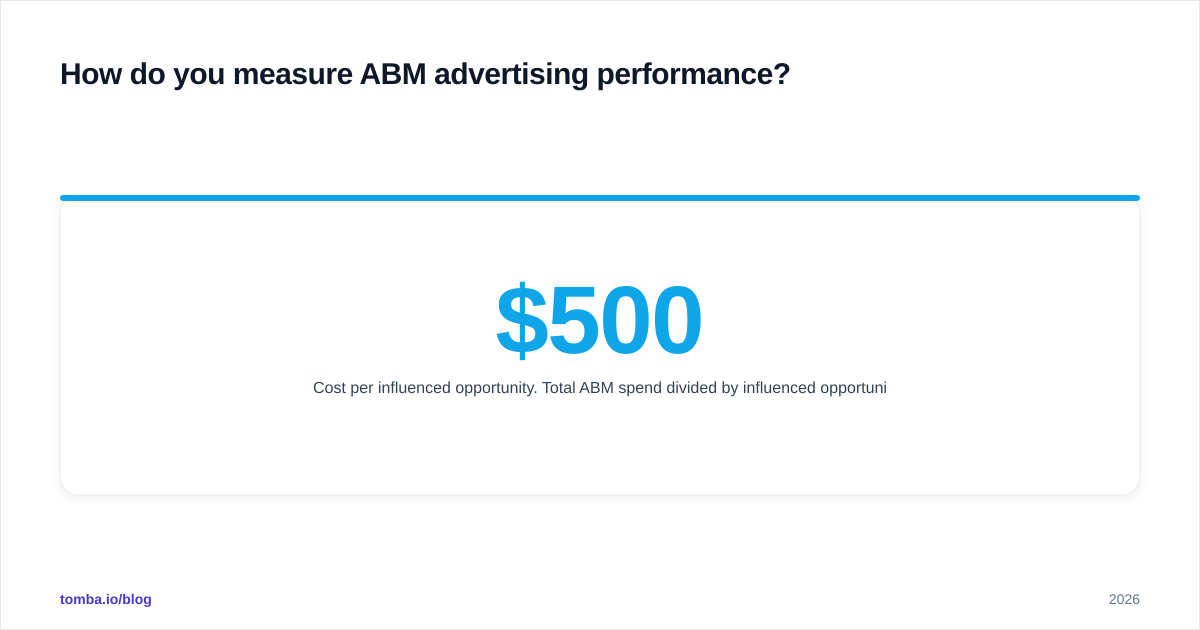
Cost per influenced opportunity. Total ABM spend divided by influenced opportunities. Benchmarks vary by ACV: $500-1,500 for $50K ACV deals, $2,000-5,000 for $250K+ ACV.
Velocity change. Are deals influenced by ABM closing faster than the baseline? This is the metric CFOs respect because it shows up in cash flow, not just marketing reports.
How does an ABM advertising platform fit into your sales stack?#
The platform is one layer of a larger stack. Putting it in the right place determines whether it pays back.
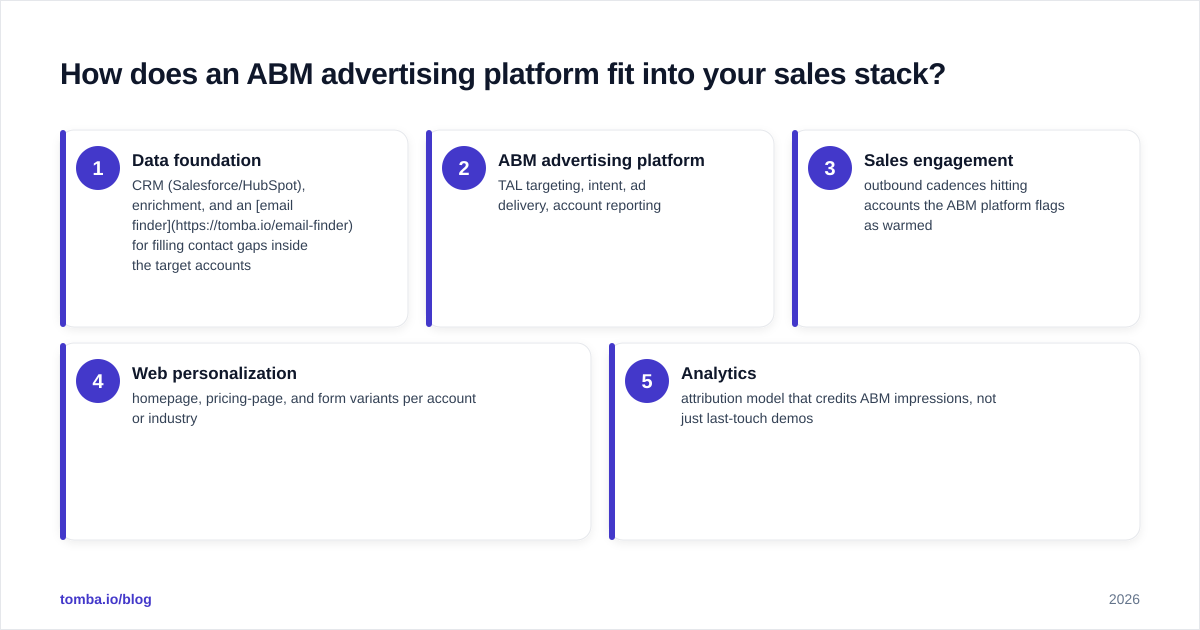
The most common stack in 2026 looks like:
- Data foundation — CRM (Salesforce/HubSpot), enrichment, and an email finder for filling contact gaps inside the target accounts
- ABM advertising platform — TAL targeting, intent, ad delivery, account reporting
- Sales engagement — outbound cadences hitting accounts the ABM platform flags as warmed
- Web personalization — homepage, pricing-page, and form variants per account or industry
- Analytics — attribution model that credits ABM impressions, not just last-touch demos
Most failures happen at layer 1. You can't run ABM campaigns against a CRM where 40% of contacts have bounced emails or stale job titles. Before signing an ABM platform contract, audit your contact data: run a verification pass against your existing CRM, then commit to monthly hygiene cycles. A clean email verifier feed into the CRM keeps the ABM platform fed with accurate buying-committee records.
For the data-feeding side, a domain search workflow is how you fill the gap when the TAL has a company but no named contacts to target.
What are the common ABM advertising mistakes to avoid?#
The same five mistakes show up across nearly every ABM program that stalls.
Mistake 1: Too many accounts. A 5,000-account list dilutes spend until every account gets four impressions. Tighter is better — start with 200 to 500 accounts you can actually win, prove it, then scale.
Mistake 2: No sales alignment. The marketing team runs ABM campaigns. Sales never sees the engagement signals. Result: zero follow-up on warmed accounts, zero feedback on bad-fit accounts. Build a weekly sync where reps mark accounts as "good fit," "bad fit," or "expand the buying group."
Mistake 3: One-shot creative. Running the same display ad for six months trains buyers to ignore it. Rotate creative every 4-6 weeks, A/B test pain-points versus solution framing, and align ad messaging to deal stage when the platform supports it.
Mistake 4: Ignoring contact-level data quality. ABM platforms are great at identifying companies. They're worse at maintaining individual contact records. Pair the platform with a dedicated contact-enrichment workflow or accept that 30%+ of your buying-committee data will be wrong within a year.
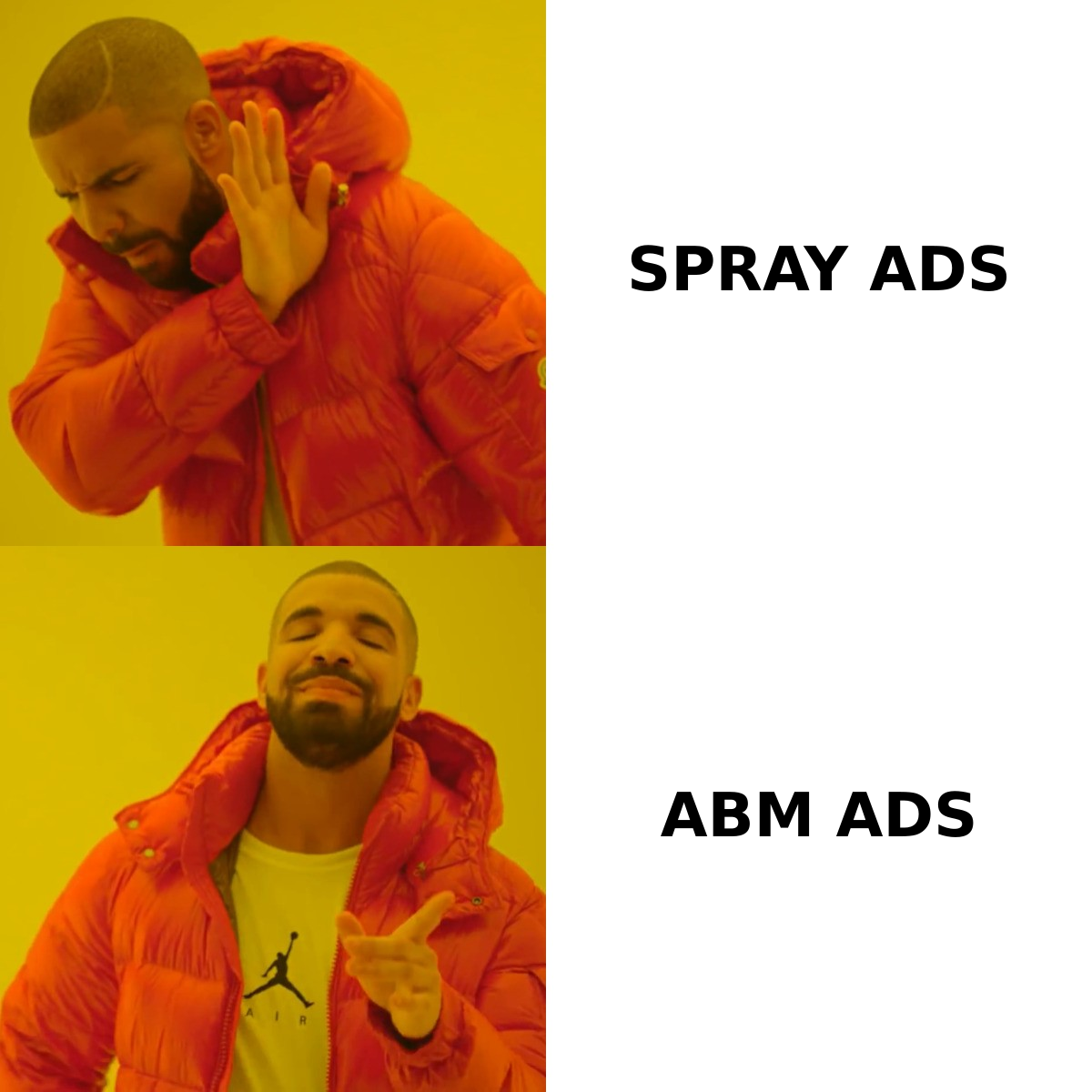
Mistake 5: Measuring like it's PPC. Judging ABM by CTR or CPC drives the program back into spray-and-pray performance marketing. Pick three account-level metrics, set a 9-month baseline before scoring, and resist the quarterly "is this working" panic.
For broader sales motion fundamentals, HubSpot's ABM guide and Salesforce's ABM playbook are decent backstops if you need internal stakeholders to align on definitions.
What's the realistic timeline to ROI?#
Real ABM advertising platforms produce influenced pipeline at 90-120 days and measurable closed-won lift at 9-12 months. Anyone selling a faster ramp is either overpromising or counting the wrong thing.
Month 1. Implementation. Connect CRM, upload TAL, define intent topics, ship first creative. Month 2-3. Campaigns live. Match rates stabilize. Engagement signals start writing back to CRM. Month 4-6. Influenced pipeline shows up. Reps begin getting alerts on warm accounts. Velocity improvements emerge. Month 7-12. Closed-won attribution catches up. The CFO sees real revenue tied to ABM-influenced deals.
Budget for the full year. ABM advertising platforms are not a Q2 campaign — they're a foundational layer that compounds over multiple quarters.
Build the contact foundation before you buy#
An ABM advertising platform amplifies whatever data you feed it. If your target-account list is clean and your buying-committee contacts are accurate, the platform shows you exactly which accounts are in market and which deals to accelerate. If the data is stale, the most expensive platform in the world serves ads to the wrong people at the right companies — and you'll blame the vendor when the real problem is upstream.
Before you sign a six-figure ABM contract, build the contact foundation. Use Tomba Email Finder to verify and complete buying-committee records across every account on your TAL — accurate emails, current job titles, verified domains. Start free with 25 searches, see how complete your real coverage is, then scale on the Tomba plan that matches your account-list size. The ABM platform you buy next will work harder because of it.
// get started
Find, verify and enrich your first contacts today
Start on the free plan with 25 searches a month, then scale when your team is ready.
Free plan · No credit card required · GDPR & CCPA
// about the author