ABM Agency Guide 2026: How to Pick the Right Partner
An ABM agency can compress your enterprise sales cycle by 40% — or burn six figures on bespoke landing pages no one visits. Here's how to tell which one you're hiring.
ABM Agency Guide 2026: How to Pick the Right Partner
TL;DR
- An ABM agency runs account-based marketing programs on your behalf — target list building, intent data, ad orchestration, personalized landing pages, and sales plays — instead of you staffing it in-house.
- Expect $8K–$60K per month depending on tier (1:1, 1:few, 1:many) and how much creative production sits inside the retainer.
- The best agencies tie fees to pipeline sourced or influenced, not impressions or MQLs.
- ABM only works when sales and marketing share the same target account list and the same definition of "engaged." Agencies that skip the alignment workshop are selling you ads, not ABM.
- Tools handle the data layer (intent, enrichment, identity resolution). The agency handles strategy, creative, and orchestration. You still own the sales motion.
What does an ABM agency actually do?#
An ABM agency is a marketing services firm that runs account-based marketing programs for B2B companies selling into a defined list of high-value accounts. Instead of running broad demand-gen campaigns aimed at lead volume, they orchestrate coordinated touches — ads, email, direct mail, sales outreach, custom microsites — against a specific set of target companies.
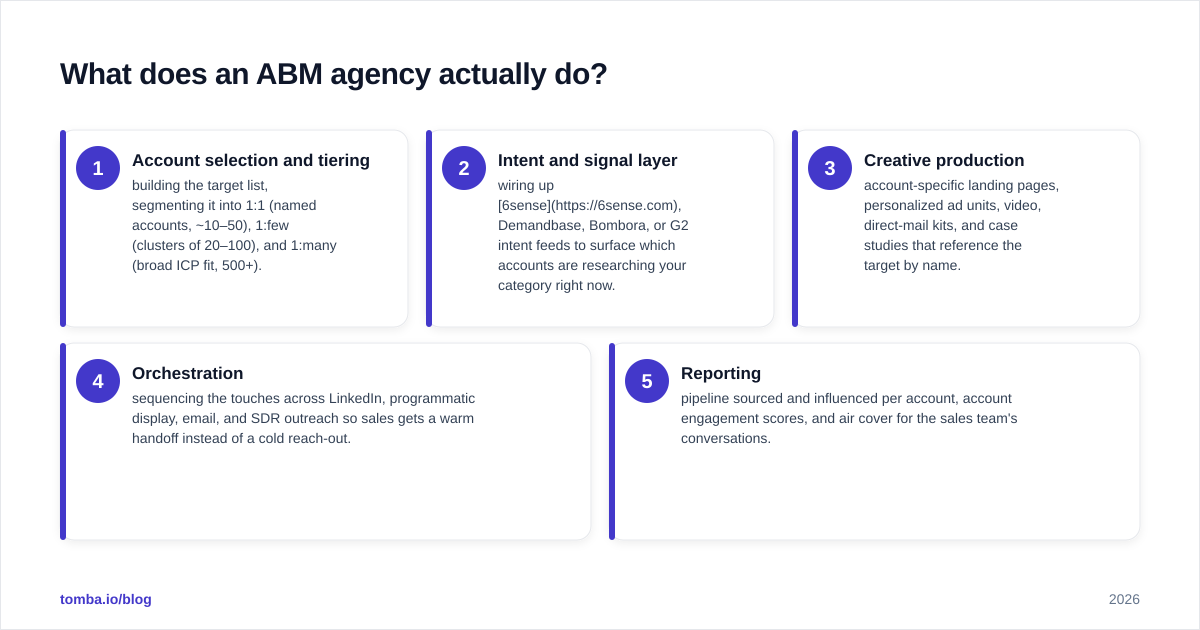
The work usually splits into five buckets:
- Account selection and tiering — building the target list, segmenting it into 1:1 (named accounts, ~10–50), 1:few (clusters of 20–100), and 1:many (broad ICP fit, 500+).
- Intent and signal layer — wiring up 6sense, Demandbase, Bombora, or G2 intent feeds to surface which accounts are researching your category right now.
- Creative production — account-specific landing pages, personalized ad units, video, direct-mail kits, and case studies that reference the target by name.
- Orchestration — sequencing the touches across LinkedIn, programmatic display, email, and SDR outreach so sales gets a warm handoff instead of a cold reach-out.
- Reporting — pipeline sourced and influenced per account, account engagement scores, and air cover for the sales team's conversations.
A good revenue operations leader uses an ABM agency to compress what would otherwise take 18 months of in-house hiring into 60–90 days.
Why hire an ABM agency instead of building in-house?#
Three reasons, in order of how often they hold up.
Speed. Standing up a working ABM motion in-house requires a strategist, an ops person who knows Demandbase or 6sense, a designer for personalized assets, a paid-media buyer fluent in LinkedIn ABM, and a sales partner who'll actually use what gets built. That's a four-quarter hiring plan. An agency walks in week one with the muscle assembled.
Tooling leverage. Enterprise ABM platforms cost $80K–$250K/year in license alone. Agencies amortize that across clients and pass the access through. If you're piloting whether ABM works for you at all, renting beats owning.
Cross-account pattern recognition. A senior strategist who has run ABM for 30 mid-market SaaS companies knows which industries respond to direct mail, which CMOs read LinkedIn carousels, which ad networks waste budget on bots. You're paying for the reps.
The case for in-house: if ABM is your primary GTM motion and you'll run it for the next five years, the math flips after year two. Hybrid models — agency for strategy and creative, in-house for ops and reporting — are increasingly common.

What does an ABM agency cost in 2026?#
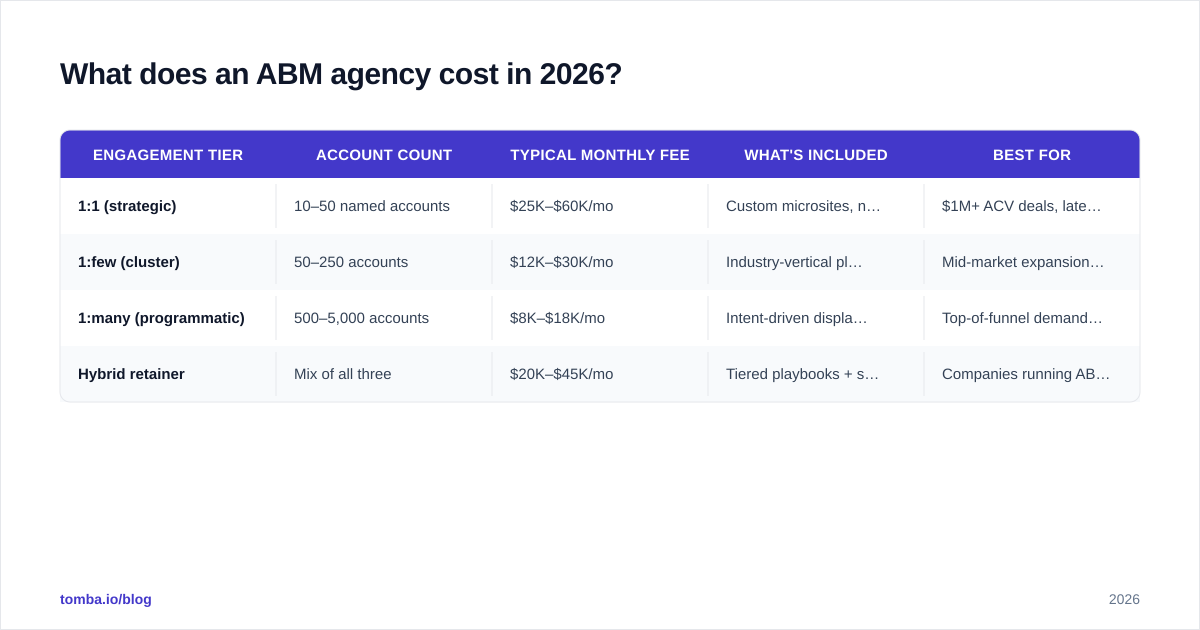
Pricing has consolidated around three tiers. The biggest variable is how much creative production lives inside the retainer versus billed separately.
| Engagement tier | Account count | Typical monthly fee | What's included | Best for |
|---|---|---|---|---|
| 1:1 (strategic) | 10–50 named accounts | $25K–$60K/mo | Custom microsites, named-account research, exec gifting, bespoke ads | $1M+ ACV deals, late-stage pipeline |
| 1:few (cluster) | 50–250 accounts | $12K–$30K/mo | Industry-vertical playbooks, segment landing pages, programmatic + LinkedIn | Mid-market expansion, vertical launches |
| 1:many (programmatic) | 500–5,000 accounts | $8K–$18K/mo | Intent-driven display, dynamic personalization, retargeting | Top-of-funnel demand creation |
| Hybrid retainer | Mix of all three | $20K–$45K/mo | Tiered playbooks + shared ops team | Companies running ABM as primary GTM |
Setup fees usually run $10K–$30K for the target list build, integration with your CRM, and the strategy workshop. Some agencies bake this into the first three months instead of billing it separately.
Watch for these line items that quietly inflate the invoice:
- Media spend pass-through markup — 15–20% on top of the actual ad spend. Negotiable.
- Creative production change orders — anything beyond the included asset count per month.
- Platform license fees — if you're using their Demandbase or 6sense seat, ask whether it's truly included or just access during the engagement.
For a calibration check, G2's ABM services category lets you cross-reference quoted pricing against verified reviews.
What should an ABM agency deliver in the first 90 days?#
Treat this as the gate. If month three rolls around and you don't have these, you hired a content agency wearing an ABM costume.
Days 1–30: Foundation.
- Target account list (TAL) signed off by sales and marketing
- Tiering logic documented (firmographic + intent + propensity)
- ICP and persona briefs per tier
- Tech stack audit — CRM, MAP, intent platform, ad accounts
- Baseline metrics: current pipeline per target account, engagement baseline
Days 31–60: Activation.
- First creative assets shipped (landing pages, ad variants, sales one-pagers)
- Intent data flowing into the CRM with account scoring rules
- First wave of ads live against tier 1 and tier 2
- Sales enablement: rep playbooks for top accounts, talking points per industry
Days 61–90: Iteration.
- Engagement reporting per account, with a clear "hot account" handoff process to AEs
- First pipeline attribution report — sourced and influenced, account-level
- Optimization cycle: paused underperformers, doubled down on what's working
- Pilot for the next quarter: which accounts to add, which to retire
Ask any agency you're evaluating to show you anonymized 90-day deliverables from a comparable client. If they show you a deck instead of artifacts, that's the answer.
Which ABM agency model fits your stage?#
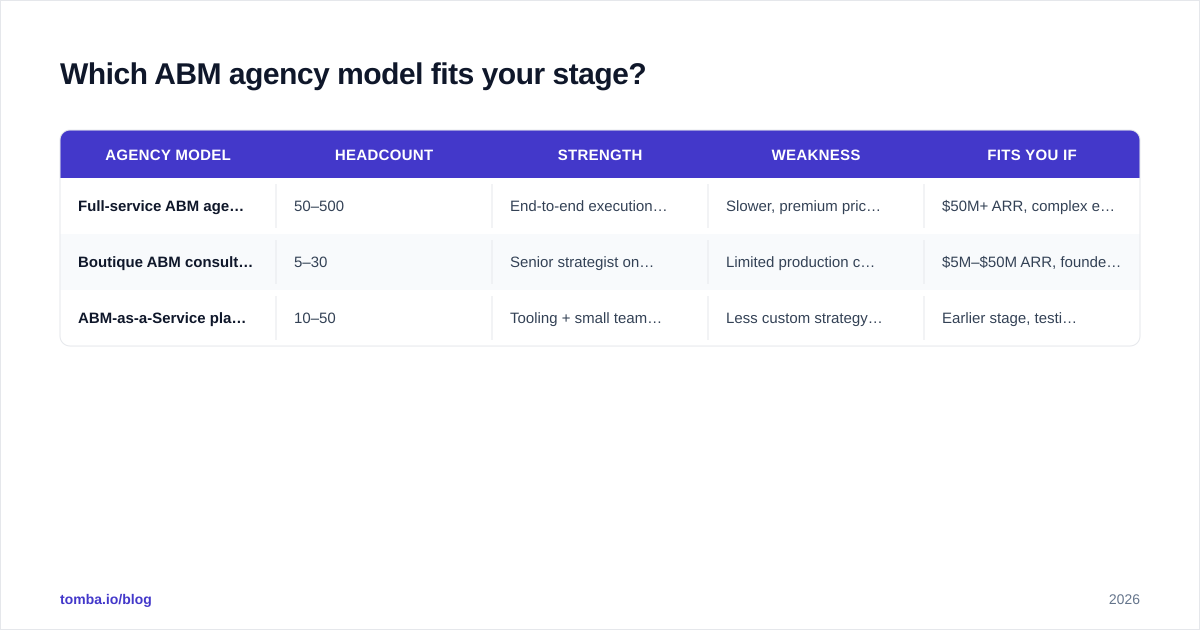
Three patterns dominate the market, and they map cleanly to company stage.
| Agency model | Headcount | Strength | Weakness | Fits you if |
|---|---|---|---|---|
| Full-service ABM agency | 50–500 | End-to-end execution, large creative bench | Slower, premium pricing, junior account staff | $50M+ ARR, complex enterprise sales |
| Boutique ABM consultancy | 5–30 | Senior strategist on every call, fast iteration | Limited production capacity, fewer integrations | $5M–$50M ARR, founder-led GTM |
| ABM-as-a-Service platform + pod | 10–50 | Tooling + small team bundled, predictable cost | Less custom strategy, templated assets | Earlier stage, testing ABM viability |
The mismatch that burns budget: a 50-person early-stage startup hiring a 500-person agency that staffs them with a 26-year-old account coordinator. You're paying senior rates for junior reps. If you can't get the agency's principal on a monthly call, you're in the wrong tier.
How do ABM agencies use intent data and email tools?#
The data layer is where ABM either works or quietly leaks money. Three feeds matter:
Intent data. Bombora, 6sense, G2 Buyer Intent, and TrustRadius signal which accounts are researching topics in your category. The agency's job is to turn "Account X spiked on 'data warehouse migration'" into a coordinated play — an ad refresh, a sales nudge, a personalized landing page — within 48 hours of the signal.
Identity resolution. When an unknown visitor lands on your pricing page, the agency uses reverse IP and cookie-based identity tools to map the visit back to a target account. Tomba's website visitor reveal handles the company-level identification piece, then routes the account to the right SDR.
Contact discovery and verification. Knowing the account is hot is half the work. You still need the right humans at that company — and you need their email to actually arrive. ABM agencies lean on tools like Tomba's email finder to source verified contacts for buying committees (typically 6–10 stakeholders per enterprise deal), and on the email verifier to keep bounce rates under 2% so the personalized outreach actually lands. A clean B2B database is the unsexy backbone of every ABM program that hits its number.
CRM enrichment. Once accounts land in Salesforce or HubSpot, data enrichment fills in firmographics, tech stack, and decision-maker contacts so segmentation rules actually work.

How do you measure if your ABM agency is working?#
ABM reporting is its own minefield because MQL-style metrics actively mislead you. The agency that brags about 8,000 impressions on a tier-1 account is showing you a vanity number.
Track these instead:
- Account engagement score — composite of ad impressions, page visits, content downloads, sales meetings, weighted per signal strength. Plot the trend per account, not the absolute number.
- Tier-1 pipeline coverage — pipeline dollars from target accounts as a percentage of your total target ACV. The benchmark is 3–5x coverage for forecast accuracy.
- Sales meeting velocity — meetings booked with target-account decision-makers per month. This is the hand-off metric between marketing and sales.
- Influenced revenue per account — closed-won revenue from accounts touched by ABM, divided by accounts in the program. Compare cohorts (treated vs. control) when you can.
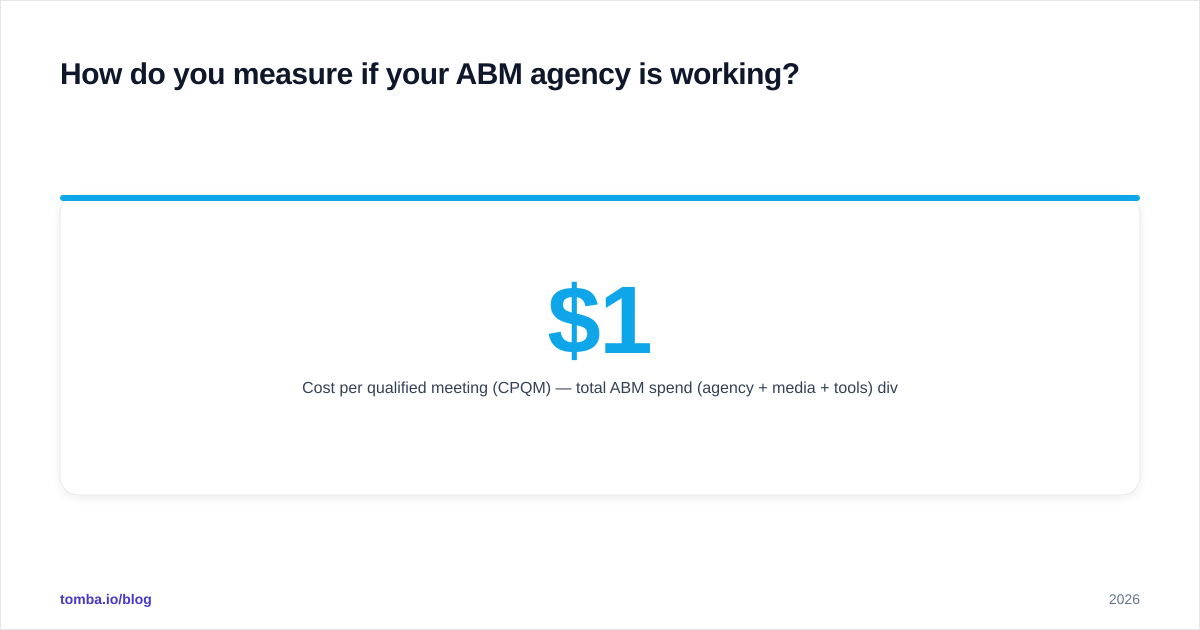
- Cost per qualified meeting (CPQM) — total ABM spend (agency + media + tools) divided by qualified meetings booked. For mid-market, $1,500–$3,500 is healthy. For enterprise, $5K–$15K is normal.
A red flag: an agency that won't share account-level performance, only program-wide aggregates. That usually means most accounts saw nothing and a few got over-served.
What questions should you ask before signing an ABM agency contract?#
Bring these into the final vendor meeting. The answers tell you whether you're hiring an ABM partner or a media buyer in a trench coat.
- Who is the day-to-day strategist on my account, and how many other clients do they run? More than four is a yellow flag.
- What's your sales-alignment workshop look like? If they don't have one, walk.
- Show me a 90-day deliverables artifact from a comparable client. Not a case study deck — actual outputs.
- How do you handle accounts that don't engage in 90 days? Good answer: retire them and replace them. Bad answer: keep running ads.
- What's your stance on attribution? They should be comfortable with multi-touch + influenced revenue, not last-click.
- What happens to the intent data, contact records, and creative assets if we end the contract? You should own everything you paid to produce.
- What's your average client tenure? Under 12 months means churn. Over 24 months means the model works.
- Do you tier media spend pass-through markup? Negotiable; should drop above $50K/mo spend.
- How do you coordinate with our SDR team's outbound cadence? ABM that doesn't sync with outbound prospecting creates duplicate touches and burned accounts.
- What's the exit clause? 60-day notice is standard. Anything longer is a trap.
Should you hire an ABM agency or buy tools instead?#
False choice, but worth answering. The honest version:
- Buy tools, not an agency if you have a senior demand-gen lead who has run ABM before, a designer who can ship personalized assets, and a sales team that already practices account-based selling. Spend the agency budget on Demandbase + 6sense + better data.
- Hire an agency if you're standing ABM up for the first time, your sales team is skeptical, or you need fast proof that the motion works before investing in headcount.
- Hybrid is what most $20M–$200M ARR companies land on: agency for strategy and creative production, in-house for ops, reporting, and sales enablement.
Whichever path you pick, the data layer is non-negotiable. Verified contact data, intent signals, and CRM enrichment are the floor — without them, the most expensive agency in the world is decorating an empty room.
The bottom line#
An ABM agency is worth hiring when you need to compress 18 months of GTM building into a quarter, when your sales team is hungry but unaligned on accounts, or when you're piloting whether account-based selling fits your motion at all. Avoid the ones that sell impressions, lock you into 12-month contracts, or won't put their senior strategist on your account.
Whatever model you pick, ABM dies the moment the data underneath it gets stale. Bad emails, mis-tiered accounts, and missing decision-makers waste every dollar above them in the stack. Start with verified contact data for your target list — find decision-makers across your tier-1 accounts with the Tomba Email Finder, verify them in bulk, and hand the agency a clean list to actually run plays against. Spin up a free account on Tomba pricing and load your TAL before the kickoff call.
// get started
Find, verify and enrich your first contacts today
Start on the free plan with 25 searches a month, then scale when your team is ready.
Free plan · No credit card required · GDPR & CCPA
Get the Tomba newsletter
Product and data updates
// about the author