ABM Attribution in 2026: The Complete B2B Playbook
ABM attribution is broken in most B2B orgs because single-touch models miss the buying committee. Here's how to fix it in 2026 with account-level scoring, weighted touches, and dark-funnel signals.
TL;DR#
- ABM attribution fails when you keep crediting individual leads instead of the whole buying committee — 6 to 10 people decide, but your CRM only sees one.
- Single-touch models (first-touch, last-touch) hide 70% of the real influence. Switch to weighted multi-touch at the account level.
- Dark-funnel signals (LinkedIn views, podcast listens, Slack mentions) drive most ABM pipeline in 2026 — and they're invisible to UTM-only attribution.
- The fix is a three-layer stack: account-level data model, weighted touch scoring, and revenue tagging at opportunity close.
- Pair clean firmographic data with a reliable email finder so every committee member you identify gets stitched to the account, not orphaned as a "new lead."
What is ABM attribution and why does it break standard reporting?#
ABM attribution is the practice of crediting marketing and sales touches to a target account — not a lead — across the entire buying committee. It exists because account-based marketing breaks every assumption baked into lead-centric CRMs.
Standard attribution thinks like a vending machine: one person inserts a coin (fills a form), one product drops out (a deal closes). ABM is the opposite — it's like a group dinner where six people order, two argue about the wine, one quietly approves the bill, and your receipt only has one name on it. If you tip based on whoever ordered first, you've missed how the meal actually happened.
That's why first-touch and last-touch models lie to ABM teams. A 2025 Gartner study found B2B buying groups now average 6 to 10 stakeholders, with 27 distinct activities per purchase. Crediting one of those 27 to "pipeline" is statistical fiction.
How is ABM attribution different from traditional B2B attribution?#
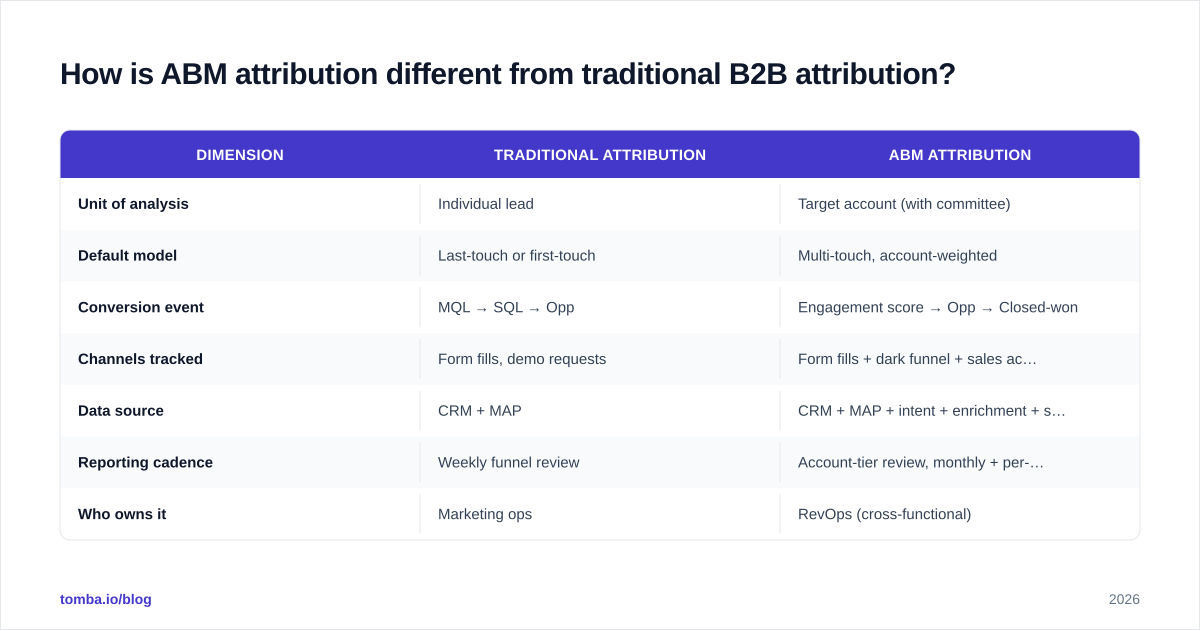
The core shift is the unit of measurement. Traditional attribution measures a lead's journey. ABM attribution measures an account's journey, then layers committee roles on top.
| Dimension | Traditional Attribution | ABM Attribution |
|---|---|---|
| Unit of analysis | Individual lead | Target account (with committee) |
| Default model | Last-touch or first-touch | Multi-touch, account-weighted |
| Conversion event | MQL → SQL → Opp | Engagement score → Opp → Closed-won |
| Channels tracked | Form fills, demo requests | Form fills + dark funnel + sales activity + intent |
| Data source | CRM + MAP | CRM + MAP + intent + enrichment + sales engagement |
| Reporting cadence | Weekly funnel review | Account-tier review, monthly + per-quarter cohort |
| Who owns it | Marketing ops | RevOps (cross-functional) |
The other change: you stop chasing "leads per channel" and start asking "which channels moved Tier-1 accounts from cold to engaged to opportunity." Different question, completely different tool stack.
What are the main ABM attribution models in 2026?#
Five models dominate. None of them are perfect — pick the one whose blind spots you can live with.
1. Account first-touch#
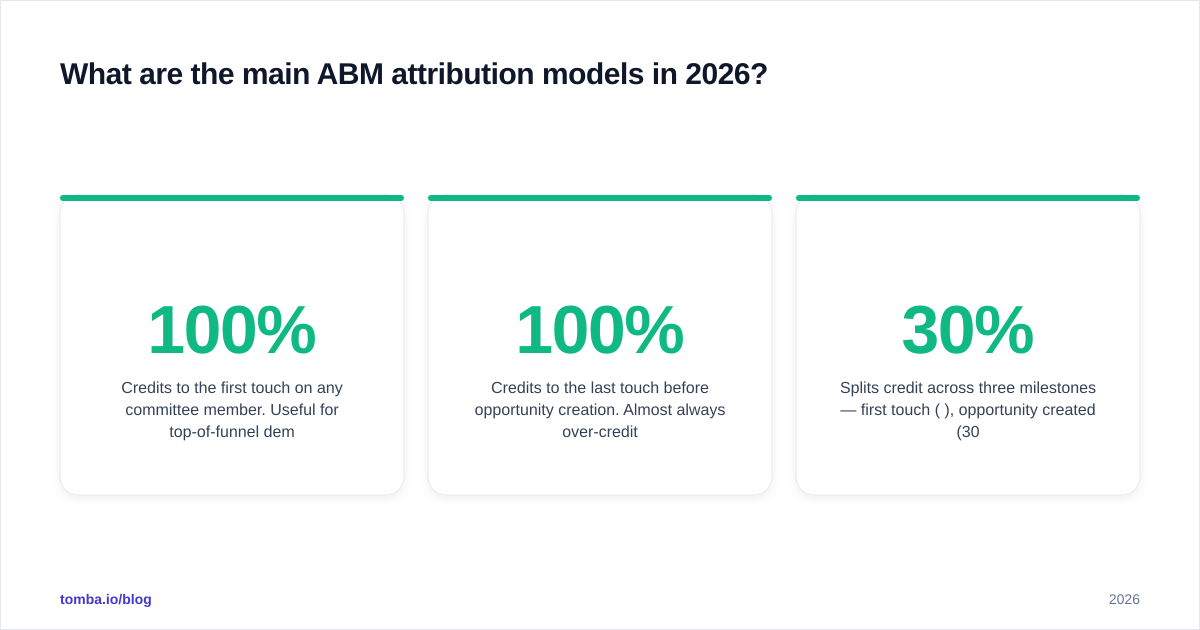
Credits 100% to the first touch on any committee member. Useful for top-of-funnel demand-gen ROI. Terrible for sales-led motions where the real work happens after the first touch.
2. Account last-touch#
Credits 100% to the last touch before opportunity creation. Almost always over-credits sales (the BDR call) and starves marketing of credit. Avoid unless you only run outbound.
3. Linear multi-touch#
Splits credit evenly across every touch from every committee member. Honest but useless for optimization — it tells you everything mattered equally, which is never true.
4. Time-decay multi-touch#
Weights recent touches more heavily. Best general-purpose ABM model. The closer to opportunity creation, the more credit a touch gets. Reflects how buying actually works: the last 30 days drive the decision, not the webinar from 8 months ago.
5. W-shaped (account-weighted)#
Splits credit across three milestones — first touch (30%), opportunity created (30%), closed-won (30%), with the remaining 10% split across every middle touch. The most defensible model for a board deck because it credits both demand-gen and sales-assist work.
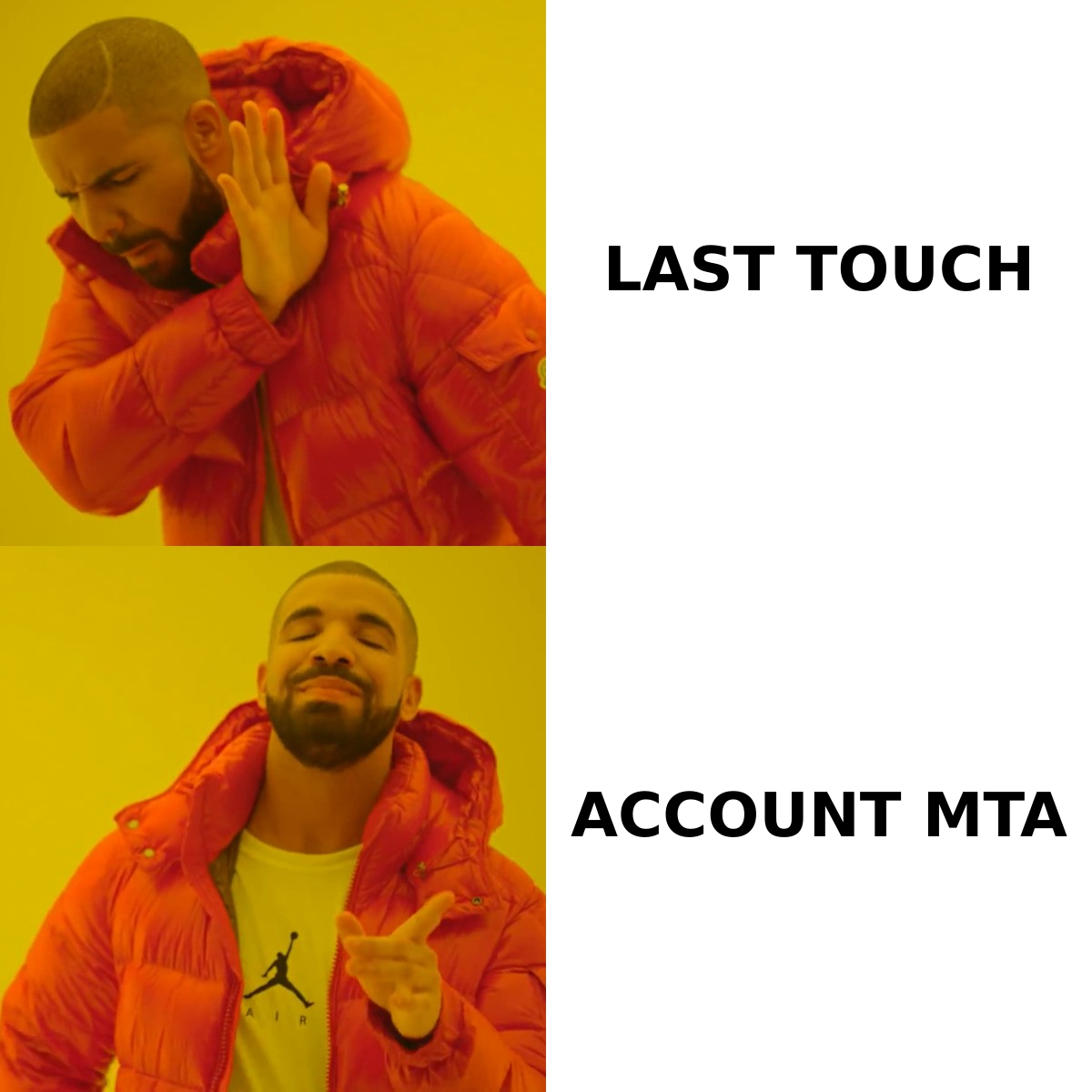
Pick W-shaped if you have a real marketing and sales motion. Pick time-decay if your sales cycle is under 60 days. Skip first-touch and last-touch unless your CFO demands them — and even then, run them as a secondary view, not the primary one.
How do you build an account-level data model?#
Three pieces have to exist before any model works.
1. Account as the source of truth. Every lead in your CRM must map to an account record before reporting runs. If 30% of your leads are floating without an account, your attribution is 30% noise. Use enrichment and reverse lookup to backfill — Tomba's reverse email lookup is one option, Clearbit and ZoomInfo are others.
2. Committee identification. Tag each contact's role on the account: economic buyer, champion, user, blocker, influencer. Without roles, you can't tell whether the CFO clicking your pricing page mattered more than a developer downloading a whitepaper.
3. Touch normalization. Every system that touches an account — email tool, ad platform, calendar, intent provider — has to write back to the account, not just the lead. This is where most ABM stacks fail. Look at your CRM right now: how many demos sit on lead records that never got merged to an account? That's your lost attribution data.
A working B2B database plus consistent firmographic enrichment is the foundation. Get the account-level data wrong and no model can save you.
What about dark-funnel attribution?#
The dark funnel is every touch you can't track with a UTM — LinkedIn post views, podcast listens, peer recommendations, G2 reviews read but not clicked, Slack community mentions. According to Forrester, 60-70% of B2B buying research now happens in channels marketers can't see.
You can't measure dark-funnel touches the way you measure paid clicks. You measure them by correlation:
- Track self-reported attribution on demo forms ("How did you hear about us?")
- Run media-mix modeling against pipeline (not leads) on a 90-day rolling window
- Watch the lift between "ungated content published" and "direct traffic to pricing page" 7-14 days later
- Use intent data to identify accounts surging on your category and overlay your campaign calendar
You won't get a clean number. You'll get a directional answer that's more honest than "100% credit to the last-touch UTM."
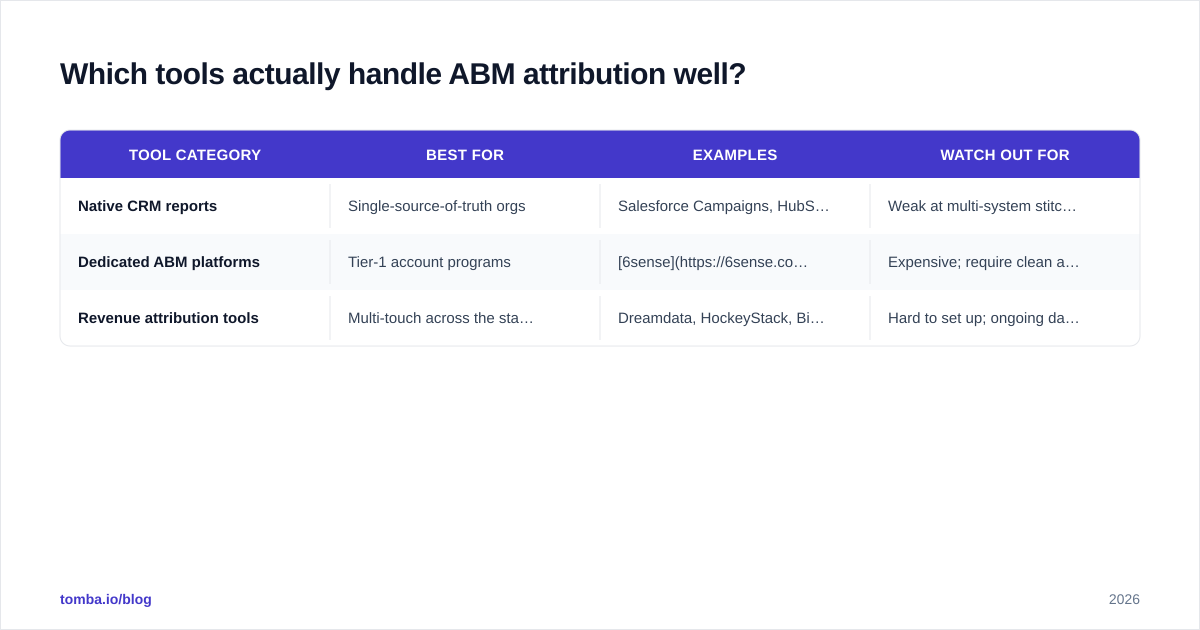
Which tools actually handle ABM attribution well?#
The market is split into three camps. Most teams need pieces of all three.
| Tool category | Best for | Examples | Watch out for |
|---|---|---|---|
| Native CRM reports | Single-source-of-truth orgs | Salesforce Campaigns, HubSpot Attribution | Weak at multi-system stitching |
| Dedicated ABM platforms | Tier-1 account programs | 6sense, Demandbase, RollWorks | Expensive; require clean account data |
| Revenue attribution tools | Multi-touch across the stack | Dreamdata, HockeyStack, Bizible | Hard to set up; ongoing data-team cost |
If you're building from scratch, start with HubSpot or Salesforce's native attribution, layer in a Salesforce integration for enrichment, and only add a dedicated platform once you've proven the account-level data model holds together. Most ABM platform deployments fail not because the platform is bad but because the underlying account data was never normalized.
For competitive context, plenty of teams evaluate a 6sense alternative or a Demandbase alternative when the licensing math stops working.
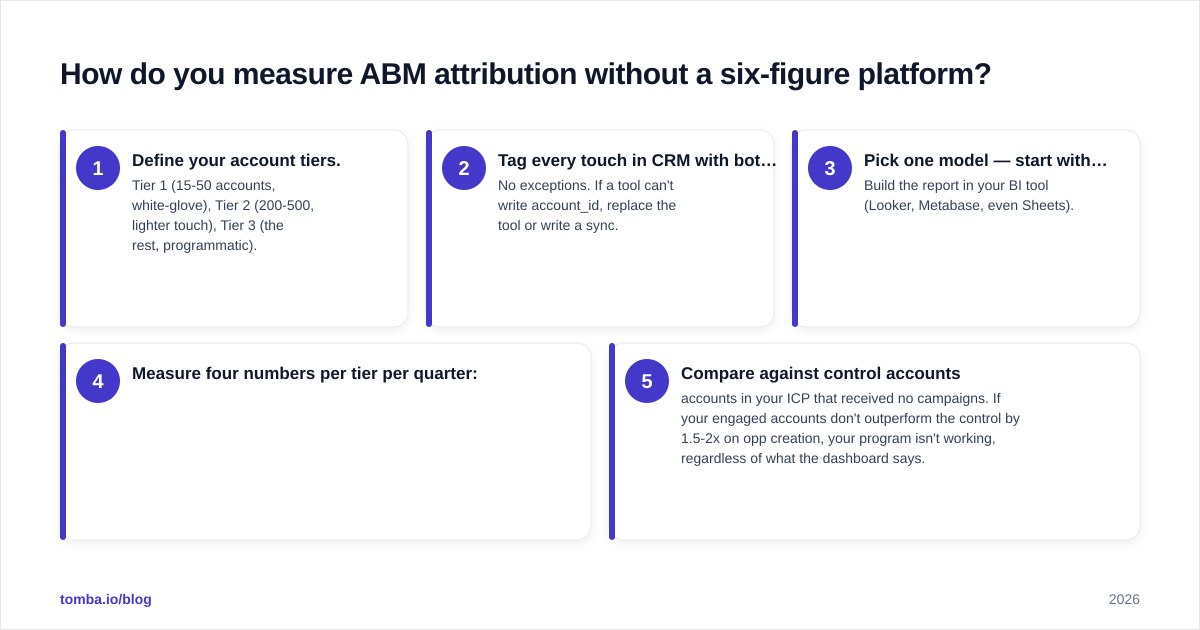
How do you measure ABM attribution without a six-figure platform?#
You can run defensible ABM attribution in a spreadsheet plus your existing CRM. Here's the minimum viable setup:
- Define your account tiers. Tier 1 (15-50 accounts, white-glove), Tier 2 (200-500, lighter touch), Tier 3 (the rest, programmatic).
- Tag every touch in CRM with both contact_id and account_id. No exceptions. If a tool can't write account_id, replace the tool or write a sync.
- Pick one model — start with time-decay. Build the report in your BI tool (Looker, Metabase, even Sheets).
- Measure four numbers per tier per quarter:
- Accounts engaged (≥3 touches across ≥2 committee members)
- Accounts qualified (sales-accepted opportunity)
- Accounts won
- Revenue per engaged account
- Compare against control accounts — accounts in your ICP that received no campaigns. If your engaged accounts don't outperform the control by 1.5-2x on opp creation, your program isn't working, regardless of what the dashboard says.
This is the "revenue operations" version of attribution: every number ties back to closed-won, not to vanity metrics like email opens.

What are the most common ABM attribution mistakes?#
The same five mistakes show up in almost every audit.
- Treating leads as accounts. Your form fills 12 people from Acme Corp over 18 months — that's one account with a committee, not 12 leads.
- Ignoring sales touches. BDR calls, AE emails, demos — they're touches. If they're not in your model, you've credited marketing for sales work (or vice versa).
- Single attribution model. No model is correct. Run W-shaped as primary, first-touch as a secondary lens, and review both.
- Reporting on lead volume. ABM doesn't generate leads — it generates engaged accounts. Lead reports will make a working ABM program look broken.
- No account-merging hygiene. Duplicate accounts ("Acme", "Acme Corp", "Acme Inc.") split credit across phantom records. Run a monthly merge cycle.
How does AI change ABM attribution in 2026?#
Two real shifts, not vendor hype.
Signal aggregation. LLM-based pipelines can now ingest intent data, web visits, ad impressions, and sales calls into a single account scoring model that updates daily. What used to require a data engineer is now a Zapier-or-Make plus an LLM call. See Zapier integration patterns for the plumbing.
Predictive committee mapping. AI can infer the buying committee from a single contact — given a champion at Acme, it predicts the likely VP of Finance, CISO, and IT director and suggests next-best contacts. Combine with a LinkedIn finder and you've collapsed weeks of manual committee research into hours.
AI doesn't fix bad attribution data. It makes bad data faster to act on. Fix the account model first, then layer in AI.
Frequently asked questions#
Q: What's the single most important metric in ABM attribution? A: Revenue per engaged account, segmented by tier. Everything else is a leading indicator.
Q: How long until ABM attribution shows results? A: 6-9 months minimum for Tier-1 accounts because B2B sales cycles are long. If your CFO expects monthly ROI, set that expectation early.
Q: Should I use marketing's attribution or sales's? A: Neither. RevOps owns it because it crosses both functions. If RevOps doesn't exist yet, see what RevOps is and assign one person.
Q: How do I attribute pipeline from a podcast I sponsored? A: Self-reported attribution on demo forms + lift modeling on direct traffic in the 14 days post-episode. Not perfect. Better than nothing.
Closing thought#
ABM attribution is less about picking the perfect model and more about agreeing — across marketing, sales, and finance — on what counts as a touch and which account it belongs to. Get that right, and even a time-decay model in a spreadsheet beats a six-figure platform running on dirty data.
If your committee data is the bottleneck, start by stitching every known contact back to the right account. Tomba's Email Finder helps you identify and enrich the rest of the buying committee from a single domain — so the next time a Tier-1 account engages, you actually know who else to credit. Pair it with the HubSpot integration or Salesforce integration and your attribution model finally has clean data to work with.
// get started
Find, verify and enrich your first contacts today
Start on the free plan with 25 searches a month, then scale when your team is ready.
Free plan · No credit card required · GDPR & CCPA
// about the author