ABM Audience Building in 2026: The Complete Playbook
Building an ABM audience that actually converts requires more than a target account list. Here's how to architect tiered audiences, signal layers, and contact maps that drive pipeline in 2026.
ABM Audience Building in 2026: The Complete Playbook
TL;DR
- An ABM audience is not a list — it's a layered model of accounts, buying committees, and behavioral signals that go into market together.
- The teams winning in 2026 build audiences in five layers: ICP, tiered accounts, buying committee, intent layer, and engagement signals.
- Most ABM programs fail because they confuse "target account list" (TAL) with "audience" — the TAL is one input, not the whole thing.
- A tight 150-300 account Tier 1 audience outperforms a 5,000-account broad sweep, even with 20x less budget.
- Tooling stack: a CRM as source of truth, an enrichment provider for contacts, an intent platform for signals, and an orchestration layer to push it all to ads and sequences.
What is an ABM audience and why does it matter in 2026?#
An ABM audience is the operational definition of the accounts and people your go-to-market motion will target in a coordinated way — through ads, outbound, content, sales plays, and events — in a given quarter.
It is different from a marketing list because it carries weight (tier), structure (buying committee), and state (signal intensity). It is different from a CRM segment because it lives across channels — your ads platform, your sequencer, your CRM, and your data warehouse all need the same definition.
In 2026 this matters more than it did in 2022. Broad-based demand-gen has gotten more expensive, intent data is cheaper and more accurate, and AI-driven SDR motions can hit 100 accounts a day with personalization — but only if the audience underneath them is sharp. A wrong-fit audience makes a great sequence write 500 high-quality emails to people who will never buy.
How do you define the ICP layer first?#
Before you touch a single account, document the ICP in writing. Vague ICPs ("mid-market SaaS, growing fast") produce vague audiences. A real ICP includes:
- Firmographics: industry codes (NAICS/SIC), revenue band, employee count, geography, ownership structure.
- Technographics: tools they already use (CRM, MAP, data warehouse, support platform).
- Triggers: hiring spikes in specific roles, funding rounds, leadership changes, product launches.
- Disqualifiers: explicit "not these" rules — competitors, partner customers, anti-fit verticals.
A practical test: hand the ICP doc to a new SDR. If they can pull a clean list from your data tool without asking three follow-up questions, the ICP is tight enough. If not, rewrite.
How do you tier accounts inside the ABM audience?#
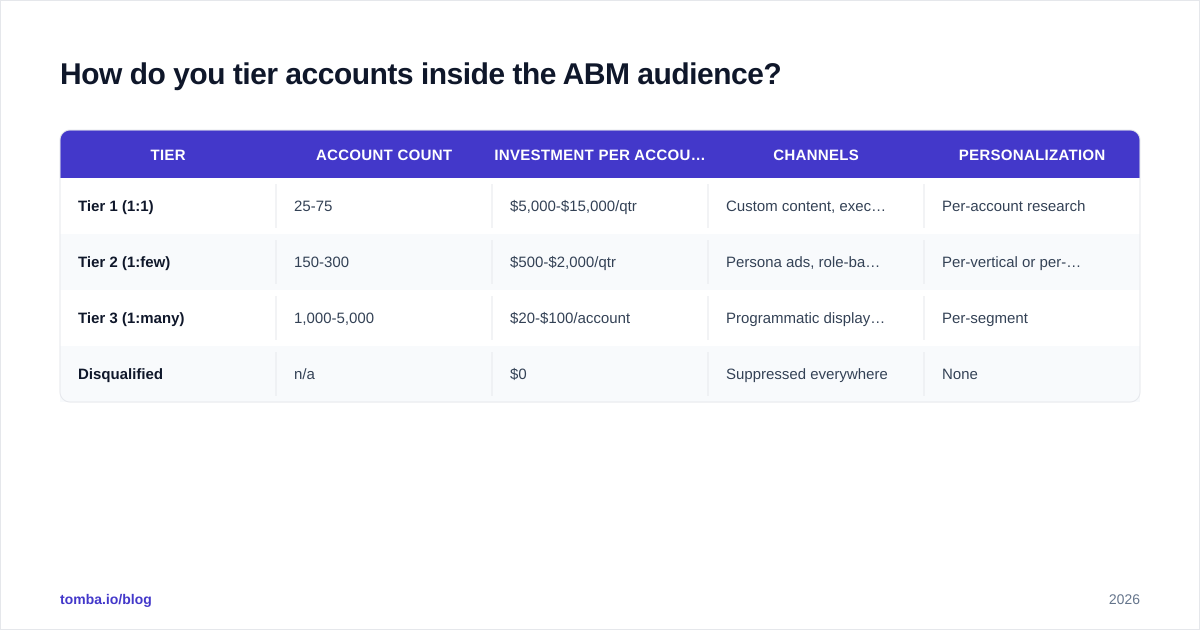
Tiering is where most teams underinvest. The instinct is to load 5,000 accounts and "see what hits." The teams hitting 30%+ meeting rates do the opposite: a small Tier 1, a moderate Tier 2, and a programmatic Tier 3.
| Tier | Account count | Investment per account | Channels | Personalization |
|---|---|---|---|---|
| Tier 1 (1:1) | 25-75 | $5,000-$15,000/qtr | Custom content, exec gifting, ABM ads, 1:1 outbound, events | Per-account research |
| Tier 2 (1:few) | 150-300 | $500-$2,000/qtr | Persona ads, role-based sequences, vertical content | Per-vertical or per-persona |
| Tier 3 (1:many) | 1,000-5,000 | $20-$100/account | Programmatic display, retargeting, light outbound | Per-segment |
| Disqualified | n/a | $0 | Suppressed everywhere | None |
The number that matters is not "how big is my list" — it's "what is my coverage rate on Tier 1." If you can't name the CFO, VP Eng, and CIO at every Tier 1 account, your audience is not ready to activate.
How does the buying committee become part of the audience?#
A B2B purchase in 2026 has, on average, 6-10 stakeholders. An ABM audience that only contains "VP Marketing" at each account is missing 80% of the deal.
For each Tier 1 and Tier 2 account, your audience should explicitly map:
- Economic buyer — signs the contract. Usually VP+/C-suite in the buying department.
- Champion — the person who wants this internally. Often a senior IC or director.
- Technical evaluator — IT, security, data teams who can veto.
- End user — the team that will use the product day-to-day.
- Procurement/legal — only relevant at deals above your threshold.
You build this map with a phone finder, LinkedIn finder, and data enrichment workflow that runs across the Tier 1 and Tier 2 list at the start of each quarter. Refresh quarterly — buying committees turn over fast.
Which intent signals belong in the audience layer?#
This is where ABM in 2026 diverges hardest from ABM in 2020. Intent is now table stakes — but most teams use it badly, scoring on raw surge volume instead of signal quality.
Signal categories worth tracking:
- Third-party intent — research activity on review sites (G2, TrustRadius), publisher networks (Bombora, TechTarget). Best for top-of-funnel awareness.
- First-party intent — your own site visits, content downloads, webinar attendance, demo requests. Best for late-funnel prioritization.
- Job-change signals — a champion moving to a new company is one of the highest-converting signals in B2B. Track champions across roles.
- Hiring signals — a company posting 5 sales engineer roles is buying a sales tool soon.
- Funding signals — Series B and later rounds usually correlate with tool consolidation or expansion.
- Technographic changes — a company adding Salesforce or HubSpot is signaling readiness for integrations into that stack.
- Anonymous web reveal — companies visiting pricing pages who haven't filled a form. Solve with a website visitor reveal tool.
The way to use signals is not "alert me on everything." It's to layer them — an account in Tier 2 with surge intent on a competitor term and a recent VP hire moves into your Tier 1 plays this week, then drops back next month if signals fade.
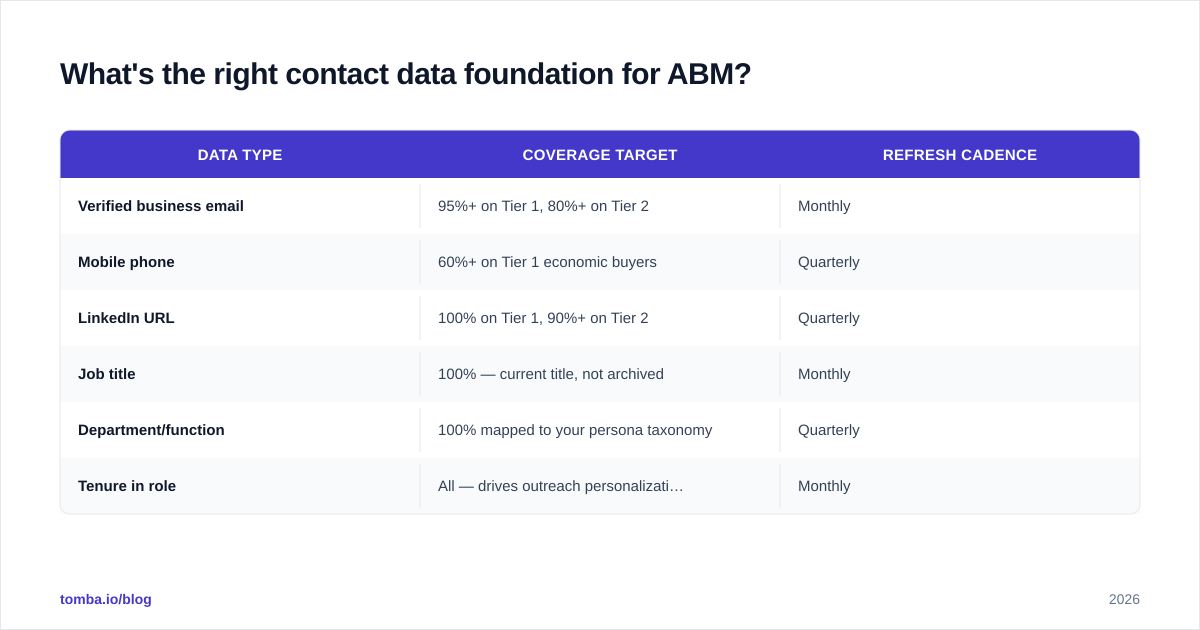
What's the right contact data foundation for ABM?#
You cannot run an ABM audience on stale data. Email bounce rates above 5% will kill sender reputation; missing direct dials kill phone connect rates.
The minimum data foundation for a serious ABM program:
| Data type | Coverage target | Refresh cadence |
|---|---|---|
| Verified business email | 95%+ on Tier 1, 80%+ on Tier 2 | Monthly |
| Mobile phone | 60%+ on Tier 1 economic buyers | Quarterly |
| LinkedIn URL | 100% on Tier 1, 90%+ on Tier 2 | Quarterly |
| Job title | 100% — current title, not archived | Monthly |
| Department/function | 100% mapped to your persona taxonomy | Quarterly |
| Tenure in role | All — drives outreach personalization | Monthly |
The cheapest way to maintain this on a budget is to combine a domain-level lookup (domain search to pull all known contacts per account) with a targeted email finder for specific roles you can't find through search.
How do you operationalize the ABM audience across channels?#
Building the audience is half the battle. Making it usable across ads, outbound, CRM, and customer success is the other half.
Three patterns work in practice:
Sync pattern: Your CRM holds the canonical account list and tier. Audience changes (tier moves, signal triggers) push to LinkedIn Matched Audiences, your ad DSP, your sequencer (Outreach/Salesloft), and your customer data platform via reverse ETL. This is the cleanest architecture but requires engineering investment.
Tag pattern: A flat tagging system in your CRM (abm_tier_1, abm_signal_hot, abm_vertical_finserv) flows out through standard CRM integrations. Slower to update but no engineering needed.
Workflow pattern: A weekly ops cadence where the RevOps lead exports current-state audiences from the CRM, layers on this week's intent signals, and pushes refreshed lists to channels manually. Doesn't scale past about 500 accounts, but works as a starting point.
The right answer depends on team size. A 3-person team should start with the workflow pattern and graduate to tagging by quarter two. A 30-person team should be on sync architecture from day one.
What tools do you need to run ABM audiences in 2026?#
You don't need a $100K/year ABM platform to start. You do need clarity on which layer of the audience each tool serves.
| Layer | Category | Examples |
|---|---|---|
| Source of truth | CRM | Salesforce, HubSpot |
| Account list build | Account database | ZoomInfo, Apollo, Cognism |
| Contact enrichment | Email/phone finder | Tomba, Lusha, Clearbit |
| Intent | Intent data | Bombora, G2 Buyer Intent, 6sense |
| Visitor reveal | Website ID | Tomba Reveal, Leadfeeder, Albacross |
| Orchestration | ABM platform | Demandbase, 6sense, RollWorks |
| Outbound execution | Sequencer | Outreach, Salesloft, Instantly |
| Ads | DSP / LinkedIn | LinkedIn Ads, Metadata, RollWorks |
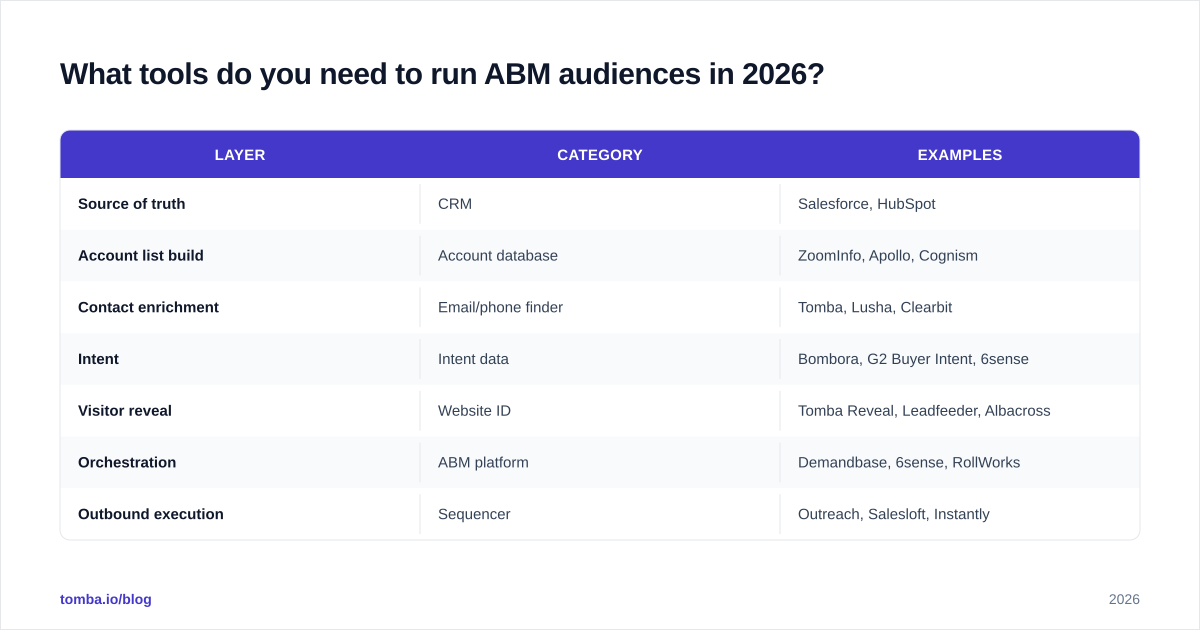
For most mid-market teams, a stack of CRM + a contact data tool with strong API support + a sequencer + LinkedIn Matched Audiences is enough to run a credible ABM motion for under $30K/year total. The premium ABM platforms become worth it above ~$5M ARR when orchestration complexity outweighs the savings of stitching tools together.
How do you measure if the ABM audience is working?#
Leading indicators (week-to-week):
- Coverage rate — % of Tier 1 accounts with at least one engaged contact this month.
- Engagement velocity — average days from first touch to first meaningful response.
- Signal-to-action lag — hours from signal trigger to first SDR action.
Lagging indicators (quarter-to-quarter):
- Pipeline-from-list — % of Tier 1 + Tier 2 accounts that produced a qualified opportunity.
- Win rate by tier — Tier 1 should win at 2-3x Tier 3 win rates if tiering is real.
- Average deal size by tier — same logic.
If your Tier 1 win rate is the same as your Tier 3, your tiering isn't doing its job — you're spending custom-content budget on accounts that would have bought anyway, or chasing accounts that won't.
Track the response rate per tier as well; a 4-5x gap between Tier 1 and Tier 3 response rates is a healthy sign of personalization paying off.
What are the most common ABM audience mistakes?#
- "Spray then narrow" — loading the CRM with 10,000 accounts and hoping to discover Tier 1 by behavior. You can't out-volume bad fit.
- Treating ICP and TAL as the same thing — your ICP is who could buy; your TAL is who you're working this quarter.
- Ignoring buying committee until late-stage — by the time you need the CFO, it's too late to start mapping them.
- Stale data — pulling a list once a year and assuming titles and emails are still correct. They're not.
- No suppression list — re-marketing to closed-lost accounts from 18 months ago with the same pitch.
- Signal overload — alerting SDRs on every surge spike. Signals need to be ranked and capped per rep per day.
- Channel mismatch — running display ads to Tier 1 only. Display is a Tier 3 channel; Tier 1 should get owned, direct touches.
For more on the broader revenue motion supporting all of this, see Tomba's revenue operations glossary entry and review the HubSpot ABM benchmarks for current performance baselines.
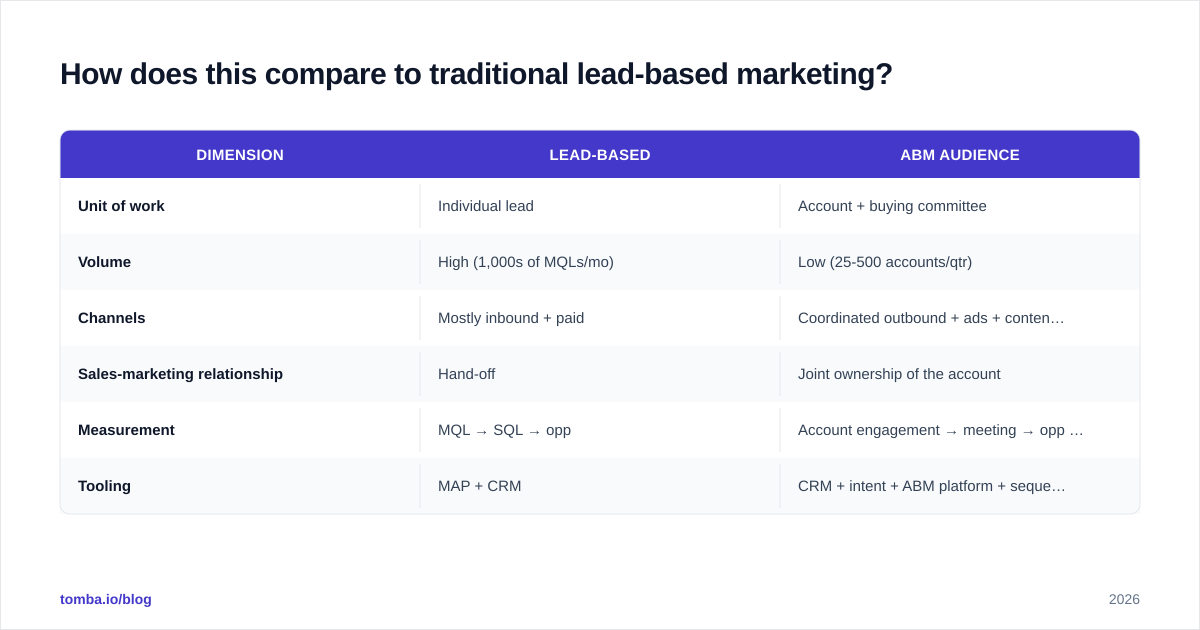
How does this compare to traditional lead-based marketing?#
| Dimension | Lead-based | ABM audience |
|---|---|---|
| Unit of work | Individual lead | Account + buying committee |
| Volume | High (1,000s of MQLs/mo) | Low (25-500 accounts/qtr) |
| Channels | Mostly inbound + paid | Coordinated outbound + ads + content + events |
| Sales-marketing relationship | Hand-off | Joint ownership of the account |
| Measurement | MQL → SQL → opp | Account engagement → meeting → opp → revenue |
| Tooling | MAP + CRM | CRM + intent + ABM platform + sequencer |
Lead-based is not dead. For very high-velocity, low-ACV motions ($1-5K) it still wins. The crossover point is somewhere around $25K ACV — above that, ABM wins on CAC, win rate, and expansion revenue. See Forrester's research on B2B buying complexity for the empirical case.
The closing CTA — start with the contact layer#
If you can't get to the right person at the right account in the right week, none of the rest of the ABM stack matters.
The fastest place to start is the contact layer: pull a clean Tier 1 list, run domain search on each account to find every relevant contact, then use the Tomba Email Finder to verify the specific committee members you need. Verified emails plus mobile numbers turn an account list into a real audience your team can activate this week.
Spin up a free Tomba account, run your top 50 accounts through it, and see how complete your buying committee map actually is. Most teams find they're missing 40% of their decision-makers — and fixing that is the highest-leverage move in ABM.
// get started
Find, verify and enrich your first contacts today
Start on the free plan with 25 searches a month, then scale when your team is ready.
Free plan · No credit card required · GDPR & CCPA
// about the author