ABM Best Practices in 2026: A Playbook That Actually Works
Most ABM programs stall at the pilot stage. Here are the account-based marketing best practices that separate the 12% who hit pipeline targets from the rest in 2026.
ABM Best Practices in 2026: A Playbook That Actually Works
TL;DR
- 73% of B2B teams run ABM, but only 12% report it beats their broader demand-gen pipeline — the gap is execution, not concept.
- The four pillars that actually move pipeline: tight account selection, multi-source intent, orchestrated plays across channels, and shared sales-marketing scoreboards.
- Tiering is non-negotiable. One-to-one (top 50), one-to-few (next 500), one-to-many programmatic (the rest of your ICP).
- Skip the fancy ABM platform until your CRM data is clean — 60% of failed programs blame "bad data" before "bad tooling."
- Measure pipeline velocity and account engagement, not MQLs. ABM dies the moment marketing celebrates clicks while sales waits for meetings.
What does ABM actually mean in 2026?#
Account-Based Marketing flips the funnel. Instead of casting a wide net and filtering for buyers, you start with a finite list of accounts that already look like your best customers, then coordinate marketing and sales to surround each one with relevant touches.
Three things changed in the last 18 months that make ABM look different than it did even in 2024:
- Generative AI made personalization cheap. Writing 200 unique opening lines used to be a quarter-long project. Now it's a Tuesday.
- Intent data went multi-source. Single-vendor intent (looking at you, Bombora) is no longer a moat. Teams stitch first-party site activity, G2 review traffic, podcast plays, and LinkedIn engagement into one signal.
- Buying committees got bigger and quieter. Gartner puts the typical B2B buying group at 11 people, with 77% of the journey happening before sales ever hears about it. ABM is how you stay in the room when no one's calling you.
If you're still measuring ABM by lead form fills, you're running 2019's playbook in a 2026 market.
Who should run ABM and who shouldn't?#
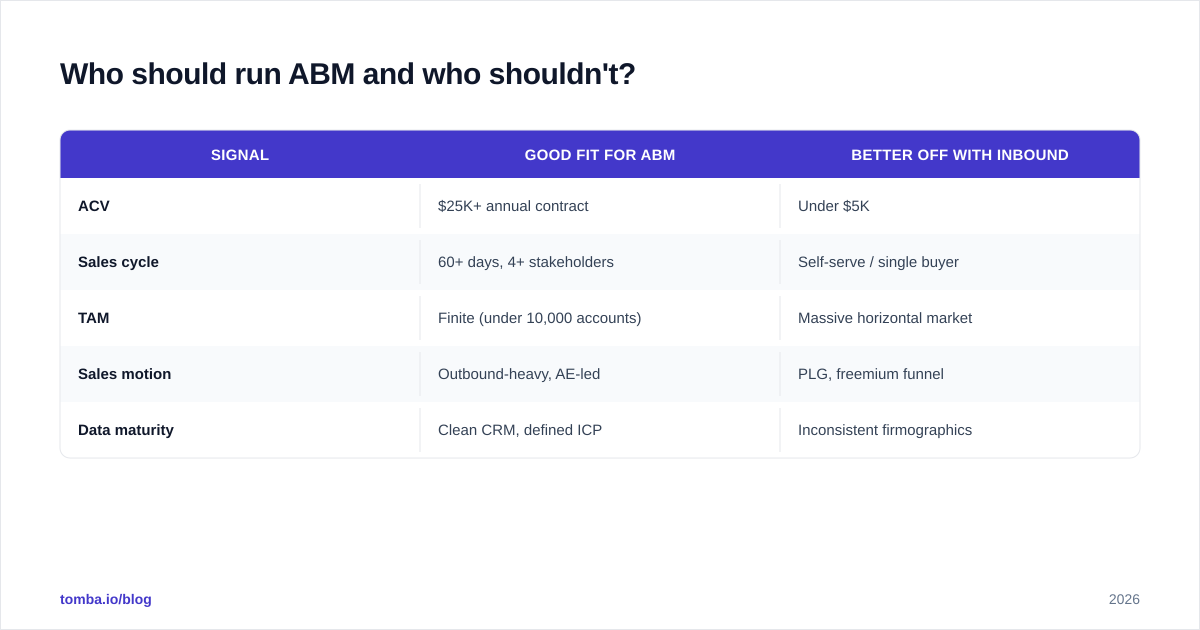
ABM is not a universal upgrade to inbound. It's a deliberate trade: fewer accounts, more depth.
| Signal | Good Fit for ABM | Better Off with Inbound |
|---|---|---|
| ACV | $25K+ annual contract | Under $5K |
| Sales cycle | 60+ days, 4+ stakeholders | Self-serve / single buyer |
| TAM | Finite (under 10,000 accounts) | Massive horizontal market |
| Sales motion | Outbound-heavy, AE-led | PLG, freemium funnel |
| Data maturity | Clean CRM, defined ICP | Inconsistent firmographics |
If three of the left-hand boxes apply, ABM will pay off. If you're a $99/mo SaaS chasing every SMB, run paid search and call it a day.
How do you build the account list?#
This is where most programs die before they start. Sales hands marketing a wishlist of 2,000 logos and calls it an ICP. That's not an ICP — it's a Christmas list.
The three-layer model:
- Tier 1 — Strategic (20-50 accounts). Custom plays. Named exec sponsors on both sides. Quarterly business reviews on the marketing side, not just sales.
- Tier 2 — Named (200-800 accounts). Industry-vertical plays, persona-specific creative, sequenced outreach.
- Tier 3 — Programmatic (the rest of your ICP). Display, retargeting, lookalike LinkedIn, automated email nurture.
To build the actual list, combine three inputs:
- Closed-won lookalikes. Pull every account that closed in the last 24 months, cluster by firmographic + technographic signals, and find the next 500 that match.
- Sales gut + executive relationships. Reps know which logos would change their commission this year. Don't ignore them — but make them defend the pick with a one-pager.
- Intent surge. Accounts spiking on your category keywords this quarter. These move from Tier 3 to Tier 2 the moment the signal fires.
A clean enrichment layer matters more than the tier you assign. Pulling verified contacts for the buying committee at each named account is the unglamorous work that decides whether the program survives Q2. Tools like Tomba Email Finder and broader data enrichment workflows are what fill in the contact rows your CRM ships empty.
What intent signals actually predict a deal?#
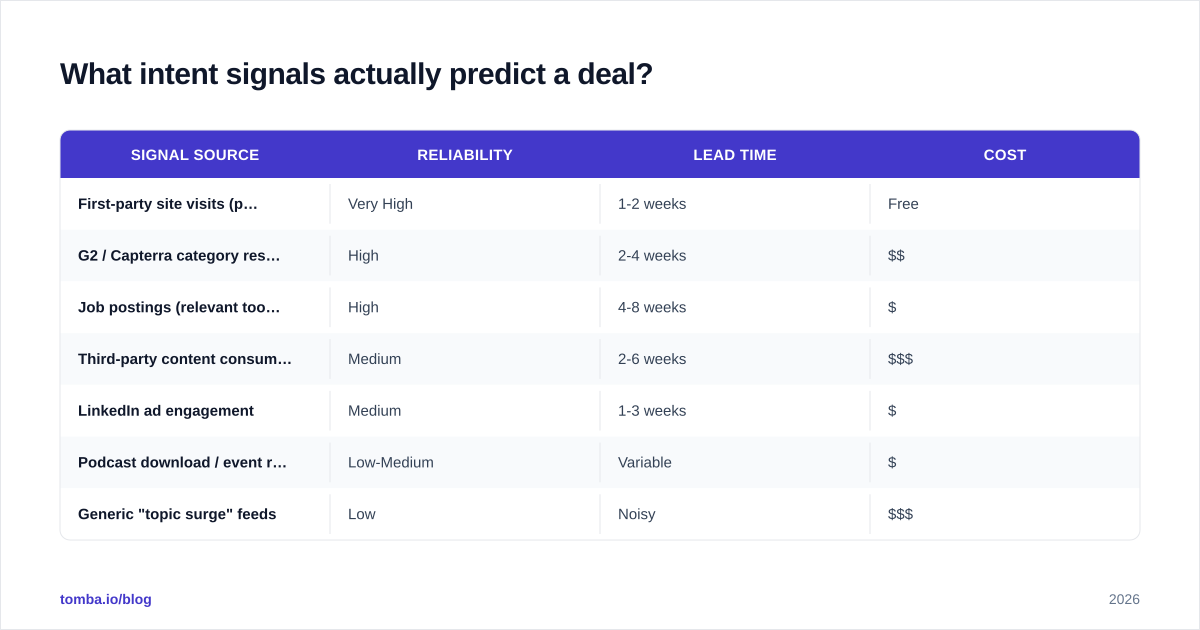
Not all intent is equal. Treat it like a stock portfolio — diversified, weighted by reliability.
| Signal Source | Reliability | Lead Time | Cost |
|---|---|---|---|
| First-party site visits (pricing page) | Very High | 1-2 weeks | Free |
| G2 / Capterra category research | High | 2-4 weeks | $$ |
| Job postings (relevant tools/roles) | High | 4-8 weeks | $ |
| Third-party content consumption (Bombora) | Medium | 2-6 weeks | $$$ |
| LinkedIn ad engagement | Medium | 1-3 weeks | $ |
| Podcast download / event registration | Low-Medium | Variable | $ |
| Generic "topic surge" feeds | Low | Noisy | $$$ |
The rule: never act on a single signal. Two correlated signals — say, three site visits to pricing within seven days plus a job posting for your category — moves an account from "interesting" to "tier-up immediately."
If you want a deeper look at how this connects to broader revenue operations discipline, the orchestration layer is where ABM either lives or dies.
How do sales and marketing actually align on ABM?#
Alignment is a verb, not a poster on the wall. The teams that pull it off share four artifacts:
1. A single account list, version-controlled. Not "the marketing list" and "the sales list." One spreadsheet (or Airtable, or CRM view) that both teams edit. When marketing adds an account, sales gets a Slack ping. When sales removes one, marketing knows within an hour.
2. A shared scoreboard. Pipeline created, pipeline velocity, win rate by tier, and account engagement score — published weekly. Not just to leadership; to everyone on both teams.
3. Quarterly account reviews. 90 minutes a quarter where SDR + AE + ABM marketer + RevOps walk through the top 20 accounts. What's working, what isn't, who's moving to Tier 2 or out of Tier 1.
4. Service-level agreements with teeth. Marketing commits to X plays per quarter. Sales commits to following up on engagement signals within Y business hours. Misses get tracked.
Without these, ABM degenerates into marketing producing assets nobody uses.
What channels and plays should you run?#
A "play" is a coordinated sequence — not a single email blast. Examples that work in 2026:
- Executive gifting + landing page. Personalized direct mail to a named exec, paired with a /exec/[first-name] landing page they can show their team.
- Industry deep-dive content + paid amplification. A 4-page report on the specific industry, gated only for non-target accounts. Tier 1 accounts get it ungated, hand-delivered.
- Retargeting + sales sequence orchestration. When an account hits three high-intent pages, marketing fires display + LinkedIn retargeting and the AE drops a sequenced LinkedIn + email touch within 24 hours.
- Webinar with named-account invites. Forget mass invites. SDRs personally invite five named-account contacts each; marketing fills the rest of the seats from a tighter ICP list.
- Reverse IP / visitor reveal. When an unidentified account from your target list hits the site, identify them and route the alert to the AE in real time.
Each play needs a defined trigger, owner, success metric, and end state. "Run a webinar" is not a play. "Q2 CISO roundtable for our top 30 financial-services accounts, owned by Dana, success = 8 Tier-1 attendees" is a play.
How do you handle data hygiene and contact discovery?#
A program is only as good as its data layer. Three checkpoints:
Firmographic accuracy. Re-verify domain, employee count, industry, and tech stack on every Tier-1 account at least twice a year. Stale data turns "perfect-fit account" into "they got acquired six months ago and your champion is gone."
Contact coverage. Each Tier-1 account needs identified contacts across the buying committee — economic buyer, champion, technical evaluator, end user, and at least one detractor-spotter. If you're missing two of those five, the account is at risk no matter how good your plays are.
Permission and deliverability. GDPR, CASL, and the patchwork of US state laws make sloppy email lists expensive. Verify every address before it hits an automation, use a real email verifier, and segment by region.
For pulling that contact layer at scale — particularly when you're enriching 500 named accounts at once — bulk email finder workflows beat hand-prospecting. You're not trying to replace the SDR; you're saving them the 90 minutes of LinkedIn scraping per account so they can spend it on actual outreach.
What metrics matter (and which should you ignore)?#
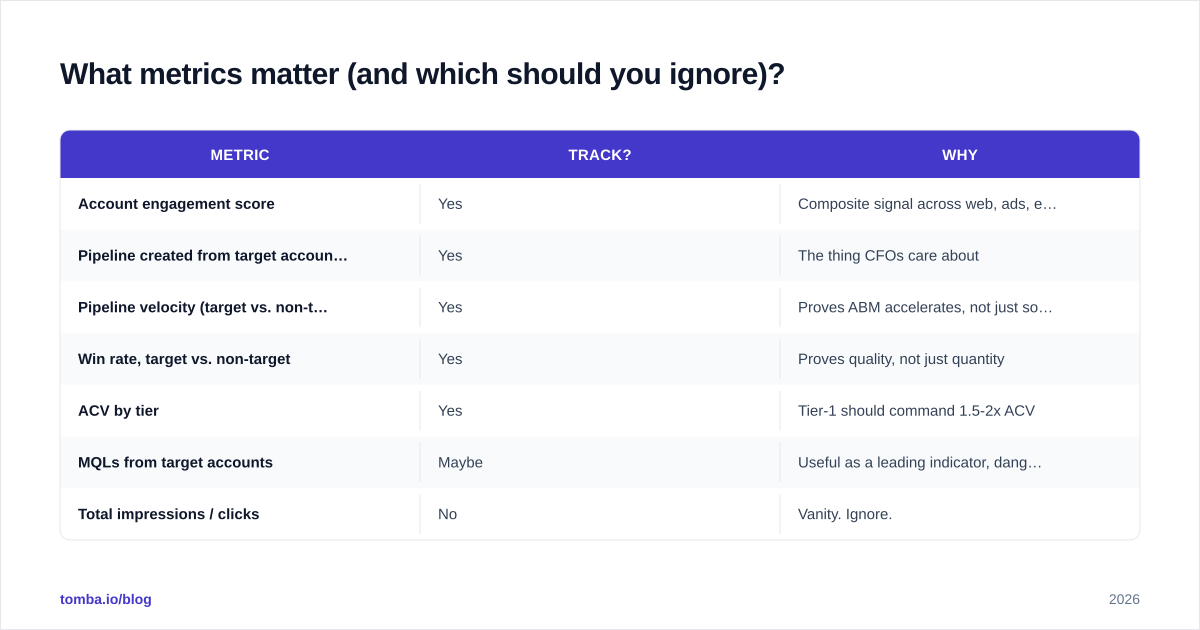
Burn this list to your monitor:
| Metric | Track? | Why |
|---|---|---|
| Account engagement score | Yes | Composite signal across web, ads, email, sales activity |
| Pipeline created from target accounts | Yes | The thing CFOs care about |
| Pipeline velocity (target vs. non-target) | Yes | Proves ABM accelerates, not just sources |
| Win rate, target vs. non-target | Yes | Proves quality, not just quantity |
| ACV by tier | Yes | Tier-1 should command 1.5-2x ACV |
| MQLs from target accounts | Maybe | Useful as a leading indicator, dangerous as a goal |
| Total impressions / clicks | No | Vanity. Ignore. |
| Email opens | No | Apple's MPP killed this metric |
| Cost per lead (target accounts) | No | CPL on 50 accounts is meaningless math |
The honest mistake most teams make is celebrating engagement metrics before pipeline shows up. Engagement is a lagging indicator of plays-being-run, not a leading indicator of revenue. Watch pipeline first, then debug with engagement.
For a richer breakdown of how engagement composites build, HubSpot's ABM resource hub and Forrester's B2B research are the references most RevOps teams cross-check against.
How do you avoid the most common ABM failures?#
Eight patterns kill 90% of programs. If two or more apply, stop and fix the foundation before scaling spend.
- List bloat. "Tier 1" balloons from 30 accounts to 300 because someone wanted their pet logo on it. Solution: cap Tier 1 numerically and require trade-offs.
- No exec sponsor on the marketing side. ABM is a budget line item, not a campaign. Without VP-level marketing ownership, it gets cut at the first quarter where pipeline lags.
- Tooling before discipline. Buying 6sense or Demandbase before fixing CRM hygiene. The platforms are good; they amplify whatever you put in, including garbage.
- Marketing producing content sales never uses. Solution: every Tier-1 asset gets co-created with an AE.
- Sales not following up on signals. If a Tier-1 account spikes and nothing happens for 72 hours, the program is broken.
- No clear exit criteria. Accounts stay in Tier 1 for years even when they ghost. Build a "demote after 2 quarters of zero engagement" rule.
- Ignoring expansion. ABM works just as well — sometimes better — on existing customers. The fastest pipeline often comes from your installed base.
- Treating it as marketing's project. ABM is RevOps. Marketing, sales, CS, and ops all own a slice.
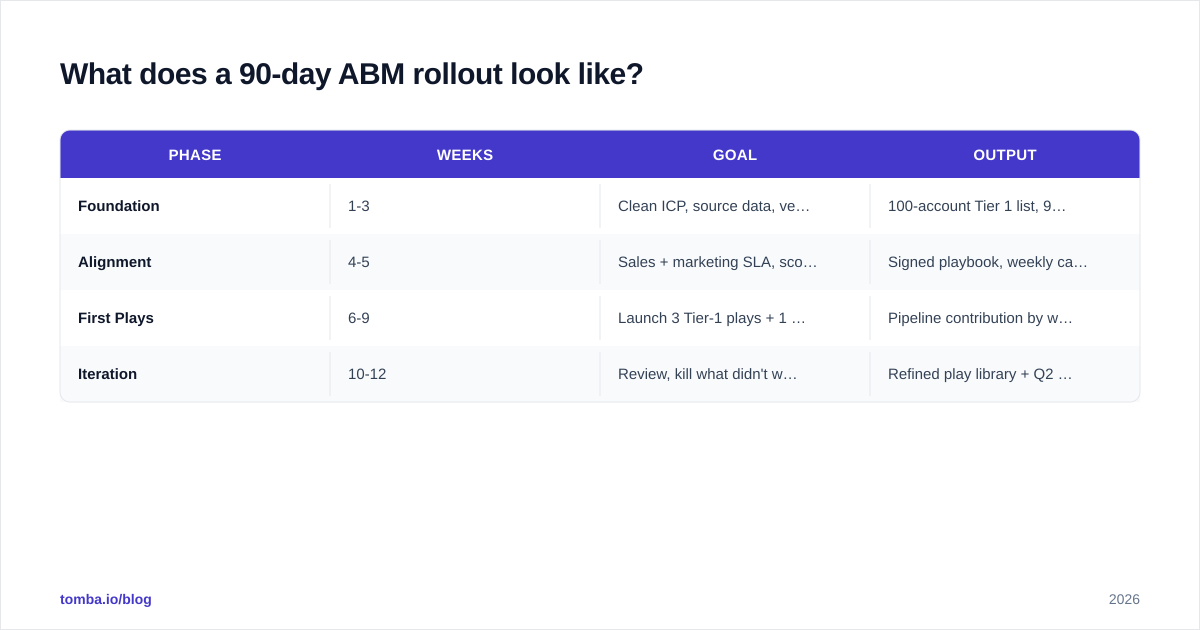
What does a 90-day ABM rollout look like?#
Don't try to launch all three tiers at once. Sequence it.
| Phase | Weeks | Goal | Output |
|---|---|---|---|
| Foundation | 1-3 | Clean ICP, source data, verify contacts | 100-account Tier 1 list, 90% contact coverage |
| Alignment | 4-5 | Sales + marketing SLA, scorecard, shared list | Signed playbook, weekly cadence set |
| First Plays | 6-9 | Launch 3 Tier-1 plays + 1 Tier-2 sequence | Pipeline contribution by week 8 |
| Iteration | 10-12 | Review, kill what didn't work, double down | Refined play library + Q2 plan |
By day 90 you should have early pipeline signal, a sharper list, and a working rhythm. If you don't have at least one Tier-1 opportunity in the pipeline by week 12, the issue isn't ABM — it's the underlying GTM motion.
Closing thought: the program is the unlock, not the platform#
Every quarter someone publishes a "Top 10 ABM Platforms" listicle and another team buys Demandbase before they've fixed their account list. Don't be that team.
The best ABM best practices in 2026 are unsexy: clean data, fewer accounts than your ego wants, ruthless alignment between sales and marketing, and a willingness to kill plays that aren't generating pipeline within a quarter.
When you're ready to build the contact data layer that makes the rest of the program possible — verified emails, decision-maker mapping, and bulk enrichment for your named-account list — start with Tomba Email Finder. Find the buying committee at every Tier-1 account, route it into your CRM, and let your SDRs spend their hours on conversations, not Boolean searches on LinkedIn.
ABM is hard. It's also one of the few B2B motions that still works. Run it with discipline and it will pay for itself before the year is out.
// get started
Find, verify and enrich your first contacts today
Start on the free plan with 25 searches a month, then scale when your team is ready.
Free plan · No credit card required · GDPR & CCPA
// about the author