How to Build an ABM Campaign That Closes Deals in 2026
A practical playbook for building an ABM campaign in 2026 — account selection, signal stacks, channel orchestration, and the metrics that actually predict revenue.
How to Build an ABM Campaign That Closes Deals in 2026
TL;DR
- An ABM campaign treats a short list of named accounts as a market of one, replacing volume-based outreach with coordinated plays across sales, marketing, and product.
- The 2026 stack runs on three signal layers: fit (firmographic + tech), intent (third-party + first-party), and engagement (web, email, ad, meeting).
- One-to-one (5–25 accounts), one-to-few (25–100), and one-to-many (100–1,000) tiers each get different budget, creative depth, and channel mix.
- Pipeline coverage, account engagement minutes, and meeting-to-opportunity conversion outrank MQLs as your north-star metrics.
- The biggest 2026 unlock is enrichment fidelity — bad contact data turns a great account list into a dead campaign.
What is an ABM campaign?#
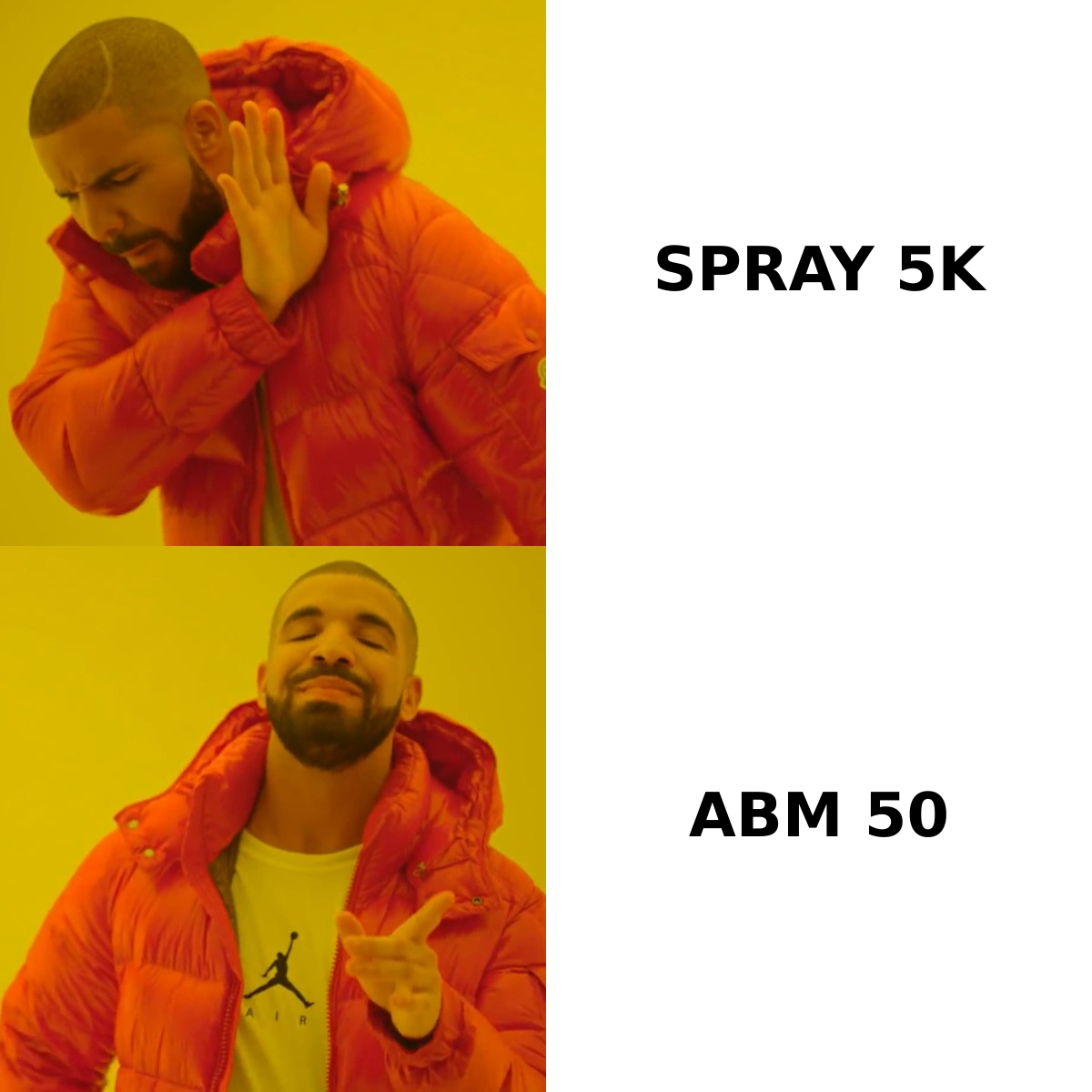
An ABM campaign is a coordinated go-to-market motion that targets a defined list of accounts rather than a broad audience. Instead of generating 5,000 leads and hoping 50 are good, you pick the 50 accounts you want, then surround the buying committee with relevant touches until they convert.
Forrester and ITSMA's research (now Forrester after the 2021 acquisition) was the original push behind the movement, and the discipline has since matured into a default GTM motion for mid-market and enterprise B2B. The category is large enough that G2's ABM grid now tracks dozens of platforms across orchestration, advertising, and intent.
The reason ABM works is unglamorous: B2B buying committees average 6–10 people, and most decisions involve at least 27 documented interactions before a contract gets signed. A campaign aimed at a person — instead of an account — keeps losing because the other eight people on that committee never saw your message.
How is an ABM campaign different from demand gen?#
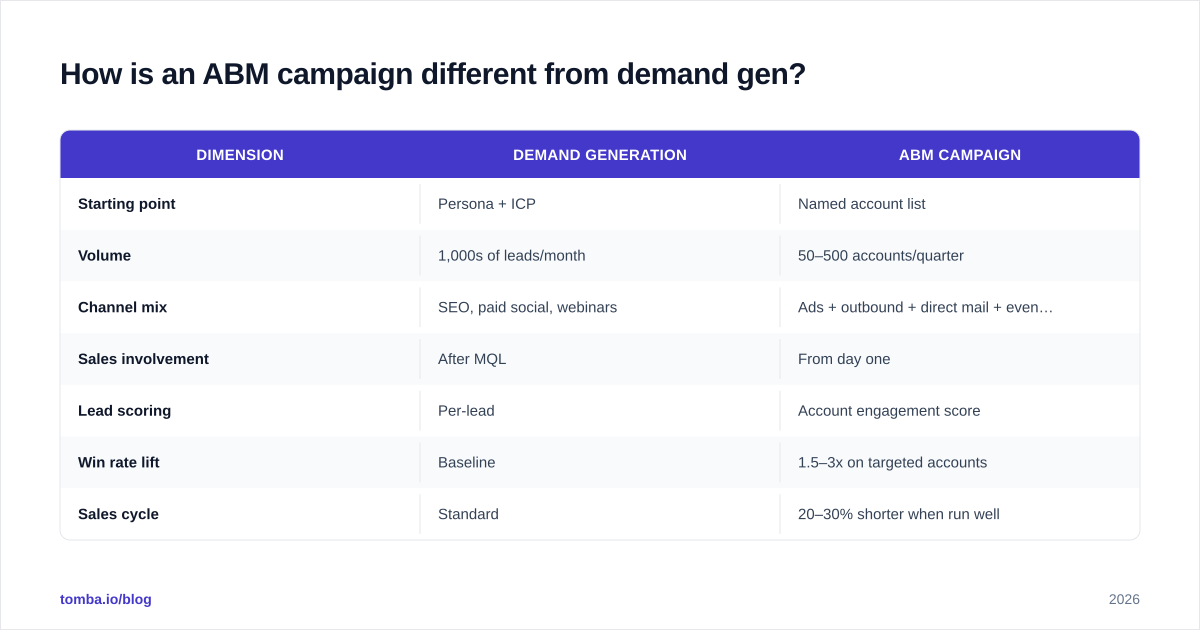
Demand gen casts wide and filters down. ABM picks the targets first and works to convert each one. Both are valid; they answer different questions.
| Dimension | Demand generation | ABM campaign |
|---|---|---|
| Starting point | Persona + ICP | Named account list |
| Volume | 1,000s of leads/month | 50–500 accounts/quarter |
| Channel mix | SEO, paid social, webinars | Ads + outbound + direct mail + events |
| Sales involvement | After MQL | From day one |
| Lead scoring | Per-lead | Account engagement score |
| Win rate lift | Baseline | 1.5–3x on targeted accounts |
| Sales cycle | Standard | 20–30% shorter when run well |
| Reporting unit | Lead, MQL, SQL | Account stage, coverage, velocity |
The two motions are not mutually exclusive. Most teams that succeed at ABM keep demand gen running underneath it — demand gen feeds the funnel, ABM concentrates effort on the accounts most likely to close at high ACV.
What does an ABM campaign actually contain?#
A real campaign — not a slide deck — has six moving parts:
- Target account list (TAL) — the named companies you'll work this quarter.
- Buying committee map — the 4–10 roles per account you need to influence.
- Signal stack — fit, intent, and engagement data feeding routing.
- Channel plays — ads, outbound email, LinkedIn, direct mail, field events.
- Content — account-specific landing pages, custom decks, ROI calculators.
- Measurement layer — engagement scoring, pipeline attribution, coverage reporting.
Skip any one of them and the campaign degrades into either personalized spam (lots of touches, no targeting logic) or beautiful inertia (a perfect list nobody acts on).
How do you build the target account list?#
The TAL is the single highest-leverage decision in any ABM campaign. A bad list cannot be saved by better creative.
Most teams build it in three passes:
Pass 1 — Fit. Start from your ICP definition: industry, headcount band, revenue range, geography, and technographic signals (e.g. "uses Salesforce + Marketo + has 50+ AEs"). A B2B database like Tomba's contact database or a tool with a domain search lets you pull the universe of companies matching those filters.
Pass 2 — Intent. Layer third-party intent (Bombora, G2, 6sense) and first-party signals (site visits, demo requests, content downloads). This is where you separate the 500 companies that fit from the 80 that fit AND are actively researching your category.
Pass 3 — Sales reality check. Sit your AEs in front of the list and ask three questions: Have you worked any of these before? Do any have a buying trigger we'd know about (funding, exec hire, M&A)? Which 10 would you trade your weekend for? The intersection of fit + intent + AE conviction is your tier-1 list.
For the contact layer, you want every named role on the buying committee — typically the economic buyer, the technical evaluator, the end user, and the procurement gatekeeper. Pulling those contacts is where an email finder earns its keep; the alternative is begging SDRs to LinkedIn-scrape manually.
What signals should an ABM campaign listen to in 2026?#
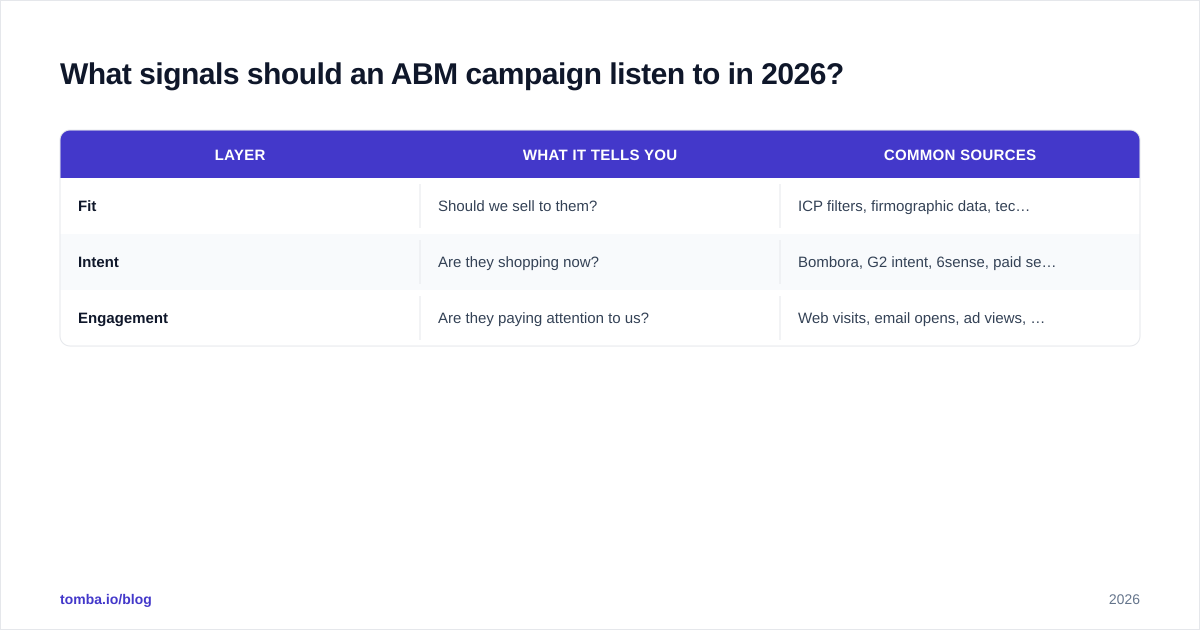
The 2026 ABM stack runs on three signal layers, not one.
| Layer | What it tells you | Common sources |
|---|---|---|
| Fit | Should we sell to them? | ICP filters, firmographic data, tech stack |
| Intent | Are they shopping now? | Bombora, G2 intent, 6sense, paid search |
| Engagement | Are they paying attention to us? | Web visits, email opens, ad views, meeting attendance |
The mistake most teams make is leaning on one layer. Fit-only campaigns spray accounts that aren't ready. Intent-only campaigns chase competitors' deals. Engagement-only campaigns drown in vanity metrics. You want all three feeding a single account score that drives routing.
A useful rule: when an account crosses two of the three thresholds (e.g. tier-1 fit + spiking intent), it should leave nurture and enter active outbound within 24 hours. Latency kills ABM more than any other operational issue.
What channel plays actually work in ABM?#
Channel mix depends on tier. The four plays below are the ones we see consistently outperform in mid-market and enterprise programs.
1. Air cover ads (always-on)#
LinkedIn and display ads targeted by account ID, running 90+ days. The goal isn't clicks — it's familiarity. When the SDR sends the first cold email, you want the buyer to already recognize the logo.
2. Coordinated outbound (1:few)#
A 14–21 day sequence across email, LinkedIn, and phone, mapped to the buying committee. Email subject lines and openers reference an account-specific signal (a new exec, a funding round, a product launch). This only works if your enrichment is accurate — bad emails sink the whole sequence.
3. Custom landing pages (1:1 and 1:few)#
A page at yoursite.com/{account-name} with the account's logo, an industry-specific use case, and a calendar booking link. Tools like Mutiny and 6sense Personalization do this dynamically; you can also hand-build the top 25.
4. Live events + direct mail (1:1)#
Field marketing dinners for 8–12 buyers, executive briefings, and direct mail with real production value. Expensive per touch, highest conversion rate of any channel for >$100K ACV deals.
How do you orchestrate sales and marketing?#
Most ABM campaigns fail not on strategy but on handoffs. Marketing books the ad spend, sales runs the sequences, and nobody owns the account-level view.
Three operational habits separate working ABM teams from spreadsheet theater:
- Weekly account review. AE + ABM lead spend 30 minutes per tier-1 account every two weeks. What changed? What's the next touch?
- Shared definition of "engaged." Engagement score thresholds are agreed upfront — for example, "15+ engagement minutes across 3+ contacts in 14 days" triggers an AE task in the CRM.
- One system of record. Whether it's HubSpot, Salesforce, or a dedicated ABM platform, account state lives in one place. The fastest way to derail a campaign is two dashboards disagreeing about whether Acme Corp is "engaged."
For teams running outbound inside an ABM motion, prospecting hygiene matters more than ever. Verify every email before send (an email verifier catches the catch-alls and roles that destroy your sender score), and pull contacts in bulk through a bulk email finder rather than one-off lookups.
Which metrics actually predict pipeline?#
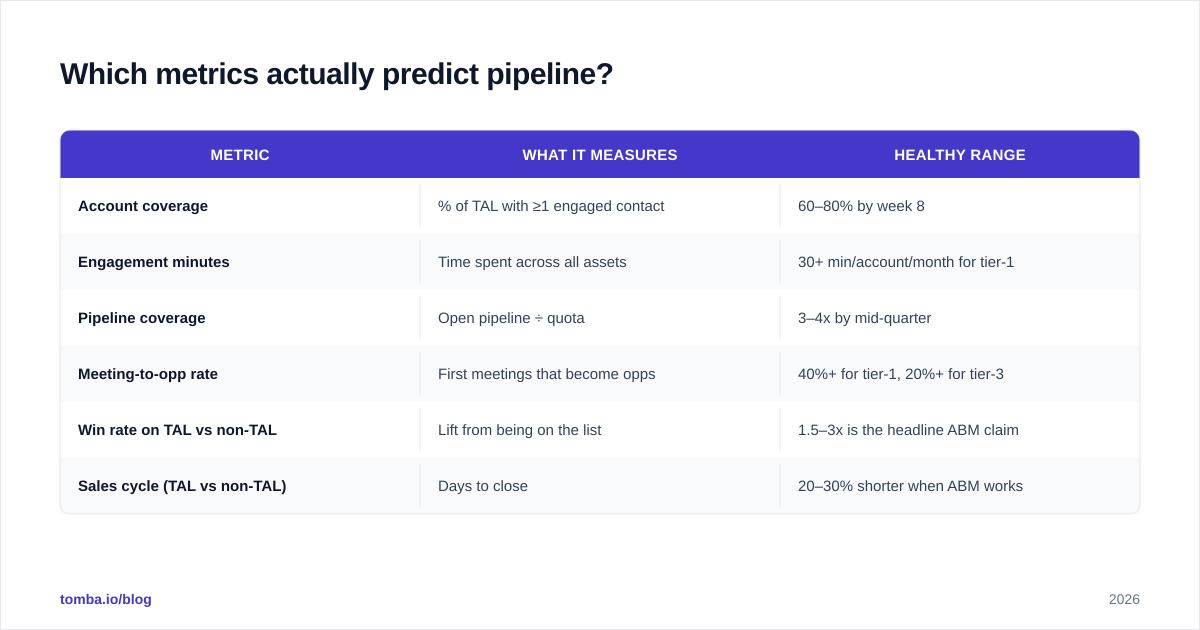
Forget MQLs. The metrics that predict ABM revenue are account-shaped, not lead-shaped.
| Metric | What it measures | Healthy range |
|---|---|---|
| Account coverage | % of TAL with ≥1 engaged contact | 60–80% by week 8 |
| Engagement minutes | Time spent across all assets | 30+ min/account/month for tier-1 |
| Pipeline coverage | Open pipeline ÷ quota | 3–4x by mid-quarter |
| Meeting-to-opp rate | First meetings that become opps | 40%+ for tier-1, 20%+ for tier-3 |
| Win rate on TAL vs non-TAL | Lift from being on the list | 1.5–3x is the headline ABM claim |
| Sales cycle (TAL vs non-TAL) | Days to close | 20–30% shorter when ABM works |
If account coverage isn't moving in the first 4 weeks, the problem is contact data or list quality — go fix the input before changing the creative. If coverage is fine but meetings aren't booking, the problem is the offer or the messaging.
What's the ABM tech stack you actually need?#
You can run a credible ABM program on five categories of tooling. Anything more is premature optimization.
| Category | Job to be done | Examples |
|---|---|---|
| Account intelligence | Build + score the TAL | 6sense, Demandbase, Clearbit |
| Contact data | Find buyers on the TAL | Tomba,ZoomInfo, Apollo |
| Engagement | Sequences + ad targeting | Outreach, Salesloft, LinkedIn |
| CRM / orchestration | Source of truth + workflow | HubSpot, Salesforce |
| Personalization | 1:1 web + content | Mutiny, RollWorks |
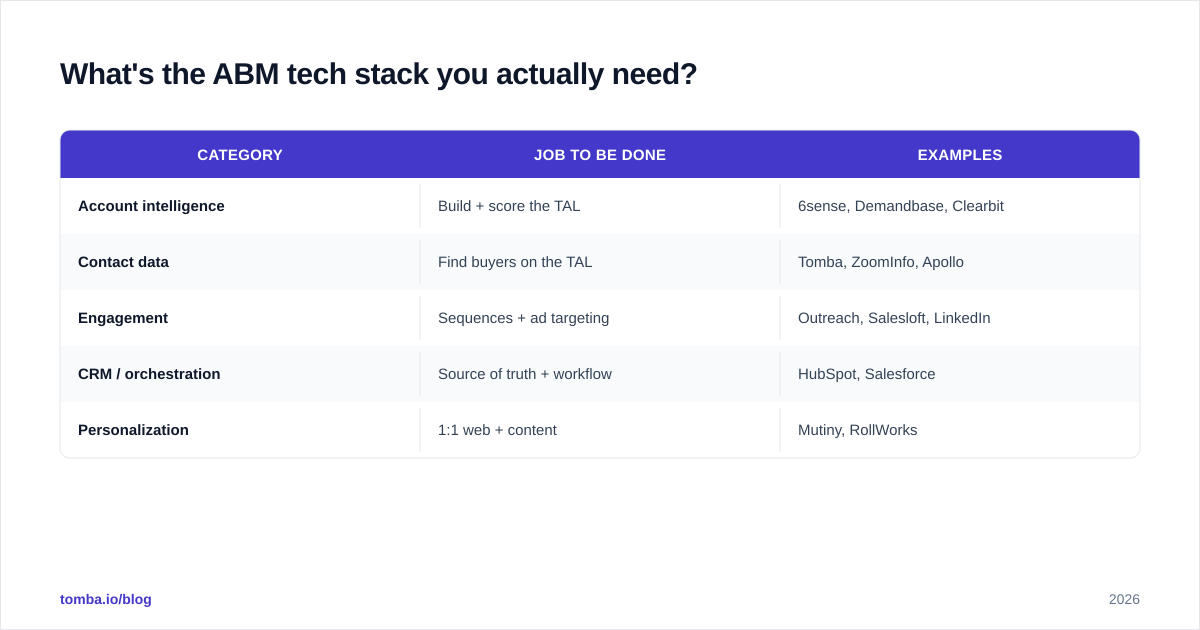
Tomba sits in the contact-data layer of that stack and integrates with the others — see the HubSpot integration and Salesforce integration for the most common ABM wiring. The reason this layer matters disproportionately: every other layer assumes you can reach the people on the account. If 30% of your contact data is wrong, your 1:1 landing pages, your ads, your sequences, and your direct mail all underperform by 30% — minimum.
What does a 90-day ABM campaign timeline look like?#
Most first-time ABM programs try to launch everything at once and burn out by week 6. A phased rollout works better.
Weeks 1–2: Foundation
- Lock the ICP and tier definitions
- Build the TAL (start with 50 accounts, not 500)
- Map buying committees and enrich contacts
- Agree on engagement thresholds with sales
Weeks 3–4: Launch
- Turn on always-on display + LinkedIn ads
- Build 5 custom 1:1 landing pages for tier-1 accounts
- Launch coordinated outbound sequences
- Set up weekly account review meetings
Weeks 5–8: Iterate
- Measure account coverage and engagement minutes
- Cut the bottom 20% of accounts, add 20% new ones
- Refine messaging on whatever play has the worst conversion
- Begin booking 1:1 executive briefings for warm accounts
Weeks 9–12: Scale or kill
- Programs hitting 60%+ coverage and 3x pipeline → scale to next 50 accounts
- Programs below 40% coverage → diagnose (data, list, or messaging) before adding accounts
What are the most common ABM campaign mistakes?#
- Tier-1 ambitions on a tier-3 budget. You cannot run a true 1:1 program on $5K/account if you only have $500.
- List built by marketing, never blessed by sales. AEs will ignore lists they didn't help build. Always.
- Personalization theater. Pasting
{first_name}into a generic email is not personalization. Reference a specific signal or skip the line. - Measuring leads. MQLs are a demand-gen metric. In ABM, an MQL with no other committee members engaged is noise.
- Letting bad data rot the campaign. A 70% accurate contact list isn't a "good start" — it's a 30% tax on every play you run. Verify, re-enrich quarterly, and treat data as a recurring cost, not a one-time spend.
Bottom line#
Run a small ABM campaign well before you run a big one badly. Pick 25 accounts, map every buyer, surround them across four channels for 90 days, and measure coverage + engagement minutes weekly. If those leading indicators move, the pipeline follows. If they don't, the answer is almost always upstream — list, data, or alignment — not a new tactic.
The 2026 advantage isn't fancier orchestration software. It's getting the boring parts right: a tight list, clean contact data, agreed thresholds, and weekly discipline.
Build your ABM contact layer with Tomba. A great target account list is worthless if you can't reach the buying committee. Tomba's Email Finder pulls verified emails for every named contact across your TAL — by domain, by name, or in bulk — and plugs directly into the CRM and outbound tools your ABM stack already runs on. Start free with 25 searches/month, or scale to the Growth plan at $99/mo for full ABM-scale enrichment. See full Tomba pricing.
// get started
Find, verify and enrich your first contacts today
Start on the free plan with 25 searches a month, then scale when your team is ready.
Free plan · No credit card required · GDPR & CCPA
// about the author