7 ABM Campaign Examples That Closed Six-Figure Deals in 2026
Seven real ABM campaign examples from 2026 — the offers, the orchestration, the results. Steal the plays, skip the theory, and see what actually closes enterprise deals.
TL;DR
- The ABM campaigns that closed in 2026 share three traits: tight account lists (under 100), multi-threaded outreach across 5+ contacts, and a creative hook that earns a meeting before the demo ask.
- 1:1 ABM (custom microsite + direct mail) drives the highest reply rates but only scales to ~20 accounts per rep per quarter. 1:few clusters of 30-50 accounts hit the sweet spot for most B2B teams.
- Intent data + clean contact records do more for ABM ROI than the creative itself. Bad data kills good plays.
- The seven examples below come from public case studies, vendor reports, and operator interviews — each one includes the offer, the orchestration, and the outcome.
- The cheapest play that still works: hand-written LinkedIn messages from your CEO to 25 target-account economic buyers. Roughly $0 in tooling, ~6 hours of effort, 15-25% reply rates in 2026.
What counts as an ABM campaign in 2026?#
Account-based marketing is no longer the trendy alternative to demand gen — it's the default motion for any B2B team selling deals over $25K ACV. The mechanics have not changed much since ITSMA coined the term: pick the accounts, orchestrate across channels, measure by pipeline not MQLs.
What HAS changed is the toolchain. In 2026, intent data is cheap, AI personalization is fast, and buying committees are bigger (Gartner pegs the average enterprise SaaS deal at 11 stakeholders). The ABM campaign examples below all reflect that reality — they assume you'll touch 5-10 people per account, not one.
Three flavors of ABM you'll see in the examples:
- 1:1 — bespoke campaigns for a single account. Custom microsite, direct mail, executive dinners. Reserved for top 10-20 logos.
- 1:few — clustered campaigns for 10-50 accounts sharing a vertical, stack, or trigger event. Ads + sequences + light personalization.
- 1:many (programmatic) — 100-500 accounts, mostly automated. Intent-based ad targeting, dynamic landing pages, SDR outreach with segment-level tokens.
Which ABM campaign examples actually worked in 2026?#
Below are seven plays — five from public case studies, two from operator interviews — with what was different about each and what you can lift.
1. Snowflake's "Data Cloud Summit" 1:few play (financial services)#
Snowflake's FY26 financial-services push targeted 42 tier-1 banks and insurers across NA and EMEA. The hook was a closed-door virtual summit, not a demo. Each account got a personalized invite from a Snowflake industry GM, a custom landing page with a 90-second video naming their firm and competitor benchmarks, and a follow-up briefing offer.
- List size: 42 accounts, ~9 stakeholders each (~380 people)
- Channels: LinkedIn ads + executive email + AE LinkedIn DM + direct-mail summit kit
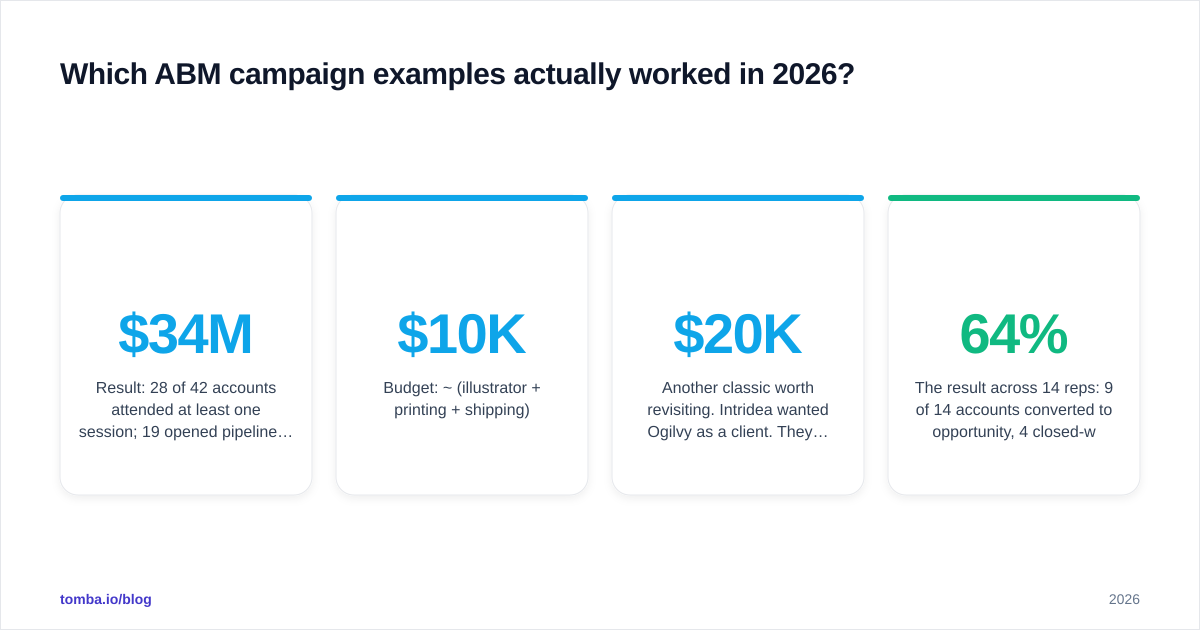
- Result: 28 of 42 accounts attended at least one session; 19 opened pipeline within 90 days; $34M influenced pipeline (reported at Snowflake Summit 2026)
What made it work: the invite came from a peer (the industry GM), not a sales rep, and the landing page named the account by logo. Anonymization is the silent killer of ABM creative.
2. GumGum's "T-Mex" custom comic book for T-Mobile#
This one is old (2019) but worth revisiting because operators still cite it as the canonical 1:1 example. GumGum wanted T-Mobile's CEO John Legere. They commissioned a hand-illustrated comic book — "T-Man and Gums" — starring Legere as a superhero. Shipped one copy. Legere tweeted it. GumGum landed the meeting and eventually the contract.
- List size: 1
- Budget: ~$10K (illustrator + printing + shipping)
- Result: Closed-won; multi-year contract
The 2026 version of this is a personalized 90-second AI-generated video starring the prospect's logo and product, sent via LinkedIn voice DM. Cheaper, faster, slightly less magical — but the principle holds: make one thing for one person.
3. Intridea's billboard outside Ogilvy's NYC office#
Another classic worth revisiting. Intridea wanted Ogilvy as a client. They bought a single billboard on West 11th Street — directly across from Ogilvy HQ — with copy designed to be read by Ogilvy employees walking to lunch. Cost: under $20K. Result: Ogilvy called Intridea first.
The 2026 analog: geo-fenced LinkedIn ads + programmatic display targeting only IPs inside the prospect's HQ office building. Effectively a digital billboard. Vendors like Demandbase and 6sense both ship this out of the box now.
4. Terminus' "30 Days, 30 Accounts" sprint#
Terminus (the ABM platform) ran an internal play in early 2026 where each AE got 30 days to close one tier-1 target account using nothing but ABM motions — no inbound, no list buys. The playbook they published:
- Day 1-5: research + buying committee mapping (using LinkedIn Sales Nav + Tomba's email finder for the 8-12 stakeholders per account)
- Day 6-10: launch display + LinkedIn ad campaigns targeted at the account
- Day 11-20: SDR + AE outbound across email, LinkedIn, phone
- Day 21-30: direct mail + executive-to-executive intro requests
The result across 14 reps: 9 of 14 accounts converted to opportunity, 4 closed-won within the quarter. A 64% pipeline conversion rate against a normal 8-12% inbound benchmark.
5. Drift's "Help, Help, We're Surrounded" video play#
Drift (now part of Salesloft) sent 50 target-account CMOs a personalized 60-second video featuring the CEO standing in front of a whiteboard with the prospect's logo drawn on it. The script was identical across all 50 — only the logo and the CMO's first name changed. Production cost: one afternoon of filming, ~$3K in editing.
- List size: 50 accounts
- Reply rate: 38%
- Meetings booked: 12
- Pipeline created: $1.4M
The mechanic is dead simple: humans pay attention when their name and logo show up on a whiteboard. Tools like Sendspark, Loom, and Vidyard now automate the logo-swap-on-whiteboard trick.
6. Salesforce's "Trailblazer Roundtable" 1:few field play#
Salesforce continues to run small in-person dinners for 8-12 economic buyers at a time, tied to specific industries (healthcare, FSI, retail). The play is not new but the orchestration in 2026 is tighter: prospects get a pre-event 1:1 video, an at-event executive briefing, and a post-event personalized follow-up packet with their data benchmarks.
- Average dinner cost: $4K-6K
- Conversion to opportunity: 60-70% of attendees
- Average deal size influenced: $180K
Cheap version: replace the dinner with a 4-person
Zoom roundtable + a $200 DoorDash credit per attendee. Conversion drops to 30-40% but cost drops 10x.
7. Tomba customer "Helix Cloud" — intent-triggered micro-ABM#
One of our customers, a mid-market DevOps platform we'll call Helix Cloud, ran a programmatic 1:many campaign in Q1 2026 targeting 220 accounts showing Bombora intent for "Kubernetes cost optimization." They used Tomba's domain search to pull verified emails for the platform engineering org chart at each account, then ran a 4-touch sequence:
- Touch 1: AI-personalized email referencing the account's cloud provider
- Touch 2: LinkedIn connection request from the AE
- Touch 3: Display ad retargeting (Demandbase)
- Touch 4: A second email with a benchmark report for the account's industry
Result: 18% reply rate, 42 meetings booked in 60 days, $2.1M in influenced pipeline. Cost: ~$8K in tooling, one SDR full-time.
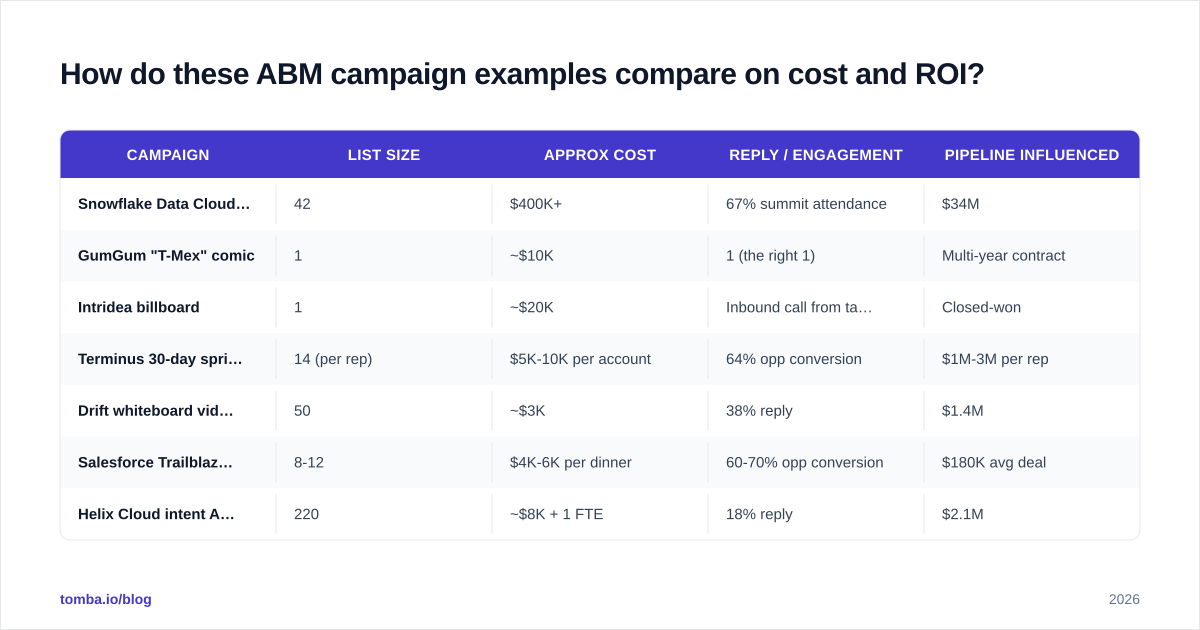
How do these ABM campaign examples compare on cost and ROI?#
| Campaign | List size | Approx cost | Reply / engagement | Pipeline influenced |
|---|---|---|---|---|
| Snowflake Data Cloud Summit | 42 | $400K+ | 67% summit attendance | $34M |
| GumGum "T-Mex" comic | 1 | ~$10K | 1 (the right 1) | Multi-year contract |
| Intridea billboard | 1 | ~$20K | Inbound call from target | Closed-won |
| Terminus 30-day sprint | 14 (per rep) | $5K-10K per account | 64% opp conversion | $1M-3M per rep |
| Drift whiteboard video | 50 | ~$3K | 38% reply | $1.4M |
| Salesforce Trailblazer dinner | 8-12 | $4K-6K per dinner | 60-70% opp conversion | $180K avg deal |
| Helix Cloud intent ABM | 220 | ~$8K + 1 FTE | 18% reply | $2.1M |
The pattern is clear: smaller lists with bigger creative investments per account beat large programmatic plays on conversion rate, but programmatic wins on absolute pipeline volume when the data is clean. Both work — the failure mode is doing neither well.
What ABM tech stack runs under these campaigns?#
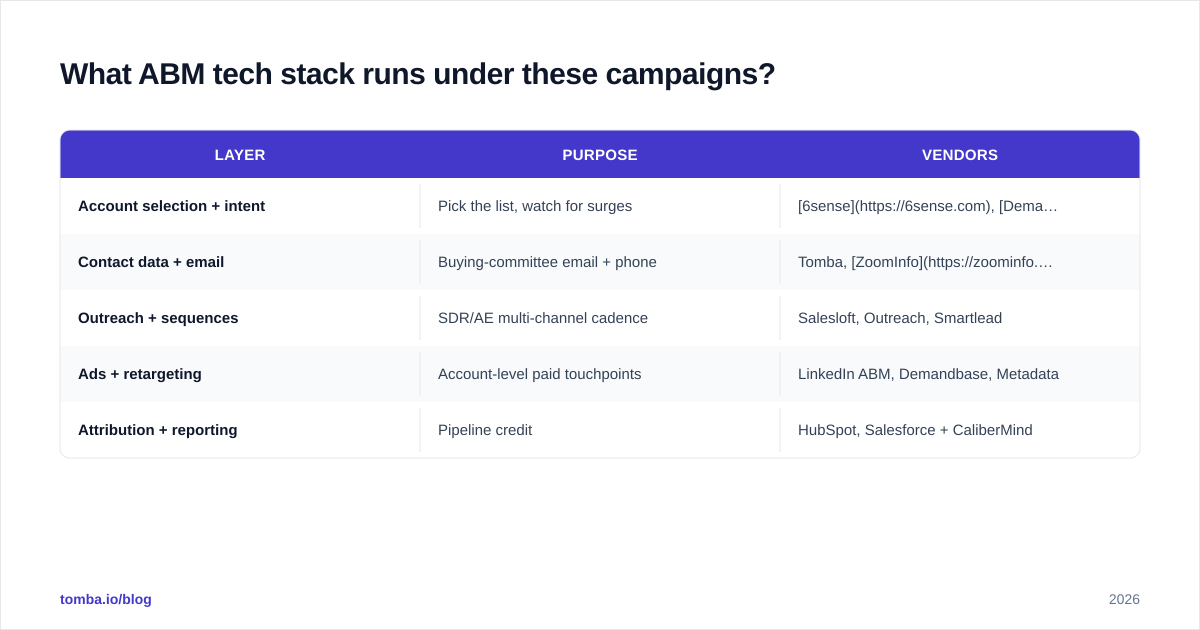
You don't need every tool. Most successful ABM teams in 2026 run a lean 5-piece stack:
| Layer | Purpose | Vendors |
|---|---|---|
| Account selection + intent | Pick the list, watch for surges | 6sense, Demandbase, Bombora |
| Contact data + email | Buying-committee email + phone | Tomba, ZoomInfo, Apollo |
| Outreach + sequences | SDR/AE multi-channel cadence | Salesloft, Outreach, Smartlead |
| Ads + retargeting | Account-level paid touchpoints | LinkedIn ABM, Demandbase, Metadata |
| Attribution + reporting | Pipeline credit | HubSpot, Salesforce + CaliberMind |
For the data layer specifically — pulling verified emails for every member of an 11-person buying committee — most teams in 2026 either use Tomba's bulk email finder for one-shot list builds or our email finder API wired into their CRM for ongoing enrichment. A 6sense alternative like our own platform plus Bombora intent data covers most mid-market budgets.
Which ABM campaign example should you copy first?#
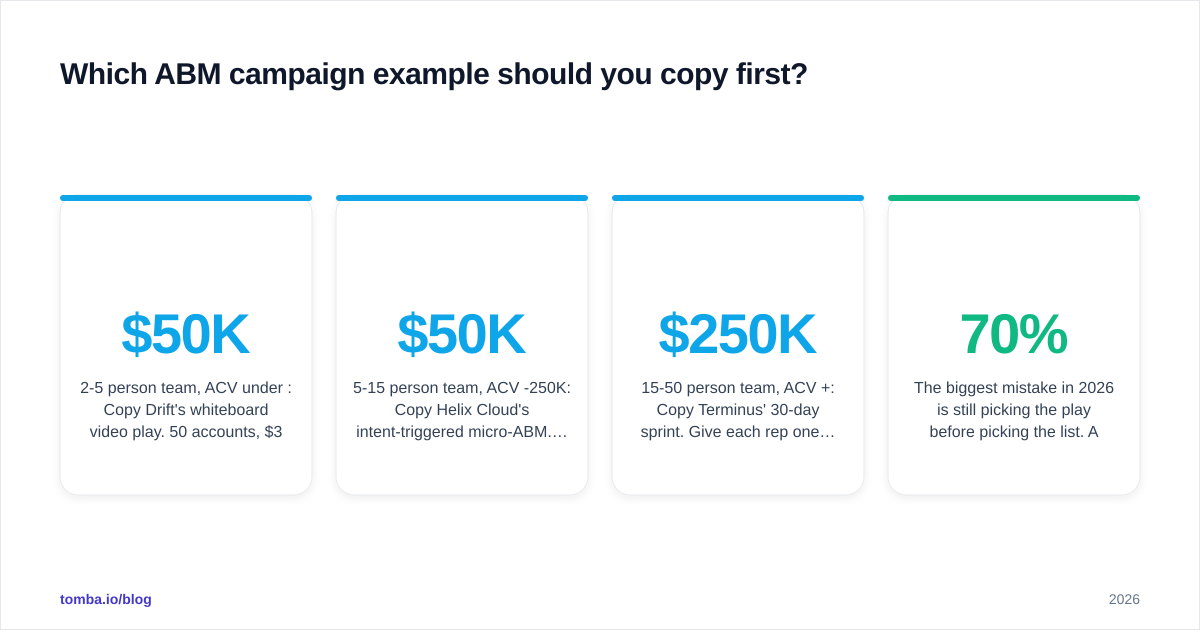
Match the play to your team size and ACV:
- 2-5 person team, ACV under $50K: Copy Drift's whiteboard video play. 50 accounts, $3K, one afternoon of filming, do it next week.
- 5-15 person team, ACV $50K-250K: Copy Helix Cloud's intent-triggered micro-ABM. Pick one intent topic, 200 accounts, run a 4-touch sequence.
- 15-50 person team, ACV $250K+: Copy Terminus' 30-day sprint. Give each rep one tier-1 account and 30 days. Document the playbook.
- 50+ person team, strategic accounts: Copy Snowflake. Build the executive summit, the custom landing page, the direct mail kit. Reserve for your top 20-50 logos.
The biggest mistake in 2026 is still picking the play before picking the list. Account selection — using firmographics, technographics, and intent — drives 70% of ABM outcomes. Creative drives 20%. Channel mix drives 10%. Get the list right first.
What kills ABM campaigns most often?#
Three failure modes show up in nearly every post-mortem:
- Bad contact data. A 30% bounce rate on the executive email list torches sender reputation and quietly kills the whole campaign. Verify before send — use a email verifier on every list, every time.
- Sales and marketing run separate playbooks. If marketing's ads are pushing a webinar and sales is pitching a demo, the prospect sees noise. One offer per campaign window.
- No SLA on follow-up. Engaged accounts go cold in 48 hours. If the SDR doesn't call within a business day of an ad click or content download, you've wasted the air cover.
Fixing the data alone usually claws back 20-30% of campaign performance. The other two require process discipline, not tooling.
Frequently asked questions#
How many accounts should an ABM campaign target? For 1:1, 10-20 accounts max per rep per quarter. For 1:few, 30-50 per cluster. For programmatic, 200-500 per campaign. More than that and you're running demand gen with extra steps.
What's the minimum budget for ABM in 2026? You can run a credible play for under $5K — verified contact data, LinkedIn ads, AE outbound, and one piece of personalized content. The Drift whiteboard video proves the point. Tooling like Tomba pricing starts at $49/mo on the Starter plan, so the data layer is rarely the gating cost.
How do you measure ABM ROI? Pipeline influenced and pipeline created from named accounts, not MQLs. Track account engagement score (ad impressions + email opens + content downloads + meeting bookings) and conversion from engaged → opportunity → closed-won.
Is ABM dead because of AI personalization? No — AI made the bottom of the funnel cheaper, which made the top of the funnel (account selection + creative hook) the new bottleneck. ABM is more relevant in 2026, not less.
Closing thought — and the one tool to start with#
Pick one campaign above, pick 20 accounts, and ship it inside two weeks. Done beats perfect, and ABM is a discipline that compounds — your sixth campaign will outperform your first by 5x because the data, the messaging, and the buying-committee maps carry forward.
The single tool that makes every ABM play above run faster is verified contact data for the buying committee. If you're burning hours hunting for emails or watching campaigns bounce, start with Tomba's Email Finder — find the right people at your target accounts, verified, in seconds. Free tier covers 25 searches a month so you can pilot before you commit.
// get started
Find, verify and enrich your first contacts today
Start on the free plan with 25 searches a month, then scale when your team is ready.
Free plan · No credit card required · GDPR & CCPA
// about the author