ABM Campaign Planning in 2026: A Complete Playbook for B2B Teams
ABM campaign planning is where most account-based programs quietly die. Here's the 2026 playbook for tier design, account selection, plays, and measurement that actually drives pipeline.
TL;DR#
- ABM campaign planning fails when teams skip tiering and jump straight to ads — start with account selection, then build plays per tier.
- A working 2026 ABM plan covers five layers: ICP, account list, buying group, plays, and measurement (pipeline-influenced, not MQLs).
- 1:1 ABM works for 5-50 accounts. 1:few for 50-500. 1:many for 500+. Mixing tiers without separate plays is the most common waste.
- Intent data is table stakes, but only useful when fused with firmographic fit and contact-level enrichment.
- Tomba's email finder and enrichment power the contact layer most ABM stacks skip — getting verified emails for the full buying group is what makes a play executable.
What is ABM campaign planning?#
ABM campaign planning is the process of selecting a finite list of high-fit accounts, mapping the buying committee inside each, and orchestrating coordinated marketing, sales, and customer plays against them. It is the opposite of demand-gen: instead of casting wide and filtering, you commit to a list and go deep.
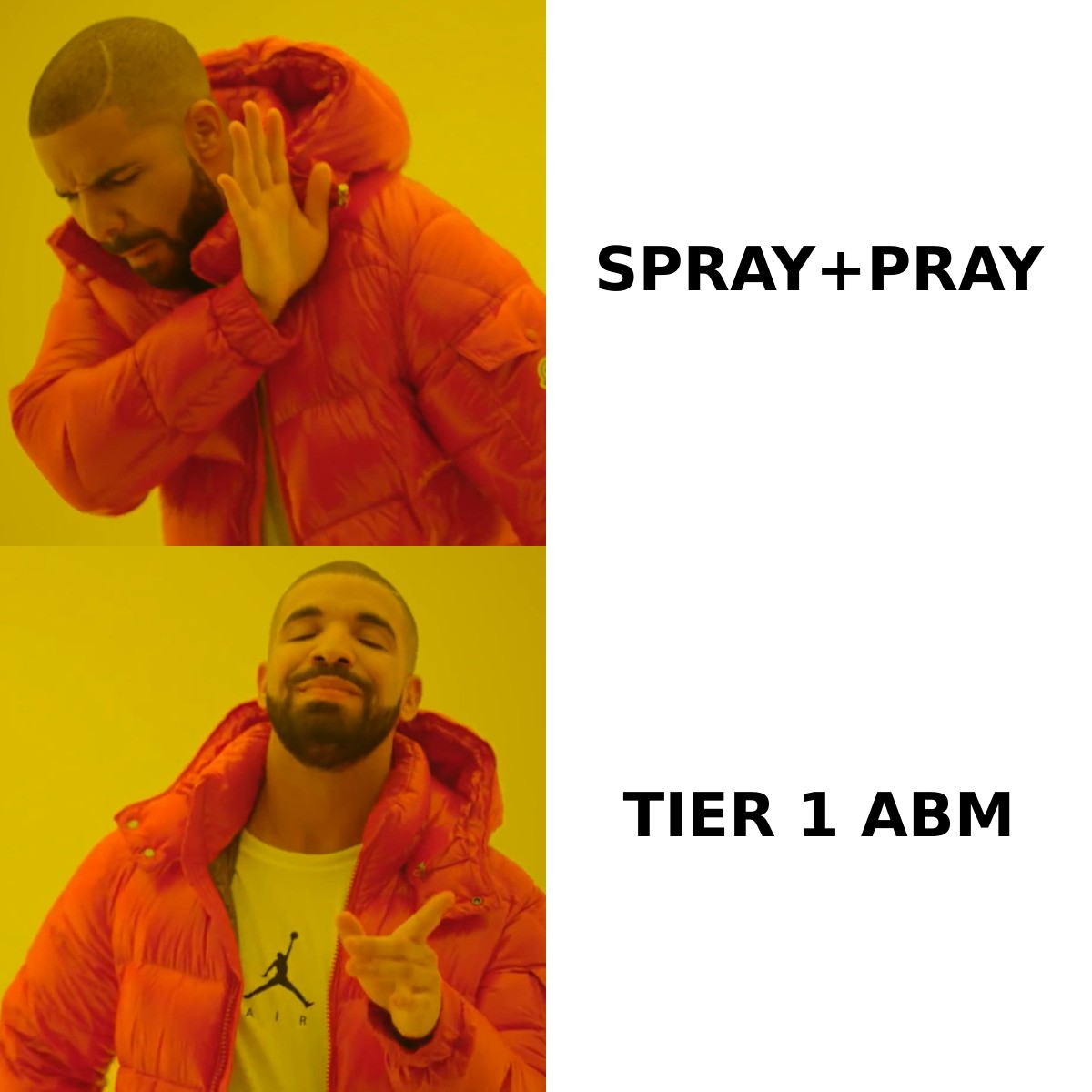
The discipline matters because account-based programs without explicit planning revert to the mean. Sales pulls leads from the MQL queue. Marketing runs broad webinars. Ads spray across LinkedIn audiences that look nothing like your ICP. The result is an "ABM program" that is really just demand-gen with a sticker on it.
A real ABM plan answers five questions before any campaign launches:
- Who are we selling to (ICP)?
- Which named accounts inside that ICP get our budget?
- Who is in the buying group at each account?
- What sequence of touches do we run per tier?
- What does pipeline influence look like at 30, 60, and 90 days?
Skip any of these and the program drifts.
How does ABM differ from demand generation?#
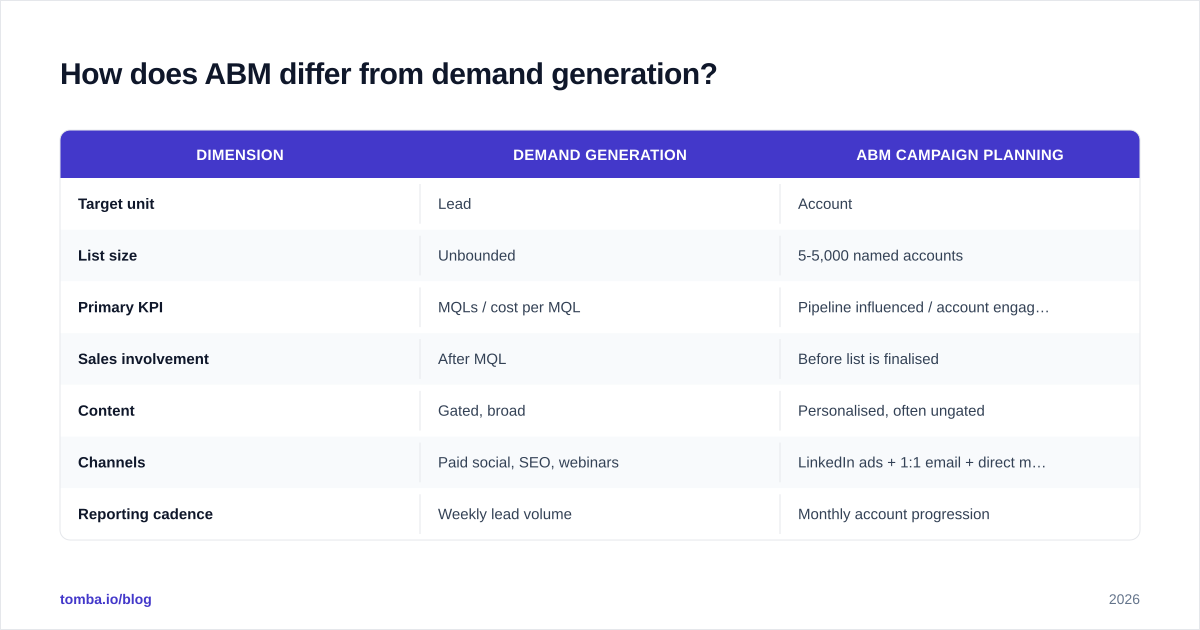
Demand gen optimises for volume at the top of the funnel. ABM optimises for depth inside a closed list. The shift changes every downstream decision: scoring, attribution, content production, even how the SDR team is paid.
| Dimension | Demand Generation | ABM Campaign Planning |
|---|---|---|
| Target unit | Lead | Account |
| List size | Unbounded | 5-5,000 named accounts |
| Primary KPI | MQLs / cost per MQL | Pipeline influenced / account engagement |
| Sales involvement | After MQL | Before list is finalised |
| Content | Gated, broad | Personalised, often ungated |
| Channels | Paid social, SEO, webinars | LinkedIn ads + 1:1 email + direct mail + events |
| Reporting cadence | Weekly lead volume | Monthly account progression |
| Sales-marketing handoff | Form fill | Joint account review |
If your weekly leadership meeting still opens with "How many MQLs did we hit this week," you do not have an ABM program. You have a demand-gen program with an ABM tab in the dashboard.
How do you build an ABM account list?#
The account list is the single most consequential decision in ABM. A bad list with perfect execution loses to a good list with mediocre execution every time.
Three inputs feed a defensible list:
Firmographic fit. Industry, revenue band, employee count, geography, tech stack. Pull this from your CRM closed-won data — not from a guess about who you "should" be selling to. The pattern almost always surprises sales leadership.
Behavioural and intent signal. Third-party intent (6sense, Bombora, G2), first-party site behaviour, opportunity-stage signal in your CRM. Intent without fit is noise. Fit without intent is a long sales cycle.
Strategic overrides. Whale accounts you must pursue regardless of score. Customer expansion targets. Lighthouse logos for case studies. Cap these at 10-15% of the list or they swallow the program.
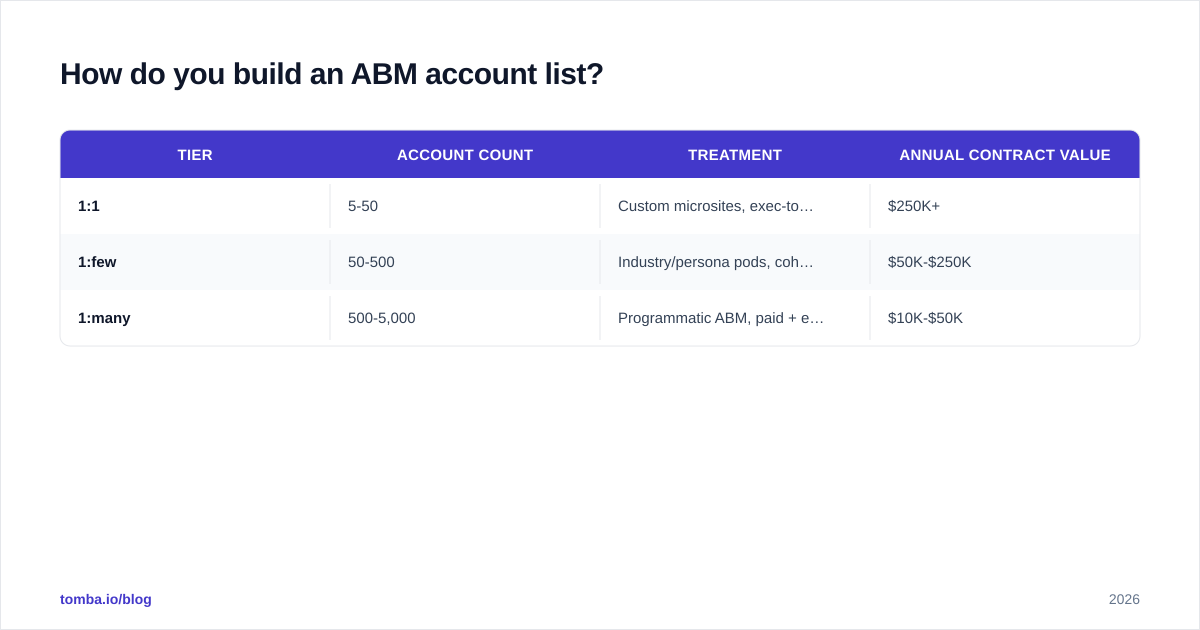
Score every candidate account on a simple 0-100 model, then bucket into three tiers:
| Tier | Account count | Treatment | Annual contract value |
|---|---|---|---|
| 1:1 | 5-50 | Custom microsites, exec-to-exec, named-account ABM | $250K+ |
| 1:few | 50-500 | Industry/persona pods, cohort plays | $50K-$250K |
| 1:many | 500-5,000 | Programmatic ABM, paid + email + retargeting | $10K-$50K |
The tier dictates the budget per account. A 1:1 play might spend $5,000 on a single account between content, ads, and direct mail. A 1:many play might spend $50.
A common gap at this stage: you have the company list, but no verified contacts inside each account. The plan is unexecutable until the buying group is mapped. Use a bulk email finder to resolve the named contacts at scale, then verify them with an email verifier before any outbound touch.
How do you map the buying group?#
Gartner's research on B2B buying — published at gartner.com — repeatedly shows the average enterprise buying group is now 6-10 people. A plan that targets only the economic buyer misses 80% of the influence.
For each tier-1 and tier-2 account, build a contact map covering four roles:
- Champion — the person who feels the pain and wants to buy.
- Economic buyer — the budget holder.
- Technical evaluator — IT, security, ops, depending on category.
- Blocker / influencer — procurement, legal, an adjacent department head whose veto kills the deal.
For each role, identify by name (not just title), verify the work email, capture LinkedIn, and tag with engagement history. A LinkedIn finder plus a domain search covers most of this in minutes per account.
Tier-3 accounts get a thinner treatment — typically just the top two personas resolved at the company level.
What plays should the plan include?#
A play is a repeatable sequence of touches tied to a trigger. Plays are the operational unit of ABM — they are what your team actually runs. The plan should specify 4-7 plays per tier.
Examples of plays that work in 2026:
New account opening (tier 1). Trigger: account added to list. Sequence: warm intro request from exec, 1:1 microsite, direct-mail kit, LinkedIn connect from AE, week-2 follow-up email referencing the kit.
Surge intent (any tier). Trigger: 6sense or Bombora flags surge on a relevant topic. Sequence: paid ads to all known contacts within 24 hours, AE outbound to champion persona, content gift relevant to the surge topic.
Champion departure (tier 1). Trigger: known champion changes jobs. Sequence: follow them to new company, congratulate, open conversation. This is the highest-converting ABM play in B2B SaaS and most teams do not run it.
Stalled opportunity revival (any tier). Trigger: opportunity inactive 30+ days. Sequence: multi-threaded outreach across 3 new personas in the same account, new POV content piece.
Customer expansion (tier 1 customer accounts). Trigger: usage milestone or org change. Sequence: success manager outreach, exec-to-exec dinner invite, expansion business case delivered.
Each play needs a documented trigger, sequence, owner, asset list, and success metric. Plays without owners do not run.
What does the orchestration stack look like?#
ABM orchestration is where most plans collapse. Marketing runs LinkedIn ads in one tool, SDRs sequence in another, AEs improvise in the CRM, and nobody can see the full picture per account.
A workable 2026 stack has six layers:
- Account intelligence — 6sense, Demandbase,
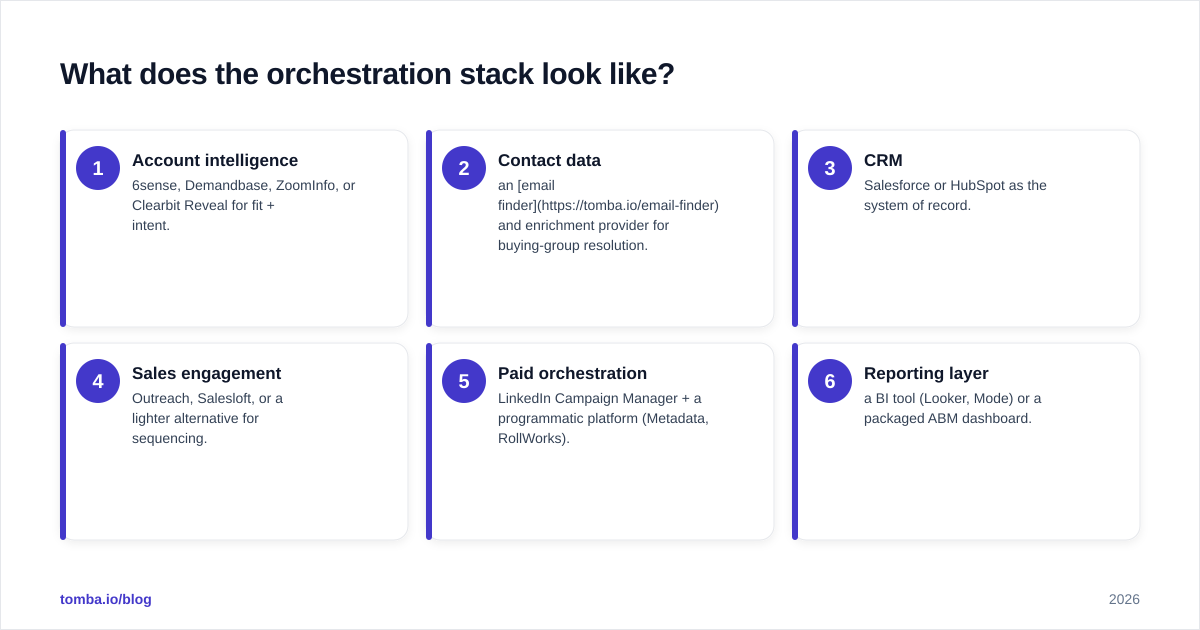
ZoomInfo, or Clearbit Reveal for fit + intent. 2. Contact data — an email finder and enrichment provider for buying-group resolution. 3. CRM — Salesforce or HubSpot as the system of record. 4. Sales engagement — Outreach, Salesloft, or a lighter alternative for sequencing. 5. Paid orchestration — LinkedIn Campaign Manager + a programmatic platform (Metadata, RollWorks). 6. Reporting layer — a BI tool (Looker, Mode) or a packaged ABM dashboard.
The integration layer matters more than any single tool. Wire account engagement back into the CRM at the account level — not just the lead level — and you can finally answer "is this account warming up?" with evidence.
Tomba's API and HubSpot integration handle the contact-data layer for teams who do not want a six-figure enrichment contract.
How do you measure ABM performance?#
ABM measurement is fundamentally different from demand gen. Lead counts are misleading. Instead, track three layers:
Engagement. Are target accounts spending more time with you over time? Composite metric across site visits, content downloads, ad impressions to known contacts, meetings booked.
Pipeline. Pipeline created from target accounts, pipeline velocity vs non-target accounts, win rate uplift.
Revenue. Closed-won ACV from target accounts, expansion revenue from target customer accounts, attribution-weighted contribution.
A clean ABM dashboard answers these questions:
| Question | Metric |
|---|---|
| Is the list warming up? | Account engagement score trend (30/60/90 days) |
| Are plays working? | Play-level reply rate, meeting rate, opportunity rate |
| Is pipeline different on ABM accounts? | Pipeline coverage ratio on ABM vs non-ABM accounts |
| Are we winning more? | Win rate on ABM accounts vs control cohort |
| Is the math working? | Pipeline-to-spend ratio per tier |
If you cannot show a control cohort, you cannot prove ABM works. Hold out 10-20% of fit accounts from ABM treatment as a control for the first two quarters — it is the only credible attribution method.
For deeper context on the operating model behind these metrics, see Tomba's primer on revenue operations.
How much should you budget for an ABM program?#
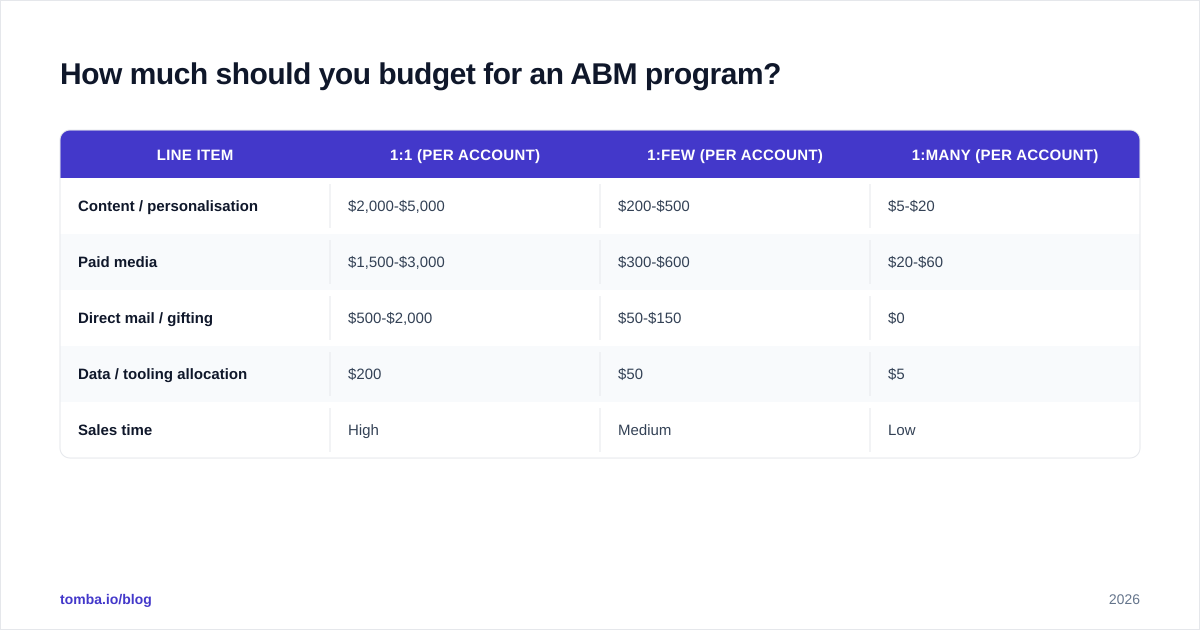
Budgets vary wildly, but the structure is consistent. Allocate by tier, not by channel:
| Line item | 1:1 (per account) | 1:few (per account) | 1:many (per account) |
|---|---|---|---|
| Content / personalisation | $2,000-$5,000 | $200-$500 | $5-$20 |
| Paid media | $1,500-$3,000 | $300-$600 | $20-$60 |
| Direct mail / gifting | $500-$2,000 | $50-$150 | $0 |
| Data / tooling allocation | $200 | $50 | $5 |
| Sales time | High | Medium | Low |
A 50-account tier-1 program lands in the $200K-$500K range annually, not counting headcount. A 2,000-account tier-3 program runs $100K-$200K. Most mid-market companies will get more leverage from a 1:few program of 200-300 accounts than from either extreme.
For pricing on the contact and enrichment layer specifically, see Tomba pricing — the Growth plan covers most teams running 1:few or 1:many at scale.
What are the most common ABM planning mistakes?#
After reviewing dozens of ABM programs, the same failure patterns repeat:
Picking accounts by gut. The CEO's wish list is not an account list. Score every account on the same model.
Skipping the buying group. Targeting only the economic buyer leaves 70% of influence unaddressed. Map all four roles.
One play for all tiers. A 1:1 play wastes budget on tier 3; a 1:many play feels generic to tier 1. Tier-specific plays are non-negotiable.
Measuring like demand gen. MQLs and form fills are the wrong unit. Move the dashboard to account engagement and pipeline coverage.
No control group. Without a holdout, "ABM is working" is a story, not a finding.
Stale contact data. Plans built on 18-month-old contact lists email people who left the company. Refresh the contact layer quarterly — see Tomba's guide on data sources for what fresh enrichment actually requires.
Marketing-only ownership. ABM is a joint operating model. If sales is not in the planning room, it is not ABM.
For the broader category context, HubSpot's ABM resources and the analyst write-ups on g2.com cover vendor selection in more depth.
When should you not run ABM?#
ABM is not universally correct. Skip it if:
- Your ACV is under $5,000 and there is no expansion motion — the math does not work.
- Your ICP includes more than 50,000 accounts globally — you are a demand-gen business, not an ABM one.
- Your sales cycle is under 14 days — the orchestration overhead eats the benefit.
- Your product is self-serve and PLG-led — invest in product experience instead.
For everyone else — most B2B SaaS with $20K+ ACV and committee buying — ABM is the default. The question is which tier, not whether.
Where does Tomba fit in an ABM plan?#
The contact layer is the part of ABM stacks that breaks most often. You have the account list, the intent data, and the orchestration tools — but the email addresses for the full buying group are stale, missing, or wrong. That is what kills the execution.
Tomba's Email Finder resolves verified work emails for any name+domain combination, and the domain search pulls the full directory of known contacts at a target account in one call. Combined with the enrichment API, you get the buying-group map that makes the rest of your ABM plan executable — at a fraction of the cost of legacy enrichment contracts.
Start free with 25 searches a month, and scale into the Growth plan once your 1:few cohort is running. Your account list is only as good as the contacts behind it — and that is exactly where Tomba pays for itself.
// get started
Find, verify and enrich your first contacts today
Start on the free plan with 25 searches a month, then scale when your team is ready.
Free plan · No credit card required · GDPR & CCPA
// about the author