ABM Campaign Planning Template: The 2026 Operator's Guide
A working ABM campaign planning template for 2026 — account selection, plays, channels, and the metrics that actually predict pipeline. Copy-paste sections included.
TL;DR#
- Most ABM plans fail because they start with channels (LinkedIn ads, gifts, sequences) instead of an account thesis. Flip the order.
- A real ABM campaign planning template has six layers: account selection, buying-committee map, account thesis, plays, channel orchestration, and a metric stack that ladders to pipeline.
- 1:1, 1:few, and 1:many are not "tiers of effort" — they are different products with different unit economics. Budget them separately.
- Pipeline contribution, account engagement velocity, and meeting-to-opportunity rate are the only three metrics that survive a CFO review. Vanity metrics (impressions, MQLs) get cut.
- This post gives you the copy-paste template, a comparison of the three ABM motions, and the tools (including data sources like Tomba) that fill in each row.
What is an ABM campaign planning template, really?#
An ABM campaign planning template is the document that turns "let's do ABM" into a campaign your SDRs, marketers, and execs can actually run on Monday morning. It is not a slide deck. It is a structured worksheet — usually a spreadsheet or Notion page — that forces you to answer six questions in order, before anyone touches an ad platform.
The six layers, in the order they have to be filled in:
- Account selection — which logos, and why these and not others.
- Buying-committee map — who you need to reach inside each logo.
- Account thesis — the one-sentence reason this account should buy this quarter.
- Plays — the specific moves you'll run against the thesis.
- Channel orchestration — which channels carry which play, in which order.
- Metrics — what proves the campaign worked, scored at the account level, not the lead level.
If you skip layer 1 and 2 (the data layers) and jump to layer 4 (plays), you get what every dashboard ironically calls "ABM": expensive cold outreach in a LinkedIn skin. Forrester's been calling this out since their 2023 ABM Wave; it hasn't gotten better.
Why do most ABM templates fail in the first 90 days?#
Three reasons, in order of how often they kill a program:
The list is too long. Marketing wants 500 accounts so impressions look good. Sales can only run real 1:1 motion against 25–40. When the list is too long, the program collapses into mass marketing with extra steps.
The buying committee is one name. Templates that have a single "primary contact" column become email-finder workflows, not ABM. You need 4–7 named humans per account, with role context — not "VP of Marketing" but "Sarah Chen, took over demand gen 60 days ago, came from Drift."
Channels are picked before plays. Teams buy a 6sense seat, then ask "what should we do with this?" Backwards. The play comes first ("warm the CFO before the CTO renewal conversation"), then you pick the channels that carry that play.
What does the ABM campaign planning template actually look like?#
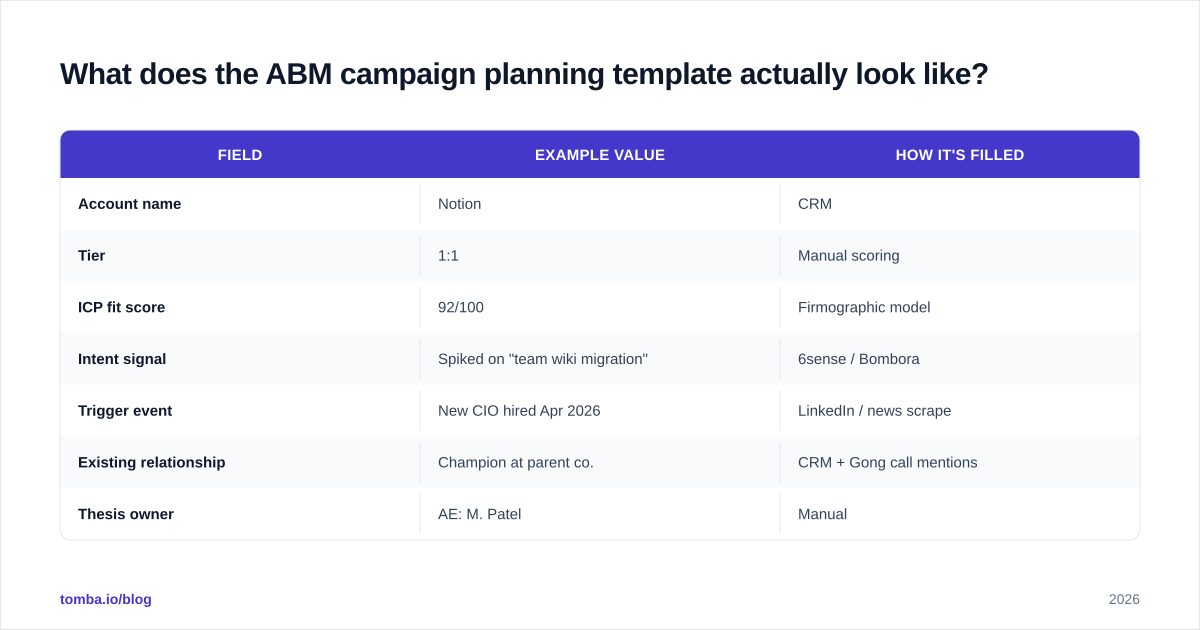
Here's the skeleton. Each row below is a column in your sheet; each section is a tab.
Tab 1 — Account selection
| Field | Example value | How it's filled |
|---|---|---|
| Account name | Notion | CRM |
| Tier | 1:1 | Manual scoring |
| ICP fit score | 92/100 | Firmographic model |
| Intent signal | Spiked on "team wiki migration" | 6sense / Bombora |
| Trigger event | New CIO hired Apr 2026 | LinkedIn / news scrape |
| Existing relationship | Champion at parent co. | CRM + Gong call mentions |
| Thesis owner | AE: M. Patel | Manual |
| Q2 status | Active, meeting booked | Manual |
Tab 2 — Buying committee (one row per person, ~5 rows per account)
| Field | Example |
|---|---|
| Account | Notion |
| Name | Sarah Chen |
| Role | VP, Demand Gen |
| Tenure | 60 days |
| Persona | Economic buyer |
| Reachable via | LinkedIn, work email |
| Verified email | sarah.chen@notion.so |
| Last touch | LinkedIn comment, 2026-05-04 |
| Stance | Warm — engaged with our CMO's post |
Filling in "verified email" and "reachable via" is where most teams stall — that's the data-acquisition step. Tools like Tomba's email finder and the domain search turn a list of "Sarah Chen at Notion" into actual deliverable addresses with confidence scores, which is the difference between this tab being usable on Monday or theoretical forever.
Tab 3 — Account thesis (one paragraph per account)
"Notion just hired a CIO from Atlassian (May 2026) and is consolidating internal tooling. Their team-wiki product competes with our migration use case, but their own internal wiki sprawl is a public pain point (see CIO's first all-hands quote). Thesis: position our enterprise migration playbook to the new CIO in Q2, before they default-pick Atlassian for internal use. Window: ~90 days."
Tab 4 — Plays (the moves)
Tab 5 — Channel orchestration (which channel runs which play, with sequence)
Tab 6 — Metrics (account-level, not lead-level)
We'll go deeper into 4, 5, and 6 below.
Should you run 1:1, 1:few, or 1:many ABM?#
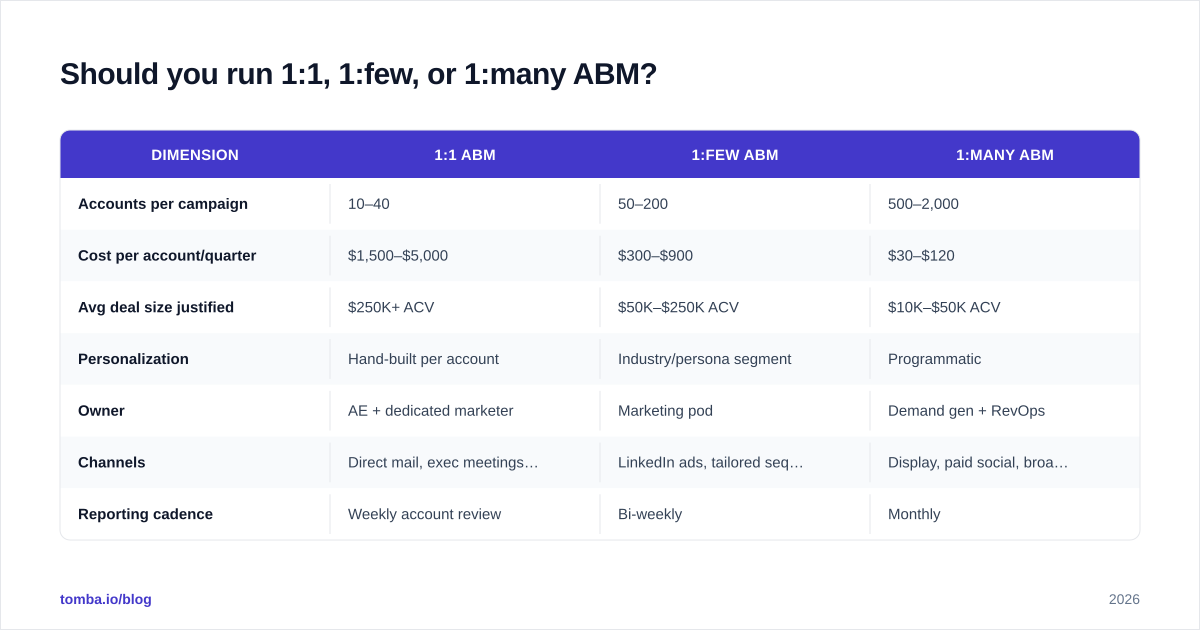
All three, but they're three different products. Mixing them in the same template is where most teams blow their budget.
| Dimension | 1:1 ABM | 1:few ABM | 1:many ABM |
|---|---|---|---|
| Accounts per campaign | 10–40 | 50–200 | 500–2,000 |
| Cost per account/quarter | $1,500–$5,000 | $300–$900 | $30–$120 |
| Avg deal size justified | $250K+ ACV | $50K–$250K ACV | $10K–$50K ACV |
| Personalization | Hand-built per account | Industry/persona segment | Programmatic |
| Owner | AE + dedicated marketer | Marketing pod | Demand gen + RevOps |
| Channels | Direct mail, exec meetings, custom landing pages | LinkedIn ads, tailored sequences, webinars | Display, paid social, broad sequences |
| Reporting cadence | Weekly account review | Bi-weekly | Monthly |
| Typical pipeline velocity | 60–180 days | 90–240 days | 120–365 days |
| Failure mode | AE burnout, low coverage | Becomes generic | Indistinguishable from MQL gen |
The mistake is running 1:many economics ($30/account) but expecting 1:1 results (a meeting with the CIO). If you have $50K/quarter for ABM and 500 accounts, you have a 1:many program. Own it.
How do you actually pick the accounts? (Tab 1, expanded)#
Three inputs feed account selection. Score each account 1–5 on each, then sort.
ICP fit (firmographic). Industry, headcount, revenue, tech stack, geography. This is the table-stakes filter; it should cut your TAM by 80%+. Use B2B data sources plus your CRM history.
Propensity (behavioral). Are they showing in-market signals? Job posts, hiring sprees, intent topics, traffic patterns. 6sense, Bombora, and G2 intent feed this. If you don't have intent data, use proxies: funding rounds, executive moves, product launches.
Reachability (operational). Can you actually get in? Existing customer at parent co.? Investor overlap? Champion who moved? A 95-fit account with zero reachable surface is worth less than a 75-fit account where your VP of Sales knows the CRO.
Score = (ICP × 0.4) + (Propensity × 0.4) + (Reachability × 0.2). Top 40 go into 1:1. Next 200 into 1:few. Rest into 1:many or off the list entirely.
What plays go in Tab 4?#
Plays are the things you actually do. Each play is a verb + an artifact + a target.
Examples that have worked across portfolios I've seen:
- "Warm the new CIO" — three custom LinkedIn comments on their posts over two weeks, then a tailored deck sent by your CRO, then a calendar link.
- "Reverse trial offer" — for accounts using a competitor, send a custom migration assessment + 60-day proof of value with a named CSM.
- "Champion change-of-job" — when a known champion moves to a target account, your AE sends a personalized note + the case study from their old company within 7 days. (Champion tracking is one of the highest-ROI plays in ABM — Gong has published response-rate data on this.)
- "Executive dinner of 8" — invite 8 VPs from 8 target accounts to a small, no-pitch dinner with your CEO. Industry-vertical themed.
- "Custom microsite" — a one-page site at /partners/notion (or wherever) with the prospect's logo, three case studies from their industry, and a Calendly. Used in 1:1 tier only.
Each play should answer: what's the artifact, who's it for (persona), what's the call-to-action, what's the success signal? If the success signal is "they opened the email," it's not an ABM play. It's an email open.
How do channels orchestrate? (Tab 5)#
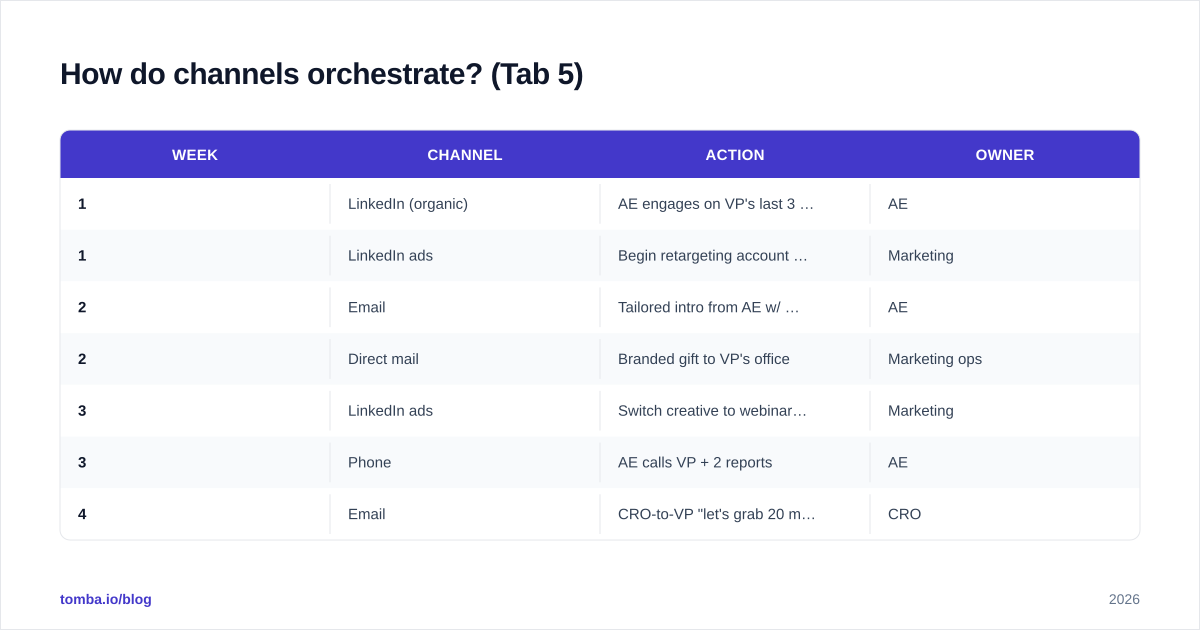
Channels are the medium. The orchestration is the sequence — which channel touches the account first, second, third, and why.
A 1:few sequence for a "new VP, consolidation thesis" play might look like:
| Week | Channel | Action | Owner |
|---|---|---|---|
| 1 | LinkedIn (organic) | AE engages on VP's last 3 posts | AE |
| 1 | LinkedIn ads | Begin retargeting account domain | Marketing |
| 2 | Tailored intro from AE w/ industry case study | AE | |
| 2 | Direct mail | Branded gift to VP's office | Marketing ops |
| 3 | LinkedIn ads | Switch creative to webinar invite | Marketing |
| 3 | Phone | AE calls VP + 2 reports | AE |
| 4 | CRO-to-VP "let's grab 20 min" | CRO | |
| 5 | Webinar | Custom invite to industry roundtable | Marketing |
| 6 | Recap + meeting ask | AE |
The point isn't the specific sequence — it's that channels are coordinated. The LinkedIn ad is warming the human the email is about to land in front of. Without that coordination, you have parallel channels, not orchestration.
To execute this, you need verified contact data across channels — email for the sequence, phone for the dial, LinkedIn URL for the engagement. The phone finder and LinkedIn finder fill the gaps your CRM has on the buying-committee tab. If your sequence stalls because half your contacts have wrong emails, the orchestration falls apart on week 2.
What metrics belong in Tab 6?#
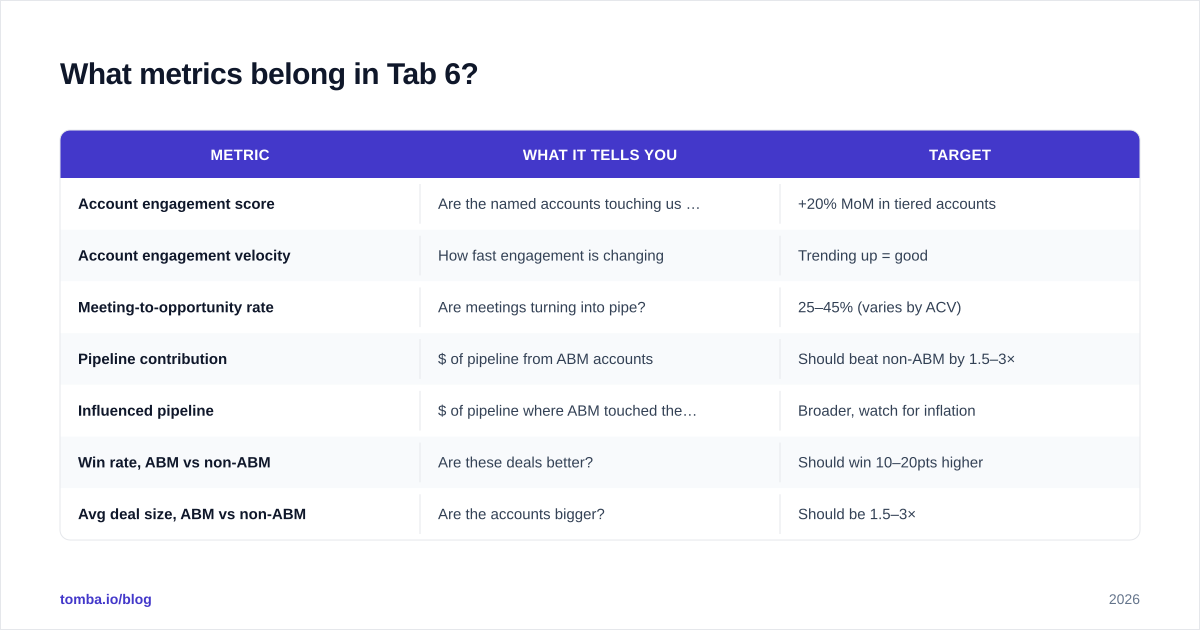
Account-level metrics, not lead-level. The CFO does not care how many MQLs you generated; they care whether the named accounts moved. Here's the metric stack that survives executive review:
| Metric | What it tells you | Target |
|---|---|---|
| Account engagement score | Are the named accounts touching us back? | +20% MoM in tiered accounts |
| Account engagement velocity | How fast engagement is changing | Trending up = good |
| Meeting-to-opportunity rate | Are meetings turning into pipe? | 25–45% (varies by ACV) |
| Pipeline contribution | $ of pipeline from ABM accounts | Should beat non-ABM by 1.5–3× |
| Influenced pipeline | $ of pipeline where ABM touched the account | Broader, watch for inflation |
| Win rate, ABM vs non-ABM | Are these deals better? | Should win 10–20pts higher |
| Avg deal size, ABM vs non-ABM | Are the accounts bigger? | Should be 1.5–3× |
| Sales cycle, ABM vs non-ABM | Are they closing faster? | Should be 15–30% faster |
Vanity metrics that should NOT be in this tab: impressions, clicks, CTR, opens, raw MQL count, raw lead count. They show up in channel-level dashboards, never in the ABM review.
If you want a deeper read on the metric philosophy, Gartner's ABM maturity model and the revenue operations discipline both push the same point: roll up to account, not lead. You can also check G2's ABM software grid to see how the vendors themselves report on outcomes.
What about the data and tooling layer?#
The template above assumes you have clean data flowing in. In practice, this is where 70% of ABM programs stall — not because the strategy is wrong, but because the buying-committee tab is half-empty or full of bounces.
The minimum tool stack to run the template:
- CRM (Salesforce, HubSpot, Pipedrive) — the source of truth for accounts and tiering.
- Intent data (6sense, Bombora, G2) — feeds the propensity score.
- Contact data (email + phone + LinkedIn) — feeds the buying-committee tab. Tomba, Apollo, and Cognism all compete here; budget roughly $99–$249/month per seat depending on volume.
- Engagement (Outreach, Salesloft, Instantly) — runs the sequences from Tab 5.
- Reporting (Looker, your CRM dashboards, or a dedicated ABM platform like Demandbase) — rolls account-level metrics for Tab 6.
If you're starting from scratch and want one less SaaS bill, the Tomba bulk email finder plus your existing CRM can carry the data layer for a tier-1 ABM program of ~40 accounts. Scale into a dedicated ABM platform when you cross 200+ active accounts.
How do you run the first 90 days?#
Days 1–14: Build Tab 1 (account list) and Tab 2 (buying committee). This is the data sprint. Block other ABM work; if these tabs aren't clean, nothing downstream works.
Days 15–30: Write Tab 3 (theses) for the top 40 accounts. One paragraph each. Pair AE + marketer per account. Reject any thesis that could apply to two accounts — that means it's generic.
Days 31–45: Design Tab 4 (plays) and Tab 5 (sequences). Pick 3–5 plays max for the quarter. Don't try ten.
Days 46–60: Launch. First touches go out. Daily standup for the first two weeks to catch broken sequences, bad data, channel collisions.
Days 61–90: Tab 6 (metrics) review weekly. Cut plays that aren't moving engagement velocity. Double down on the one that is. Plan Q2.
What's the closing point?#
The ABM campaign planning template is not the magic. The discipline of filling it in — in order, without skipping the data layers — is the magic. Teams that try to template-shop their way to ABM (downloading frameworks but not doing the account research) get the same result as teams that don't do ABM at all, but with a higher bill.
Start with 25 accounts. Fill in every column for every account. Pick three plays. Run them for 90 days. Measure account engagement, not impressions. Iterate.
Ready to fill in the buying-committee tab? The hardest column to populate in every ABM template is the verified contact info for 5–7 humans per account. The Tomba Email Finder gets you deliverable work emails — with confidence scores, source citations, and bulk upload from your CRM list — starting on the free tier (25 searches/month) and scaling to the Starter plan at $49/month. Spend the saved hours writing better account theses, not chasing email syntax.
Ready to find emails that actually work?
Join 150,000+ professionals who stopped guessing and started sending. Free credits on signup — no credit card required.
Get the Tomba newsletter
Practical outbound tactics and product updates — once every two weeks.
About the author