ABM Channels in 2026: The 7 That Actually Move Pipeline
Most ABM channel mixes are built on hope and webinar replays. Here's which channels actually move pipeline in 2026, how to sequence them, and where to stop spending.
ABM Channels in 2026: The 7 That Actually Move Pipeline
TL;DR
- Account-based marketing lives or dies on channel mix, not on tooling — and most teams over-index on display ads and webinars that don't touch buyers.
- The seven ABM channels that consistently move pipeline in 2026: 1:1 email, LinkedIn (organic + paid), direct mail, intent-triggered ads, executive events, account-based SDR plays, and partner co-sell.
- The cheapest wins come from sequencing channels — not adding new ones. A 4-touch sequence beats a 12-touch blast on the same accounts.
- ABM channel ROI depends on data quality. Bad emails, missing phone numbers, or stale firmographics kneecap every channel on this list.
- This guide ranks each ABM channel by cost, response rate, and time-to-pipeline, then shows how to combine them into a tier-1 sequence that actually works.
If you've been told ABM is "dead" or "evolved into something else" — ignore that. What changed is the channel mix. The accounts your team picked in Q1 still need to hear from you. The question is which ABM channels are worth the spend in 2026 and which ones are vanity line items on a board slide.
This post ranks the seven channels that show up in winning ABM programs, compares them on cost and response, and gives you a sequence template you can run next quarter.
What are ABM channels, exactly?#
ABM channels are the touchpoints you use to reach a named list of target accounts — not a persona, not a segment, not a lookalike audience. The defining trait is that every touch is account-aware: the creative, offer, and timing change based on the specific company (and often the specific person) on the other end.
That distinction matters. A LinkedIn ad targeted at "VP Marketing in SaaS" is demand gen. A LinkedIn ad targeted at the 47 named accounts your AE owns, with copy that references their company name, is ABM. Same channel, different practice.
The seven channels below all support that account-aware execution. The bad ABM channels — the ones you should cut — are the ones that can't be made account-specific without breaking the channel itself.
Which ABM channels actually move pipeline in 2026?#
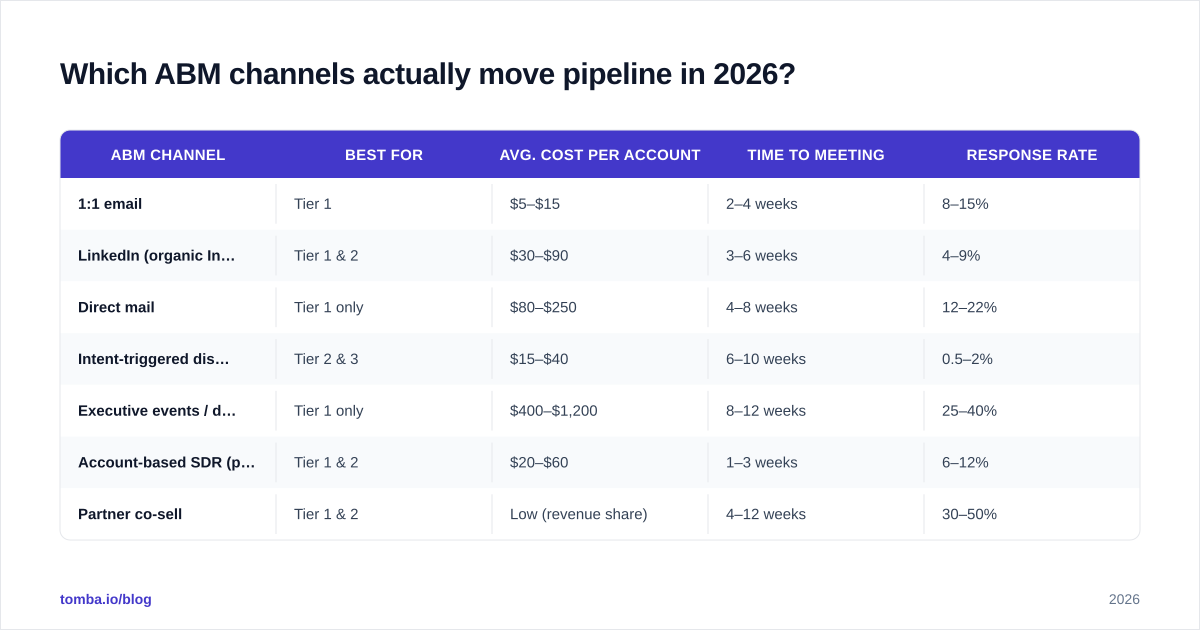
Here's the ranked list. We're judging each channel on three things: cost per engaged account, time from first touch to meeting booked, and whether it works for tier-1 (named, high-ACV) or programmatic ABM (broader list, lower touch).
| ABM Channel | Best for | Avg. cost per account | Time to meeting | Response rate |
|---|---|---|---|---|
| 1:1 email | Tier 1 | $5–$15 | 2–4 weeks | 8–15% |
| LinkedIn (organic InMail + paid) | Tier 1 & 2 | $30–$90 | 3–6 weeks | 4–9% |
| Direct mail | Tier 1 only | $80–$250 | 4–8 weeks | 12–22% |
| Intent-triggered display ads | Tier 2 & 3 | $15–$40 | 6–10 weeks | 0.5–2% |
| Executive events / dinners | Tier 1 only | $400–$1,200 | 8–12 weeks | 25–40% |
| Account-based SDR (phone + email) | Tier 1 & 2 | $20–$60 | 1–3 weeks | 6–12% |
| Partner co-sell | Tier 1 & 2 | Low (revenue share) | 4–12 weeks | 30–50% |
Read the table left-to-right and you can see the trade-off: high-cost channels (events, direct mail) get the best response rates but only work at small scale. Programmatic channels (display, paid social) are cheap per account but need volume to produce a single meeting.
1. 1:1 email — still the highest-ROI ABM channel#
A targeted email written for a specific buyer, referencing a specific trigger (funding, hiring, product launch, leadership change), remains the single best-converting ABM channel on a cost-adjusted basis. The catch: it's only as good as the data behind it.
If your sequencer is firing at info@ aliases or unverified guesses, you're burning the channel. Use a verified email finder to source the address, then run it through an email verifier before it lands in the sequence. Bounce rates above 4% will get you flagged by Google Postmaster within a week.
The 2026 version of this channel isn't "spray better." It's three to five emails per account, all hand-tuned at the top, with the SDR or AE in the loop on the first send.
2. LinkedIn — the only paid social channel worth ABM dollars#
LinkedIn is the only social network where you can target an actual list of companies and titles with enough precision to make ABM work. The play has two halves:
- Organic — your AEs and execs commenting on, sharing, and DMing buyers at target accounts. This is unscalable on purpose. It's how tier-1 relationships start.
- Paid — uploaded company lists with conversation ads or sponsored content. Budget per account matters more than total spend; you need 8–12 impressions on the right people before a click is meaningful.
According to LinkedIn's own B2B benchmark data, ad recall on company-list campaigns runs 2–3× higher than persona-only campaigns. That's why this channel ranks above display.
3. Direct mail — back from the dead#
Physical mail had a quiet renaissance starting in 2023 and didn't stop. When everyone else is fighting for inbox attention, a hand-written note or a quality gift sent to a specific buyer is impossible to ignore. The cost is real ($80–$250 per package after platform fees), so this is strictly a tier-1 channel.
Sequence it right: direct mail lands on Tuesday, your AE emails Wednesday referencing the package, your SDR calls Thursday. The conversion rate compounds because the buyer remembers your name by the third touch.
4. Intent-triggered display ads#
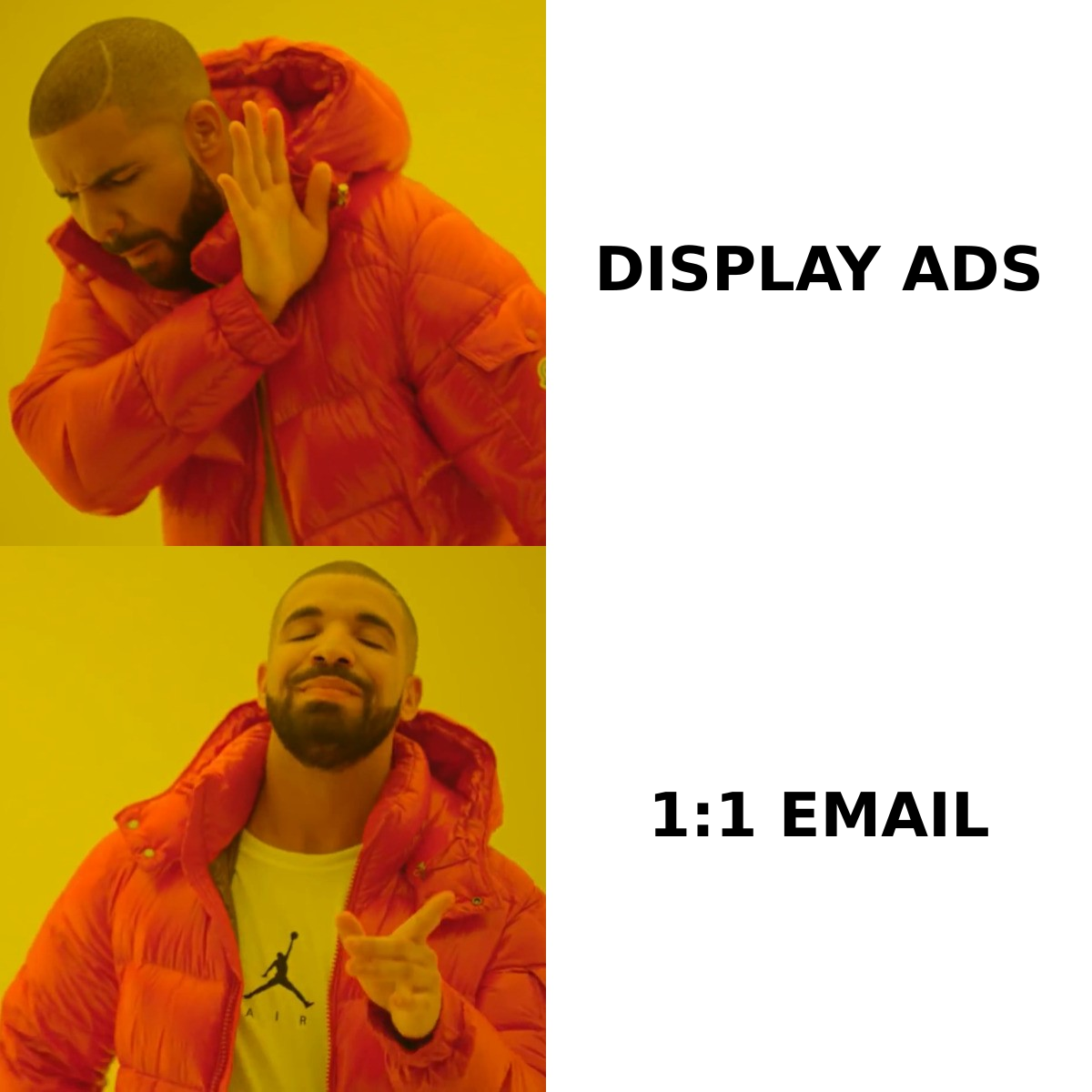
Display advertising on its own is dead for ABM. Display advertising triggered by intent signals — surge data from Bombora, G2 buyer intent, or your own first-party site behavior — works as an air-cover channel. The job isn't to generate clicks. The job is to keep your logo in the buyer's peripheral vision while the human channels (email, LinkedIn, phone) do the heavy lifting.
Tools like 6sense, Demandbase, and RollWorks dominate this layer. If you're not running intent data yet, this isn't where to start — fix your data quality first.
5. Executive events and dinners#
Twelve buyers around a table at a restaurant in the right city, hosted by your CEO or a respected industry voice, produces more pipeline per dollar than any digital channel — at extreme cost and zero scale. Reserve this for your top 20 accounts per quarter.
The hard part isn't the event. It's the follow-up. Every guest needs three personalized touches in the week after, and your CRM needs to know who attended so the AE doesn't re-introduce themselves cold the next month.
6. Account-based SDR plays (phone + email + LinkedIn)#
The classic SDR motion, rebuilt around accounts instead of leads. Your SDR owns 30–50 accounts, not 300 leads. They run a 14-day sequence per account that combines phone, email, and LinkedIn touches, all referencing the same account-level research.
This channel lives or dies on phone-number quality. Find direct dials (not switchboards) with a phone finder, and validate them so your reps aren't burning hours on disconnected lines. The economics of an SDR on an account list assume 4–6 dials per meeting — double that and the channel collapses.
7. Partner co-sell#
The most underrated ABM channel in 2026. If your target account already buys from a partner (a Salesforce, HubSpot, Snowflake, or a smaller ecosystem player), a warm intro from that partner converts at 30–50% — multiples better than any cold channel.
The catch is operational: you need an account-mapping process, a partner-friendly co-marketing motion, and a way to track sourced vs. influenced pipeline. Start with two or three strategic partners, not twelve.
How do you sequence ABM channels together?#
The mistake most teams make is running channels in parallel without coordination. A buyer sees your display ad on Monday, gets a generic SDR email on Tuesday, a LinkedIn connection request on Wednesday — and none of them reference each other. The buyer's takeaway: "this company is everywhere but nothing they say is relevant to me."
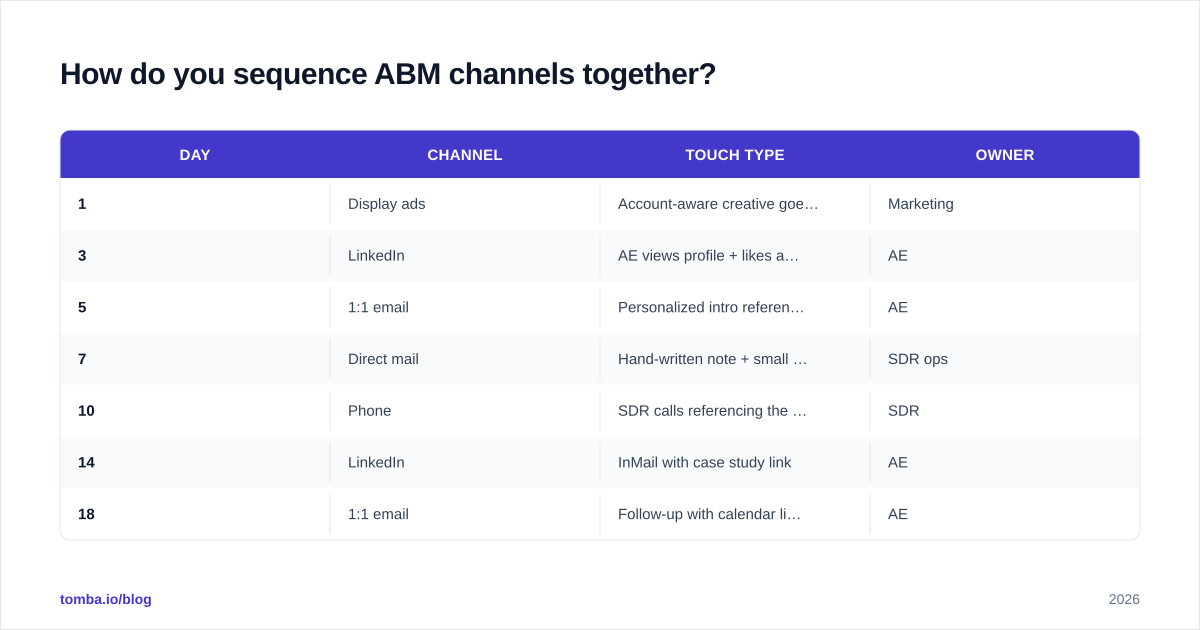
A sequenced ABM channel mix solves that. Here's a 30-day tier-1 sequence template:
| Day | Channel | Touch type | Owner |
|---|---|---|---|
| 1 | Display ads | Account-aware creative goes live | Marketing |
| 3 | AE views profile + likes a recent post | AE | |
| 5 | 1:1 email | Personalized intro referencing a trigger | AE |
| 7 | Direct mail | Hand-written note + small gift | SDR ops |
| 10 | Phone | SDR calls referencing the mail piece | SDR |
| 14 | InMail with case study link | AE | |
| 18 | 1:1 email | Follow-up with calendar link | AE |
| 22 | Phone | Second SDR call | SDR |
| 30 | LinkedIn / email | Break-up message | AE |
Every touch references the prior one. The buyer experiences a coordinated campaign, not seven disconnected vendors who happen to share a logo.
For programmatic ABM (tier 2/3), compress this to a 14-day digital-first sequence: display + LinkedIn ads run in the background, with two emails and one phone attempt from an SDR. Reserve direct mail and events for the named tier-1 list.
What about ABM channels you should cut?#
Three channels show up on most ABM channel slides but rarely earn their cost in 2026:
- Generic webinars — running a "State of the Industry" webinar and calling everyone who attended an ABM touch is demand gen, not ABM. Account-specific roundtables work; broadcast webinars don't.
- Programmatic display without intent data — buying impressions against a flat company list, with no surge signal, produces ad fatigue and zero pipeline.
- Chat widgets without account routing — a chat tool that doesn't recognize the visitor's company and route them to their AE is just a contact form.
If your dashboard has any of these as a top-3 line item, audit them next quarter. Reallocate the budget to direct mail or partner co-sell.
How does data quality affect every ABM channel?#
This is the part most ABM articles skip. Every channel above assumes you know:
- The right company on the list (firmographics current, not 2-year-old data)
- The right buying-committee titles at that company
- A reachable email for each
- A direct phone number where applicable
- Recent trigger events (funding, hires, product launches)
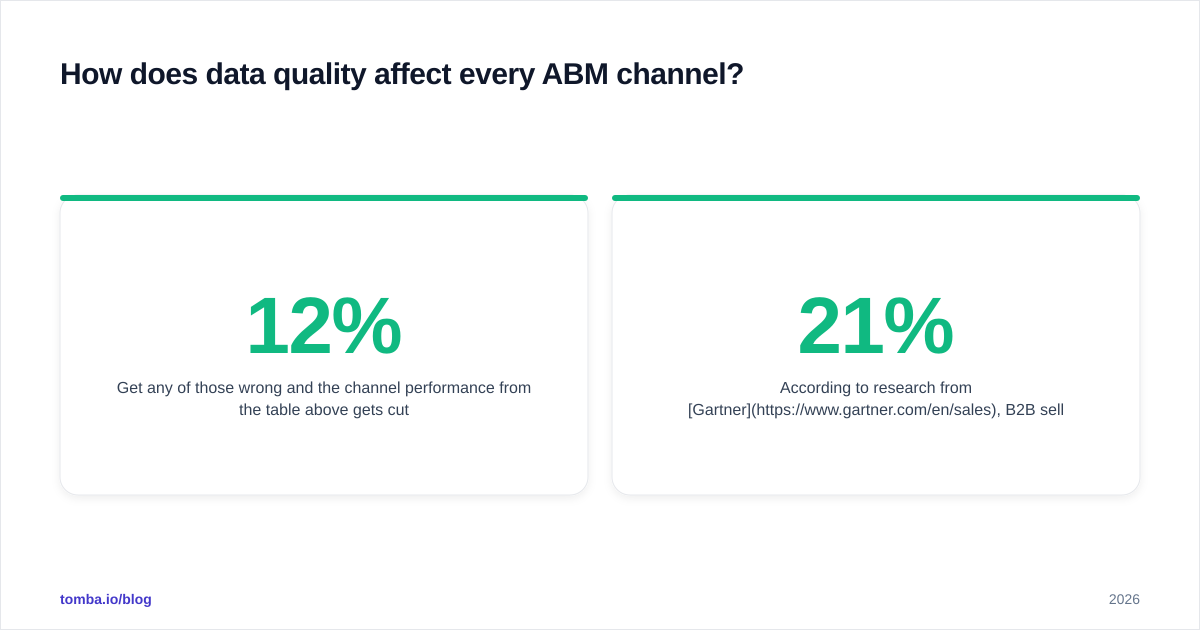
Get any of those wrong and the channel performance from the table above gets cut in half. A 12% direct-mail response rate becomes 6% when half the addresses are stale. An 8% email response becomes 2% when your list is full of catch-all domains and former employees.
That's why data enrichment and ongoing list hygiene aren't a side task — they're the foundation every ABM channel sits on. Run your target-account list through a verification step at least quarterly, and re-enrich any account that's been on the list more than six months.
According to research from Gartner, B2B sellers spend up to 21% of their time on data-related tasks. The teams that consolidate that into a single enrichment pipeline get those hours back and route them into the high-leverage channels (1:1 email, phone, events) where humans actually compound the ROI.
How do you measure ABM channel performance?#
Skip last-touch attribution. With seven channels firing on the same account, the last touch tells you nothing about which channel actually moved the needle.
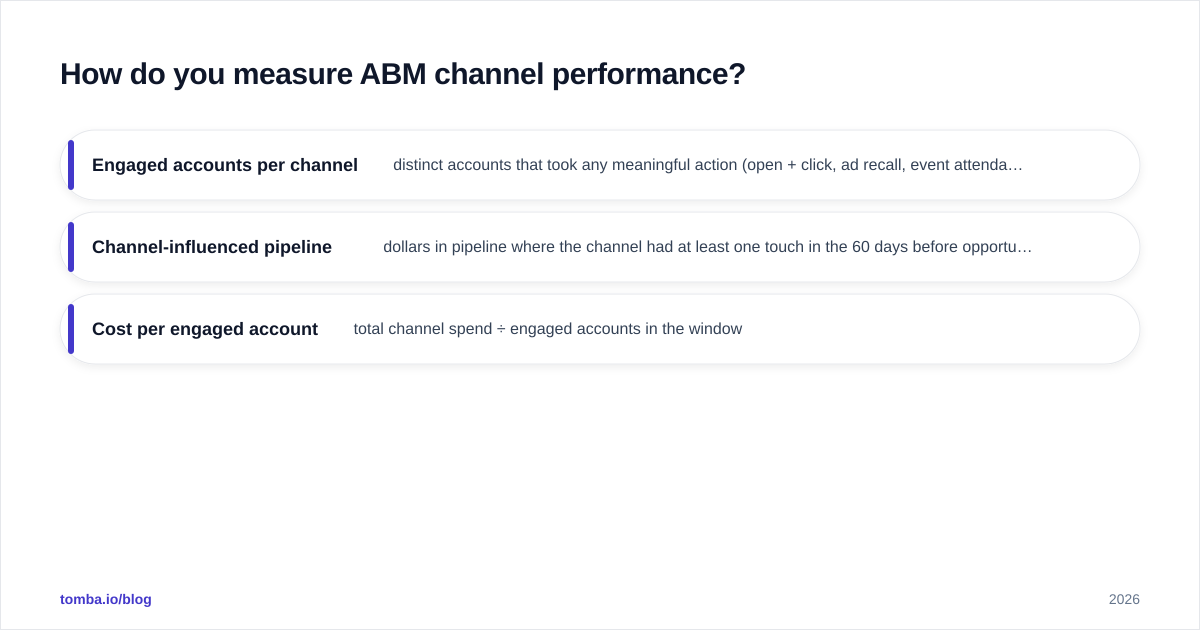
The three metrics that matter:
- Engaged accounts per channel — distinct accounts that took any meaningful action (open + click, ad recall, event attendance, mail response) attributable to the channel
- Channel-influenced pipeline — dollars in pipeline where the channel had at least one touch in the 60 days before opportunity creation
- Cost per engaged account — total channel spend ÷ engaged accounts in the window
Run these per channel per quarter. Cut the bottom two. Reinvest in the top three. Repeat.
ABM channels FAQ#
Is ABM still worth doing in 2026? Yes, for B2B companies with ACV above ~$25K and named target accounts. Below that, you're better off with demand gen.
How many ABM channels do I need? Three is enough for tier 1 (email + LinkedIn + phone is a complete starter mix). Add direct mail and events as the program matures. More than seven becomes operationally expensive without proportional return.
What's the cheapest ABM channel to start with? 1:1 email, assuming your data is clean. Total channel cost is low; the constraint is human time to personalize. Pair it with LinkedIn organic for zero ad spend.
Do I need an ABM platform like Demandbase or 6sense? Not on day one. You need a target-account list, an enrichment source, and a CRM. Add an ABM platform when you're running intent data and account-aware ads at scale.
How do display ads fit into ABM? Air cover only. Don't expect clicks; expect ad recall that makes your other channels land harder. Always pair with intent data.
Bringing it together#
The seven ABM channels above aren't new. What changes year to year is the mix, the sequencing, and which channels you can run without burning your sender reputation or your reps' time. In 2026, the winning programs are the ones that pick four channels, sequence them, and execute with clean data — not the ones that bolt on a ninth tool.
If you're rebuilding your ABM channel mix, start with the data layer. Verified emails, accurate phone numbers, and current firmographics make every channel on this list 2–3× more effective.
Tomba's Email Finder is built for this — verified emails for your target-account list, with bulk lookup, API access, and CRM integrations for HubSpot, Salesforce, and Pipedrive. Start free with 25 searches a month, or check Tomba pricing for plans that scale with your account list.
Ready to find emails that actually work?
Join 150,000+ professionals who stopped guessing and started sending. Free credits on signup — no credit card required.
Get the Tomba newsletter
Practical outbound tactics and product updates — once every two weeks.
About the author