ABM Data in 2026: The Complete Playbook for Account-Based GTM
ABM data is the firmographic, technographic, intent, and contact intelligence that powers account-based marketing. Here's how to source it, score it, and operationalize it in 2026.
TL;DR#
- ABM data is the combined firmographic, technographic, intent, engagement, and contact intelligence that lets you target a finite list of accounts with precision instead of broadcasting to a market.
- A working ABM data stack has four layers: account selection data, buying-group contact data, intent and engagement signals, and a CRM-ready enrichment layer that keeps records fresh.
- Most ABM programs fail at the contact layer, not the targeting layer — stale emails, missing direct dials, and outdated job titles kill conversion before the campaign starts.
- In 2026, the winning teams blend a primary B2B database (Apollo, ZoomInfo, or Cognism) with a real-time verification provider like Tomba for outbound execution and a dedicated intent source (Bombora, 6sense, G2).
- Budget realistically: $1.50 to $4 per verified, enriched contact is normal; anything cheaper is usually scraped, stale, or both.
What is ABM data?#
ABM data is the set of records and signals you need to run an account-based program end to end. It is not one dataset. It is at least four datasets that have to agree with each other.
The four layers, in plain language:
- Account data — the company itself: industry, revenue, employee count, location, funding, tech stack. This is how you pick the 200 or 2,000 accounts worth chasing.
- Contact data — the humans inside those accounts: names, titles, emails, direct dials, LinkedIn URLs. This is how you actually reach them.
- Intent and engagement data — signals that say now: third-party intent topics, ad clicks, site visits, content downloads, demo requests, job changes.
- Enrichment and hygiene data — the connective tissue that keeps the first three layers fresh inside your CRM and marketing automation platform.
The mistake most teams make is treating ABM as a strategy problem when it is mostly a data problem. The strategy is simple: pick the right accounts, find the right people, time the message to a real signal. Each step depends on data quality that decays roughly 2.5% per month for B2B contacts, according to HubSpot's long-running benchmarks.
Why does ABM data matter more in 2026 than it did in 2022?#
Three shifts hit at once.
First, buying committees grew. Gartner now puts the median enterprise B2B buying group at 11 people, up from 6.8 a few years ago. You cannot win an account by knowing one VP. You need the whole map.
Second, outbound got harder. Inbox protection tightened — Gmail and Yahoo now enforce strict authentication and complaint thresholds. Bad lists do not just underperform; they get your domain blacklisted. Clean email deliverability starts with clean contact data, not just warmed-up inboxes.
Third, intent data went mainstream and then commoditized. Every vendor sells it. The differentiator is no longer "do you have intent" but "can you route it to the right rep within an hour, with verified contacts attached?" That's an enrichment and orchestration problem.
What are the main sources of ABM data?#
There are five practical sources, each with different strengths and cost profiles.
| Source type | Examples | Best for | Watch out for |
|---|---|---|---|
| B2B databases | ZoomInfo, Apollo, Cognism, Lusha | Bulk account + contact discovery | Staleness on long-tail accounts, GDPR exposure |
| Email finders / verifiers | Tomba, Hunter, Findymail | Just-in-time contact discovery and verification | Coverage gaps on senior execs |
| Intent providers | Bombora, 6sense, G2 Buyer Intent | Timing and account prioritization | Noise; needs filtering against your ICP |
| Web reveal / visitor ID | RB2B, Clearbit Reveal, Tomba Reveal | Catching warm anonymous traffic | US-only coverage for some vendors |
| First-party signals | CRM, MAP, product analytics | Highest-converting signal | Locked in silos; needs RevOps glue |
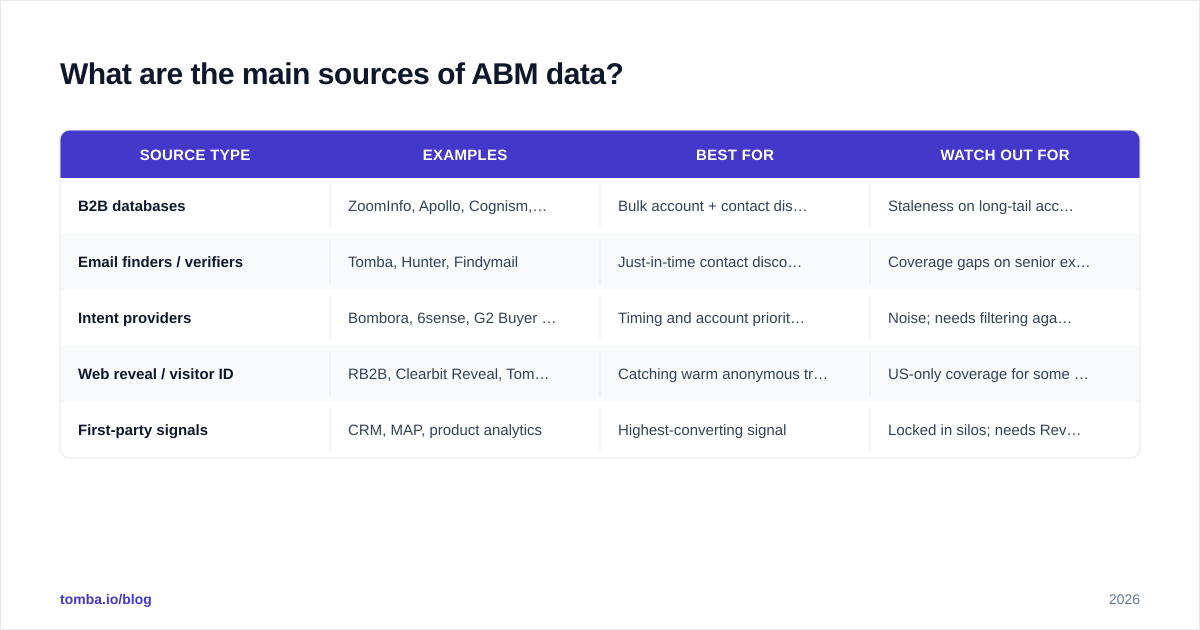
No single source covers all four ABM data layers. Teams that try to standardize on one vendor either pay enterprise prices or accept big gaps. The teams that win blend: one database for breadth, one finder/verifier for accuracy on outbound day, one intent source, and a data enrichment workflow that reconciles them all into the CRM.
What does a working ABM data stack look like?#
Here's the architecture I see at teams that actually hit pipeline targets, not just MQL targets.
Layer 1 — Account selection. Pull a long list from your database of choice using ICP filters: industry, headcount band, revenue band, geography, tech stack signals. Score it with intent (Bombora topics, G2 category views) and first-party fit (existing customers in segment, win rate by segment). Output: a tiered account list — Tier 1 (1:1), Tier 2 (1:few), Tier 3 (1:many).
Layer 2 — Buying-group mapping. For each Tier 1 account, build a contact map of 6 to 12 personas: economic buyer, champion, end users, blockers. Pull names from LinkedIn Sales Navigator, then run them through an email finder and verifier to get reachable contacts. For Tier 2, automate this in bulk with a bulk email finder. Tier 3 can rely on database exports.
Layer 3 — Signal layer. Wire intent topics, site visitor reveal, and product usage signals into a single scoring model. Anything that crosses a threshold triggers a play.
Layer 4 — Activation. Push enriched, verified contacts into your sequencing tool, ad platform, and CRM. Refresh records every 30 to 60 days.
The trap is buying a tool for each layer and never connecting them. The connective layer — Zapier, Make, n8n, or a HubSpot integration — is where ABM data either becomes operational or stays a dashboard.
How do you evaluate ABM data quality?#
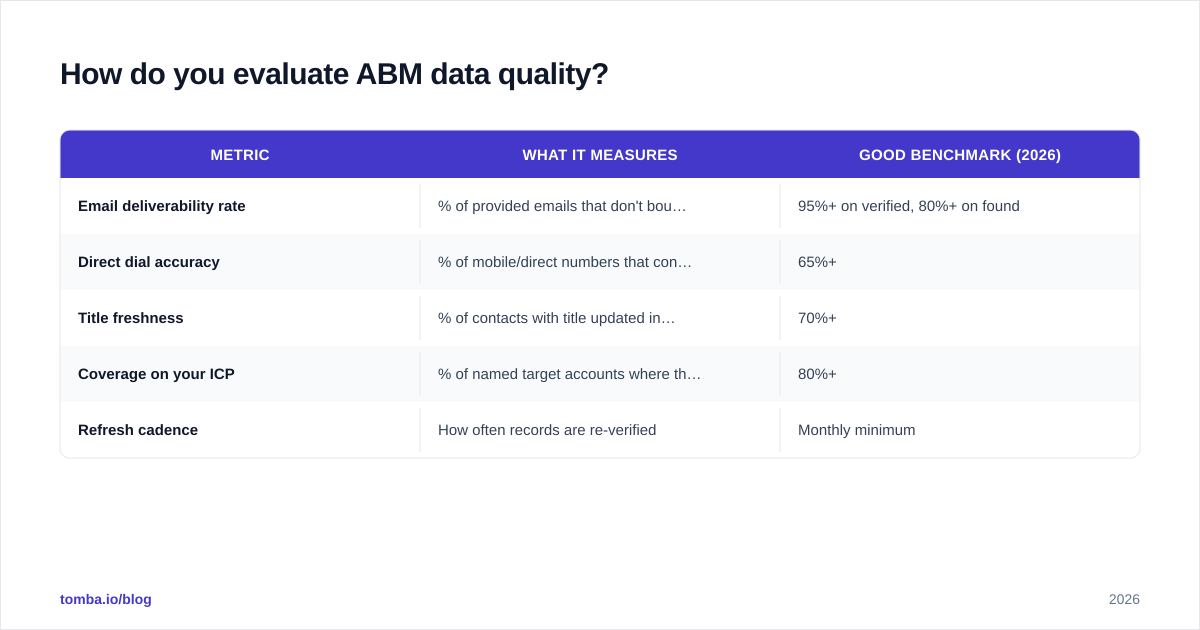
Five metrics matter. Test any vendor against these before you sign.
| Metric | What it measures | Good benchmark (2026) |
|---|---|---|
| Email deliverability rate | % of provided emails that don't bounce | 95%+ on verified, 80%+ on found |
| Direct dial accuracy | % of mobile/direct numbers that connect to the right person | 65%+ |
| Title freshness | % of contacts with title updated in last 90 days | 70%+ |
| Coverage on your ICP | % of named target accounts where the vendor has ≥5 decision-makers | 80%+ |
| Refresh cadence | How often records are re-verified | Monthly minimum |
Run a 100-record blind test. Pull the same 100 target contacts from three vendors. Send a verification job through a tool like Tomba's email verifier and compare bounce rates. Call 20 direct dials at random. The vendor that wins on email deliverability and dial accuracy almost always wins on pipeline downstream — and it's rarely the one with the biggest logo.
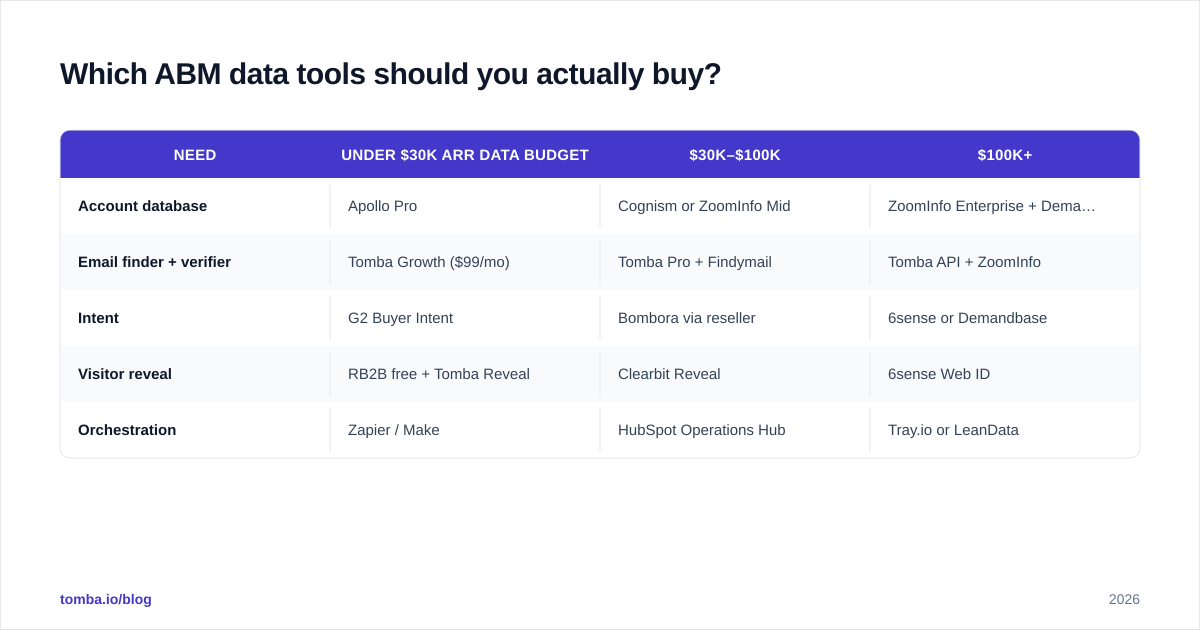
Which ABM data tools should you actually buy?#
Depends on company stage, list size, and budget. Here's the honest cut.
| Need | Under $30K ARR data budget | $30K–$100K | $100K+ |
|---|---|---|---|
| Account database | Apollo Pro | Cognism orZoomInfo Mid | ZoomInfo Enterprise + Demandbase |
| Email finder + verifier | Tomba Growth ($99/mo) | Tomba Pro + Findymail | Tomba API + ZoomInfo |
| Intent | G2 Buyer Intent | Bombora via reseller | 6sense or Demandbase |
| Visitor reveal | RB2B free + Tomba Reveal | Clearbit Reveal | 6sense Web ID |
| Orchestration | Zapier / Make | HubSpot Operations Hub | Tray.io or LeanData |
For mid-market teams running outbound-heavy ABM, the highest-leverage swap is replacing a $40K/year database seat-bloat with Tomba pricing for verified finds plus a leaner database for fit data. You stop paying for credits you never use and start paying for accuracy you actually need.
How do you keep ABM data clean over time?#
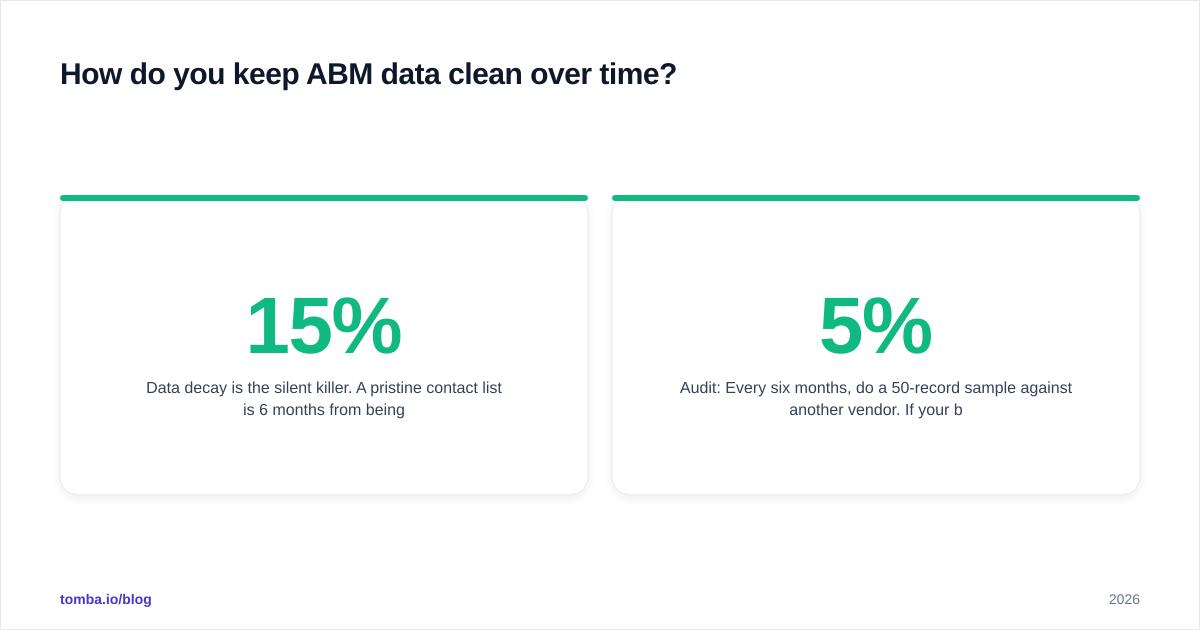
Data decay is the silent killer. A pristine contact list is 6 months from being 15% wrong. Here's the maintenance loop that works.
Monthly: Re-verify all active sequence contacts. Use a bulk verify job, drop anything that returns "invalid" or "catch-all unknown," and re-find replacements.
Quarterly: Re-enrich the full Tier 1 and Tier 2 account list. Titles change. People leave. New champions appear. Pull updated firmographics and re-map the buying group.
Triggered: On every job-change signal, immediately re-find the contact at the new company (this is one of the highest-converting plays in B2B — your champion just moved and brought budget with them) and replace them at the old company.
Audit: Every six months, do a 50-record sample against another vendor. If your bounce rate has crept above 5%, your refresh cadence is too loose.
The Tomba API and [
Zapier integration](https://tomba.io/integrations/zapier) are the easiest way to wire this maintenance loop into a HubSpot or Salesforce workflow without building custom code. Forrester estimates that B2B data hygiene programs return roughly 7x their cost in saved campaign spend and recovered pipeline.
How does ABM data connect to revenue?#
This is the question that determines whether the budget survives the next planning cycle. The honest answer: ABM data does not generate revenue. It removes the bottlenecks between intent and revenue.
The math, conservatively:
- 1,000 target accounts
- 8 contacts per account = 8,000 records
- 85% email deliverability (clean data) vs 60% (dirty data) = 2,000 extra inboxes reached
- 3% positive reply rate = 60 extra conversations
- 25% meeting-to-opportunity = 15 extra opportunities
- $40K average deal size, 22% close rate = $132K in incremental closed-won
That's the marginal value of clean data on a single quarterly campaign for a mid-market team. The investment to get there is usually less than $15K in data and verification tooling. The ROI argument is not subtle.
What are the biggest ABM data mistakes?#
I see the same five mistakes across teams of every size.
- Picking accounts before defining ICP rigorously. "Anyone with 200+ employees in SaaS" is not an ICP, it's a phone book.
- Buying contact data once and never refreshing. Every list has a 6-month half-life.
- Treating intent as a list to call instead of a signal to prioritize. Intent without an ICP filter just gives you a bigger pile of noise.
- Skipping verification to save $200/month. A bounce above 5% will cost you the domain. Use a real email verifier or a free email checker for ad-hoc work.
- No buying-group depth. One contact per account is not ABM; it's spray-and-pray with extra steps.
How do you get started if you're new to ABM data?#
Don't buy the biggest stack. Buy the smallest stack that lets you run one tier 1 campaign end to end.
Week 1: Pick 50 target accounts. Define 8 personas per account. That's a 400-contact universe.
Week 2: Find and verify those 400 contacts. A Tomba Starter or Growth plan ($49–$99/mo) handles this comfortably. Cross-check against LinkedIn for title accuracy.
Week 3: Layer intent. Even free signals — G2 category views, your own website visits — beat nothing.
Week 4: Activate. Run a coordinated email + LinkedIn + ad sequence to that 400-person list.
Measure: reply rate, meeting rate, opportunity rate. Then scale what worked. The teams that try to build a full Demandbase + 6sense + ZoomInfo stack in month one almost always stall in month three. The teams that ship a working 50-account play in month one usually have a 500-account program by month six.
Closing: build the data foundation first#
Every ABM strategy deck in the world looks the same. The execution gap is always data: do you have verified contacts for the right people at the right accounts at the right time? If yes, the playbook works. If no, the prettiest strategy in the world will not save it.
Start with the contact layer because it's the easiest to fix and the most often broken. Run a list through Tomba Email Finder — find emails by domain, name, or company, verify them in the same call, and push the clean records into your CRM. Free tier gets you 25 searches to test, and the Growth plan at $99/mo covers most mid-market ABM programs end to end. Get the data right, and the rest of the program has a chance.
Ready to find emails that actually work?
Join 150,000+ professionals who stopped guessing and started sending. Free credits on signup — no credit card required.
Get the Tomba newsletter
Practical outbound tactics and product updates — once every two weeks.
About the author