ABM Direct Mail Strategy in 2026: Playbook That Books Meetings
A practical 2026 ABM direct mail strategy: who to target, what to send, when to ship, and how to attribute pipeline. Built for revenue teams, not marketers chasing impressions.
TL;DR#
- ABM direct mail still works in 2026 — but only when it's tied to a tight account list, a triggered moment, and a follow-up sequence within 72 hours.
- The math: a $75 gift box that converts 8% of 200 accounts into meetings beats a $0.50 cold email at 0.4% reply rate on every revenue metric that matters.
- The killers are bad addresses, generic gifts, no SDR follow-up, and trying to measure mail like a paid ad. Fix those four and the channel prints pipeline.
- You don't need a SaaS "sending platform" to start. You need 100 accurate contact records, a budget, a vendor, and a Slack alert when the box gets delivered.
- The new shift in 2026: AI-personalized gift selection, QR-coded landing pages, and direct mail triggered by intent data — not quarterly batch blasts.
What is an ABM direct mail strategy?#
An ABM direct mail strategy is the deliberate use of physical mail — gifts, handwritten notes, dimensional packages, branded swag — to break into a defined list of target accounts. Unlike traditional direct marketing, which sprays catalogs across ZIP codes, ABM mail goes to a hand-picked list of 50 to 500 accounts that match your ideal customer profile, with each piece tied to a named contact and a specific sales motion.
Think of it like a wedding invitation versus a flyer. The flyer is cheap, ignored, and judged by open rate. The invitation is expensive, opened immediately, and judged by who shows up. ABM mail is the invitation — and in 2026, with inboxes more crowded than ever and LinkedIn DMs hitting saturation, the physical mailbox has become the most under-used channel left.
The strategy has four ingredients you cannot skip:
- A target list curated by revenue potential, not list size
- A trigger — funding round, exec hire, product launch, intent spike — not "Tuesday"
- A gift or piece tied to the recipient's actual job or moment
- A multi-touch follow-up sequence (email, LinkedIn, call) that lands within 72 hours of delivery
Skip any one and the channel fails. Most teams skip three and then complain that direct mail doesn't work.
Why does ABM direct mail still work in 2026?#
Three forces converged this year that made physical mail more effective than it has been in a decade.
First, email saturation hit a new floor. The average B2B inbox now receives 147 messages a day, and Google's spam filters in 2026 are aggressive enough that any sender below a 0.3% complaint rate threshold gets throttled within 48 hours. Reply rates on cold email have dropped roughly 40% since 2023 across most industries — and that's before you account for AI-generated outreach saturating prospect inboxes with near-identical messages.
Second, remote work normalized home delivery. In 2026, roughly 58% of knowledge workers are still hybrid or fully remote, which means your gift box now arrives at a kitchen table where the buyer actually opens it instead of a corporate mail room where security holds it for two weeks.
Third, AI made personalization cheap and scalable. You can now pull recent LinkedIn activity, podcast appearances, and company announcements for 200 accounts in an afternoon — and tailor the gift, the note, and the landing page to each one without hiring an army of researchers. That was a fantasy in 2020. It's a Tuesday workflow now.
What does the math actually look like?#
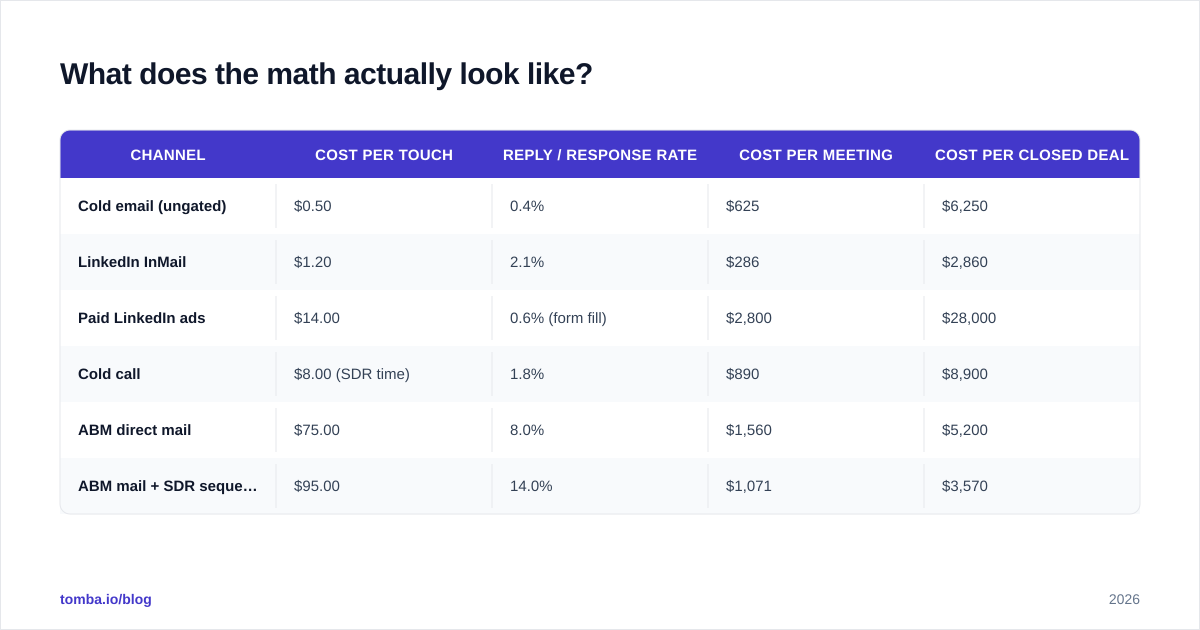
Direct mail looks expensive until you compare it to the full cost of every other channel. Here's a realistic comparison for a deal worth $40K ACV.
| Channel | Cost per touch | Reply / response rate | Cost per meeting | Cost per closed deal |
|---|---|---|---|---|
| Cold email (ungated) | $0.50 | 0.4% | $625 | $6,250 |
| LinkedIn InMail | $1.20 | 2.1% | $286 | $2,860 |
| Paid LinkedIn ads | $14.00 | 0.6% (form fill) | $2,800 | $28,000 |
| Cold call | $8.00 (SDR time) | 1.8% | $890 | $8,900 |
| ABM direct mail | $75.00 | 8.0% | $1,560 | $5,200 |
| ABM mail + SDR sequence | $95.00 | 14.0% | $1,071 | $3,570 |
The mail-plus-sequence row is the one to study. Mail on its own is fine. Mail wired into an SDR cadence beats every other channel on the most important metric — cost per closed deal — because it doesn't compete with email and LinkedIn, it amplifies them.
The trap is treating direct mail as a standalone touch. The trap looks like this: marketing ships 500 boxes, takes a victory lap, and 480 of them never get a follow-up email. That's not a direct mail strategy. That's a gifting program.
How do you build the target list?#
The list is 60% of the outcome. A great gift to the wrong person is worse than no gift at all — you've just spent $75 to be ignored.
The list rule is simple: every account on it must have a named, verified contact, a clear buying trigger, and a deal size that justifies the spend. If you can't write a one-line answer to "why this account, why now," it doesn't go on the list.
Concretely, build the list in three layers:
Layer 1 — Fit. Pull your ICP filters: industry, size, geography, tech stack, growth signals. Most teams stop here. This is where most teams fail. Fit alone gets you a 2,000-account list that's impossible to ship physical mail to.
Layer 2 — Trigger. Layer on a recent event: funding round in the last 90 days, executive hire in the last 60, product launch, intent spike on a key topic, competitor news. The trigger is what makes the gift relevant. No trigger, no gift.
Layer 3 — Contact accuracy. Verify the recipient's job title, full name spelling, and shipping address. This is where direct mail programs hemorrhage money — 18% of B2B address data goes stale every year, and a box shipped to the wrong address is a 100% wasted spend.
This is where data accuracy becomes a budget question, not a cleanliness one. Use a B2B database with recent verification dates, run mailing addresses through an enrichment pass, and confirm the recipient is still at the company before you ship. A quick email verifier pass on the contact's work email is the cheapest sanity check — if their email bounces, the address is probably stale too.
For shipping addresses specifically, accept that home addresses are now table stakes. Roughly two thirds of the boxes you ship will go to homes, not offices. Get explicit permission via a pre-ship email or a LinkedIn DM that says "we'd love to send you something — what's the best address?" The pre-ship message is also the fastest way to weed out accounts that aren't actually interested.
What should you actually send?#
The gift is where most teams panic and ship branded socks. Branded socks do not book meetings. Branded socks book a tweet.
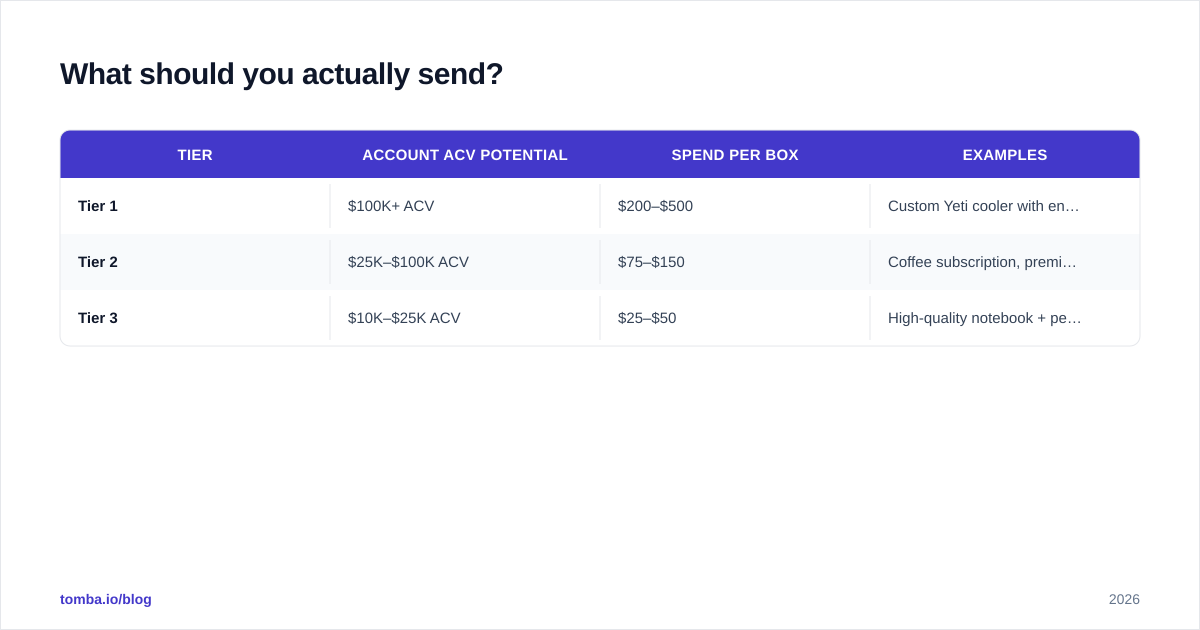
Think in three tiers, matched to your account's revenue potential.
| Tier | Account ACV potential | Spend per box | Examples |
|---|---|---|---|
| Tier 1 | $100K+ ACV | $200–$500 | Custom Yeti cooler with engraved name, premium leather laptop sleeve, signed book + handwritten note from your CEO, charcuterie board for an exec team meeting |
| Tier 2 | $25K–$100K ACV | $75–$150 | Coffee subscription, premium snack box, hardcover book related to their role, branded high-quality mug + handwritten card |
| Tier 3 | $10K–$25K ACV | $25–$50 | High-quality notebook + pen, single-origin coffee bag, premium snack box (smaller), donation in their name to a cause they post about |
A few rules that hold across tiers:
- No branded swag as the primary gift. A logo'd t-shirt is a thank-you-after-the-deal, not a meeting opener. If you want to include branded material, make it a small premium item (a nice notebook) and let the main gift do the work.
- Tie the gift to a trigger. "Congrats on the Series B" with a bottle of champagne beats "we'd love to chat" with the same bottle every single time.
- Include a handwritten note. Not laser-printed cursive. Actually handwritten. There are services that will do this for $4 per note and the difference in reply rate is roughly 3x versus printed.
- Always include a QR code or short URL to a personalized landing page — not your homepage. The landing page should reference the recipient by name, include a 60-second video from the AE, and have one CTA: book a meeting.
The personalized landing page is the under-rated lever. It turns "thanks for the gift" into "I watched the video and booked time." Tools like Reachdesk, Sendoso, and PostalIO all support this; you can also roll your own with a Webflow or framer template and a dynamic URL.
How do you sequence the follow-up?#
The follow-up cadence is what separates mail-as-gifting from mail-as-pipeline. Here's the cadence that consistently produces 14% meeting rates.
T-3 days (pre-ship): Email or LinkedIn message — "we'd love to send you something, what's the best address?" This is the consent step and the address-verification step combined. Skip it and your bounce rate doubles.
T-0 (ship day): Box is shipped. Slack alert fires when carrier scans it.
T+1 day (delivery): Slack alert when delivered. SDR sends a same-day "did it arrive?" email referencing the gift by name.
T+2 days: AE sends a LinkedIn voice note or short Loom video — 60 seconds, named, referencing the gift and the trigger.
T+4 days: SDR call. Reference the box, the trigger, and ask for 15 minutes.
T+7 days: Email with the personalized landing page link again, plus a relevant case study or asset.
T+14 days: Final breakup email or LinkedIn message.
That's seven touches over two weeks, anchored on the physical gift. Without the gift, that same sequence converts at maybe 3%. With the gift, it pushes 14%. The gift is the permission slip for every touch that follows.
For the SDR side of this, your sourcing engine needs to feed clean records into the sequence. Most teams pair a bulk email finder for the initial list build with a per-record lookup tool for the on-the-fly verification step. If you're enriching from LinkedIn, a LinkedIn finder shortens the path from profile to verified work email.
What's the right budget and how do you attribute it?#
The budget question is the question that kills most ABM mail programs before they start. Finance asks "what's the ROI" and marketing answers with "uh."
Here's the framework that works.
Per-program budget: Start with 100 accounts, Tier 2 gifts at $95 all-in (gift + shipping + landing page + sequence cost). That's $9,500. At a 14% meeting rate that's 14 meetings. At a 30% meeting-to-opportunity rate that's roughly 4 opportunities. At a 25% close rate that's 1 deal. If your ACV is $40K, you've returned 4.2x. If your ACV is $100K, you've returned 10x.
Quarterly budget: Three to four programs per quarter, each tied to a distinct trigger (new funding rounds, conference attendees, churned competitor customers, etc.). That's $30K–$40K per quarter — small enough to defend, big enough to learn.
Attribution model: First-touch attribution is wrong for direct mail. Multi-touch with a 14-day window from delivery is right. Tag every deal that touches the program in your CRM with a dm_program_q1_2026 field and report on sourced + influenced pipeline separately. Influenced pipeline is usually 3–5x sourced pipeline, and finance needs to see both.
The biggest budget mistake is shipping mail and waiting six months to see what closed. By that time you've already cut the program. Set up a 90-day in-program revenue review where you look at meetings booked, opps created, and deals in motion — not closed-won, which takes longer than the program cycle.
How does AI change ABM direct mail in 2026?#
Three real shifts, not the hype version.
AI-driven gift selection. Instead of one gift per tier, you can now generate a custom gift recommendation per contact based on their public LinkedIn activity, podcast appearances, and recent posts. A buyer who just posted about marathon training gets a premium running gel pack and a recovery roller. A buyer who joined a board gets a board-leadership book. The cost is the same; the reply rate roughly doubles.
Triggered shipping from intent data. Wire your direct mail vendor into your intent platform (6sense, Bombora, Demandbase) so that when an account hits a topic spike for your category, the box ships automatically the next day. This compresses the "research → list → ship" cycle from six weeks to 48 hours, which is what makes the trigger relevant instead of stale.
AI-personalized landing pages. The page that the QR code points to is now generated per recipient — their name, their company, a video that references their recent news, a case study from their industry. This used to require a 10-person ABM team. In 2026 it's a single workflow.
What hasn't changed: the handwritten note, the SDR follow-up, the human decision about who deserves a box and who doesn't. AI makes the program scalable. It doesn't replace the strategy.
For teams pairing direct mail with outbound sequences, AI-assisted copy tools like cold email AI writers can draft the T+1 follow-up and the T+7 reactivation email — but always with the named gift in the subject line, never as a generic re-engagement.
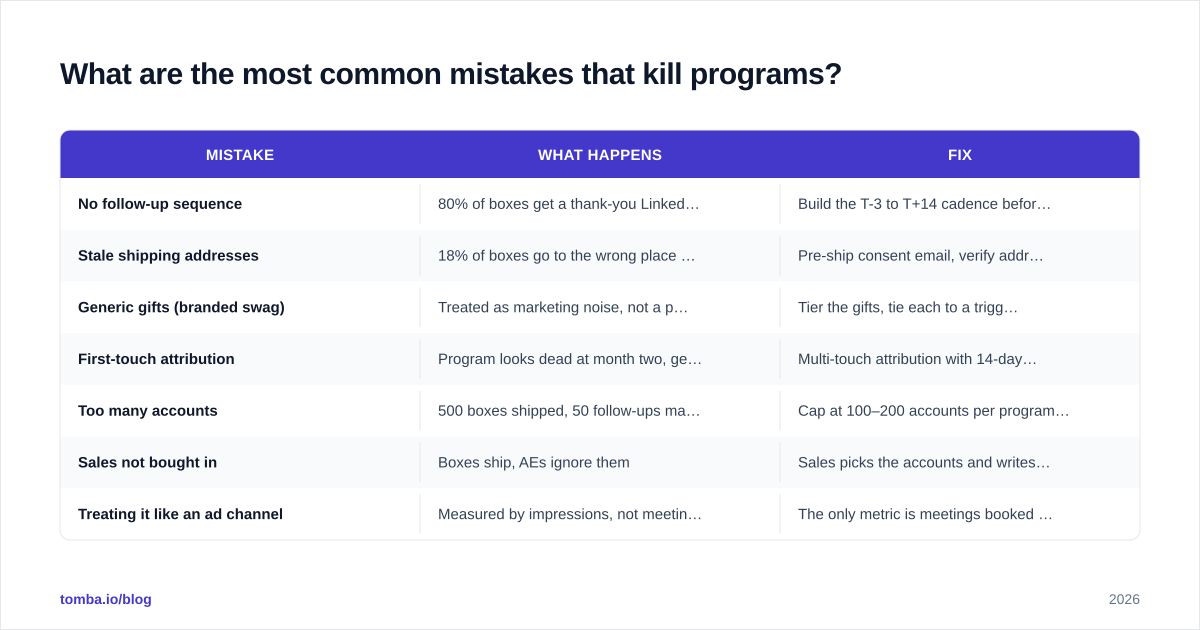
What are the most common mistakes that kill programs?#
After watching a few dozen ABM mail programs run, the failure patterns repeat.
| Mistake | What happens | Fix |
|---|---|---|
| No follow-up sequence | 80% of boxes get a thank-you LinkedIn comment and no meeting | Build the T-3 to T+14 cadence before you ship anything |
| Stale shipping addresses | 18% of boxes go to the wrong place or sit in old offices | Pre-ship consent email, verify addresses within the last 90 days |
| Generic gifts (branded swag) | Treated as marketing noise, not a personal gesture | Tier the gifts, tie each to a trigger, no logos on the primary item |
| First-touch attribution | Program looks dead at month two, gets cut | Multi-touch attribution with 14-day delivery window, track influenced pipeline |
| Too many accounts | 500 boxes shipped, 50 follow-ups made | Cap at 100–200 accounts per program, force tight execution |
| Sales not bought in | Boxes ship, AEs ignore them | Sales picks the accounts and writes the trigger before any box ships |
| Treating it like an ad channel | Measured by impressions, not meetings | The only metric is meetings booked and pipeline created |
| No QR code or trackable URL | No idea who engaged | Every box has a QR to a per-recipient landing page |
The single biggest fix is the last sales-bought-in row. ABM mail is a sales channel that marketing executes. If sales doesn't pick the accounts, write the triggers, and run the follow-up, the program will not work no matter how nice the gifts are.
What tools and vendors should you evaluate?#
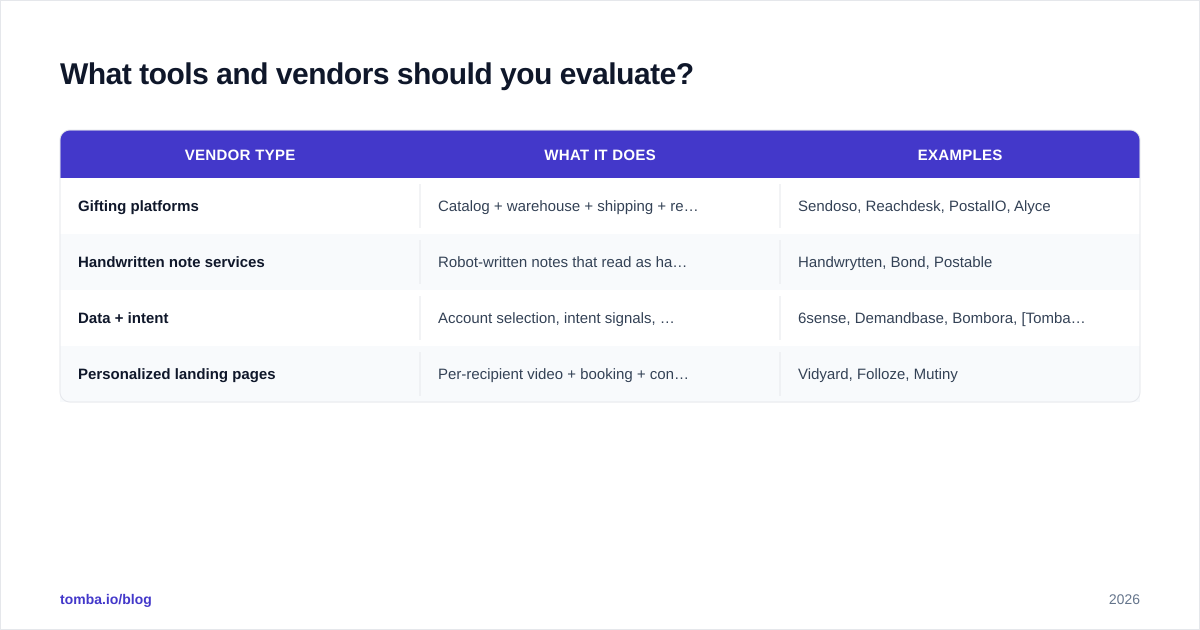
There are roughly four categories of vendors in the space. You don't need all four to start — a spreadsheet and a single corporate-gifting platform will cover 80% of what you need in year one.
| Vendor type | What it does | Examples |
|---|---|---|
| Gifting platforms | Catalog + warehouse + shipping + recipient address collection | Sendoso, Reachdesk, PostalIO, Alyce |
| Handwritten note services | Robot-written notes that read as handwritten | Handwrytten, Bond, Postable |
| Data + intent | Account selection, intent signals, contact enrichment | 6sense, Demandbase, Bombora, Tomba |
| Personalized landing pages | Per-recipient video + booking + content | Vidyard, Folloze, Mutiny |
A reasonable first stack: one gifting platform (Sendoso or Reachdesk), one data source for contact accuracy (your existing enrichment tool, or Tomba's data enrichment for cost-conscious teams), and one video tool (Vidyard or Loom). The personalized landing page can live on your own marketing site as a dynamic template.
For broader context on how this fits into the outbound stack, HubSpot's research on ABM benchmarks and G2's gifting category reviews are the two most current public references.
How do you measure success?#
The metric stack, in order:
- Delivery rate — what percent of boxes actually got to the recipient (target: 95%+)
- Engagement rate — QR scans, landing page visits, video views (target: 60%+)
- Reply rate — any human response (target: 25%+)
- Meeting rate — booked, qualified meetings (target: 12–15%)
- Opportunity rate — meetings that became open opps (target: 30% of meetings)
- Sourced + influenced pipeline — total dollar value tied to the program
- Cost per closed deal — the only number that matters to finance
Report monthly to sales leadership on metrics 4 through 7. Report weekly to the SDR team on metrics 1 through 4. Don't show meetings to finance and don't show cost-per-deal to SDRs. They're different audiences with different incentives.
The 90-day review is the moment where you decide whether to scale, kill, or iterate. Be honest. If the meeting rate is below 8% after 200 boxes, something is broken — and it's usually the list or the follow-up, not the gift.
Final take#
ABM direct mail in 2026 is a high-leverage sales channel pretending to be a marketing channel. Treat it like a sales channel, give it tight account lists, real triggers, accurate addresses, and disciplined follow-up — and it will out-convert every other outbound motion you have. Treat it like a gifting program, measure it by impressions, and let marketing run it alone, and it will burn budget and prove the skeptics right.
The teams winning with this in 2026 share three habits: they cap programs at 200 accounts, they wire sales into the account selection from day one, and they treat the box as the start of a sequence, not the sequence itself.
Ready to build the target list? The hardest part of any ABM direct mail program is finding verified, accurate contacts to ship to — names, titles, work emails, and shipping addresses that aren't 18 months stale. The Tomba Email Finder gives you verified email addresses for any account on your target list, with confidence scores and source citations so you know which contacts to trust before you spend $95 on a box. Start free with 25 searches per month, scale up on the Starter plan at $49/month when you're ready to run your first 100-account program. See full Tomba pricing for team and enterprise plans.
Ready to find emails that actually work?
Join 150,000+ professionals who stopped guessing and started sending. Free credits on signup — no credit card required.
Get the Tomba newsletter
Practical outbound tactics and product updates — once every two weeks.
About the author