ABM Email Marketing in 2026: The Complete Playbook
ABM email marketing turns spray-and-pray outbound into precision plays for named accounts. Here's the 2026 playbook — frameworks, tools, templates, and measurable metrics.
ABM Email Marketing in 2026: The Complete Playbook
TL;DR
- ABM email marketing replaces volume outbound with coordinated, multi-threaded email plays aimed at a fixed list of named accounts.
- In 2026, the winning stack pairs intent signals, enriched contact data, and AI-personalized sequences — not just generic merge tags.
- Best-in-class ABM teams hit 8-15% reply rates and 2-4x higher meeting-to-opportunity conversion vs. broad outbound.
- A working ABM email program needs five inputs: tiered account list, buying committee map, channel mix, sequence cadence, and a feedback loop with sales.
- Skip "personalization at scale" theater. Real ABM is fewer accounts, deeper research, and tighter sales-marketing alignment.
Account-based marketing has been a buzzword since 2014. What changed in 2026 isn't the philosophy — it's that the tooling finally caught up. You can now identify in-market accounts, map a six-person buying committee, find verified work emails for all of them, and orchestrate a coordinated sequence across email and LinkedIn in under an hour. If you're still running ABM by exporting a Salesforce report and copy-pasting into Mailchimp, you're losing to teams that have automated the boring parts and focused human time on the message.
This playbook covers what ABM email marketing actually means in 2026, how to build the program from scratch, the tool categories you need, and the metrics that prove it's working.
What is ABM email marketing?#
ABM email marketing is the practice of sending coordinated, account-specific email campaigns to multiple decision-makers within a pre-selected list of target accounts — instead of broadcasting to anyone who fits a demographic.
The mental model: traditional demand gen is fishing with a net. ABM email is spear-fishing with a list of specific fish you've already identified, where each cast is informed by what that fish ate last week.
Three things separate ABM email from "personalized cold email":
- The account is the unit, not the contact. You're not trying to get one reply from one lead. You're trying to engage 3-7 people inside one company across a 6-12 week window.
- The list is fixed. You don't keep expanding. You decided these 200 accounts are the ones. Now you go deep.
- Sales and marketing share the campaign. Marketing warms with ads and content, SDRs send the cold opener, AEs handle direct reach to senior buyers. Everyone sees the same dashboard.
Why does ABM email marketing matter in 2026?#
The economics finally tilted in ABM's favor. Three forces did it:
Inbox saturation killed broad outbound. Average reply rates on cold sequences dropped from ~8% in 2020 to under 2% in most B2B benchmarks. Google and Microsoft tightened sender rules in 2024, and warmup budgets ballooned. Spraying 10,000 prospects to get 80 replies now costs more in domains and deliverability tooling than running tight ABM plays to 200 accounts.
Intent data went mainstream. Tools like Bombora, G2 buyer intent, and 6sense surge signals are accessible to mid-market sellers, not just enterprise. You can see who's researching your category this week.
AI personalization is real now. LLMs can read a target's LinkedIn, last earnings call, and recent press, then draft a first line a human SDR would have spent 15 minutes on. The bottleneck moved from "can we personalize" to "is our list good enough to deserve it."
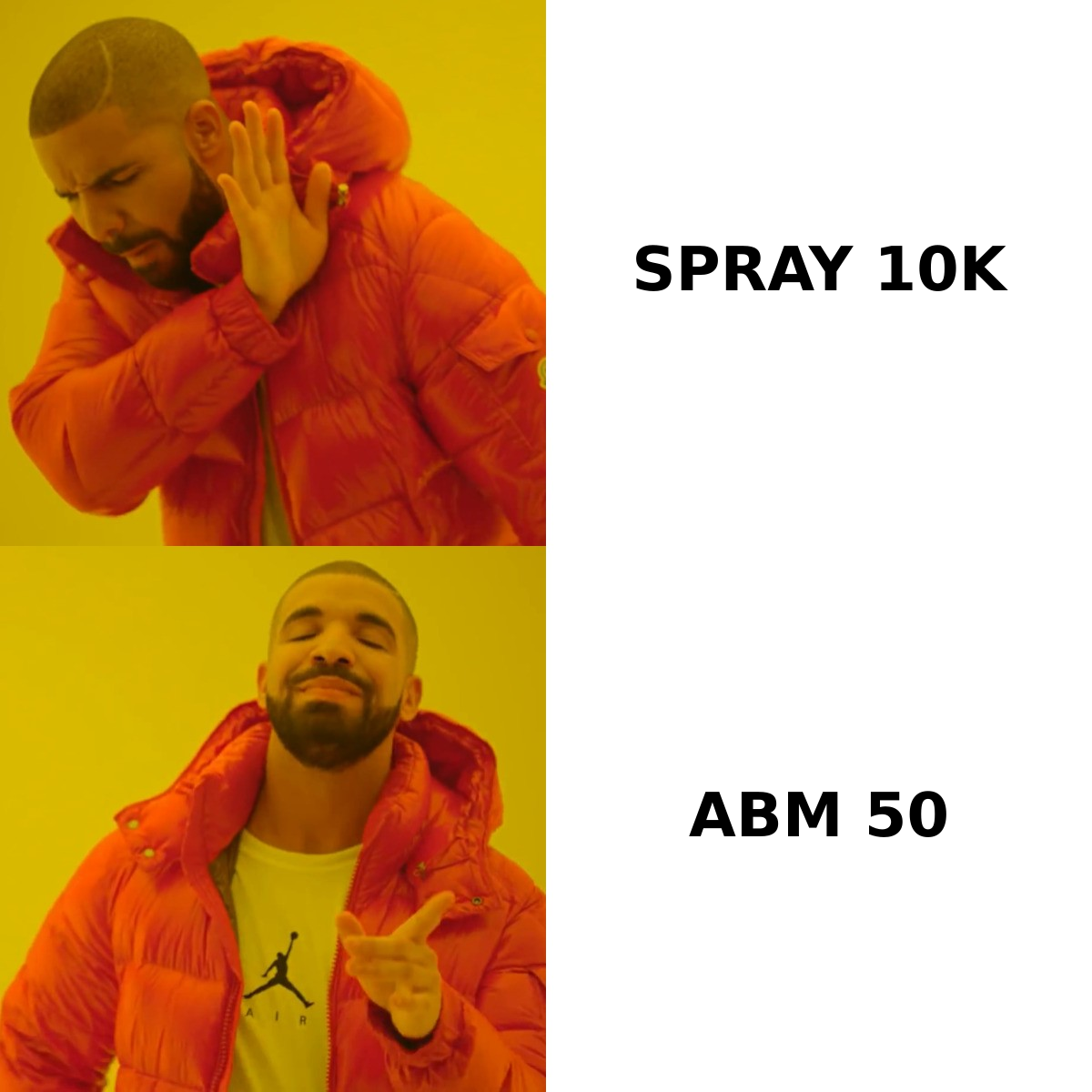
The result: a focused team of two SDRs running ABM email plays against 300 accounts can outproduce a five-person team blasting 50,000 contacts a month. We've watched it happen across three portfolio companies in the last 18 months.
How is ABM email different from cold email and demand gen?#
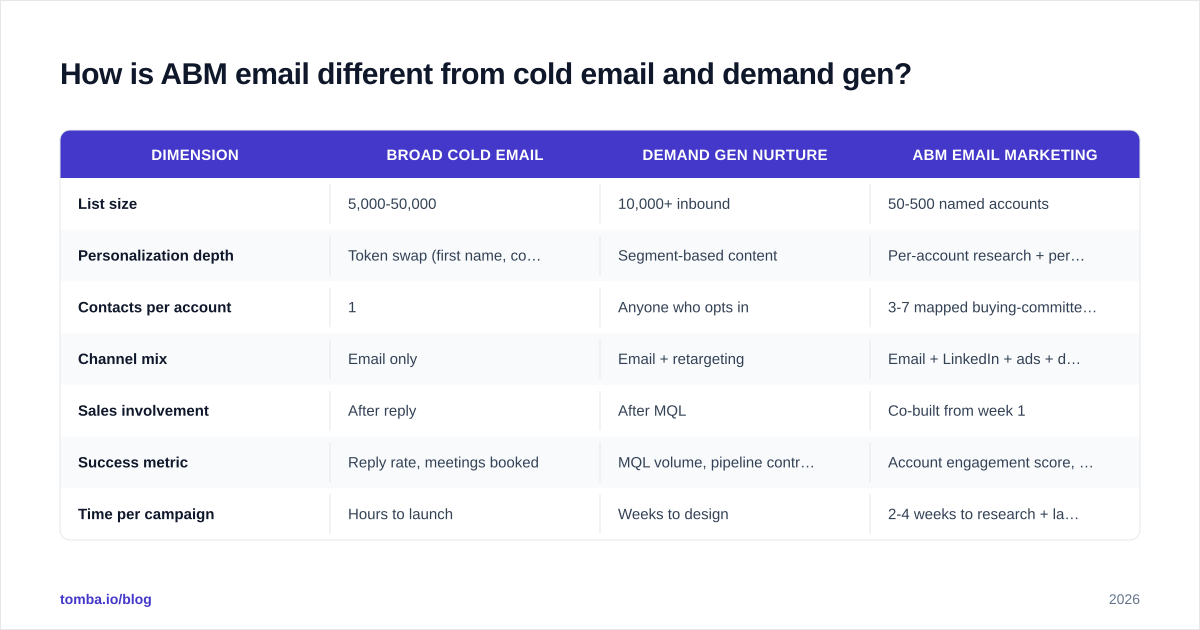
| Dimension | Broad Cold Email | Demand Gen Nurture | ABM Email Marketing |
|---|---|---|---|
| List size | 5,000-50,000 | 10,000+ inbound | 50-500 named accounts |
| Personalization depth | Token swap (first name, company) | Segment-based content | Per-account research + per-persona angle |
| Contacts per account | 1 | Anyone who opts in | 3-7 mapped buying-committee roles |
| Channel mix | Email only | Email + retargeting | Email + LinkedIn + ads + direct mail |
| Sales involvement | After reply | After MQL | Co-built from week 1 |
| Success metric | Reply rate, meetings booked | MQL volume, pipeline contribution | Account engagement score, opportunity created, revenue per account |
| Time per campaign | Hours to launch | Weeks to design | 2-4 weeks to research + launch |
| Typical reply rate | 1-2% | N/A (inbound) | 8-15% |
| Cost per qualified meeting | $150-400 | $200-600 | $400-1,200 (but 2-3x higher close rate) |
The cost-per-meeting looks worse for ABM until you look at win rate. ABM-sourced opportunities close at roughly 2-3x the rate of broad outbound, and the average contract value is typically 30-50% higher because you're hand-picking accounts that fit your ICP — not whoever happened to download a whitepaper.
For more on the underlying methodology, the Gartner B2B buying research on buying committees is required reading — it's why mapping 6-7 contacts per account matters.
How do you build the target account list?#
Account selection is where most ABM programs fail. Teams pick accounts based on logos they wish were customers ("Coca-Cola would be cool") instead of accounts that actually look like their best wins.
Use a three-tier model:
Tier 1 (10-30 accounts): Strategic. The dream logos. Hand-built by leadership. Each gets a custom landing page, personal video, sometimes direct mail. AE-led from day one.
Tier 2 (50-150 accounts): Lookalikes of your top 20 closed-won deals — same industry, size, tech stack, growth stage. SDR-led with heavy marketing air cover (LinkedIn ads, retargeting).
Tier 3 (200-1,000 accounts): Programmatic ABM. Anyone in your TAM showing high intent signals this quarter. Lighter touch — automated sequences with persona-based personalization, no per-account research.
The selection inputs you need:
- A scored fit model (industry, size, geo, tech stack)
- Intent signals (research activity, job postings, funding events)
- Disqualifiers (current customer, recent loss, security restrictions)
For sourcing the actual contacts inside each account, a domain search tool gives you every verified email at a company in seconds. From there you filter by job title to map the buying committee.
Who needs to be on the email list per account?#
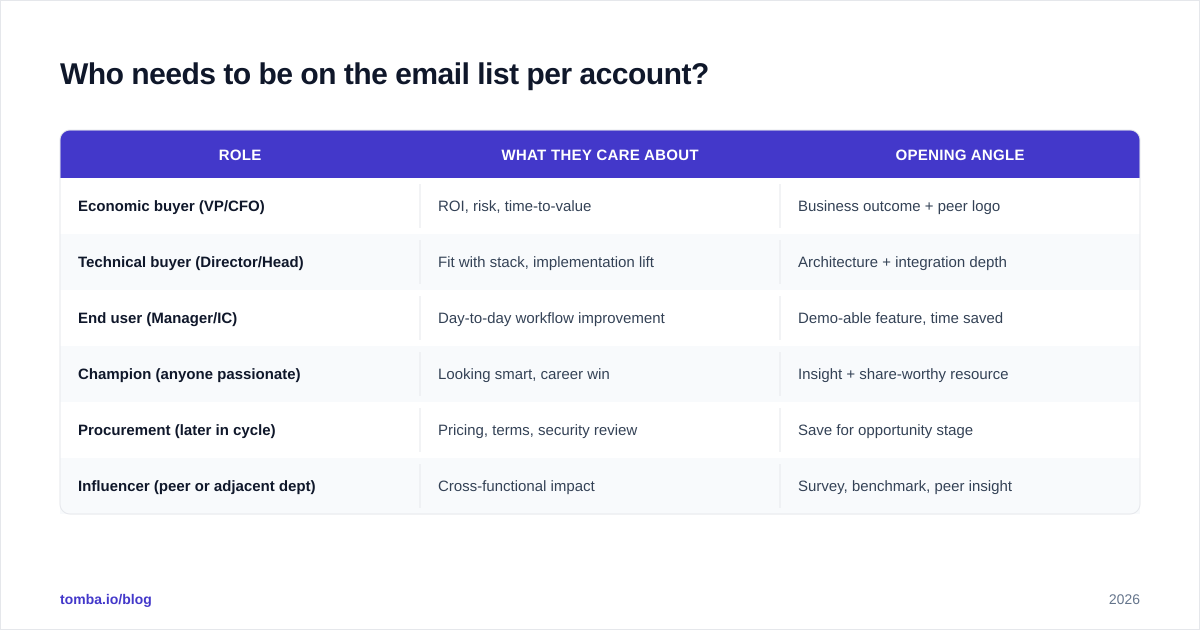
A B2B buying decision in 2026 involves an average of 6-10 stakeholders, per Forrester research. Your sequence needs to reach a meaningful slice of that committee — typically 4-6 people per account, mapped to roles:
| Role | What they care about | Opening angle |
|---|---|---|
| Economic buyer (VP/CFO) | ROI, risk, time-to-value | Business outcome + peer logo |
| Technical buyer (Director/Head) | Fit with stack, implementation lift | Architecture + integration depth |
| End user (Manager/IC) | Day-to-day workflow improvement | Demo-able feature, time saved |
| Champion (anyone passionate) | Looking smart, career win | Insight + share-worthy resource |
| Procurement (later in cycle) | Pricing, terms, security review | Save for opportunity stage |
| Influencer (peer or adjacent dept) | Cross-functional impact | Survey, benchmark, peer insight |
The mistake teams make: blasting the same email to all six roles. That's not ABM, that's a mail merge. Each persona gets a different opener, different proof point, different CTA — orchestrated so they reinforce each other when the buying committee compares notes in their Slack.
A LinkedIn finder and a phone finder round out the contact set when email-only isn't enough — usually for the senior buyer who hasn't opened a cold email since 2019.
What does an ABM email sequence look like?#
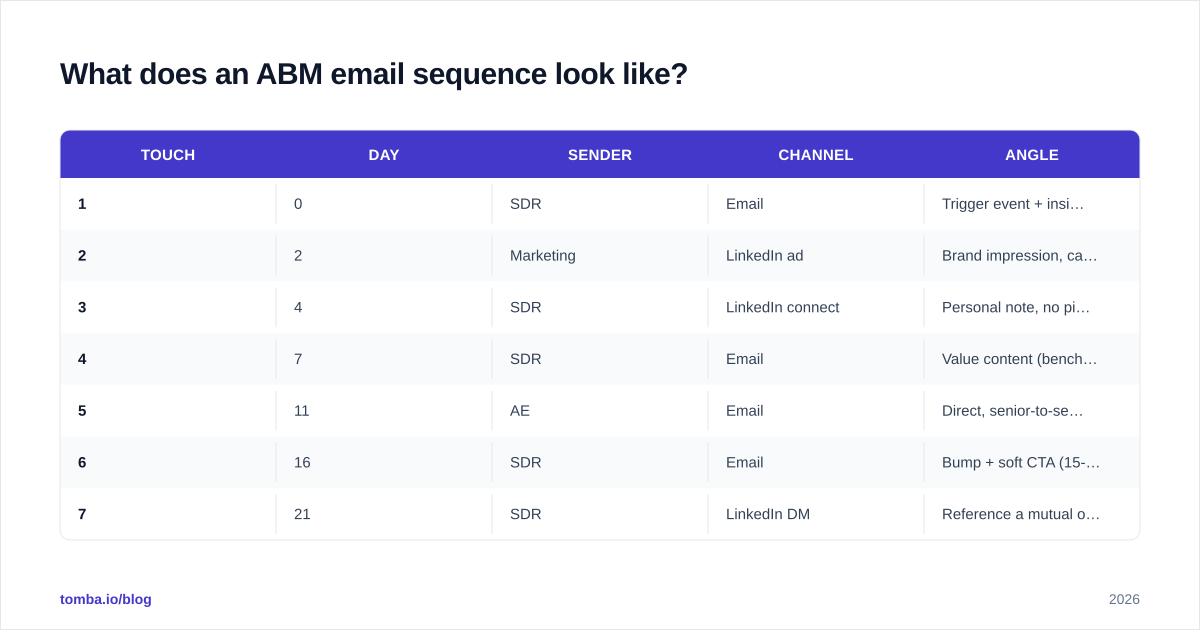
Here's a working 8-touch, 6-week sequence for a Tier 2 account. Each row shows the touch, who sends it, and the angle.
| Touch | Day | Sender | Channel | Angle |
|---|---|---|---|---|
| 1 | 0 | SDR | Trigger event + insight (no ask) | |
| 2 | 2 | Marketing | LinkedIn ad | Brand impression, case study |
| 3 | 4 | SDR | LinkedIn connect | Personal note, no pitch |
| 4 | 7 | SDR | Value content (benchmark, teardown) | |
| 5 | 11 | AE | Direct, senior-to-senior, peer logo | |
| 6 | 16 | SDR | Bump + soft CTA (15-min frame) | |
| 7 | 21 | SDR | LinkedIn DM | Reference a mutual or recent post |
| 8 | 28 | AE | Breakup + permission to close file |
A few things that make this work:
- Multi-sender. The economic buyer ignores SDRs but opens AE emails. The end user opens SDR emails but ignores AEs. Mix them on purpose.
- No two touches feel identical. If touches 1, 4, and 6 are all "checking in" emails, you've already lost.
- Marketing air cover runs in parallel. By touch 5, the prospect has seen your logo three times on LinkedIn, so the cold email isn't actually cold anymore.
- The breakup email pulls roughly 30% of total replies. Don't skip it.
For the actual copy, our cold email templates library has tested opener structures by persona. Pair them with a subject line tester before sending.
What tools do you need for an ABM email program?#
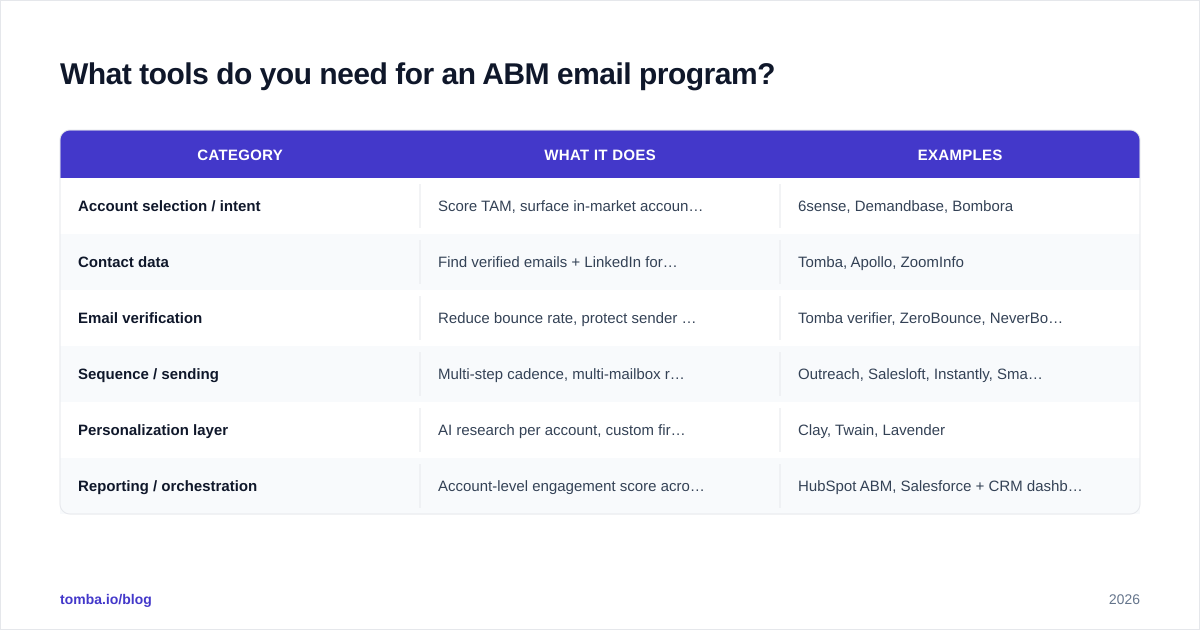
The stack breaks into six categories. You don't need a best-in-class tool in every slot — but you need something functional in each.
| Category | What it does | Examples |
|---|---|---|
| Account selection / intent | Score TAM, surface in-market accounts | 6sense, Demandbase, Bombora |
| Contact data | Find verified emails + LinkedIn for buying committee | Tomba, Apollo,ZoomInfo |
| Email verification | Reduce bounce rate, protect sender reputation | Tomba verifier, ZeroBounce, NeverBounce |
| Sequence / sending | Multi-step cadence, multi-mailbox rotation | Outreach, Salesloft, Instantly, Smartlead |
| Personalization layer | AI research per account, custom first lines | Clay, Twain, Lavender |
| Reporting / orchestration | Account-level engagement score across channels | HubSpot ABM, Salesforce + CRM dashboards |
For mid-market teams running their first ABM program, you can compress this stack significantly. A practical starter stack:
- Tomba for email finder + verification (handles two stack slots)
- Clay or your existing CRM for account enrichment
- Smartlead or Instantly for sending
- HubSpot or Salesforce for the engagement view
Total monthly cost: $400-800. That's the whole stack — not per seat, but for a 2-3 person team. Compare that to a single enterprise 6sense seat at $40K+/year and the math is obvious for teams under $5M ARR.
Speaking of pricing, Tomba pricing starts at $49/mo for the Starter plan (1,000 searches + verifications), which covers a typical Tier 2 ABM list for a quarter. The Growth plan at $99/mo handles a full multi-tier program.
How do you write ABM email copy that gets replies?#
The rule: every email must pass the "could this have been sent to anyone else" test. If yes, rewrite it.
Three personalization layers, ranked by impact:
Layer 1 — Company-level (must-have): Reference something specific the account did in the last 90 days. A funding round, a leadership hire, a product launch, a job posting that signals a pain point, a recent earnings comment.
Layer 2 — Persona-level (high impact): Speak to the role's actual mandate. A CFO reads emails about cost-of-capital and runway. A VP of Engineering reads emails about scaling, hiring, and reliability. Generic "I help companies grow revenue" lines get deleted.
Layer 3 — Individual-level (when warranted): A recent LinkedIn post they wrote, a podcast they appeared on, a conference talk. Reserved for Tier 1 accounts — the research time doesn't scale to 500 contacts.
Anti-patterns to avoid:
- "I noticed you're the [Title] at [Company]" — robotic, screams template
- "Hope this finds you well" — wastes the first line, the most valuable real estate
- Multiple paragraphs before the ask — senior buyers skim
- The "feature dump" pitch — list three benefits, not 12 features
- A 20-minute meeting ask in touch 1 — escalate the ask gradually
Keep emails under 90 words for touches 1-4. Save longer-form for touch 5 when an AE goes peer-to-peer. Test subject lines on a 10% sample before sending — even a 1% lift on a 500-account list compounds across the sequence.
How do you measure ABM email success?#
Forget open rates — they're broken since Apple Mail privacy protection rolled out. The metrics that matter in 2026:
| Metric | Definition | Target |
|---|---|---|
| Account engagement rate | % of target accounts with ≥1 reply, click, or LinkedIn interaction | 40-60% |
| Multi-threaded reply rate | % of accounts where 2+ contacts engaged | 15-25% |
| Meeting-to-opportunity conversion | Booked meetings that become opportunities | 35-55% |
| Opportunity-to-close win rate | ABM-sourced opps that close | 25-40% |
| Average deal size, ABM vs. inbound | Compare ACV by source | 1.3-1.7x premium |
| Time to first meeting | Days from sequence start to meeting booked | 14-28 days |
| Cost per opportunity | Total program spend / opps created | $1,500-4,000 |
| Account influence on closed-won | % of closed deals where ABM touched ≥3 contacts | 60%+ |
The single most important one: multi-threaded reply rate. If only one person at the account ever replies, you don't have ABM working — you have a single contact in an enterprise sales process, which is fragile. Champions leave. Priorities shift. You need 2+ engaged contacts per account or the deal stalls.
For the underlying revenue ops dashboards, our piece on revenue operations covers how to instrument this in HubSpot and Salesforce.
What are the biggest ABM email mistakes?#
After watching dozens of programs, the failure modes cluster into five buckets:
- List bloat. Starting with 50 accounts, expanding to 5,000 by month three because "we have capacity." Now it's broad outbound with extra steps.
- No buying committee map. Sending to one contact per account. When that person ghosts, the account dies.
- Sales and marketing run separate programs. Marketing's "ABM campaign" doesn't show up in CRM. SDRs don't know which accounts are getting ads. Buyers experience uncoordinated noise.
- No measurement of multi-threading. Tracking reply rate per email instead of engagement per account. You hit your reply quota but never close anything.
- Skipping verification. Sending to unverified emails bombs your sender reputation, which kills the campaign before the message even matters. Always run lists through an email verifier before sending.
The fifth one is the most preventable and the most damaging. A 12% bounce rate on a 500-account send doesn't just waste 60 emails — it flags your domain at Google and Microsoft and tanks deliverability for the next two weeks. Verify first, send second.
When does ABM email NOT make sense?#
ABM is the right model when your average contract value is above $15K, your sales cycle is over 30 days, and your TAM is under 50,000 accounts. Below those thresholds, the per-account research overhead breaks the unit economics.
If you're selling a $99/month SaaS to small businesses, you don't need ABM. You need a sharp self-serve funnel, a landing page that converts, and broad outbound with one-line personalization. Save the ABM playbook for when your deals are big enough that hand-research pays for itself.
The break-even rule of thumb: ABM works when (deal size × win rate lift) > (2 × broad outbound cost per meeting). Run the math for your business before adopting the playbook.
Final thoughts#
ABM email marketing in 2026 isn't a tool, it's a discipline. The companies winning at it have done three things: shrunk their target list, mapped the full buying committee per account, and stitched sales and marketing into one campaign instead of two.
If you're starting fresh, build the contact data foundation first — you can't run ABM if you don't know who works at each account or how to reach them. The Tomba Email Finder gives you verified work emails for every named contact in your target list, starting at $49/month for the Starter plan and free up to 25 searches if you want to test it. Pair it with the domain search to pull every contact at a target company in one query, then layer your sequence on top. That's the foundation — the messaging and orchestration get easier once the data is right.
Ready to find emails that actually work?
Join 150,000+ professionals who stopped guessing and started sending. Free credits on signup — no credit card required.
Get the Tomba newsletter
Practical outbound tactics and product updates — once every two weeks.
About the author