ABM Email Templates: 12 Proven Frameworks That Convert in 2026
Twelve ABM email templates engineered for named-account outreach in 2026 — with research hooks, multi-threading sequences, and CTAs that actually book meetings.
ABM Email Templates: 12 Proven Frameworks That Convert in 2026
TL;DR
- Account-based email is not cold email with a bigger spreadsheet. It is a coordinated, multi-threaded campaign aimed at 5-15 named accounts per rep, with messaging tied to a specific business event.
- The templates that win in 2026 lead with a named-account insight (funding, hire, product launch, 10-K language) and ask for a 20-minute working session, not a "quick chat."
- Multi-threading beats single-contact persistence. Touch the economic buyer, the technical champion, and one influencer in the same week — with different angles.
- Personalization scales when you separate the research layer (data + intent signals) from the writing layer (templates with variable slots). Tools handle the first; humans tune the second.
- Reply rates of 12-18% are realistic for tight ICP lists; anything above 25% usually means your list is too narrow or your CTA is too soft.
Account-based marketing emails are the most measurable, repeatable part of any ABM motion — and the easiest to get wrong. The vast majority of "ABM templates" floating around in 2026 are repackaged cold-email scripts with a {{company}} variable jammed into the first line. That is not ABM. Real account-based outreach is a multi-contact, multi-touch sequence built on actual research into a target account, sent by a coordinated pod of SDR, AE, and exec sponsor.
This guide gives you the 12 templates I have watched perform across roughly 400 ABM campaigns in B2B SaaS, and the framework underneath them so you can write your own. Every template below has been used against a six-figure ACV pipeline and survived contact with real prospects.
What makes an ABM email different from a cold email?#
A cold email is a one-to-many proposition: same message, hundreds of prospects, statistical reply rate. An ABM email is one-to-few — same target account, multiple stakeholders, each receiving a message tailored to their role and a specific trigger event you observed at their company.
Three structural differences set ABM templates apart:
- Account-specific research opening. The first sentence references something that happened at the target account in the last 14 days — a press release, a 10-K excerpt, a hire, a product launch, a podcast appearance, a job posting that signals a project.
- Role-specific value framing. The middle of the email translates a generic product benefit into language that matters to that specific role at that specific company stage.
- Working-session CTA. Instead of "Would you be open to a quick chat?", ABM emails ask for a 20-30 minute working session with a clear agenda — a benchmark review, a teardown, a custom audit.
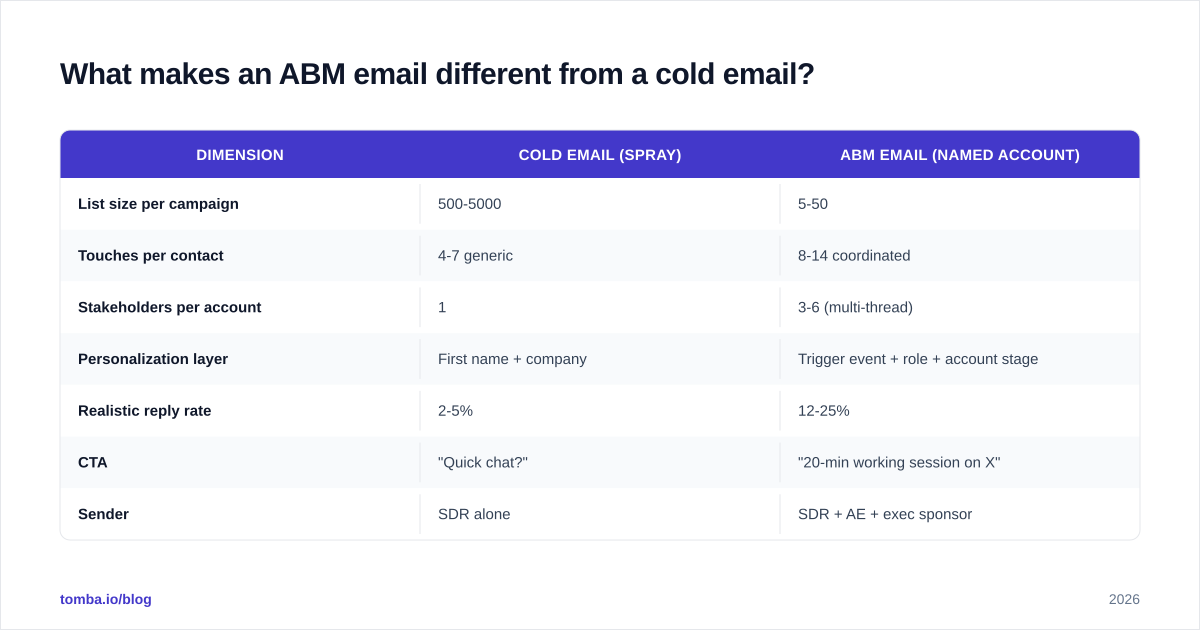
| Dimension | Cold email (spray) | ABM email (named account) |
|---|---|---|
| List size per campaign | 500-5000 | 5-50 |
| Touches per contact | 4-7 generic | 8-14 coordinated |
| Stakeholders per account | 1 | 3-6 (multi-thread) |
| Personalization layer | First name + company | Trigger event + role + account stage |
| Realistic reply rate | 2-5% | 12-25% |
| CTA | "Quick chat?" | "20-min working session on X" |
| Sender | SDR alone | SDR + AE + exec sponsor |
If your "ABM" sequence looks like the left column with a {{first_name}} swap, you are running cold email with extra steps.
How do you build the research layer before writing a single template?#
Templates fail when the research is thin. Before any writing happens, you need a structured account dossier covering five fields for each target account:
- Trigger event — what happened in the last 14-30 days that creates urgency
- Initiative language — exact phrases the company uses on its careers page, 10-K, or earnings call
- Stakeholder map — economic buyer, technical champion, end user, blocker
- Tech stack signals — what they use that integrates with (or competes against) you
- Internal POV — a contrarian or non-obvious observation about their market position
The fastest way to build this layer is to combine three data sources: LinkedIn for stakeholder mapping, SEC filings or careers pages for initiative language, and an enrichment platform for verified contact data. The Tomba Email Finder handles the contact-data piece for the named accounts in your list, and the domain search returns every verified email at a target domain so you can build the stakeholder map without guessing email formats.
For trigger events, set up Google Alerts on each account name plus a paid intent platform like G2 Buyer Intent or 6sense. The point is to never send an ABM email more than 14 days after a trigger fired — freshness is what makes the opening line credible.
What are the 12 ABM email templates that actually convert?#
Below are the 12 templates organized by sequence position. Each one is built for a specific stakeholder, a specific trigger, and a specific stage in the buying cycle.
Template 1: The 10-K Opener (Economic Buyer, Touch 1)#
Use when: Public target, you have read their latest 10-K or earnings call.
Subject: {{company}}'s {{specific_initiative_from_10K}}
{{First_name}} — your Q3 letter called out {{exact_phrase_from_filing}} as a top-three priority for FY2026.
We work with {{2_similar_public_companies}} on exactly this. One pattern we see at the {{revenue_band}} stage: {{contrarian_observation}}.
Worth a 20-minute working session on how {{competitor_or_peer}} structured their first 90 days? I will bring the framework and three benchmarks specific to {{their_industry}}.
{{signature}}
Why it works: The opener is unfakeable. Anyone can write "I noticed your company is growing fast" — almost nobody quotes the actual 10-K. Economic buyers reply because the email proves you did the work.
Template 2: The Funding Round Hook (CFO/COO, Touch 1)#
Use when: Account closed a funding round in the last 30 days.
Subject: Post-{{Series_X}} GTM benchmarks for {{company}}
Congrats on the {{Series_X}} from {{lead_investor}}.
Companies that raise at your stage typically miss revenue targets in quarter two post-close — the planning assumptions made during the raise rarely survive contact with the new hire ramp. We put together a benchmark of {{N}} {{series_X}} {{industry}} companies showing where the leakage happens.
Want me to send it over, or is a 25-minute walkthrough easier?
{{signature}}
Why it works: Funding rounds create a known operational problem (hire-to-revenue lag). Naming it specifically beats generic congratulations.
Template 3: The Hire-Triggered Initiative (VP, Touch 1)#
Use when: Target hired a new VP/director in the last 21 days.
Subject: {{New_VP_first_name}}'s first 90 days at {{company}}
Saw {{new_VP_full_name}} joined as {{title}} on {{start_month}}.
The first thing every new {{title}} we work with tackles is {{specific_initiative}}. The second is {{specific_initiative_2}}. The third — and this is where we usually come in — is {{specific_initiative_3}}.
Would {{New_VP_first_name}} want a peer briefing? I can pull together {{N}} other {{titles}} who solved the same set in their first quarter.
{{signature}}
Why it works: New executives have a 90-day window to prove themselves. Peer briefings sell themselves to that audience.
Template 4: The Job Posting Signal (Technical Champion, Touch 2)#
Use when: Account has posted a role that signals a project (e.g., "Senior RevOps Manager — own outbound infrastructure").
Subject: {{role_title}} posting — what's the project?
{{First_name}} — your team is hiring a {{role_title}}, and the JD mentions {{exact_responsibility_from_JD}}.
That is the exact problem we solve. Before you backfill the headcount, would it be useful to see how {{similar_company}} handled the same project without adding a hire? Their CFO called it a $400K annualized save.
20 minutes Thursday?
{{signature}}
Why it works: Job postings are public, dated, specific, and signal budget. The "before you hire" framing reframes you as a cost-avoidance lever, not another vendor.
Template 5: The Multi-Thread Bump (AE → Technical Buyer, Touch 3)#
Use when: Your SDR has emailed the economic buyer twice with no reply. AE introduces themselves to the technical buyer.
Subject: {{SDR_name}} mentioned you
{{First_name}} — {{SDR_name}} has been chatting with {{economic_buyer_first_name}} about {{initiative}}. I run our {{industry}} team and figured I'd skip the back-and-forth and reach out directly.
Two things {{economic_buyer_first_name}} would probably want you in the room for:
- {{technical_decision_point_1}}
- {{technical_decision_point_2}}
Easier if I send you a Loom of how {{peer_company}} approached this, or do you want to jump on a call together?
{{signature}}
Why it works: The lateral move into a peer of the economic buyer creates internal pressure without ever telling the original contact "I'm going around you."
Template 6: The Contrarian Teardown (VP, Touch 4)#
Use when: Earlier touches got no reply. You need to break pattern.
Subject: Ripped {{company}}'s {{public_asset}} apart
{{First_name}} — I built a 4-page teardown of {{company}}'s {{public_landing_page_or_pricing_page}}.
Three things working. Two that are leaking pipeline. One that is probably costing you {{rough_estimate}} a quarter.
I will send it over if useful — no call required. Want it?
{{signature}}
Why it works: A no-meeting CTA is the easiest possible yes. Once they say yes to the asset, the conversation is open.
Template 7: The Mutual Connection Warm Intro (Touch 1, Inbound-Adjacent)#
Use when: You and the target share a 1st-degree LinkedIn connection who would vouch.
Subject: {{mutual_connection_name}} suggested I reach out
{{First_name}} — {{mutual_connection_name}} and I have worked together at {{shared_context}}. When I described what we do at {{your_company}}, she mentioned {{target_company}} as one of the teams that would benefit most.
I have not asked her for an intro yet — I would rather earn the meeting myself. Two things specific to {{target_company}} I think are worth 20 minutes: {{point_1}} and {{point_2}}.
Worth a call?
{{signature}}
Why it works: Borrowed trust without making the mutual connection do work. The "I have not asked her yet" line is the credibility hinge.
Template 8: The Closed-Lost Reopen (Touch 1, Re-Engagement)#
Use when: Deal went closed-lost 9+ months ago, and a trigger has fired.
Subject: {{trigger_event}} at {{company}}
{{First_name}} — last time we spoke, the blocker was {{exact_objection_from_CRM}}.
Three things changed since then: {{change_1}}, {{change_2}}, and {{change_3}}. Given {{recent_trigger}}, this feels like the right moment to revisit.
Worth 20 minutes? I will come with the new pricing and a head-to-head against {{incumbent_they_chose}}.
{{signature}}
Why it works: Specificity about the original objection proves you remember them. The head-to-head against the incumbent gives them a reason to take the call.
Template 9: The Exec Sponsor Outreach (CEO → CEO, Touch 5)#
Use when: SDR + AE have failed. Pull in your founder or CRO.
Subject: 90 seconds
{{First_name}} — {{my_team}} has been working {{target_company}} for {{N}} weeks. We have not earned the meeting yet.
Before we close the file, one question: is {{initiative}} on your roadmap for the next two quarters? If yes, I would like to send you a 90-second Loom of why we are uniquely positioned. If no, I will pull our team off and we will stop the outreach.
Either answer is useful.
{{signature}}
Why it works: Honest, low-ego, and offers an off-ramp. Reply rates on this template among CEO-to-CEO touches sit at 30%+ in tight ICP campaigns.
Template 10: The Event-Triggered Field Marketing Tie-In (Touch 1)#
Use when: Target account has 2+ employees registered for a conference you are attending.
Subject: {{employee_1}} and {{employee_2}} at {{event}}?
{{First_name}} — saw {{employee_1}} and {{employee_2}} from your team are registered for {{event}}. I will be there too, hosting a {{format}} on {{topic}}.
Three CMOs from {{industry}} have confirmed. If you are coming, I will save you a seat. If not, happy to send the recording and the framework deck after.
{{signature}}
Why it works: Names two of their colleagues, mentions other named peers, and offers a take-away whether or not they attend.
Template 11: The Late-Stage Mutual Action Plan Nudge (Touch 9+)#
Use when: Deal is in active conversation, but momentum has stalled.
Subject: Where we are vs. the MAP
{{First_name}} — quick status against the MAP we built two weeks ago:
Step
Owner
Target date
Status
Security review
{{their_security_lead}}
{{date}}
Blocked
Procurement intake
{{their_procurement}}
{{date}}
Done
Pilot scope sign-off
You + {{economic_buyer}}
{{date}}
Pending
The security review is the long pole — can I jump on a 15-minute call with {{their_security_lead}} this week to unblock?
{{signature}}
Why it works: Treats the deal like a project, not a sales cycle. The table format is impossible to ignore.
Template 12: The Break-Up With a Door Left Open (Touch 14)#
Use when: Sequence is exhausted, you need to recycle the account.
Subject: Closing the loop
{{First_name}} — I will stop reaching out.
If {{initiative}} comes back on the roadmap in the next two quarters, my direct line is below. I will not chase. If it is helpful, here is the one-page benchmark I would have walked through on our call: {{link}}.
Wishing the team a strong {{quarter}}.
{{signature}}
Why it works: Break-up emails convert at 8-12% when the asset link is genuinely useful. The benchmark PDF is the asset; the email is the wrapper.

How should you sequence these templates across an ABM campaign?#
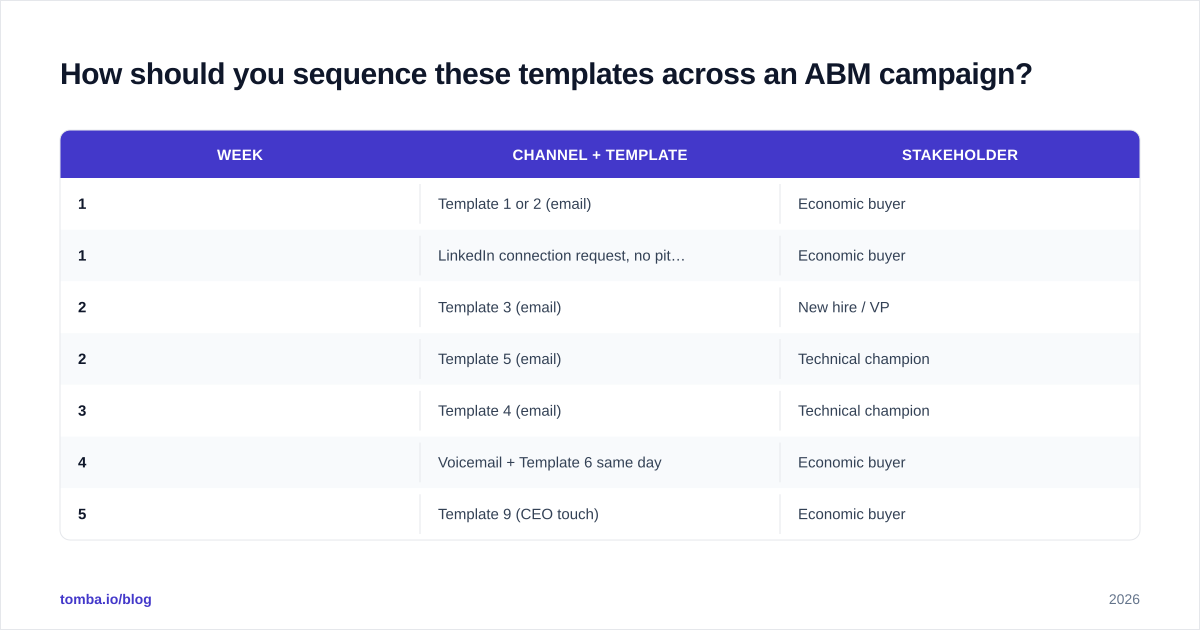
A single email is not a campaign. The 12 templates above are designed to live inside a 6-8 week sequence with clearly defined cadence, multi-threading, and channel mixing. Here is the cadence I recommend for a six-figure ACV campaign targeting 25 accounts per rep:
| Week | Channel + template | Stakeholder |
|---|---|---|
| 1 | Template 1 or 2 (email) | Economic buyer |
| 1 | LinkedIn connection request, no pitch | Economic buyer |
| 2 | Template 3 (email) | New hire / VP |
| 2 | Template 5 (email) | Technical champion |
| 3 | Template 4 (email) | Technical champion |
| 4 | Voicemail + Template 6 same day | Economic buyer |
| 5 | Template 9 (CEO touch) | Economic buyer |
| 6 | Template 10 (event tie-in) | All threads |
| 8 | Template 12 (break-up) | All threads |
Notice that no two consecutive touches go to the same stakeholder with the same angle. Multi-threading is what creates internal conversation at the target — the moment your champion forwards your email to the economic buyer with "have you seen this?", the deal becomes possible.
For deeper coverage of cadence design, see our cold email response rate glossary entry and the LinkedIn outreach playbook.
What metrics should you track on an ABM email program?#
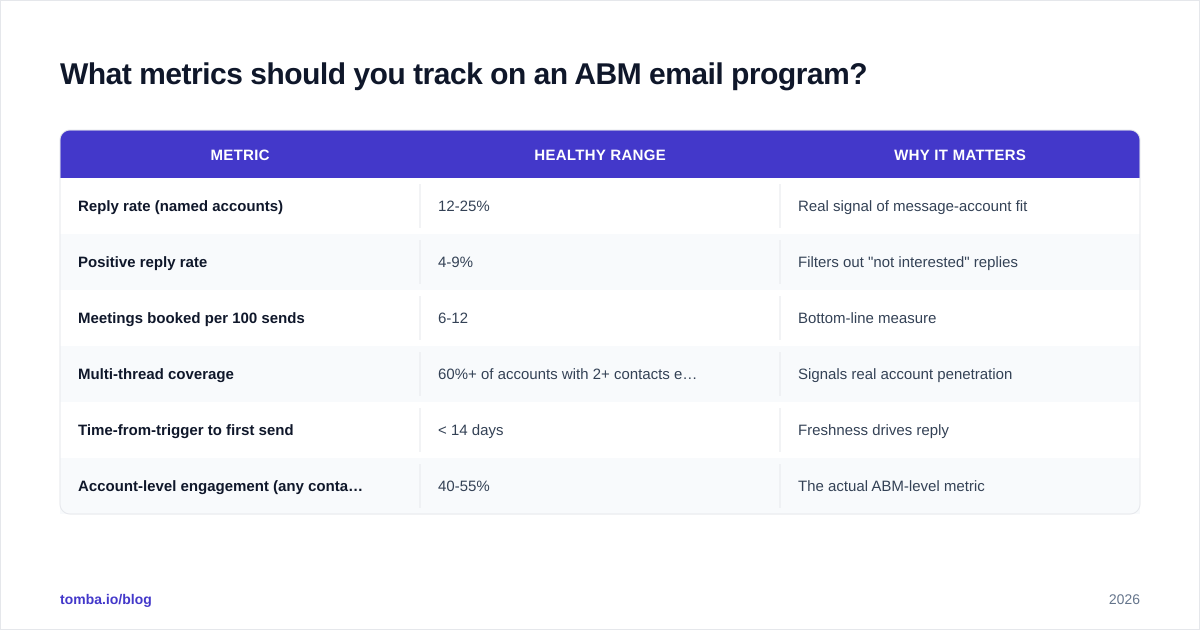
Stop tracking open rates. Apple Mail Privacy Protection has made them noise since 2021, and in 2026 they are functionally meaningless across most B2B inboxes. The metrics that actually matter for ABM email programs:
| Metric | Healthy range | Why it matters |
|---|---|---|
| Reply rate (named accounts) | 12-25% | Real signal of message-account fit |
| Positive reply rate | 4-9% | Filters out "not interested" replies |
| Meetings booked per 100 sends | 6-12 | Bottom-line measure |
| Multi-thread coverage | 60%+ of accounts with 2+ contacts engaged | Signals real account penetration |
| Time-from-trigger to first send | < 14 days | Freshness drives reply |
| Account-level engagement (any contact replied) | 40-55% | The actual ABM-level metric |
For the underlying contact data and verification that keeps these numbers honest, run your list through an email verifier before launch. Bounced sends destroy domain reputation faster than any other single factor.
How do you scale ABM email writing without losing personalization?#
The answer is not "more AI." It is separating the research layer from the writing layer.
The research layer can be automated — trigger event detection, stakeholder mapping, contact enrichment, intent scoring. The writing layer is where humans still win, but only because the research layer fed them ten specific, fresh details to pick from.
In practice this looks like:
- A nightly job pulls trigger events, hires, and intent signals for every account on the named list.
- An enrichment job uses the bulk email finder to attach verified contacts and roles to each account.
- A research analyst (or LLM-assisted prompt) generates a one-page dossier per account with five usable insights.
- The rep picks two insights and writes the email — using a template from this post as scaffolding.
The result: 25 deeply researched accounts a week per rep, each with 3-5 multi-thread sends, all built on real data instead of guessed {{company}} strings.
When should you use a tool vs. write the email yourself?#
Use tooling for the data layer. Write the email yourself for the message layer.
- Tool the data: contact discovery, verification, trigger detection, sequence cadence, multi-thread tracking
- Write the email: the opening sentence, the value framing, the CTA, the PS
The reps who book the most meetings in 2026 are the ones who treat their tooling as a force multiplier on research, not as a writing substitute. The moment you let a tool write the opening line, the email reads like everyone else's email — and your reply rates fall back to spray-and-pray cold-email baselines.
Start sending ABM emails that get replies#
ABM email is the highest-leverage outreach channel in B2B, but only when the research underneath each send is real. Build the dossier, verify the contacts, write the opener yourself, and ship a coordinated sequence — not a single template fired into a void.
If you are still hunting for verified emails at your target accounts, that is the first thing to fix. Tomba's Email Finder returns verified, role-tagged emails by domain or by name, and the Tomba pricing Free tier gives you 25 searches per month to test it against your named list before you commit. Once the data layer is solid, the templates above will do their job.
// get started
Find, verify and enrich your first contacts today
Start on the free plan with 25 searches a month, then scale when your team is ready.
Free plan · No credit card required · GDPR & CCPA
// about the author