ABM for Startups in 2026: A Practical Playbook That Works
Account-based marketing isn't just for enterprise. Here's how lean startups run ABM in 2026 — without a six-figure tech stack or a 20-person team.
TL;DR#
- Account-based marketing works for startups when you trade enterprise tooling for tight focus: 50–200 named accounts, not 5,000.
- Tier accounts into 1:1, 1:few, and 1:many — most early-stage teams start with 1:few and graduate up.
- You don't need 6sense or Demandbase to ship ABM. A spreadsheet, an email finder, LinkedIn, and a sequencer get you 80% of the value.
- Measure pipeline created from target accounts, not MQLs. If your CFO asks about MQLs in an ABM motion, you've already lost.
- Budget under $500/mo can run a 100-account 1:few program if you stack the right tools and skip the analyst-grade platforms.
What is ABM and why should a startup care?#
Account-based marketing flips the funnel. Instead of attracting a broad audience and filtering for fit, you pick the companies you want as customers, then build marketing and sales motions around each one.
For a startup, this matters for a specific reason: you almost certainly have a narrow ICP that converts well and a much wider audience that wastes your founders' time. ABM is the formalization of "stop talking to bad-fit leads."
The classic ABM definition from ITSMA (the analyst firm that coined the term in 2004) calls it "treating individual accounts as markets of one." That's enterprise-speak. The startup translation: pick 100 companies, learn them cold, hit them from three angles, and don't apologize for ignoring everyone else.
Gartner reports that ABM programs deliver an average 171% lift in annual contract value compared with traditional demand-gen. The catch is that most of the case studies come from companies with seven-figure marketing budgets. The question this post answers: how do you get a fraction of that lift on a startup budget?
Is ABM actually viable for startups, or is it an enterprise myth?#
It's viable, but only if you accept three constraints that enterprise ABM teams don't.
Constraint 1: Your list is smaller. A series-B startup running ABM on 5,000 accounts will drown. Start at 50–200. You can always expand; you can rarely contract gracefully.
Constraint 2: Founders are part of the team. ABM at HubSpot's scale separates marketing, SDR, AE, and customer marketing into four lanes. At a startup, your founder writes the LinkedIn DM, your one marketer runs the ad campaign, and your AE closes the call. Roles collapse. That's fine — just don't pretend you have a 20-person revenue org.
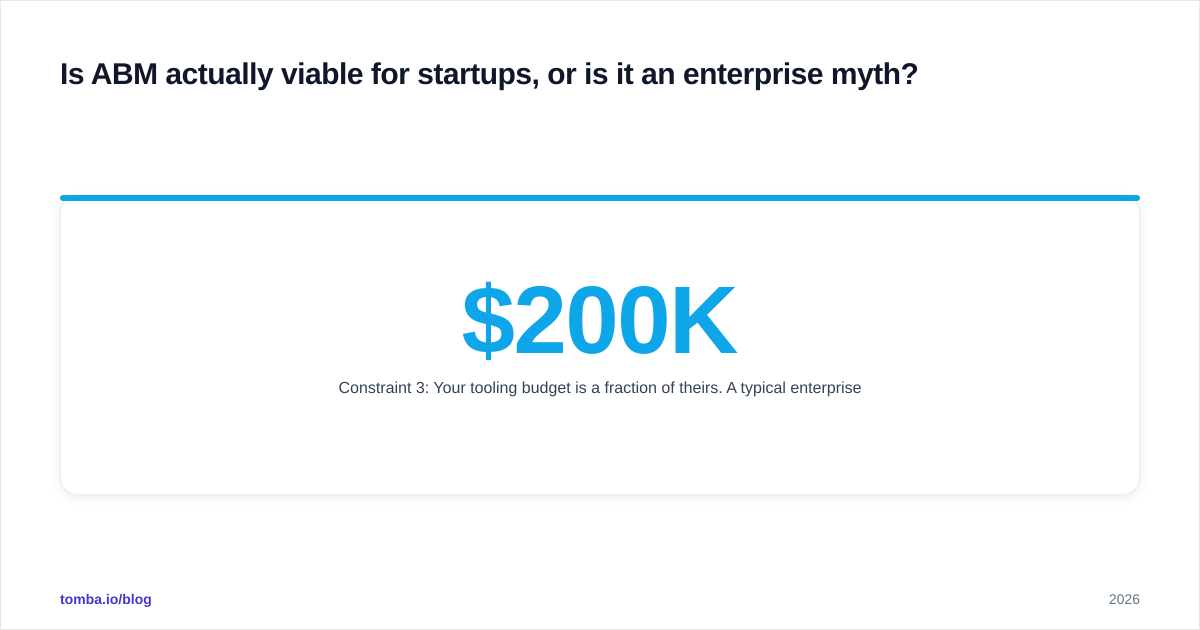
Constraint 3: Your tooling budget is a fraction of theirs. A typical enterprise ABM stack — 6sense, Demandbase, Bombora, Outreach, plus a CRM — runs $200K+ annually. Startups need to deliver 80% of the outcome at 5% of the cost. That's the entire premise of the "lean ABM" stack below.
How is startup ABM different from enterprise ABM?#
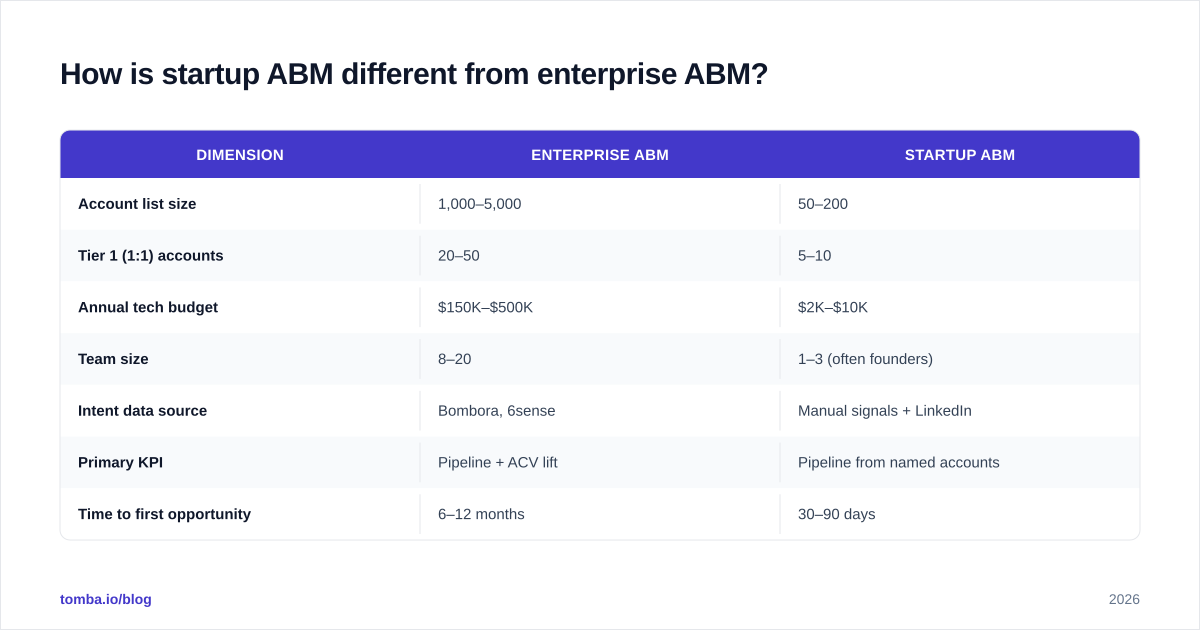
The mechanics are the same. The economics aren't.
| Dimension | Enterprise ABM | Startup ABM |
|---|---|---|
| Account list size | 1,000–5,000 | 50–200 |
| Tier 1 (1:1) accounts | 20–50 | 5–10 |
| Annual tech budget | $150K–$500K | $2K–$10K |
| Team size | 8–20 | 1–3 (often founders) |
| Intent data source | Bombora, 6sense | Manual signals + LinkedIn |
| Primary KPI | Pipeline + ACV lift | Pipeline from named accounts |
| Time to first opportunity | 6–12 months | 30–90 days |
| Buying committee touches | 8–12 per account | 3–5 per account |
The startup version trades surface area for depth. You'll touch fewer people per account, but you'll do it with sharper context because you can't hide behind a 50-page persona doc.
How do you build your first target account list?#
This is where most startup ABM programs die. People grab a SaaS list off Crunchbase, paste 800 logos into a spreadsheet, and call it a list. Three months later, no one opens it.
Build the list in four passes:
Pass 1: Define the "won" pattern. Pull your last 20 closed-won deals. What's the median company size, industry, tech stack, and trigger event (funding, hire, product launch)? If you have fewer than 20 deals, use the 10 best-fit demos and the 5 ICP customers you wish you had.
Pass 2: Find lookalikes. Use Crunchbase or LinkedIn Sales Navigator to find companies matching the won pattern. Cap at 300 to start. You'll cut this further.
Pass 3: Score and rank. For each account, score on: fit (1–5), urgency signal (recent funding, new hire, public pain), and reachability (do you have a warm intro or contact). Multiply, then sort.
Pass 4: Cut to your real list size. Tier 1 (1:1): top 5–10. Tier 2 (1:few): next 30–60. Tier 3 (1:many): the rest, up to your team capacity ceiling.
Once the list is locked, use a tool like Tomba's domain search to pull verified emails for the buying committee at every account — founder/CEO, VP of the relevant function, and the day-to-day user persona. Three contacts per account is the floor.
What does the lean ABM stack actually look like?#
The enterprise stack is built for analyst defensibility. The startup stack is built for outcomes. Here's the head-to-head:
| Capability | Enterprise stack | Startup stack | Monthly cost |
|---|---|---|---|
| Account list + scoring | 6sense or Demandbase | Sales Navigator + Sheets | $99 |
| Contact discovery | ZoomInfo | Tomba Email Finder | $49 |
| Email verification | ZoomInfo + Bouncer | Tomba Email Verifier | included |
| Sequencer | Outreach or Salesloft | Instantly or Smartlead | $97 |
| LinkedIn outreach | LinkedIn ABM ads | Manual + Sales Nav | $0 incremental |
| Intent signals | Bombora | Manual signal tracking + alerts | $0 |
| Ads (1:1 / 1:few) | RollWorks or Terminus | LinkedIn Matched Audiences | $500+ test |
| CRM | Salesforce | HubSpot Starter or Pipedrive | $20–$45 |
| Total | $15K+/mo | ~$300/mo + ad spend |
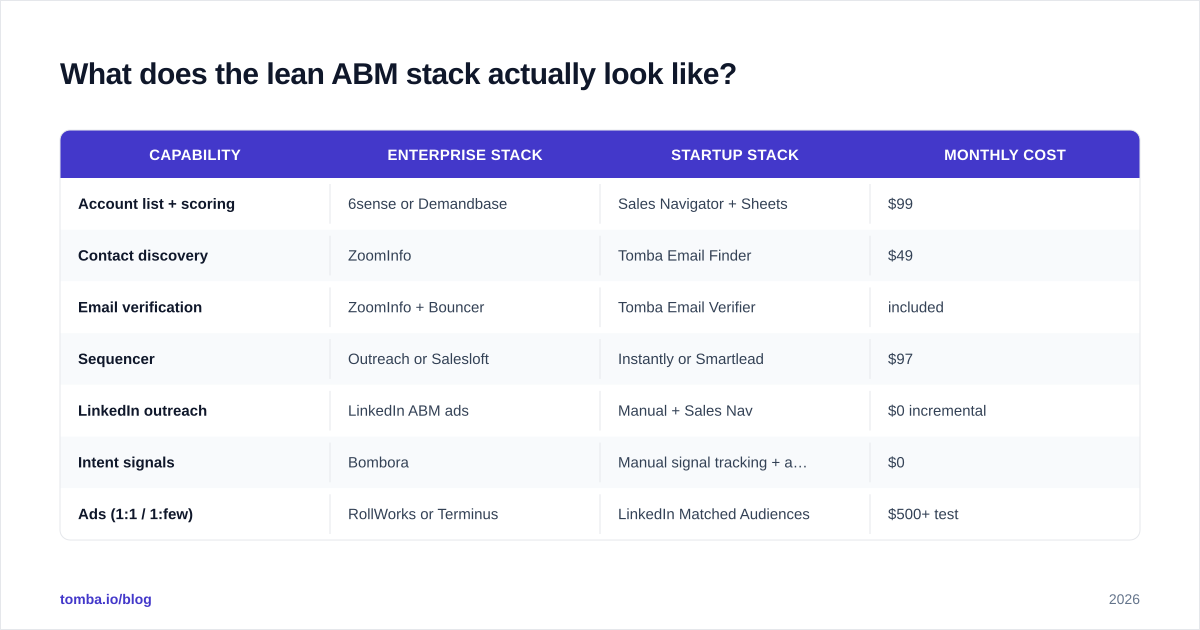
The trade-off is real. You lose probabilistic intent scoring and you'll do more manual research. But for a 100-account program, the manual work is tractable for one disciplined operator.
If you're choosing between contact-data vendors, see how Tomba pricing compares to enterprise alternatives — the Starter plan at $49/mo covers a typical 100-account 1:few program with room to spare.
How do you actually run a 1:few ABM play?#
A 1:few play targets a cluster of similar accounts — say, 20 fintech startups in series A — with shared messaging tailored to that cluster's specific pain.
Here's a six-week cadence that ships pipeline:
Week 1 — Account intel. For each account: pull recent news, hires, product launches, and competitor mentions. Build a one-line "why now" for each. If you can't write a credible "why now," cut the account.
Week 2 — Asset creation. Build one cluster-specific asset: a benchmark report, a teardown, a calculator, or a vertical-specific case study. Not a generic ebook. Something an account in that cluster would screenshot and Slack to their boss.
Week 3 — Outbound launch. Founder emails the CEO. SDR emails the VP. Marketer warms the user persona with helpful content. Three threads, same week.
Week 4 — Ads + LinkedIn. Upload the account list to LinkedIn Matched Audiences. Run a $500 test campaign promoting the asset from week 2. Connection requests to the buying committee from the founder and AE.
Week 5 — Multi-thread follow-up. No reply? Try a different angle — peer reference, customer quote, or a calendar link with three specific slots.
Week 6 — Measure and prune. Which accounts engaged? Which didn't? Promote engagers to Tier 2 attention; demote silent ones for now.

What metrics actually matter?#
Forget MQLs. ABM is account-centric, so your metrics must be too.
The four that matter:
- Account engagement rate. % of target accounts where at least one buying committee member touched your content (visit, reply, meeting) in the last 30 days. Target: 30%+ within 90 days of launch.
- Pipeline from named accounts. Total opportunity value created from your target list. This is the only board-deck metric that matters.
- Multi-thread rate. Average number of contacts engaged per active account. Solo-thread deals close less reliably; aim for 3+.
- Time to first meeting. Days from "account added to list" to "first booked meeting." Below 30 days for Tier 1, below 60 for Tier 2.
HubSpot's ABM research flags one common failure mode: teams report on lead volume from ABM campaigns instead of account engagement. That's mixing the old funnel with the new one, and it makes the program look weak even when it's working.
How do you find contacts at target accounts without enterprise data?#
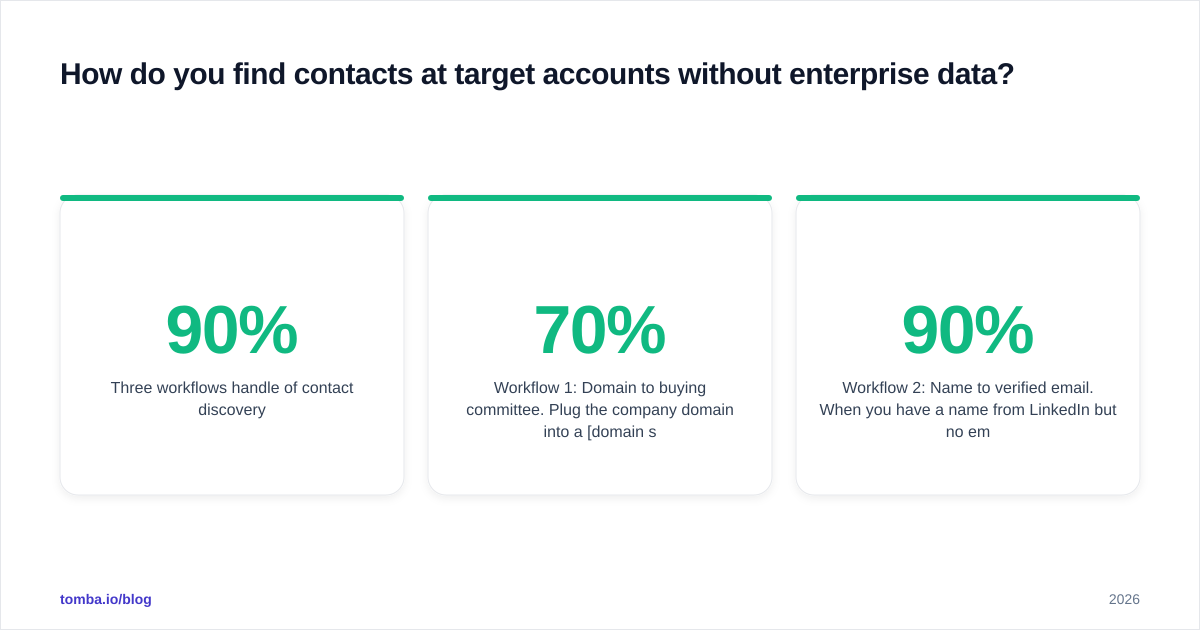
Three workflows handle 90% of contact discovery:
Workflow 1: Domain to buying committee. Plug the company domain into a domain search tool. You get every public email on that domain, ranked by department and seniority. Filter for the roles in your buying committee. This catches 60–70% of mid-market accounts.
Workflow 2: Name to verified email. When you have a name from LinkedIn but no email, use an email finder that returns a verified address with a confidence score. Reject anything below 90% confidence.
Workflow 3: Bulk enrichment. When your list grows past 100 accounts, run it through a bulk email finder instead of one-by-one lookups. Upload a CSV of company + name pairs, get back verified emails for the whole list in minutes.
For LinkedIn-heavy prospecting — common in B2B SaaS ABM — a LinkedIn finder converts profile URLs into work emails so you can move from social signal to direct outreach without losing the thread.
What are the most common startup ABM mistakes?#
Five failure modes account for most early-stage ABM disappointment:
Mistake 1: List too big. 1,000 accounts isn't ABM — it's a target list with a fancy name. If your team can't recite the top 10 from memory in week 2, the list is too big.
Mistake 2: No "why now." Every Tier 1 account needs a current trigger. A series A two years ago is not a trigger. A series B last week is.
Mistake 3: Single-threading. One email to one VP is outbound, not ABM. If you're not hitting at least three contacts per account across at least two channels, you're running an SDR motion in ABM clothing.
Mistake 4: Measuring lead volume. "We got 47 MQLs from the campaign" is the wrong sentence. The right one is "8 of 50 target accounts now have an active opportunity."
Mistake 5: Treating ABM as a campaign. ABM is a motion, not a Q3 push. The teams that win run their list continuously, prune monthly, and treat account intel as an evergreen asset.
How do startups graduate from 1:few to 1:1?#
You don't start at 1:1. You earn into it.
A Tier 1 (1:1) account justifies founder time, custom assets, and bespoke landing pages. Typical thresholds:
- Annual contract potential of $50K+
- Already showing engagement (multiple visits, content downloads, or a warm intro)
- Strategic logo value beyond direct revenue (anchor customer in a new vertical)
When an account hits Tier 1, your playbook changes. Build a one-page microsite for them. Record a 90-second Loom referencing their specific situation. Have your CEO send a handwritten note. The unit economics are different — you're spending $500–$2,000 of human time per account — so reserve this for the 5–10 accounts where it pays back 100x.
For the manual research that fuels 1:1 plays, tools like a reverse email lookup help when you have a partial signal (someone visited your site, a referral mentioned a name) and need to surface the full contact profile.
What does a 90-day ABM rollout plan look like?#
If you're starting from zero, here's a 90-day plan that gets you to first opportunity without melting the team:
Days 1–14: Foundation.
- Pull won-deal pattern, define ICP
- Build account list (cap at 100)
- Score and tier
- Pull buying committee contacts for Tier 1 and Tier 2
Days 15–30: Asset and infrastructure.
- One cluster-specific asset (report, teardown, or calculator)
- Sequencer set up, domain warmed
- LinkedIn Matched Audiences uploaded
- CRM custom fields for target-account flag and tier
Days 31–60: First plays in market.
- 1:few play for Tier 2 (60–90 accounts)
- 1:1 attention for Tier 1 (5–10 accounts)
- Weekly account engagement review
Days 61–90: Pipeline and iteration.
- First opportunities should appear (target: 5–10)
- Prune silent accounts, promote engagers
- Decide which channel mix gets reinforced
Closing thoughts and where to start#
ABM at startup scale isn't about copying enterprise playbooks with smaller numbers. It's about accepting that with 50–200 accounts and one disciplined operator, you can outperform a five-person SDR team that's spraying 5,000 contacts a month.
Three honest truths to anchor on:
- The list is the program. A bad list with great tactics loses to a great list with average tactics every time.
- Buying committee data is non-negotiable. You need 3+ verified contacts per account. Skip this and ABM collapses into single-thread outbound.
- Founders are part of the motion at this stage. Pretending otherwise creates marketing campaigns that miss the deal.
If you're standing up an ABM program this quarter, the contact-data layer is the cheapest place to start and the most expensive place to skimp. Tomba's email finder gives you verified buying-committee contacts at $49/month on Starter — enough to run a 100-account 1:few program end to end. Start there, prove pipeline on a tight list, then graduate to the bigger spend once the motion is working.
// get started
Find, verify and enrich your first contacts today
Start on the free plan with 25 searches a month, then scale when your team is ready.
Free plan · No credit card required · GDPR & CCPA
Get the Tomba newsletter
Product and data updates
// about the author