ABM Funnel in 2026: How to Build, Measure, and Scale It
The ABM funnel flips traditional demand gen on its head. Here's how to build one that actually closes enterprise deals in 2026 — stages, metrics, tooling, and the mistakes that kill pipeline.
ABM Funnel in 2026: How to Build, Measure, and Scale It
TL;DR
- The ABM funnel inverts the classic demand-gen funnel — you start with a fixed list of target accounts, then expand reach inside each one.
- Five stages matter: Identify, Expand, Engage, Convert, Advocate. Each has its own KPI; lead-volume metrics from MQL-era playbooks will mislead you.
- Account-level intent data plus contact-level enrichment is the minimum tooling bar. Without both, you're guessing.
- Sales and marketing must share the same account list, the same scoring model, and the same dashboard — or the funnel collapses into two parallel pipelines that argue at QBR.
- A working ABM funnel typically lifts deal size 30-50% and shortens sales cycle 20-30% inside the named-account segment within two quarters.
What is an ABM funnel?#
An ABM funnel is the path a pre-selected target account travels from "not aware of you" to "expanding contract." It is account-shaped, not lead-shaped. Where a traditional funnel asks "how many leads can we capture and qualify?", an ABM funnel asks "how deep can we penetrate this fixed list of companies we already decided we want?"
That distinction changes everything downstream — your scoring model, your reporting, your forecast math, your comp plan. If you bolt ABM onto a lead-volume operation without rewiring those four things, you'll get the cost of ABM with the results of demand gen.
The clearest way to think about it: a marketing qualified lead is one human raising a hand. An ABM-qualified account is a company you decided was worth pursuing before anyone there ever heard your name. The work is to manufacture the awareness, not wait for the hand-raise.
How is the ABM funnel different from a traditional funnel?#
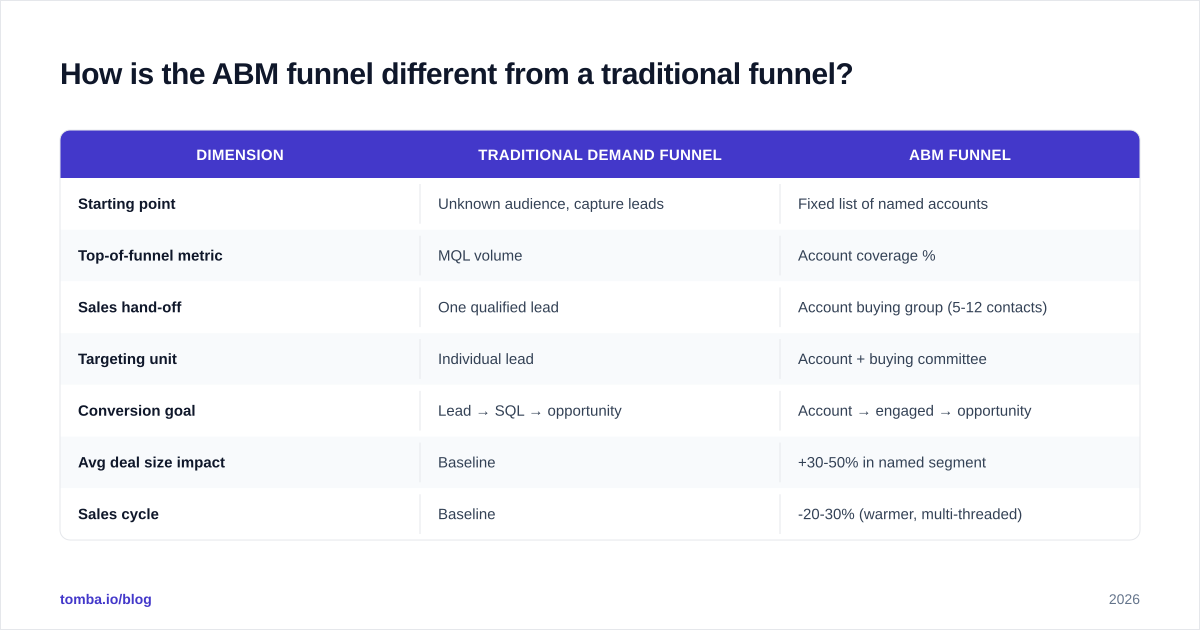
The traditional funnel is wide at the top and narrows. ABM is the opposite — a fixed top, then expansion inside each account.
| Dimension | Traditional Demand Funnel | ABM Funnel |
|---|---|---|
| Starting point | Unknown audience, capture leads | Fixed list of named accounts |
| Top-of-funnel metric | MQL volume | Account coverage % |
| Sales hand-off | One qualified lead | Account buying group (5-12 contacts) |
| Targeting unit | Individual lead | Account + buying committee |
| Conversion goal | Lead → SQL → opportunity | Account → engaged → opportunity |
| Avg deal size impact | Baseline | +30-50% in named segment |
| Sales cycle | Baseline | -20-30% (warmer, multi-threaded) |
| Reporting cadence | Lead source by week | Account engagement by week |
| Failure mode | Garbage MQLs from gated content | Lists drift from ICP, sales ignores accounts |
If your dashboard still leads with "MQLs by source this month," you do not actually have an ABM funnel — you have a lead-gen funnel with an account-list filter taped on the side.
What are the stages of the ABM funnel?#
There are five. Skip any one and the next stage breaks.
Stage 1: Identify (build the target account list)#
This is the foundation. Get it wrong and the rest of the funnel is just expensive theatre.
Your ICP definition needs three layers:
- Firmographic — industry, revenue band, employee count, geography, tech stack.
- Strategic — accounts that match your reference customers, that compete with your reference customers, or that have a specific business event (funding, leadership change, M&A).
- Intent — accounts already researching the problem you solve, signaled through third-party intent data, site visitors, and review-site activity.
A useful target list is 50-300 accounts per rep for 1:1 ABM, 500-1,500 for 1:few, and 2,000-10,000 for programmatic 1:many. Bigger than that and you've drifted back into demand gen.
Stage 2: Expand (map the buying committee inside each account)#
Gartner has been consistent for a decade that the average B2B buying committee is 6-10 people. In enterprise software in 2026, we routinely see 11-14. Your funnel needs contact coverage of the actual decision-making unit, not just whoever filled out a form.
For each account, identify:
- Economic buyer — signs the contract
- Technical buyer — evaluates the product
- User champion — will live in the tool daily
- Influencer(s) — adjacent leaders who say yes or no
- Blocker(s) — security, procurement, legal
Building that map is mostly a data-quality problem. You need accurate emails, direct dials, and current titles for 6-12 people per account, refreshed continuously as people change jobs. This is where a serious email finder and data enrichment layer earn their cost — finding the CISO's verified work email at a 5,000-person bank is not a job for a free Chrome extension.
Stage 3: Engage (run coordinated multi-channel plays)#
Single-channel ABM doesn't move enterprise accounts. The buying committee needs to see you across email, LinkedIn, paid social, retargeting display, and (for top-tier accounts) direct mail and in-person events — all carrying the same narrative.
A typical 1:1 play sequence over 6-8 weeks:
- Week 1-2: paid social warm-up against the committee, retargeting display lit up
- Week 3: personalized email from AE to economic buyer + champion
- Week 3-4: LinkedIn engagement from AE on prospects' posts
- Week 4: BDR outbound to influencers + users, referencing the exec touch
- Week 5: webinar / executive briefing invite to the full committee
- Week 6-7: direct mail to top 2 personas
- Week 8: gift + meeting ask
Coordination is the hard part. If marketing runs the ad campaign and sales doesn't know which accounts are in-market, you waste both budgets.
Stage 4: Convert (multi-thread to closed-won)#
Conversion in ABM is not "lead becomes opportunity." It's "account becomes engaged → engaged becomes pipeline → pipeline becomes closed-won," and a single account can contribute multiple opportunities (land-and-expand, multi-BU deals).
Track at the account level:
- Engagement score (composite: email opens, site visits, ad engagement, meeting attendance, content downloads, weighted by persona seniority)
- Coverage (% of buying committee with at least one tracked engagement)
- Velocity (days from first engagement to first meeting, first meeting to opportunity)
- Win rate inside the named list vs. outside it
If your named-account win rate isn't materially higher than your generic inbound win rate after two quarters, the ABM program isn't working — go fix the list before fixing anything else.
Stage 5: Advocate (expand and reference)#
The unique leverage of ABM is the post-close motion. Because you only fought to win accounts that were a deliberate strategic fit, those accounts are also your best expansion and reference candidates.
Bake this in:
- Quarterly business reviews scored on expansion-readiness
- Customer advisory board recruited from top-quartile accounts
- Reference logo program with a target of 30-50% participation
- Net revenue retention as a primary ABM KPI, not a CS afterthought
What metrics matter at each stage of the ABM funnel?#
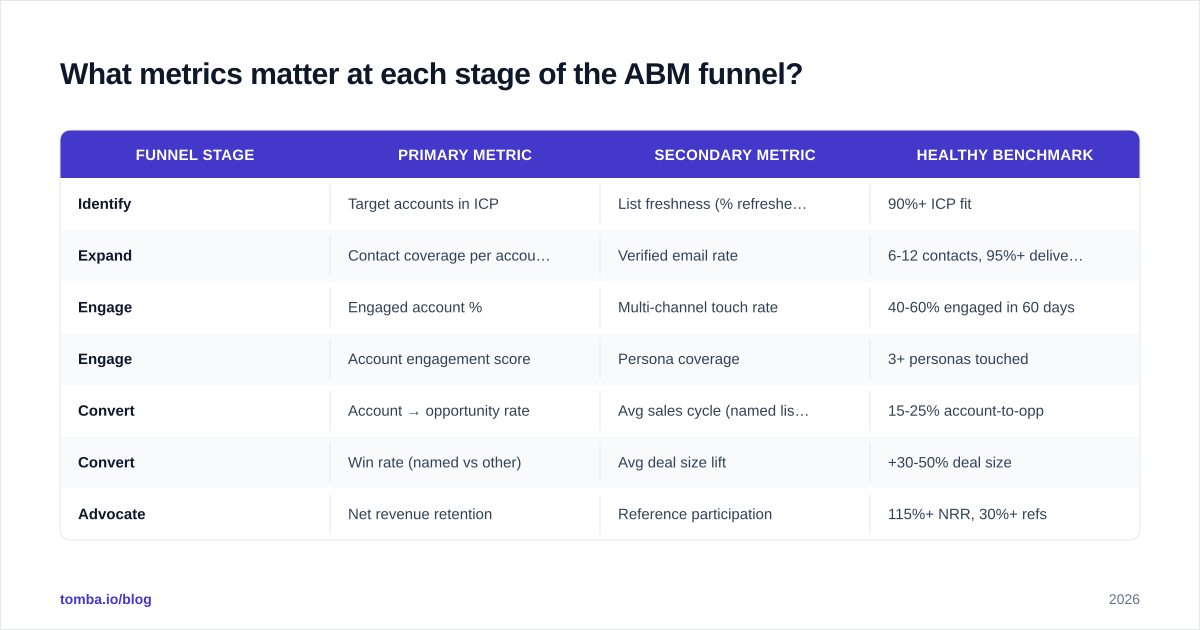
Throw out lead volume. The ABM funnel runs on account-level metrics, and most legacy MAP reports are useless for them.
| Funnel Stage | Primary Metric | Secondary Metric | Healthy Benchmark |
|---|---|---|---|
| Identify | Target accounts in ICP | List freshness (% refreshed/quarter) | 90%+ ICP fit |
| Expand | Contact coverage per account | Verified email rate | 6-12 contacts, 95%+ deliverable |
| Engage | Engaged account % | Multi-channel touch rate | 40-60% engaged in 60 days |
| Engage | Account engagement score | Persona coverage | 3+ personas touched |
| Convert | Account → opportunity rate | Avg sales cycle (named list) | 15-25% account-to-opp |
| Convert | Win rate (named vs other) | Avg deal size lift | +30-50% deal size |
| Advocate | Net revenue retention | Reference participation | 115%+ NRR, 30%+ refs |
One trap to avoid: don't roll up account-level metrics into lead-level dashboards just because your BI tool defaults that way. If your CMO opens the dashboard and the first number is "MQLs YTD," you've already lost the framing battle.
For deeper definitions of the underlying terms, the revenue operations glossary and Gartner's B2B buying research are both useful references.
What tools do you need to run an ABM funnel?#
The 2026 ABM stack has four mandatory layers and several optional ones. You don't need the most expensive vendor in each — you need every layer to actually exist.
| Layer | What it does | Examples |
|---|---|---|
| Account data + intent | Builds and refreshes the target list, surfaces in-market accounts | 6sense, Demandbase,ZoomInfo |
| Contact data + enrichment | Verified emails, direct dials, titles for the buying committee | Tomba, Apollo, Cognism |
| Orchestration | Coordinates plays across channels, scores account engagement | HubSpot, Marketo, Demandbase Orchestrate |
| Sales execution | Sequencing, dialer, CRM hygiene for the AE/BDR team | Outreach, Salesloft, HubSpot Sales |
| Optional: direct mail | Physical sends triggered by engagement signals | Sendoso, Reachdesk |
| Optional: gifting/events | Tier-1 account experiences | Postal, Goldcast |
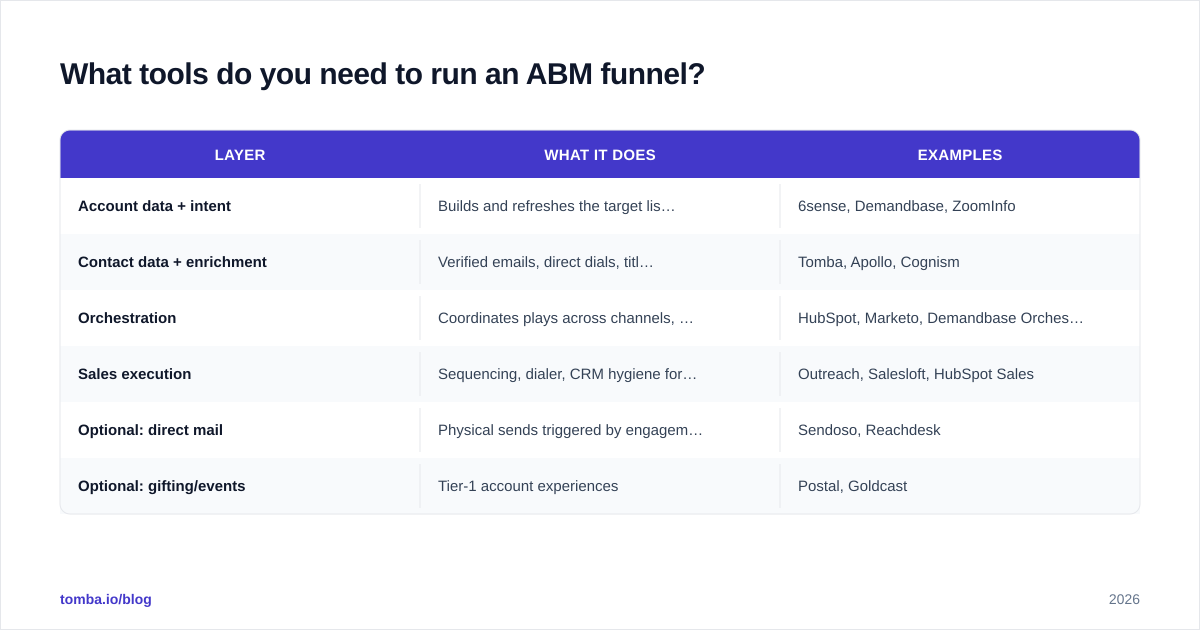
The contact-data layer is where most ABM programs quietly fail. You can buy a beautiful intent platform that tells you 47 accounts are spiking — and then your BDR team has 60% bounce rates because the emails inside those accounts are 18 months stale. Wire a real email verifier and continuous enrichment into the workflow or the intent layer is just expensive theatre.
How do sales and marketing align around an ABM funnel?#
This is where most ABM programs die. Three structural things have to be true:
- Shared list. Sales and marketing operate from the same target account list, refreshed on the same cadence, with the same tiering (1:1, 1:few, 1:many).
- Shared definition of "engaged." An account doesn't become an MQA (marketing qualified account) because one intern visited the pricing page. Co-define the threshold — typically 3+ engagement signals from 2+ personas inside a 30-day window.
- Shared comp. If marketing is comped on MQL volume and sales is comped on named-account revenue, they will pull in opposite directions. Move marketing onto pipeline created and revenue closed inside the named segment.
A weekly 30-minute account review between the AE pod and the marketing pod, looking at the same dashboard, beats every fancy alignment framework in print. Run it, take notes, leave.
How do you build an ABM funnel from scratch in 90 days?#
Realistic 90-day rollout for a B2B SaaS company at $5M-$50M ARR:
Days 1-15 — Foundation
- Define ICP with sales leadership; agree on 1-3 tiers
- Build the v1 target list (start with 200-500 accounts; you can scale later)
- Audit data quality on those accounts; backfill verified contacts using a bulk email finder workflow
- Wire intent data into your CRM
Days 16-45 — First plays
- Pick 2 plays per tier; document them as runbooks
- Stand up the shared dashboard (account list, coverage, engagement, opp creation)
- Launch tier-1 plays for top 20-50 accounts; tier-2 programmatic for the rest
- Run weekly sales-marketing standups
Days 46-90 — Measure and tune
- First scoring model recalibration based on real engagement data
- Kill plays that aren't producing meetings; double down on the ones that are
- Expand list by 30-50% based on what's working
- First QBR with leadership on named-account pipeline, not MQLs
If you're trying to do this and also keep your existing MQL machine running at full volume, you will short-staff the ABM motion and learn nothing. Cap MQL targets explicitly for the first two quarters.
What are the most common ABM funnel mistakes?#
After watching dozens of programs launch, the recurring failures are boringly consistent:
- List too large. "Let's just put 8,000 accounts in 1:1" — no, that's spam with extra steps. Tier ruthlessly.
- No buying-committee map. Targeting one persona per account is just personalized demand gen.
- Demand-gen metrics on an ABM funnel. If MQLs are still the headline KPI, sales will ignore the program.
- Stale data. A target list refreshed annually is dead by month three. Continuous enrichment is non-negotiable.
- Single channel. Email-only ABM is a contradiction. The committee has to see you in 4+ places.
- No exit criteria. Accounts that don't engage in 6 months should leave the active list. Otherwise reps lie about coverage forever.
- Marketing-led, sales-tolerant. If the AEs aren't enthusiastic owners of named accounts, the funnel is just an expensive newsletter.
Where does Tomba fit in the ABM funnel?#
Honest version: Tomba isn't an orchestration platform and won't replace 6sense or Demandbase. Where it earns a seat is in the contact-data layer of the Expand stage — finding and verifying the 6-12 people inside each target account, then keeping that data fresh as people change roles.
Practical workflow most teams run:
- Intent platform surfaces 50 in-market accounts this week
- Domain search pulls verified emails for every relevant title at each domain
- Email verifier confirms deliverability before sequences go live
- Data enrichment backfills phone, LinkedIn, seniority, and department for the buying committee
- Records flow into the CRM tagged to the account, ready for orchestration
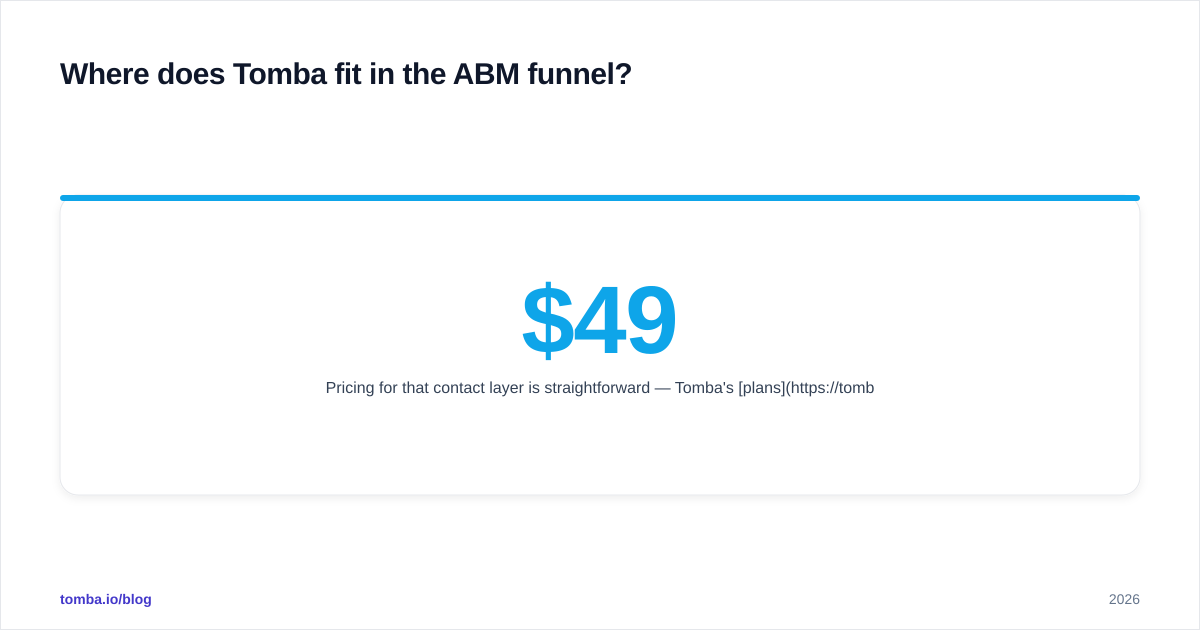
Pricing for that contact layer is straightforward — Tomba's plans start with a 25-search free tier and a $49/month Starter, scaling up to $99 Growth and $249 Pro tiers that most ABM teams land on.
Want to compare options at the contact-data layer specifically? G2's account-based marketing category and HubSpot's ABM guide are both reasonable starting points before you commit to any vendor.
Build your ABM funnel on data you can trust#
The ABM funnel only works when the contact layer is accurate. Intent platforms tell you which accounts are warming up; orchestration tools fire the plays; but if the emails bouncing back are 40% of your send volume, none of it converts.
Start there. Use the Tomba Email Finder to map the buying committee at every account on your target list — verified emails, direct routing, continuous refresh. Pair it with the verifier on every send and you remove the single most common reason ABM programs underperform their forecast.
Pick 100 target accounts, find every relevant decision-maker inside them, and run your first ABM play in the next two weeks. The framework above gets you the rest of the way.
Ready to find emails that actually work?
Join 150,000+ professionals who stopped guessing and started sending. Free credits on signup — no credit card required.
Get the Tomba newsletter
Practical outbound tactics and product updates — once every two weeks.
About the author