ABM Goals in 2026: How to Set Targets That Actually Drive Revenue
Most ABM programs fail because the goals are wrong. Here's how to set ABM goals in 2026 that tie account engagement to pipeline, revenue, and retention.
ABM Goals in 2026: How to Set Targets That Actually Drive Revenue
TL;DR
- ABM goals only work when they ladder up from revenue, not from activity volume. Pipeline coverage, account engagement, and deal velocity are the three anchors.
- Tier your accounts (1:1, 1:few, 1:many) and set different goals for each tier — a 1:1 target list of 25 will never look like a 1:many list of 2,000.
- Nine KPIs cover 95% of ABM programs: account coverage, account engagement, MQA-to-opportunity rate, pipeline velocity, ACV lift, win rate, deal cycle, NRR, and CAC payback.
- Benchmarks worth aiming for in 2026: 30%+ account coverage on tier-1, 2x pipeline velocity vs non-ABM, 1.5x ACV lift, 68%+ win rate on engaged accounts.
- Tooling matters less than alignment. If sales and marketing don't share the same target list and the same definition of "engaged," every dashboard you build will lie.
What are ABM goals, really?#
Account-based marketing goals are the measurable outcomes you commit to when you decide to sell to a finite list of accounts rather than to a broad market. They are not campaign goals. They are not lead goals. They are revenue goals expressed at the account level.
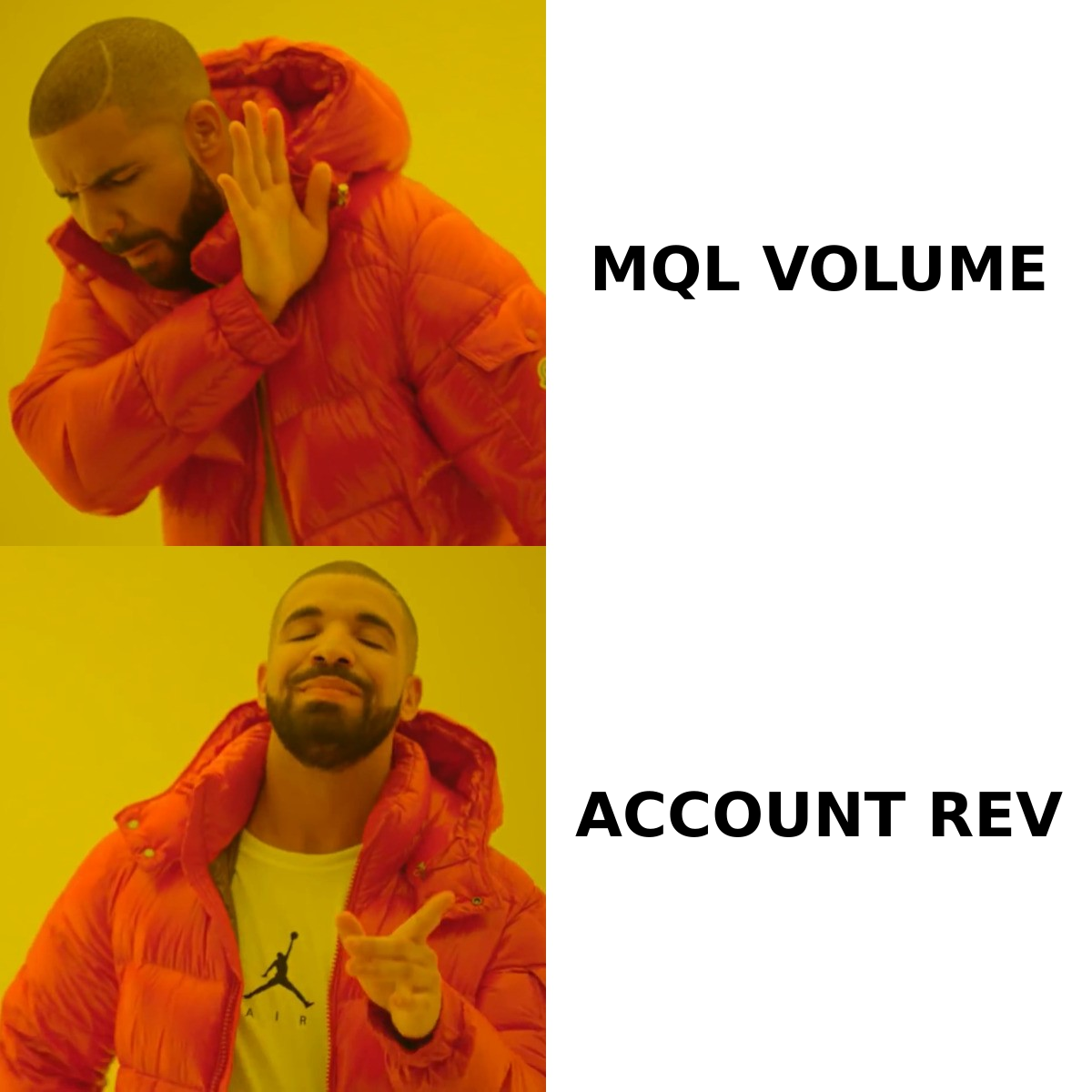
The shift sounds small but it changes everything. A demand-gen team optimizes for MQL volume and cost per lead. An ABM team optimizes for how many target accounts move from cold to engaged to pipeline to closed-won, and how much each one is worth across its lifetime.
If your "ABM goal" still reads like "generate 500 MQLs from the enterprise segment," you have a demand-gen program with an ABM label. Real ABM goals look like: "Open 22 new logos from our top-50 named list at an average ACV of $180K, with a 14-month payback."
Why do so many ABM programs miss their goals?#
Three failure modes show up in almost every postmortem.
The first is goal inheritance. The team imports KPIs from the demand-gen playbook — leads, MQLs, form fills — and slaps them onto a named-account list. The metrics produce numbers but those numbers don't predict revenue. Forrester has been calling this out for years in its B2B revenue waterfall research, and the pattern hasn't changed.
The second is tier confusion. A 1:1 strategic-accounts motion needs deep, personalized creative and probably 12+ touches per buying committee member. A 1:many tech-target motion needs scale and automation. Teams that set one goal across all three tiers always overspend on the wide tier or underinvest on the deep tier.
The third is misaligned data. Marketing scores accounts based on intent and engagement. Sales qualifies based on BANT or MEDDIC. Without a shared definition of "qualified account," the same logo is "hot" to one team and "cold" to the other. That gap quietly kills more ABM programs than budget cuts.
What ABM goals should you actually set?#
Start by separating goals into four layers: account coverage, engagement, pipeline, and revenue. Each layer has 2-3 KPIs that lead into the next.
Layer 1 — Account coverage goals#
Coverage is the percentage of your target account list where you have an active relationship or engagement signal. It answers: are we even on the field?
- Account penetration: % of target accounts where 3+ buying-committee personas are reachable and contacted
- Contact data completeness: % of target accounts with verified email + phone + LinkedIn for key roles
- Multi-thread coverage: average number of contacted personas per account
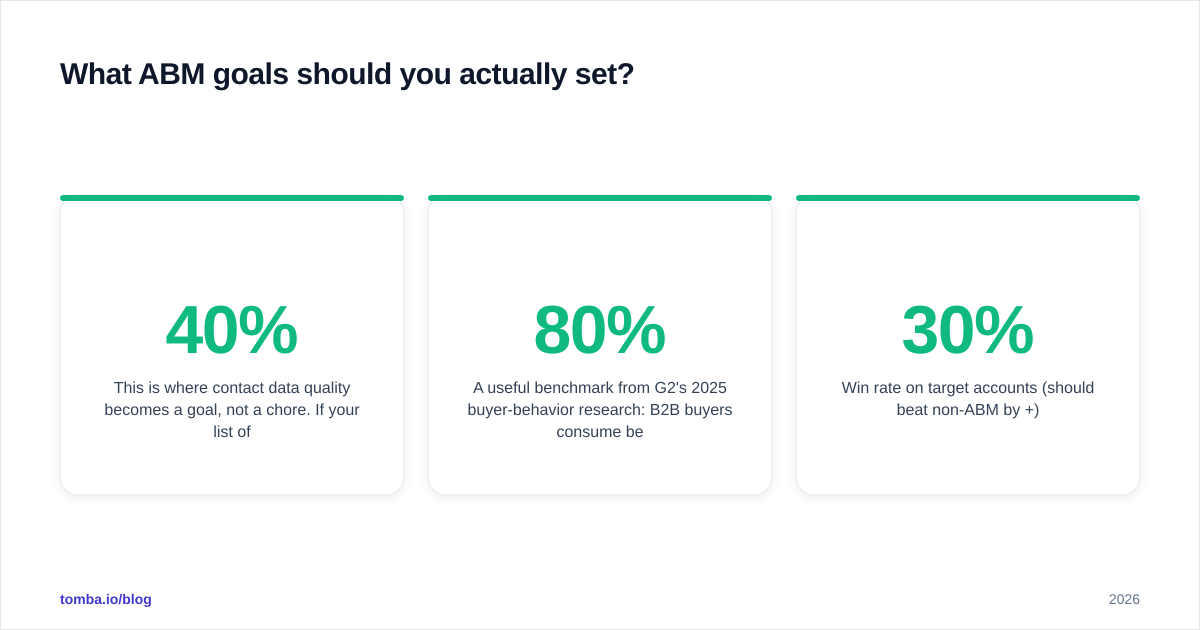
This is where contact data quality becomes a goal, not a chore. If your list of 200 named accounts only has clean contact data for 40% of the buying committee, every downstream metric will be capped. A clean B2B database and an accurate email finder aren't nice-to-haves here — they set the ceiling.
Layer 2 — Account engagement goals#
Engagement is the bridge between coverage and pipeline. Common KPIs:
- Account engagement score: weighted activity from web, email, ads, events, content
- Marketing-qualified account (MQA) rate: % of accounts that cross an engagement threshold
- Surge accounts: accounts with a sudden lift in intent signals month-over-month
A useful benchmark from G2's 2025 buyer-behavior research: B2B buyers consume between 6 and 10 pieces of content before talking to sales. If your engagement goal is "1 visit to the pricing page" you'll declare victory on accounts that are still 80% of the way from buying.
Layer 3 — Pipeline goals#
This is where ABM earns its keep.
- Pipeline coverage: $ pipeline created from target accounts / new-business quota (3x is the floor; 4-5x is healthy)
- MQA-to-opportunity conversion: % of engaged accounts that become opportunities
- Pipeline velocity: ($ opps × win rate) / sales cycle days
- Average deal size from target accounts vs non-target
Layer 4 — Revenue & retention goals#
- Win rate on target accounts (should beat non-ABM by 30%+)
- ACV / deal size lift
- Net revenue retention on accounts acquired through ABM
- CAC payback period
What does a good ABM goal-setting framework look like?#
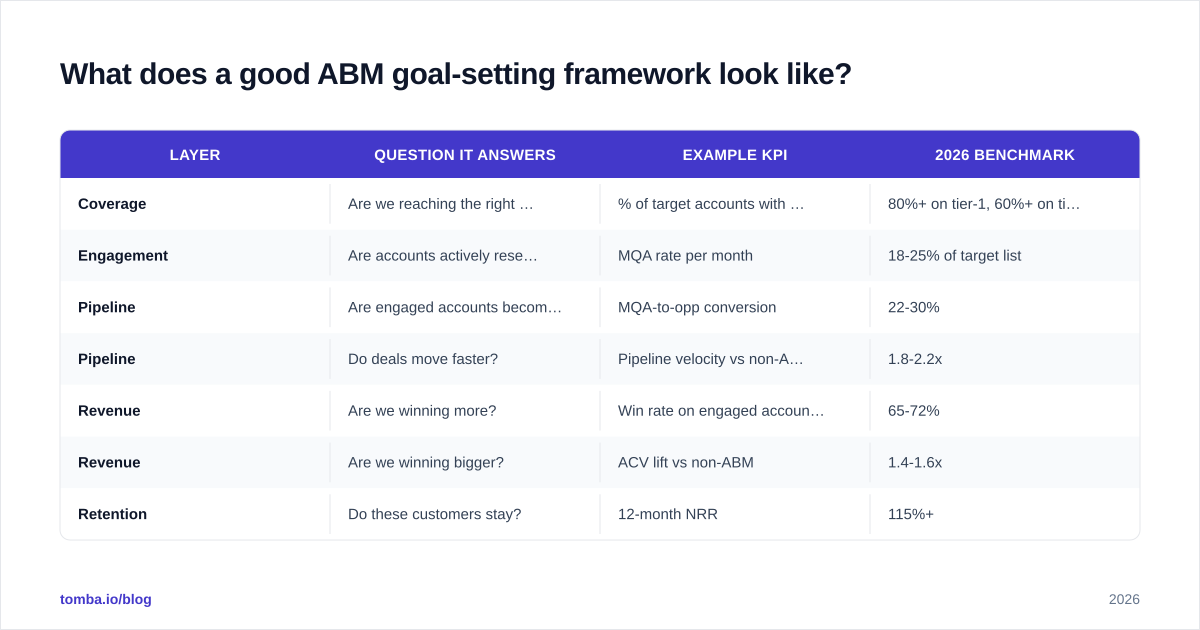
Here is the structure I use on every new ABM rollout. It is not original — variations of it appear in HubSpot's ABM guide, ITSMA's playbook, and most enterprise vendor decks — but the discipline of writing every goal at every layer is what separates programs that hit number from programs that don't.
| Layer | Question it answers | Example KPI | 2026 benchmark |
|---|---|---|---|
| Coverage | Are we reaching the right people? | % of target accounts with 3+ verified contacts | 80%+ on tier-1, 60%+ on tier-2 |
| Engagement | Are accounts actively researching us? | MQA rate per month | 18-25% of target list |
| Pipeline | Are engaged accounts becoming deals? | MQA-to-opp conversion | 22-30% |
| Pipeline | Do deals move faster? | Pipeline velocity vs non-ABM | 1.8-2.2x |
| Revenue | Are we winning more? | Win rate on engaged accounts | 65-72% |
| Revenue | Are we winning bigger? | ACV lift vs non-ABM | 1.4-1.6x |
| Retention | Do these customers stay? | 12-month NRR | 115%+ |
How do you tier accounts and set different goals per tier?#
Three tiers, three different goals.
Tier 1 — Strategic (1:1). Usually 10-50 accounts. Each gets a named campaign, custom landing page, executive sponsor, and a 12-month plan. Goals: 100% coverage, 60%+ engagement, $X new ARR per logo. Volume metrics are useless here.
Tier 2 — Named (1:few). Usually 100-500 accounts grouped by industry, persona, or trigger. Shared creative with light personalization. Goals: 70% coverage, MQA rate, pipeline coverage ratio.
Tier 3 — Programmatic (1:many). Usually 1,000-10,000 accounts that match your ICP. Automation-heavy: ads, intent data, sequences. Goals: cost per engaged account, MQA volume, pipeline contribution.
The mistake is setting the same KPI across all three. "Generate 200 MQAs" makes sense on tier 3 and is meaningless on tier 1, where you want depth, not breadth.
Which KPIs should you actually report on?#
A clean ABM dashboard fits on one screen. Anything more and the leadership team stops reading it.
The nine KPIs that cover most programs:
- Target account list size (with tier breakdown)
- Account coverage % (contacts × accounts)
- Account engagement score / MQA volume
- New opportunities created from target accounts
- Pipeline $ from target accounts
- Pipeline coverage ratio (pipeline ÷ quota)
- Win rate on target accounts vs control
- Average ACV from target vs control
- NRR on ABM-acquired logos (rolling 12 months)
Track them monthly. Review them quarterly with sales leadership. If sales and marketing don't sign the same dashboard, you don't have a dashboard, you have two competing narratives.
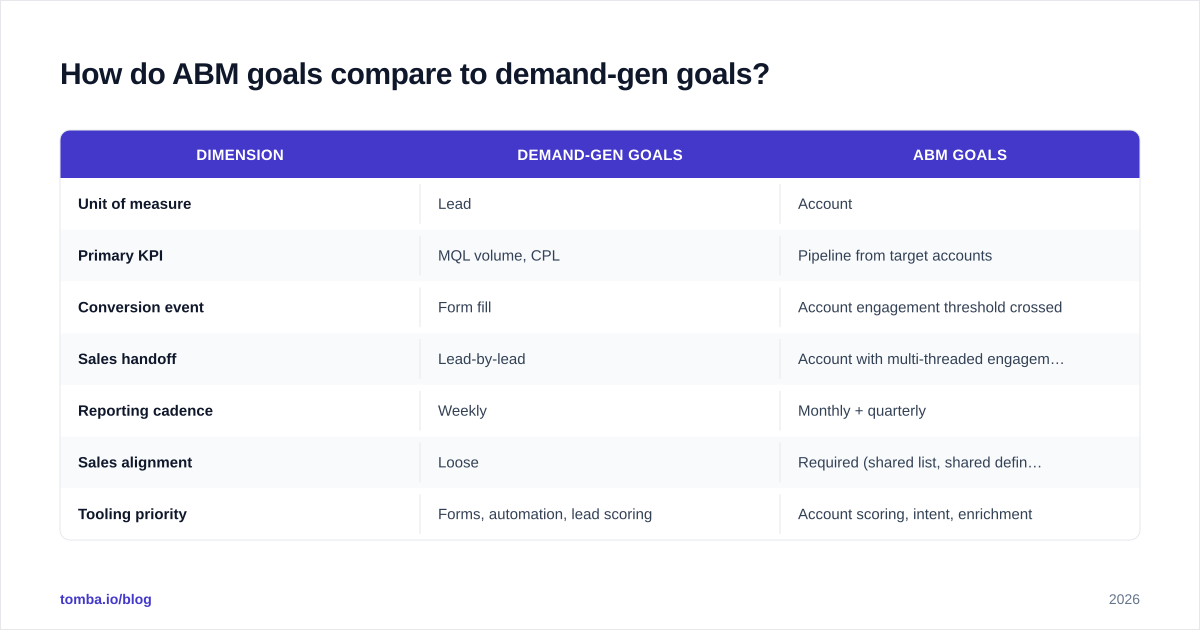
How do ABM goals compare to demand-gen goals?#
| Dimension | Demand-gen goals | ABM goals |
|---|---|---|
| Unit of measure | Lead | Account |
| Primary KPI | MQL volume, CPL | Pipeline from target accounts |
| Conversion event | Form fill | Account engagement threshold crossed |
| Sales handoff | Lead-by-lead | Account with multi-threaded engagement |
| Reporting cadence | Weekly | Monthly + quarterly |
| Sales alignment | Loose | Required (shared list, shared definitions) |
| Tooling priority | Forms, automation, lead scoring | Account scoring, intent, enrichment |
The biggest practical difference: in demand-gen, marketing hands over qualified leads. In ABM, marketing and sales are on the same account from day one. The goal sheet has to reflect that.
What tools do you actually need to hit ABM goals?#
The tooling stack collapses into four jobs:
- ICP and account selection — firmographics + technographics. Clearbit, ZoomInfo, or Apollo for the discovery layer.
- Contact and email data — verified work emails for every persona on your committee. This is where coverage goals live or die. Tomba's domain search plus data enrichment are the cheapest way to fill the contact gaps in a target list.
- Intent and engagement — 6sense, Demandbase, Bombora, G2 buyer intent.
- Activation — sequences, ads, direct mail. Apollo, Outreach, Salesloft, LinkedIn Sales Navigator.
Don't buy the platform first. Set the goals, audit your current data on the target list, then buy the tool that closes the biggest gap. Buyers reverse this order all the time and end up with a $90K/year intent platform feeding an account list with 30% coverage — pouring fuel into an engine with no pistons.
How do you align sales and marketing on shared ABM goals?#
Three contracts make or break the alignment.
The target account list. One list, one source of truth, signed by both teams. No "marketing's tier 1" vs "sales's strategic accounts." If sales drops an account, it leaves the list. If marketing adds one, sales gets a say.
The MQA definition. Engagement threshold, scoring rules, what triggers the handoff, who works it inside what SLA. Write it down. Yes, in a doc. The number of ABM programs running without this written definition is the number of ABM programs underperforming.
The compensation model. Both teams' incentives should pay out on shared revenue from the target list. If marketing's bonus is MQL volume while sales's bonus is closed-won, you are paying them to disagree.
Salesforce's State of Sales reports keep finding the same thing year after year: aligned revenue teams hit quota at roughly 1.3-1.4x the rate of misaligned ones. ABM is the single highest-leverage place to enforce that alignment because the account list forces a conversation.
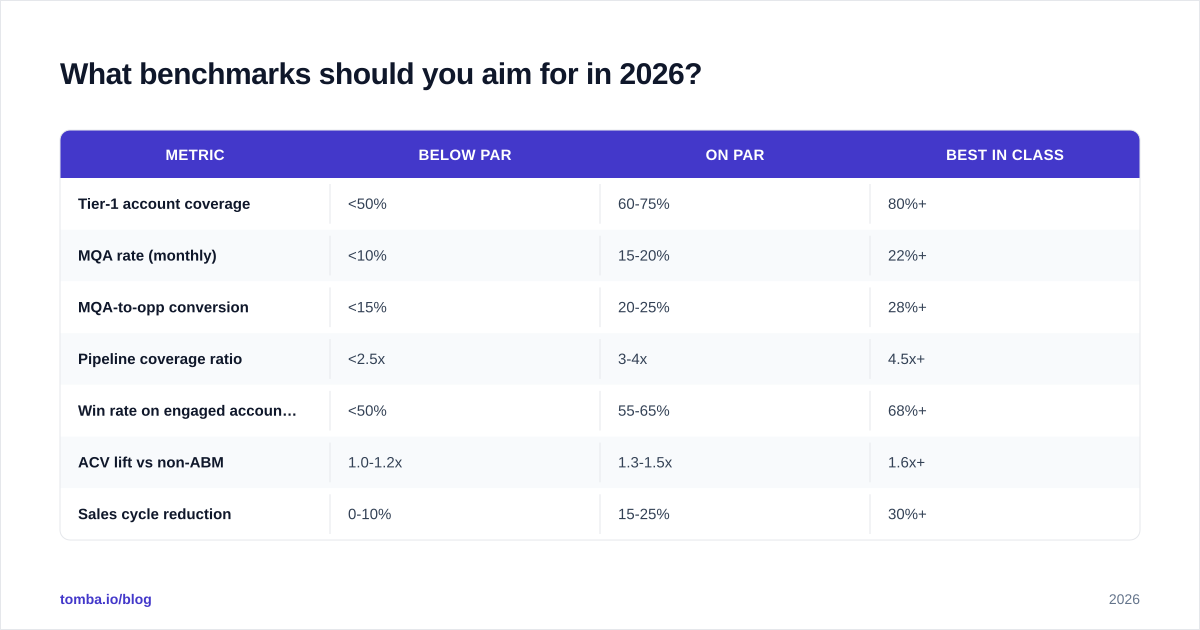
What benchmarks should you aim for in 2026?#
Benchmarks shift with industry, ACV, and sales cycle length, but these are the rough goalposts most B2B teams should aim at this year:
| Metric | Below par | On par | Best in class |
|---|---|---|---|
| Tier-1 account coverage | <50% | 60-75% | 80%+ |
| MQA rate (monthly) | <10% | 15-20% | 22%+ |
| MQA-to-opp conversion | <15% | 20-25% | 28%+ |
| Pipeline coverage ratio | <2.5x | 3-4x | 4.5x+ |
| Win rate on engaged accounts | <50% | 55-65% | 68%+ |
| ACV lift vs non-ABM | 1.0-1.2x | 1.3-1.5x | 1.6x+ |
| Sales cycle reduction | 0-10% | 15-25% | 30%+ |
| 12-month NRR | <105% | 108-114% | 118%+ |
Calibrate to your own baseline. A program that moves win rate from 38% to 51% in a year is doing better than one that holds at 68% because the easy gains were already taken.
How do you avoid the classic ABM goal-setting traps?#
Five traps come up over and over.
- Setting volume goals on a fixed-list strategy. You can't 10x leads from 50 accounts. Set depth goals, not breadth goals, on the small tier.
- Mistaking activity for outcomes. "We ran 12 campaigns" is not a goal. "We opened 18 new opportunities" is.
- Ignoring retention. ABM acquisition is expensive. If NRR is flat, the math never works. Always include a retention KPI.
- Quarterly-only horizon. ABM cycles are 6-18 months on enterprise deals. Holding teams to quarterly pipeline metrics forces short-term tactics that erode the program.
- Treating ABM as a campaign. It is a go-to-market motion. The goals should sit in the revenue operations plan, not the marketing calendar.
How do you operationalize ABM goals without a year-long rebuild?#
A pragmatic 90-day rollout looks like this:
- Days 1-30: Lock the target account list with sales. Audit contact data coverage. Score the gap. Pick the top 3 KPIs you will commit to publicly.
- Days 31-60: Stand up the dashboard. Define MQA. Run a baseline measurement of every benchmark in the table above. Don't try to launch new campaigns yet — measure what already runs.
- Days 61-90: Launch one tier-1 motion and one tier-3 motion in parallel. Report against the three committed KPIs every 2 weeks. Keep one slide showing pipeline coverage; keep another showing engaged-account count.
By day 90 you'll know which gap to close next: data, engagement, conversion, or retention. Most teams find the gap is data — they planned a sophisticated engagement engine on top of a list with 35% contact coverage.
Where Tomba fits in your ABM goal stack#
If your tier-1 and tier-2 account coverage is the bottleneck — and it usually is — start there before you spend a dollar on the activation layer. The Tomba Email Finder lets you pull verified work emails for every persona on a buying committee, in bulk, by domain. Combined with data enrichment for firmographics and role metadata, you can take a 200-account target list from 35% contact coverage to 85% in a few hours instead of a few quarters. That single move is usually worth more pipeline than any new intent tool. Start free with 25 searches a month, scale to 5,000 with the Starter plan, or call the API directly from your ABM platform. Set the goals first; close the coverage gap next; everything else follows.
// get started
Find, verify and enrich your first contacts today
Start on the free plan with 25 searches a month, then scale when your team is ready.
Free plan · No credit card required · GDPR & CCPA
// about the author