15 ABM Landing Page Examples That Convert in 2026
See how 15 account-based marketing teams build landing pages that close six-figure deals. Breakdowns, templates, and a conversion framework for 2026.
15 ABM Landing Page Examples That Convert in 2026
TL;DR
- Account-based landing pages outperform generic demo pages by 3-6x because they replace a stock pitch with the prospect's logo, industry data, and named-buyer messaging.
- The best ABM landing pages in 2026 share five traits: dynamic personalization, a single CTA, social proof from peer companies, executive-level copy, and a fast-loading layout under two seconds.
- 1:1 pages (one URL per target account) beat 1:few pages on win rate but cost more to produce — most teams blend both tiers.
- You don't need a separate CMS. Webflow, Mutiny, RollWorks, Folloze, and PathFactory all let you spin up account-personalized URLs in hours.
- Pair the page with verified contact data — a great landing page is wasted if the ABM list itself is full of bad emails. Tools like the Tomba Email Finder keep target-account contact records clean before the campaign goes live.
What is an ABM landing page?#
An ABM landing page is a destination built for a specific company or a tight cluster of look-alike companies, not for anonymous traffic. Instead of "Welcome — see how our platform helps sales teams," the headline reads "Snowflake, here's how Acme cut your data-onboarding time by 41%." The page name, logo, copy, case studies, and CTA all swap based on which account is visiting.
Two flavors dominate:
- 1:1 pages — one URL per named target account. Used for Tier 1 deals worth $100k+ ACV.
- 1:few pages — one template that re-skins for an industry cluster or a list of 10-50 logos (e.g., "FinTech Series B" or "Mid-Market HR Tech").
The mechanism is simple. When the sales team identifies a target, marketing publishes a page in 1-3 days, the SDR sends a direct link in a personalized email, and the prospect lands on a page that already speaks to their stack, their peers, and their KPI.
For a refresher on the broader category, see Gartner's account-based marketing definition and HubSpot's ABM guide.
Why do ABM landing pages convert better than generic demo pages?#
Three reasons keep showing up in the data ITSMA, Forrester, and Demandbase publish each year:
- Relevance compounds. A prospect who sees their own logo and a peer case study on the hero scrolls 2x further than one staring at a stock illustration.
- Buying committees self-qualify. When the CFO sees finance-specific ROI numbers and the VP of Eng sees integration architecture on the same page, fewer "let me loop in my colleague" delays kill momentum.
- The CTA is the only path forward. Generic pages offer nav links, blog teasers, and pricing tabs. ABM pages strip everything except "Book a call with [SDR name]." Decision fatigue drops; click-through climbs.
What are the 15 best ABM landing page examples in 2026?#
Below is a teardown of the pages I keep referencing when consulting with B2B marketing teams. Each one solves a different problem — personalization at scale, executive trust-building, technical depth, or pipeline acceleration.
1. Snowflake — partner co-branded pages#
Snowflake's data partner pages (snowflake.com/partners/[partner-slug]) are essentially 1:few ABM templates. Each one swaps the partner logo, integration architecture diagram, and joint customer quote. The hero answers one question: "What does Snowflake plus [partner] do for me?" Conversion lift on these pages reportedly sits 4-5x above their generic demo page.
2. Drift — account-personalized "Welcome [Company]" pages#
Drift was the original poster child for this play. The page renders the prospect's logo in the hero band, pulls the prospect's industry into the headline, and routes the chatbot to the named SDR. Even though Drift was acquired by Salesloft, the pattern lives on across modern conversational platforms.
3. Terminus — "How we'd run ABM for [Account]" microsites#
Instead of a one-pager, Terminus published mini-strategy decks as landing pages — a recorded Loom, a sample campaign architecture, and three peer logos at the bottom. The CTA is a calendar link to the AE, not a generic "request demo."
4. Gong — industry-specific revenue intelligence pages#
Gong runs separate landing pages for SaaS sales orgs, financial services, and manufacturing. Each one swaps stats ("Companies like yours close 27% more deals"), screenshots of relevant playbooks, and named customers from that vertical.
5. 6sense — predictive scoring teardown pages#
6sense uses pages that pull in the visiting company's own predictive score from their data and display a custom "Here's how we'd help your team" report. Borderline magical the first time you see it.
6. Salesforce — Customer 360 industry hubs#
Each Salesforce Industries hub (salesforce.com/industries/[vertical]) is technically a 1:many ABM page. The retail hub speaks only to retail KPIs. The healthcare hub talks HIPAA from the first sentence. Page-level CTAs route to vertical AEs.
7. HubSpot — "Apps for [Industry]" comparison pages#
HubSpot's app marketplace serves up vertical-specific app bundles as landing pages. The pricing and ROI calculator on each one auto-fills based on the visitor's company size pulled from enrichment data.
8. Demandbase — 1:1 deal rooms#
Demandbase has popularized the "deal room" — a private URL with the prospect's logo, the AE's video intro, a custom ROI sheet, and shared docs. It's a landing page that doubles as a buying-committee workspace.
9. Mutiny — competitor swap pages#
Mutiny famously runs pages like "Why [Competitor]'s customers move to Mutiny." The headline, screenshots, and migration timeline all swap based on which competitor's IP range or campaign UTM landed there.
10. Outreach — sales playbook download gates#
Outreach gates industry-specific cold email playbooks behind a short form. The page changes based on whether you're SaaS, FinServ, or manufacturing — same template, three personalities.
11. ZoomInfo — account-intent reveal pages#
ZoomInfo shows the visiting account a personalized "Here's the intent signal trail your team is leaving across the web" page. Heavy data theater, but it works for enterprise buyers.
12. Apollo — 1:few mid-market pages#
Apollo runs a series of "X-person sales team starter pack" pages. The headline auto-detects company size and swaps the recommended package.
13. Clearbit (now HubSpot) — reveal-based copy swap#
Clearbit's own marketing site historically swapped the hero copy based on the firmographic data they revealed about the visitor. Same product page, different headline for a 200-person SaaS than for a 5,000-person bank.
14. RollWorks — campaign-specific microsites#
RollWorks templated 1:few campaign microsites — one for each Tier 2 cluster. Each one has a 90-second product video, a peer logo wall, and an SDR direct-book CTA.
15. Folloze — content board landing pages#
Folloze pages aren't really pages; they're curated content boards that look like one. A buying committee at the prospect company can see the same persona-tagged content with their logo at the top. Engagement scores roll up to the AE in real time.
What do the best ABM landing pages have in common?#
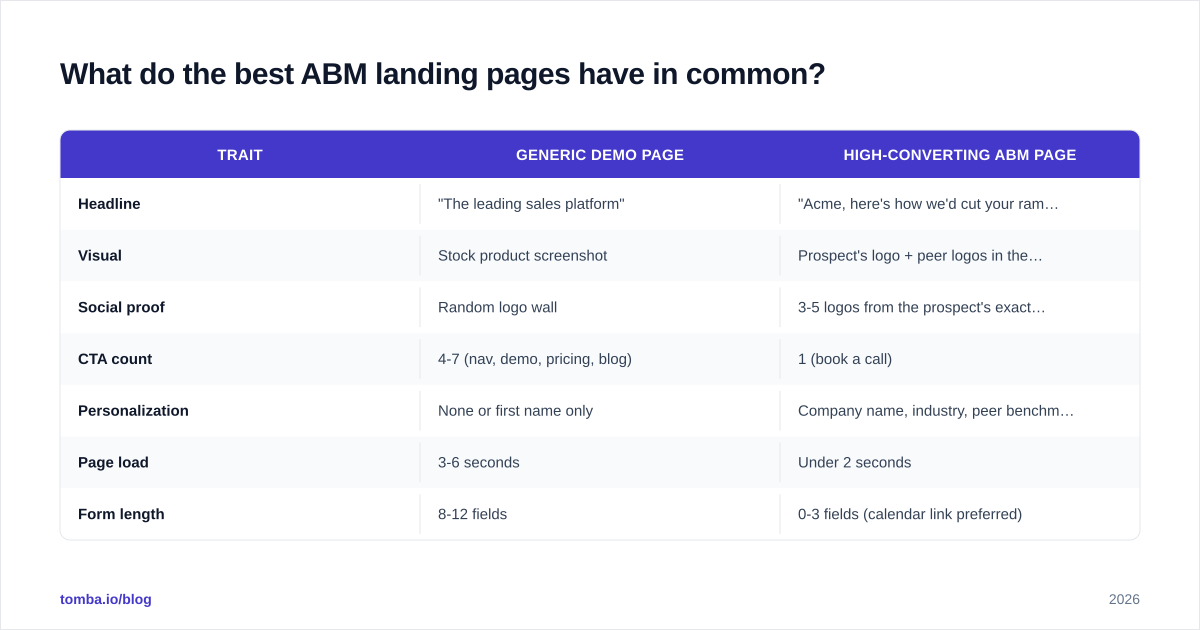
After studying the 15 above plus another 30 I've audited for clients, the same five traits keep appearing:
| Trait | Generic Demo Page | High-Converting ABM Page |
|---|---|---|
| Headline | "The leading sales platform" | "Acme, here's how we'd cut your ramp time 41%" |
| Visual | Stock product screenshot | Prospect's logo + peer logos in their industry |
| Social proof | Random logo wall | 3-5 logos from the prospect's exact segment |
| CTA count | 4-7 (nav, demo, pricing, blog) | 1 (book a call) |
| Personalization | None or first name only | Company name, industry, peer benchmarks |
| Page load | 3-6 seconds | Under 2 seconds |
| Form length | 8-12 fields | 0-3 fields (calendar link preferred) |
The headline test is the simplest gut check: read the H1 aloud. If you could swap your competitor's name in and the sentence still works, the headline isn't ABM enough.
How do you build an ABM landing page in 2026?#
Five steps. None of them require an engineering ticket.
Step 1 — Lock the target account list#
Before you touch a page builder, the target list has to be clean. That means verified emails, real firmographic data, and current job titles. A landing page sent to a list with 30% bounce rate burns your sender domain and the campaign. Most teams use a tool like the Tomba Email Finder or run their CRM through an email verifier before launch.
Step 2 — Pick a personalization layer#
You don't need a new CMS. The four common approaches:
- Mutiny / RB2B / Intellimize — JavaScript snippet on your existing page that swaps text and images based on reverse-IP firmographic data.
- Webflow + CMS items — one template, one CMS row per account, dynamic URLs.
- Folloze / PathFactory / Uberflip — purpose-built ABM content experiences with built-in analytics.
- Hand-rolled Next.js + Vercel — for engineering-heavy teams, a single page with
getStaticPropsper account slug.
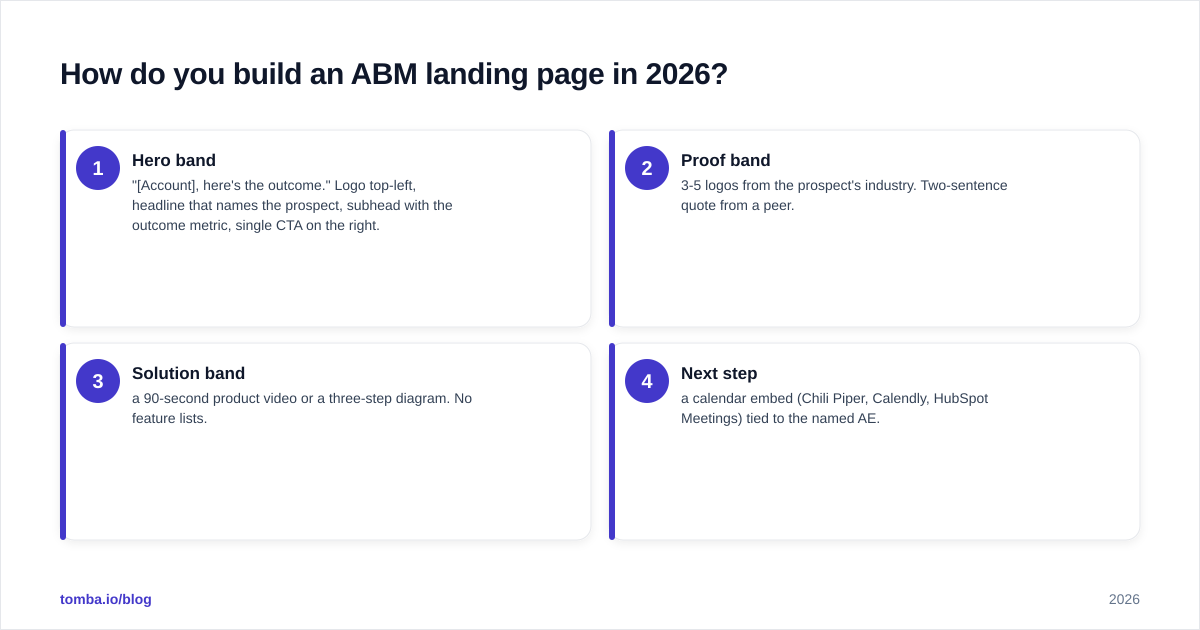
Step 3 — Write the four blocks every page needs#
- Hero band — "[Account], here's the outcome." Logo top-left, headline that names the prospect, subhead with the outcome metric, single CTA on the right.
- Proof band — 3-5 logos from the prospect's industry. Two-sentence quote from a peer.
- Solution band — a 90-second product video or a three-step diagram. No feature lists.
- Next step — a calendar embed (Chili Piper, Calendly, HubSpot Meetings) tied to the named AE.
Step 4 — Wire up tracking#
Per-page UTM, IP reveal (RB2B, Vector, or Tomba's website visitor reveal), and a Slack/Teams alert when a target-account visitor lands. Sales should know within five minutes when a Tier 1 prospect hits the page.
Step 5 — Pair with sequenced outbound#
The page only works if the prospect actually opens the link. That means a tight cold email or LinkedIn sequence. If you're still building outreach, see Tomba's cold email templates and the LinkedIn outreach glossary entry for working sequences.
Which ABM landing page tools should you compare?#
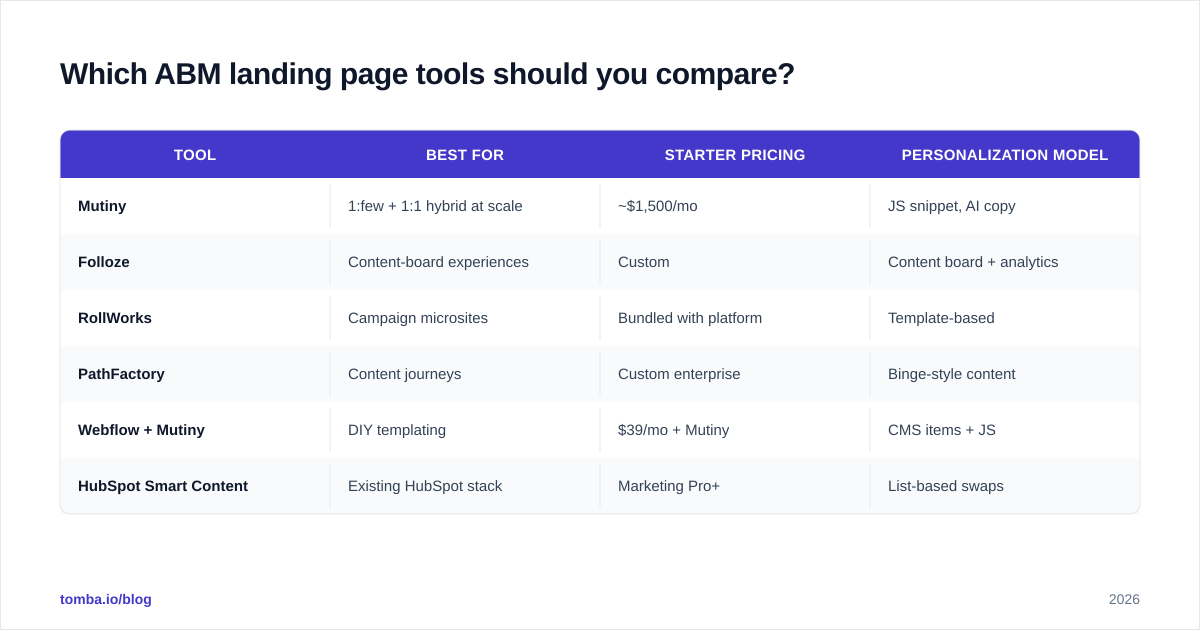
Most teams pick from this shortlist. Pricing as of early 2026 — confirm directly:
| Tool | Best for | Starter pricing | Personalization model |
|---|---|---|---|
| Mutiny | 1:few + 1:1 hybrid at scale | ~$1,500/mo | JS snippet, AI copy |
| Folloze | Content-board experiences | Custom | Content board + analytics |
| RollWorks | Campaign microsites | Bundled with platform | Template-based |
| PathFactory | Content journeys | Custom enterprise | Binge-style content |
| Webflow + Mutiny | DIY templating | $39/mo + Mutiny | CMS items + JS |
| HubSpot Smart Content | Existing HubSpot stack | Marketing Pro+ | List-based swaps |
Independent reviews are on G2's ABM software category and Forrester's ABM Wave report. Skip vendor-only comparison pages.
What KPIs prove your ABM landing page is working?#
Stop obsessing over conversion rate alone. Better signals:
- Target-account visit rate — what percentage of your named list actually loaded the page?
- Buying-committee depth — how many unique people from one account viewed the page?
- Meeting-set rate — of visitors, how many booked time with the AE?
- Pipeline created per page — divide page traffic by sourced pipeline dollars.
- Sales-cycle compression — did deals touched by an ABM page close faster than untouched ones?
A page hitting 8% raw conversion but only attracting 10 visitors a month is worth less than a 2% page hitting 500 named-account visits. Volume of the right traffic matters more than rate.
Common mistakes that kill ABM landing pages#
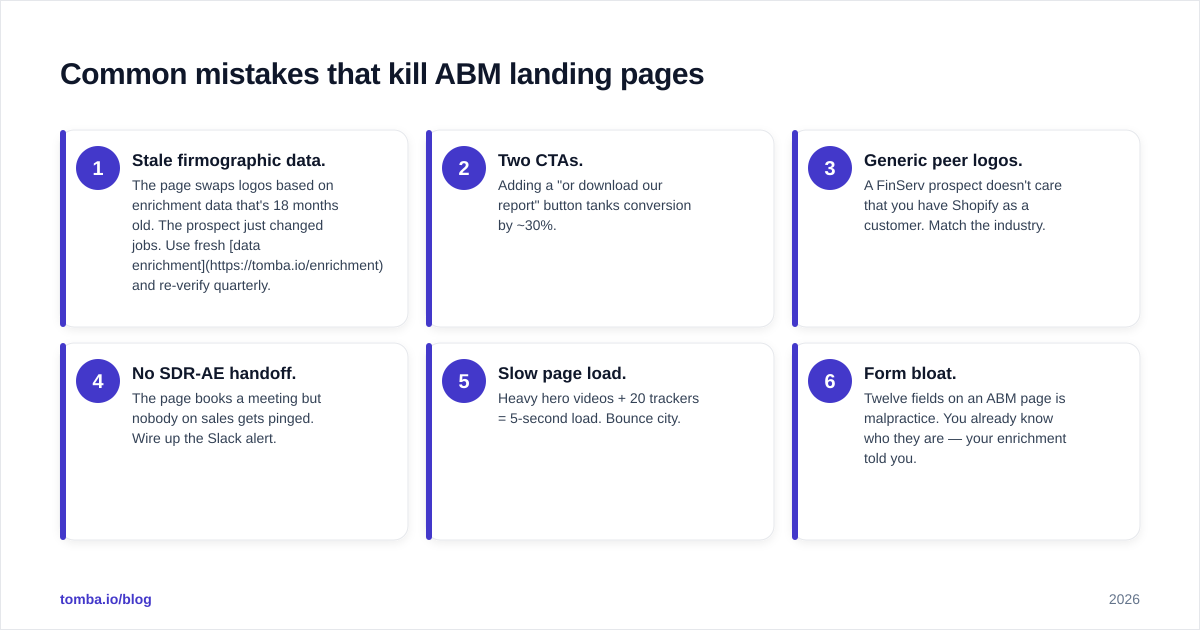
I see the same six issues during audits:
- Stale firmographic data. The page swaps logos based on enrichment data that's 18 months old. The prospect just changed jobs. Use fresh data enrichment and re-verify quarterly.
- Two CTAs. Adding a "or download our report" button tanks conversion by ~30%.
- Generic peer logos. A FinServ prospect doesn't care that you have Shopify as a customer. Match the industry.
- No SDR-AE handoff. The page books a meeting but nobody on sales gets pinged. Wire up the Slack alert.
- Slow page load. Heavy hero videos + 20 trackers = 5-second load. Bounce city.
- Form bloat. Twelve fields on an ABM page is malpractice. You already know who they are — your enrichment told you.
When should you NOT use an ABM landing page?#
ABM pages cost more than generic pages to build and maintain. Skip them when:
- ACV is under $5k — the math doesn't work.
- The buying cycle is under two weeks — there's no time to nurture.
- You can't verify contact data before launch — bad data poisons the campaign.
- You don't have a named SDR/AE pairing per account — there's no one to follow up.
For SMB-velocity motions, a strong generic page with a chat widget will out-perform a half-baked ABM stack.
Ship the page, then ship the list#
A beautiful ABM landing page sent to a list of bounced emails is wasted spend. Before you publish your next 1:1 microsite, run the target-account list through a verifier and re-find the contacts who moved jobs. Tomba's Email Finder pulls verified business emails by domain and name in one API call, and the bulk email finder handles the full list in minutes. Start free at tomba.io/pricing — the free tier covers a first ABM pilot, and the $49/mo Starter plan covers most mid-market campaigns.
Build the page, verify the list, and let the right person land on the right URL.
// get started
Find, verify and enrich your first contacts today
Start on the free plan with 25 searches a month, then scale when your team is ready.
Free plan · No credit card required · GDPR & CCPA
// about the author