ABM Lead Generation in 2026: The Complete Playbook
Account-based marketing flipped the lead-gen funnel on its head. Here's how modern revenue teams build target account lists, orchestrate plays, and measure pipeline impact in 2026.
ABM Lead Generation in 2026: The Complete Playbook
Most B2B teams still confuse account-based marketing with "personalized email blasts to a bigger list." That's why their pipeline looks the same as it did three years ago. Real ABM lead generation reverses the funnel: you pick the accounts first, then engineer demand inside them. This guide breaks down how the discipline actually works in 2026, what the stack looks like, and where lead-gen teams keep tripping over the same execution mistakes.
TL;DR#
- ABM lead generation starts with a named account list (50-500 companies), not a buyer persona.
- The unit of measurement is accounts engaged and pipeline created, not MQLs.
- Modern programs blend intent data, contact enrichment, multi-channel plays, and sales triggers into a single orchestrated motion.
- A working stack in 2026 needs four layers: data, signal, activation, and measurement.
- Most failures aren't strategy problems — they're data quality and sales-marketing alignment problems.
What is ABM lead generation, really?#
Traditional lead generation is a fishing trawler: cast a wide net, sort the catch, throw most of it back. Account-based marketing is spearfishing: you pick the fish, then design the spear.
In practice, ABM lead generation means three things working together:
- A target account list built from ICP fit and buying signals, not job-title filters
- Coordinated plays across email, ads, LinkedIn, direct mail, and SDR outbound aimed at the same accounts at the same time
- Sales and marketing measured on the same number — pipeline sourced and influenced inside those accounts
The shift is philosophical before it's tactical. Your form fills go down. Your meetings with priority accounts go up. CFOs stop asking "where did this MQL come from?" and start asking "are we in the deal cycle at the accounts we said mattered?"
How is ABM different from traditional demand generation?#
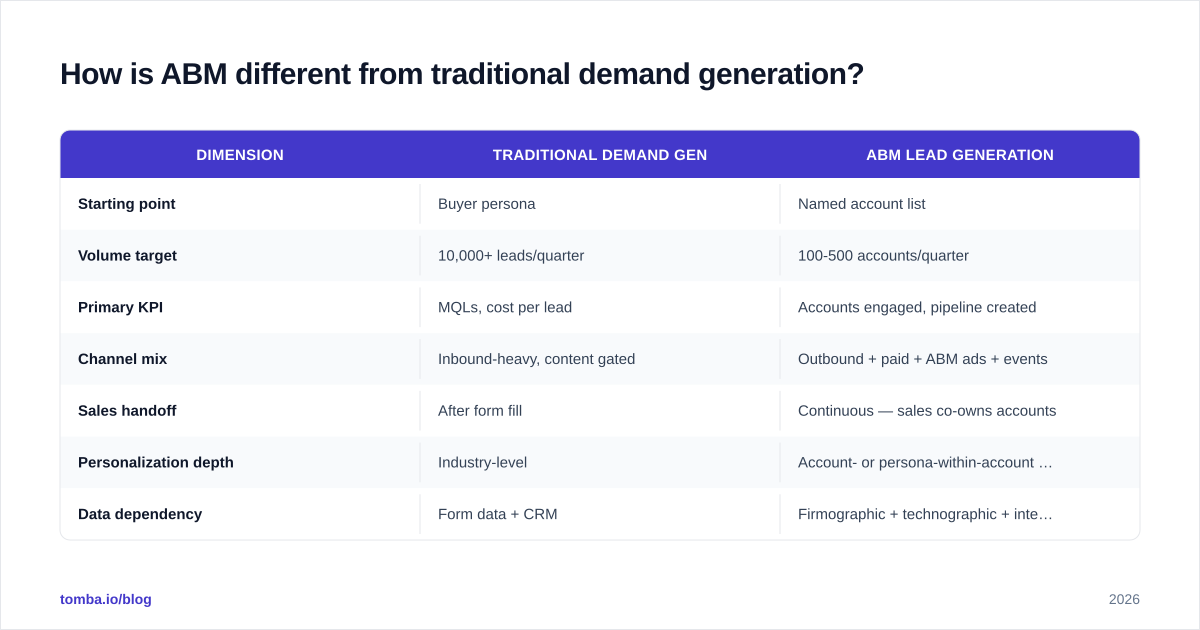
The two approaches share tactics — emails, content, ads — but optimize for entirely different outcomes. The table below makes the contrast concrete.
| Dimension | Traditional Demand Gen | ABM Lead Generation |
|---|---|---|
| Starting point | Buyer persona | Named account list |
| Volume target | 10,000+ leads/quarter | 100-500 accounts/quarter |
| Primary KPI | MQLs, cost per lead | Accounts engaged, pipeline created |
| Channel mix | Inbound-heavy, content gated | Outbound + paid + ABM ads + events |
| Sales handoff | After form fill | Continuous — sales co-owns accounts |
| Personalization depth | Industry-level | Account- or persona-within-account level |
| Data dependency | Form data + CRM | Firmographic + technographic + intent |
| Avg deal size impact | Flat or slight lift | 30-40% larger (per Forrester) |
| Sales cycle | Often longer | Compressed when targeting fits |
The bottom of that table — deal size and cycle length — is why CFOs sign off on ABM budgets even when MQL volume drops. You're trading raw lead count for pipeline value per touch.
What does the ABM lead generation tech stack look like in 2026?#
You don't need 30 tools. You need one tool that does each of these four jobs well, then integrations that make them feel like one product.
Layer 1 — Account and contact data#
This is the foundation. Bad data means your "personalization" is a Mail Merge with the wrong company name. You need:
- A B2B database for firmographic and contact data
- An email finder and email verifier to keep deliverability above 95%
- Data enrichment on inbound and CRM records to fill the gaps your forms don't capture
If your CRM still has 40% of records missing job title or company size, ABM scoring is dead on arrival. Fix the data layer before you buy a single ad.
Layer 2 — Intent and signal#
Intent data tells you which accounts are researching solutions like yours right now. The leading providers — 6sense, Bombora, G2, Demandbase — each pull from different surface areas (third-party publisher networks, review sites, your own site behavior, ad engagement).
Stack at least two signal sources so you triangulate rather than guess. A single intent provider will tell you 200 accounts are "surging" — most are noise.
Layer 3 — Activation channels#
Where do you actually reach the accounts? Modern ABM programs use 4-6 channels per play:
- LinkedIn ads (account targeting)
- Display retargeting (RollWorks, Demandbase, Metadata)
- Cold email (sequenced through Outreach, Salesloft, Apollo, or Instantly)
- SDR outbound calls
- Direct mail / gifting (Sendoso, Reachdesk)
- Webinars and curated events
Layer 4 — Measurement#
You need a single dashboard that shows account-level engagement, not channel-level vanity metrics. The questions it must answer:
- Which target accounts have engaged in the last 30 days?
- Which of those have an open opportunity?
- What's pipeline velocity inside the named list vs. outside?
How do you build a target account list that doesn't fall apart in 90 days?#
The biggest mistake teams make is treating the named account list like a static spreadsheet. It's a living asset.
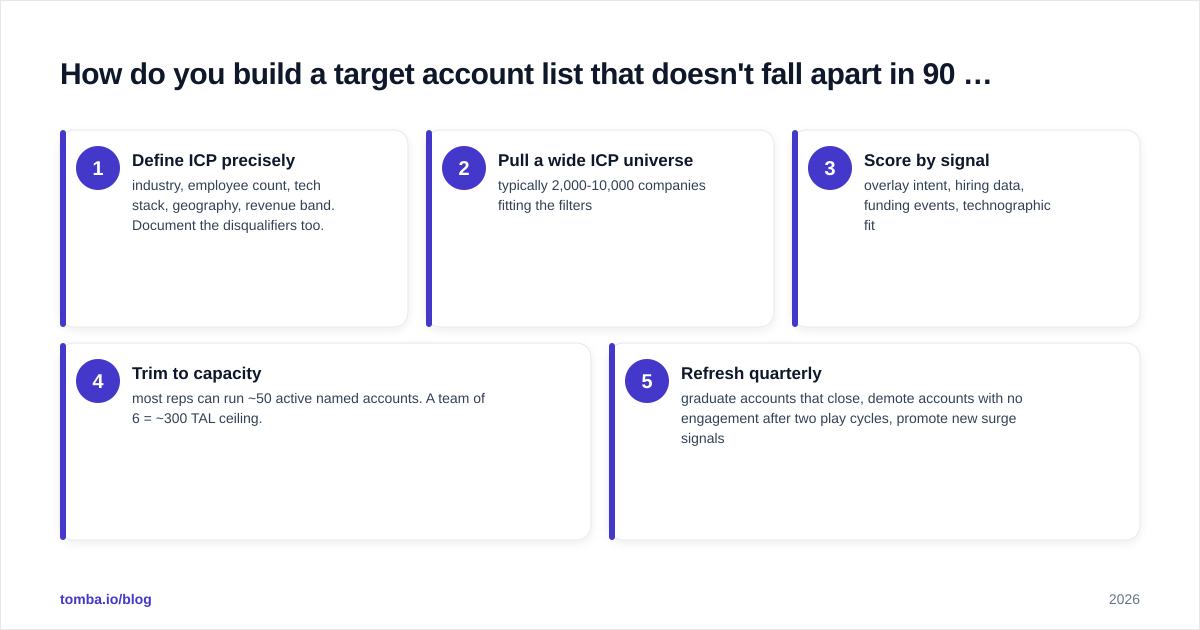
A solid TAL build in 2026 follows five steps:
- Define ICP precisely — industry, employee count, tech stack, geography, revenue band. Document the disqualifiers too.
- Pull a wide ICP universe — typically 2,000-10,000 companies fitting the filters
- Score by signal — overlay intent, hiring data, funding events, technographic fit
- Trim to capacity — most reps can run ~50 active named accounts. A team of 6 = ~300 TAL ceiling.
- Refresh quarterly — graduate accounts that close, demote accounts with no engagement after two play cycles, promote new surge signals
HubSpot's research shows account lists refreshed quarterly outperform static annual lists by roughly 2x in pipeline contribution. Don't skip the refresh ritual.
If you're building the list inside your CRM, a bulk email finder and domain search shortcut the contact discovery for each named account — typically 5-15 buying committee members per company.
What kind of plays actually move pipeline?#
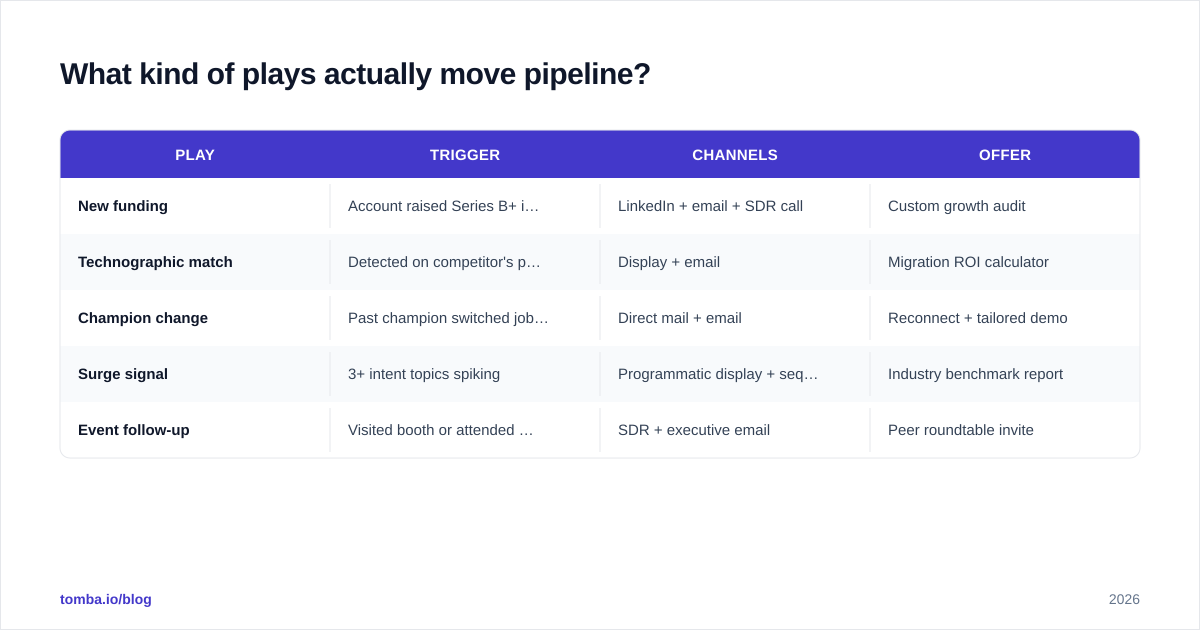
Plays are the unit of execution. Each play targets a defined account segment, runs across 2-4 channels, has a clear offer, and a measurable goal.
Five plays that consistently work in 2026:
| Play | Trigger | Channels | Offer |
|---|---|---|---|
| New funding | Account raised Series B+ in last 60 days | LinkedIn + email + SDR call | Custom growth audit |
| Technographic match | Detected on competitor's product | Display + email | Migration ROI calculator |
| Champion change | Past champion switched jobs to a TAL account | Direct mail + email | Reconnect + tailored demo |
| Surge signal | 3+ intent topics spiking | Programmatic display + sequenced email | Industry benchmark report |
| Event follow-up | Visited booth or attended webinar | SDR + executive email | Peer roundtable invite |
Build a library. Run 2-3 plays simultaneously. Measure response rate per play, not per channel.
Where does intent data actually fit?#
Intent data is the most over-sold and under-implemented part of the ABM stack. Two ground rules separate teams that get value from those that burn budget.
Ground rule 1: Intent without identity resolution is just charts. Knowing "someone at acme.com is researching CRMs" only matters if you can identify who, plug them into a sequence, and put them in front of your AE. A reverse email lookup plus LinkedIn finder workflow closes the gap between anonymous signal and named buying committee.
Ground rule 2: Intent decays in days, not weeks. If your operations process takes 14 days from signal-fire to SDR call, the account has already shortlisted vendors. The play needs to fire within 24-72 hours.
According to Gartner, B2B buyers complete 70% of their evaluation before talking to a vendor. Intent data is your only window into that 70%.

How do you measure ABM lead generation?#
Throw out the MQL goal. Replace it with these five metrics:
- Account coverage — % of TAL with at least one known contact engaged in the last 90 days
- Pipeline contribution — $ of pipeline sourced from named accounts as % of total
- Account velocity — average days from first engagement to closed-won inside TAL vs. outside
- Average deal size lift — TAL deals vs. non-TAL deals
- Multi-threading depth — average number of engaged contacts per opportunity
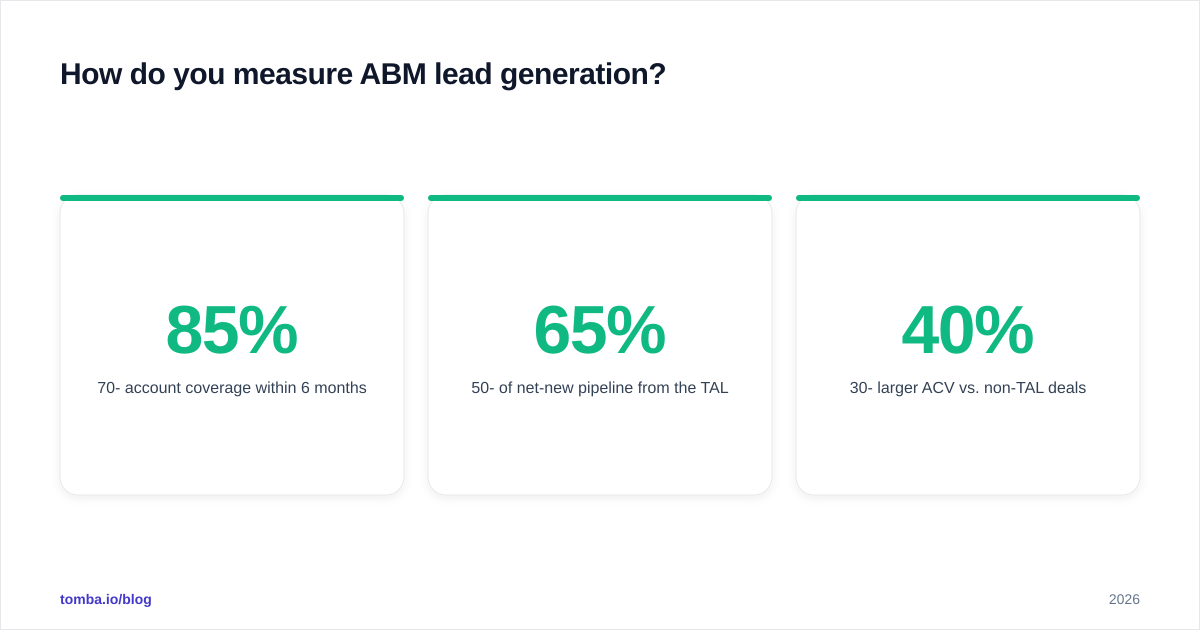
A healthy program in 2026 typically lands at:
- 70-85% account coverage within 6 months
- 50-65% of net-new pipeline from the TAL
- 30-40% larger ACV vs. non-TAL deals
- 4-6 engaged contacts per opportunity
If your numbers are well off these benchmarks, the bottleneck is almost always one of three things: list quality, sales-marketing handoff timing, or contact data freshness.
Where do most ABM lead generation programs fail?#
Same five reasons, every time:
- Personas instead of accounts. The team launches what they call "ABM" but it's still a persona play with a smaller list. No named-account orchestration.
- Sales not in the room during list build. AEs disown a list they didn't help build. Co-create the TAL.
- Channels run in silos. Paid runs LinkedIn, SDRs run cold email, content publishes blog posts — nothing is timed together. The buyer sees noise, not a campaign.
- Data rot. Studies referenced on G2 put B2B contact data decay at roughly 30% per year. If you're not enriching and re-verifying quarterly, half your TAL is unreachable by month nine.
- Vanity dashboards. Engagement scores nobody acts on. The right dashboard is the one your CRO opens every Monday.
Fix data and alignment before you spend on a new channel. Always.
What role does email play in an ABM motion?#
Email isn't the whole motion, but it's the connective tissue. Three uses dominate:
- 1:1 sequenced outbound to named buying committee members
- 1:few nurture keyed to play triggers (funding, tech change, champion move)
- Re-engagement when an account goes cold for 60+ days
For all three, deliverability is the gate. The cleanest sequence in the world fails if your sending domain has a sender reputation issue or your list has 8% bounces.
Verify contacts before sending. Warm new sending domains for 30+ days. Keep bounce rates under 2% by running every list through an email verifier before send.
How do you ramp ABM from zero in 90 days?#
A realistic 90-day rollout looks like this:
| Days | Milestone |
|---|---|
| 1-14 | Sales + marketing co-build the ICP and pull the wide list |
| 15-30 | Enrich, verify, and score; lock the first 100 named accounts |
| 31-45 | Build the first 2 plays end-to-end; instrument measurement dashboards |
| 46-60 | Launch plays; daily standups between SDR + marketing |
| 61-75 | Iterate on play performance; refresh TAL with intent data |
| 76-90 | Quarterly business review; promote what worked, kill what didn't |
By day 90 you should have first-meeting data on at least 30% of the TAL. If you don't, the problem is execution cadence, not strategy.
Final take — what to do this quarter#
ABM lead generation is a discipline, not a product. The tools matter less than the operating rhythm. Get sales and marketing in the same room weekly, run plays that fire on real signal, measure pipeline not MQLs, and refresh data quarterly.
If you're rebuilding your stack and need clean contact data to feed the rest of it, start with the Tomba Email Finder. Find verified buying-committee contacts inside your named accounts, push them into your sequencer, and let the rest of your ABM stack do its job. The free tier (25 searches/mo) is enough to test a list of 5-10 target accounts before you commit. See full Tomba pricing for scaling up.
Ready to find emails that actually work?
Join 150,000+ professionals who stopped guessing and started sending. Free credits on signup — no credit card required.
Get the Tomba newsletter
Practical outbound tactics and product updates — once every two weeks.
About the author