ABM Lead Scoring in 2026: The Complete Account-Based Guide
Traditional lead scoring punishes ABM teams. Here's how to score accounts and buying groups in 2026 — with a working model, weights, and tools that won't waste your SDRs' time.
ABM Lead Scoring in 2026: The Complete Account-Based Guide
TL;DR
- Traditional lead scoring rewards individual form-fills; ABM lead scoring rewards the account and the buying group around it.
- A working 2026 model blends three layers: fit (firmographic + technographic), intent (third-party + first-party signals), and engagement (multi-threaded activity across the buying committee).
- Most teams fail because they score people instead of accounts, weight demographics too heavily, and let MQL volume targets override account quality.
- The right stack is a CRM, an intent-data source, an enrichment layer, and a contact discovery tool — not a $60K/year ABM platform on day one.
- Recalibrate your model every quarter. Win-rate by score band is the only metric that matters; if it isn't monotonic, your weights are wrong.
If you're running account-based marketing in 2026 and still using a lead-scoring model designed in 2014, your SDRs are calling the wrong people and your AEs are working the wrong accounts. This guide rebuilds the model from scratch.
What is ABM lead scoring and why does it differ from traditional lead scoring?#
Traditional lead scoring asks one question: "How likely is this individual to buy?" It assigns points for job titles, downloaded eBooks, and webinar attendance, then routes anyone over a threshold to sales as a marketing qualified lead.
ABM lead scoring asks a different question: "How likely is this account to buy, and which people inside it should we engage?" The unit of scoring shifts from the individual to the account, and a layer of buying-group scoring sits on top.
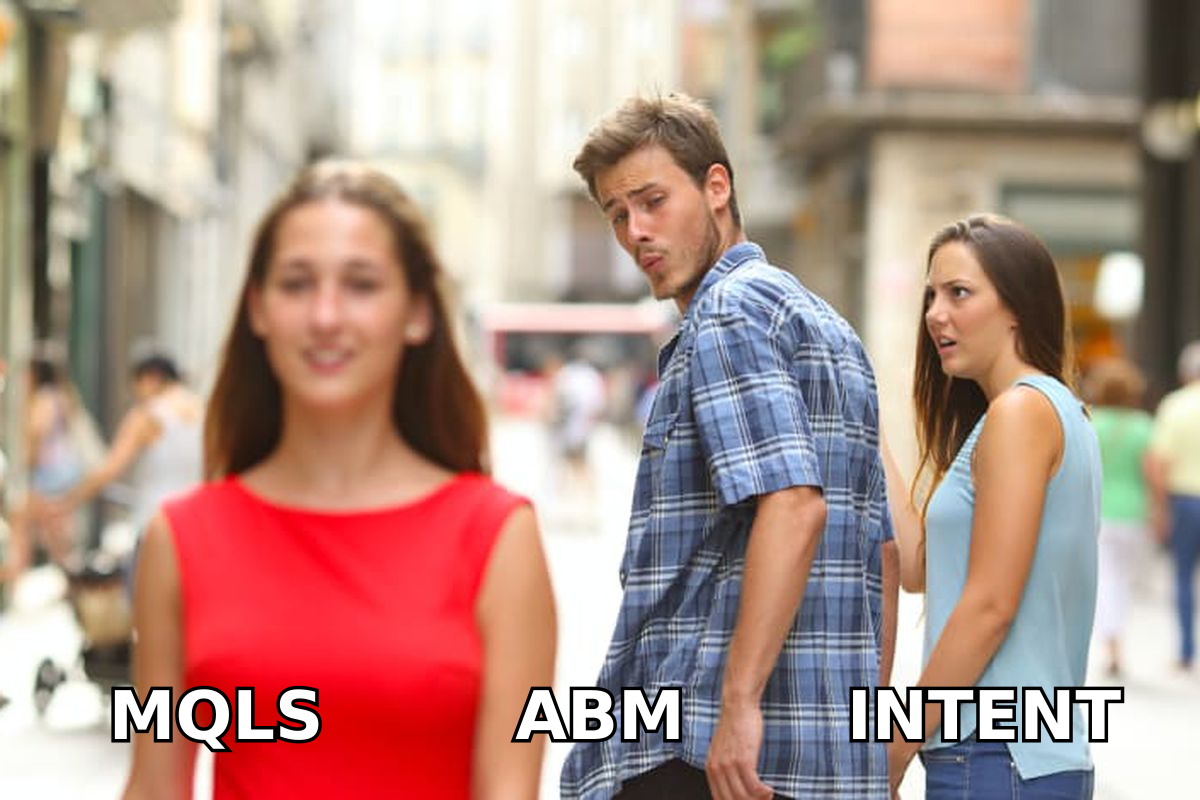
Think of traditional scoring like a dating app — it ranks individuals one by one. ABM scoring is more like scouting an entire company's basketball team: you're evaluating the roster, the chemistry, and which players are actually on the court this quarter.
The implications are concrete:
- A VP of Engineering downloading a PDF doesn't matter if nobody else at the account is showing intent.
- Three mid-level managers from the same target account engaging across two channels may matter more than one C-suite contact at a non-ICP company.
- Disqualifying signals (wrong industry, wrong size, recent churn) should zero out the account, not just deduct points.
According to Gartner research on B2B buying behavior, the average enterprise purchase now involves 6 to 10 stakeholders. Scoring one of them in isolation gives you a 10% to 16% view of the truth.
What does a modern ABM lead scoring model look like?#
A 2026 model has three layers, each weighted independently and then combined into a final account score from 0 to 100.
Layer 1 — Fit (40% weight). Does this account match your ideal customer profile? Firmographic (industry, employee count, revenue, geography) and technographic (tech stack, integrations they already use) signals.
Layer 2 — Intent (30% weight). Is anyone at the account actively researching the problem you solve? Third-party intent data (Bombora, G2, 6sense surge data) plus first-party signals (your pricing page, demo requests, integration docs).
Layer 3 — Engagement (30% weight). How many people at the account have engaged with you, how recently, and through how many channels? This is where buying-group multi-threading shows up in the score.
| Layer | Weight | Example Signals | Disqualifier |
|---|---|---|---|
| Fit | 40% | Industry, headcount, ARR, region, tech stack | Wrong industry or <50 employees |
| Intent | 30% | Bombora topic surge, G2 category views, pricing page visits | Zero intent for 90+ days |
| Engagement | 30% | Demo requests, repeat visitors, multi-contact engagement | No engagement in 60 days |
| Negative | -∞ | Recent churn, competitor employee, free-tier abuse | Auto-disqualify |
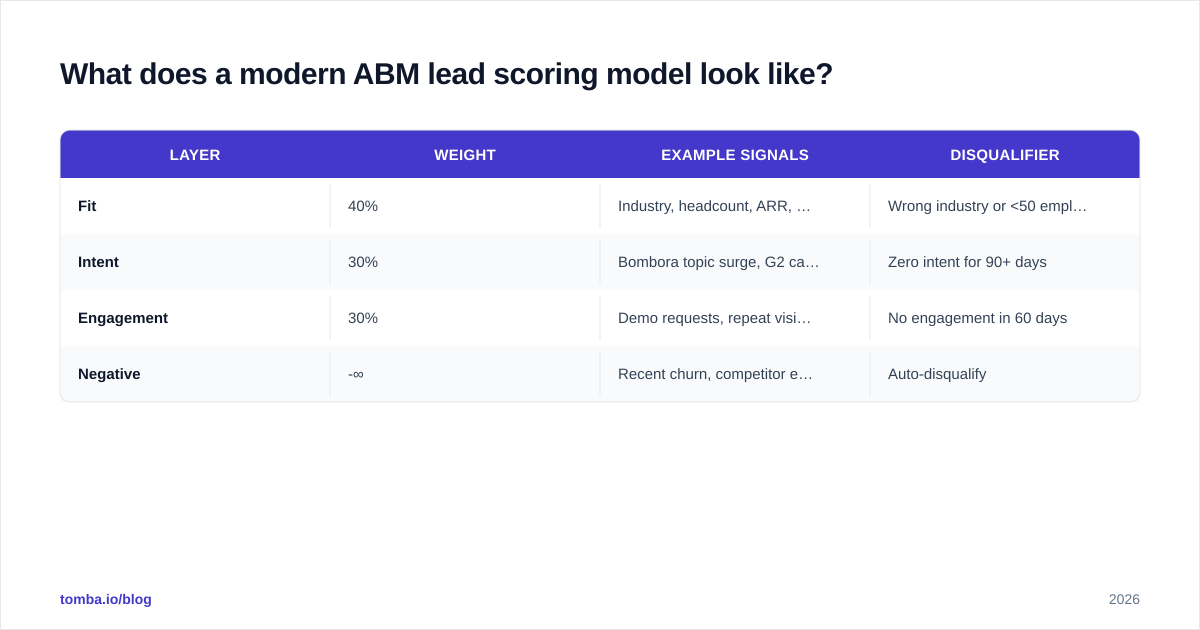
The negative-signal row matters more than people realize. A perfect-fit account that fired you 14 months ago should not be in your top 50. Hard disqualifiers prevent your SDRs from chasing ghost accounts.
How do you weight fit, intent, and engagement signals?#
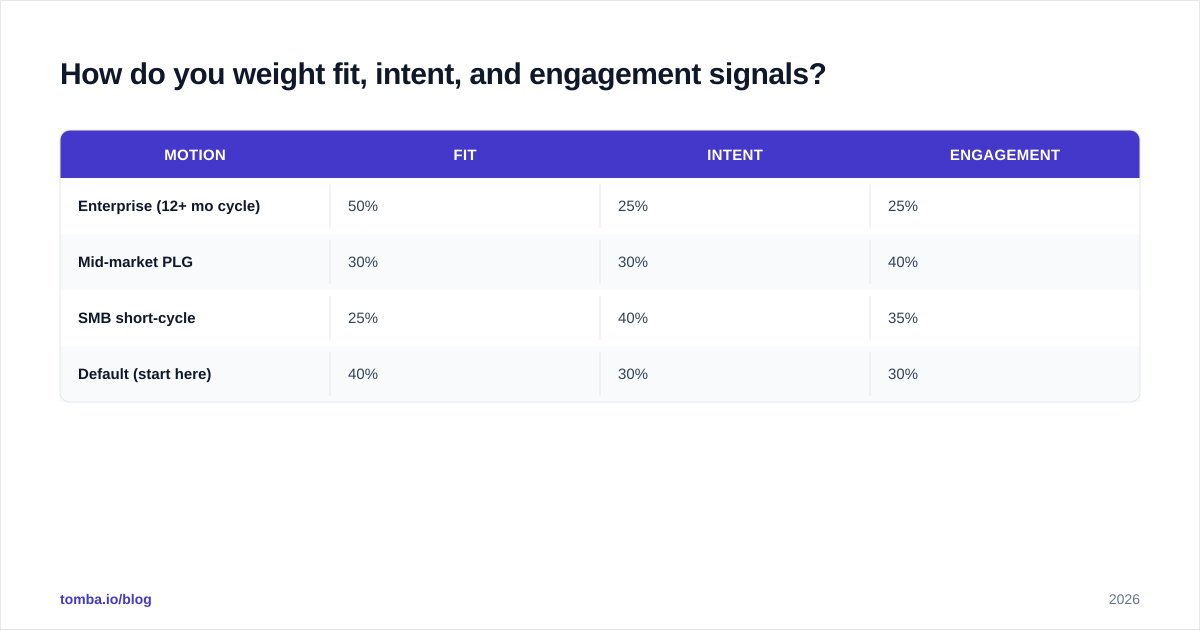
The 40/30/30 split above is a starting point, not gospel. Your weighting should match your actual win-rate data. Here's how to calibrate.
Pull your last 200 closed-won deals and your last 400 closed-lost. For each, score the account retroactively across the three layers. Then run a simple regression: which layer predicted the outcome best?
In practice we see three patterns:
- Long-cycle enterprise (12+ months): Fit dominates. A perfect-fit account will eventually buy; intent is too noisy at this horizon. Weight fit at 50% or higher.
- Mid-market PLG-influenced motion: Engagement dominates. Self-serve signal (free trial activity, integration installs) outpredicts firmographics. Weight engagement at 40% to 45%.
- Short-cycle SMB: Intent dominates. The window between "researching" and "buying" is six weeks. Weight intent at 40% and engagement at 35%.
| Motion | Fit | Intent | Engagement |
|---|---|---|---|
| Enterprise (12+ mo cycle) | 50% | 25% | 25% |
| Mid-market PLG | 30% | 30% | 40% |
| SMB short-cycle | 25% | 40% | 35% |
| Default (start here) | 40% | 30% | 30% |
The model is wrong if win rate isn't monotonically increasing across score bands. If your 80-100 band closes at 22% but your 60-80 band closes at 26%, your weights are off. Rerun the regression.
What intent signals actually predict pipeline?#
Not all intent is created equal. We rank signals by predictive value based on conversion data from B2B SaaS teams running ABM in 2025-2026.
Tier 1 — High signal, low noise:
- Demo request or "talk to sales" form fill
- Pricing page visit by 2+ contacts at the same account within 14 days
- Direct competitor comparison page view
- Integration documentation page view (signals technical evaluation)
Tier 2 — Medium signal, requires context:
- G2 category page views (only if your category page, not adjacent)
- Bombora surge on your specific topics (filter out generic "B2B SaaS")
- LinkedIn ad clicks from named-account targeting
- Webinar attendance for late-funnel topics
Tier 3 — Low signal, treat as background:
- Blog post reads
- Newsletter subscribes
- Top-of-funnel eBook downloads
- Generic LinkedIn impressions
The mistake most teams make is weighting all three tiers equally. A pricing page visit is not the same data point as an eBook download — it shouldn't add the same points.
Pair third-party intent with first-party reveal data. Tools like website visitor reveal identify which anonymous companies hit your pricing page, then you cross-reference against your ICP and surface the matches to sales. That single workflow tends to drive 15% to 25% of ABM-sourced pipeline once it's running.
How do you score the buying group, not just the lead?#
This is where most ABM teams break their model. They score the contact, route the contact, and then wonder why deals stall when the champion can't get budget.
Buying-group scoring layers on top of account scoring and answers two questions:
- Coverage: Have we engaged the right roles? (Economic buyer, champion, user, blocker)
- Depth: How engaged is each role?
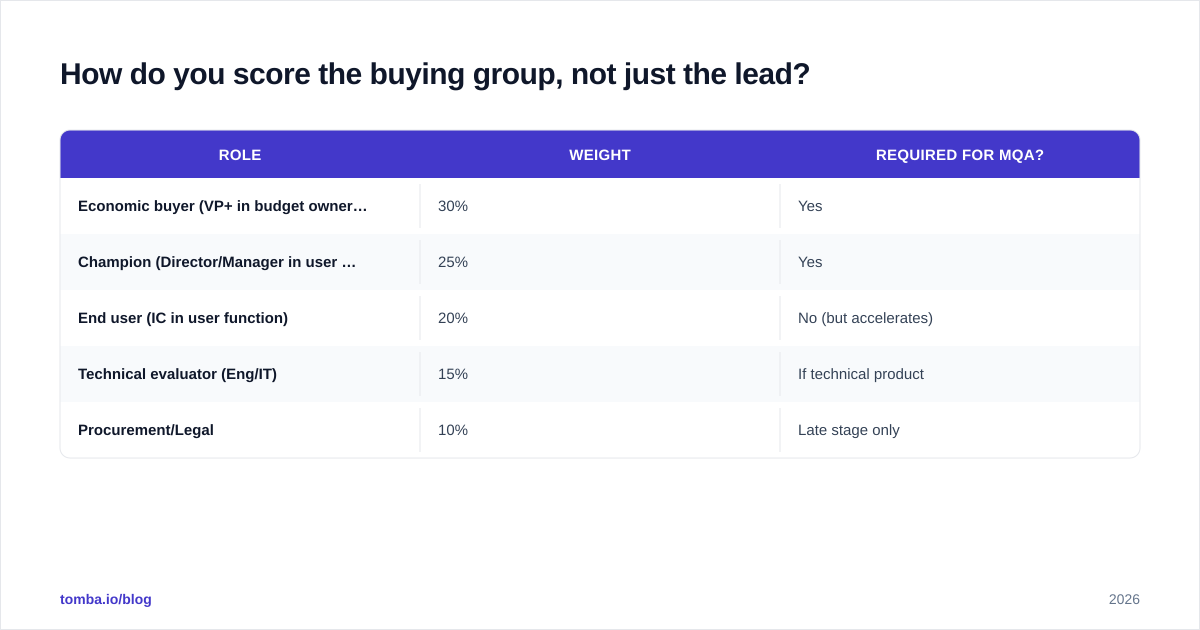
A practical coverage matrix for a typical B2B SaaS deal:
| Role | Weight | Required for MQA? |
|---|---|---|
| Economic buyer (VP+ in budget owner function) | 30% | Yes |
| Champion (Director/Manager in user function) | 25% | Yes |
| End user (IC in user function) | 20% | No (but accelerates) |
| Technical evaluator (Eng/IT) | 15% | If technical product |
| Procurement/Legal | 10% | Late stage only |
A Marketing-Qualified Account (MQA) requires coverage of both the economic buyer and the champion at minimum. Without champion engagement, the deal has no internal momentum. Without economic-buyer engagement, the deal can't close.
This is also where contact discovery tools become non-optional. You can't engage roles you haven't identified. An email finder plus LinkedIn finder workflow lets you go from "we have one champion at Acme" to "we have a six-person buying group mapped" in a single afternoon.
What tools do you actually need to run ABM lead scoring?#
You do not need a $60,000-per-year ABM platform to start. Here's the minimum viable stack and what it costs in 2026.
| Layer | Tool Category | Example Tools | Monthly Cost |
|---|---|---|---|
| Contact discovery | Email finder + enrichment | Tomba ($49-$249/mo), Apollo,ZoomInfo | $49-$1,500 |
| CRM with scoring | Native scoring engine | HubSpot, Salesforce | $50-$1,200 |
| Intent data | Third-party surge | Bombora, G2 Buyer Intent, 6sense | $0-$5,000 |
| First-party reveal | Visitor identification | Tomba Reveal, RB2B, Clearbit | $99-$999 |
| Enrichment | Firmographics + technographics | Tomba Enrichment, Clearbit, Apollo | Bundled |
| Orchestration | Workflow automation | Zapier, Make, native CRM | $20-$300 |
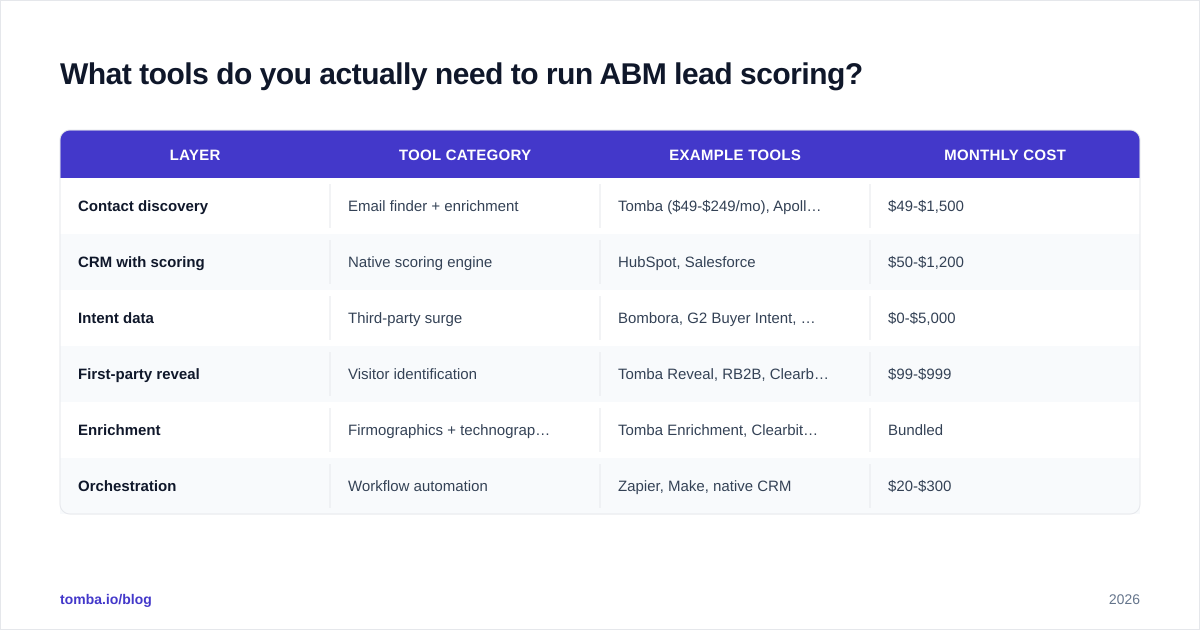
A lean stack — CRM + email finder + visitor reveal + Bombora's free tier through a partner — runs about $400 per month for a team of 5 SDRs. Compare that to 6sense pricing, which starts around $60,000 annually for the entry enterprise tier.
The 6sense, Demandbase, and ZoomInfo Marketing Hub tier of the market makes sense once you're spending $1M+ on ABM annually and need orchestration across paid media, sales, and CS. Below that threshold, you're paying for capabilities you won't use. For lighter alternatives in that comparison, see options to 6sense and Demandbase.
How do you operationalize the score in your CRM?#
A score that lives in a spreadsheet is decoration. The score has to drive routing, alerts, and dashboards inside the CRM your reps actually use.
Set up four state transitions:
- Account Score ≥ 70 + No Owner → MEL (Marketing Engaged Lead). Route to SDR queue for outbound research.
- Account Score ≥ 70 + Coverage ≥ 2 roles → MQA. Route to AE for outreach sequence.
- Account Score ≥ 85 + Economic Buyer engaged → SAL (Sales Accepted Lead). Notify AE in Slack, create opportunity.
- Account Score drops by 20+ in 30 days → Recycle. Pull from active pipeline, return to nurture.
The recycle state matters. ABM teams accumulate dead accounts in their "active" segment because nobody removes them. A score-decay trigger forces hygiene without anyone having to remember to do it.
For implementation, both HubSpot's ABM tools and Salesforce's account-engagement features have native account-level scoring, though you'll want to layer custom properties for buying-group coverage. The HubSpot integration and Salesforce integration push enrichment and contact data into the score fields automatically.
How do you measure if your ABM lead scoring is working?#
Two metrics, and only two metrics, tell you if the model is calibrated.
Metric 1: Win rate by score band. Bucket every closed deal in the last 12 months by its account score at the time it became an opportunity. Plot win rate per band.
| Score Band | Expected Win Rate | Red Flag |
|---|---|---|
| 90-100 | 35%+ | <25% means false positives |
| 70-89 | 20-30% | <15% means weights are off |
| 50-69 | 10-15% | Acceptable nurture pool |
| <50 | <8% | Disqualify, don't route |
If the curve isn't monotonic — higher score = higher win rate, every band — your model is wrong. Recalibrate.
Metric 2: SDR time spent on high-score vs low-score accounts. Pull activity data from your sales engagement platform. If your 90+ accounts get less than 60% of SDR call volume, your routing is broken. Fix the queue, not the score.
Vanity metrics to ignore: total MQAs generated, average score across all accounts, accounts above threshold. None of these tell you if the model predicts revenue.
What are the most common ABM lead scoring mistakes?#
After auditing dozens of ABM programs, the same five mistakes appear repeatedly.
Scoring contacts instead of accounts. The contact-level score becomes the de facto routing signal, and the account roll-up is decoration. Fix: make the account score the primary field, hide contact score from views.
Weighting demographics too heavily. Job title and seniority are the easiest signals to capture and the worst at predicting intent. A Director who's actively researching beats a VP who isn't. Cap demographic weight at 25% inside the fit layer.
No negative scoring. A 75-score account that's a competitor employee, a recent churn, or a free-tier abuser will burn your SDR's day. Hard disqualifiers should zero the score, not deduct 10 points.
Stale weights. The model that worked in Q1 2024 will not work in Q2 2026. Your ICP shifted, your competitors entered new categories, the macro changed. Recalibrate quarterly using the win-rate-by-band check.
No buying-group layer. A single champion at a 95-score account looks identical to a six-person mapped buying group at the same account. They are not the same opportunity. Add coverage scoring or your AEs will keep losing late-stage deals to "no decision."
How do you actually start? A 30-day rollout#
Don't try to launch the perfect model. Launch a v0.1 model in week one and improve from there.
- Week 1: Define ICP. Pull 200 closed-won + 400 closed-lost. Score retroactively across three layers using rough weights.
- Week 2: Implement the fit + engagement score in your CRM (skip intent if you don't have a data source yet). Set the four state transitions.
- Week 3: Add a contact-discovery workflow. Find missing decision-maker emails and LinkedIn profiles for your top 100 scoring accounts. A bulk email finder handles this in a single batch.
- Week 4: Layer in intent data (start with free first-party reveal + a G2 Buyer Intent free tier). Run the first calibration check.
By day 30 you have a working model. By day 90 you have a calibrated one. Most teams skip the calibration step and then wonder why their score doesn't predict anything six months later.
The closing pitch#
ABM lead scoring is only as good as the data feeding it. If your buying-group coverage is incomplete, your engagement layer is broken. If your account profiles are missing technographics or decision-maker emails, your fit layer is broken.
The fastest fix is to plug a contact-discovery layer into your scoring pipeline. The Tomba Email Finder identifies the decision-makers at your top-scoring accounts, enriches them with job title and LinkedIn data, and pushes the records into HubSpot or Salesforce so your scoring engine has something real to score. You can start free with 25 searches per month, scale to the $49 Starter plan for small ABM teams, or hit the API for bulk enrichment across thousands of target accounts. See full Tomba pricing and pair it with your existing CRM — the score gets sharper the day you turn it on.
// get started
Find, verify and enrich your first contacts today
Start on the free plan with 25 searches a month, then scale when your team is ready.
Free plan · No credit card required · GDPR & CCPA
// about the author