ABM Leads in 2026: How to Find, Score, and Convert Target Accounts
ABM leads aren't MQLs in a trench coat. Here's how modern B2B teams source, score, and convert named-account contacts in 2026 — with a working framework, tooling table, and the metrics that actually predict pipeline.
TL;DR#
- ABM leads are named-account contacts who match a defined ICP, buying committee role, and account-level intent signal — not raw MQLs from a form fill.
- The 2026 playbook treats accounts as the atomic unit. Leads are routed to accounts, not the other way around.
- A working ABM lead engine needs four layers: account list, contact discovery, intent and fit scoring, and orchestrated outreach across email, LinkedIn, and phone.
- Conversion benchmarks have shifted: tight ABM programs now hit 8-12% account-to-opportunity rates, compared to 1-3% for spray-and-pray outbound.
- The cheapest mistake is skipping contact verification. A bad contact tanks deliverability and burns the account for 90 days.
Account-based marketing finally outgrew its "enterprise-only" reputation. In 2026, mid-market SaaS teams with 5-person sales orgs run ABM motions that used to require a full RevOps department. The reason is boring but real: data is cheaper, intent signals are stitched into more tools, and buying committees have grown to an average of 11 stakeholders per deal according to Gartner's B2B buying research.
So the question isn't whether to run ABM. It's how to generate ABM leads that actually convert — without drowning in lookalike lists or paying enterprise prices for tooling you can build with three integrated products.
What are ABM leads, exactly?#
An ABM lead is a person at a pre-defined target account who matches a specific buying-committee role and shows fit, intent, or engagement signals worth acting on.
Three pieces matter:
- The account came first. Someone — usually marketing or RevOps — built a target list before anyone ran a campaign. The lead exists because the account does, not the other way around.
- The role is intentional. You're not chasing "anyone at Acme." You're chasing the VP of Engineering, the Director of Procurement, and the CFO — because your deal needs all three to sign.
- There's a signal. Either fit (right company size, tech stack, vertical), intent (researching your category), or engagement (visited your site, replied to a cold email, attended a webinar).
Strip out any of those three and you're back to running outbound or inbound. Both are fine motions. They're just not ABM.
How are ABM leads different from MQLs?#
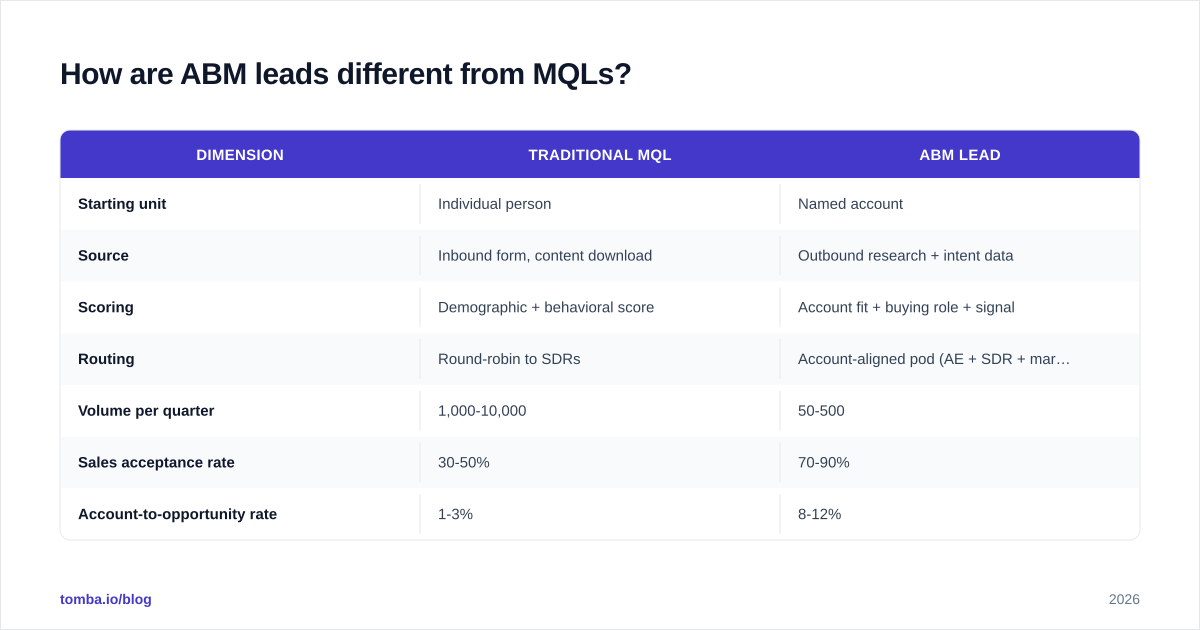
The cleanest mental model: MQLs are a marketing artifact. ABM leads are a go-to-market artifact.
| Dimension | Traditional MQL | ABM Lead |
|---|---|---|
| Starting unit | Individual person | Named account |
| Source | Inbound form, content download | Outbound research + intent data |
| Scoring | Demographic + behavioral score | Account fit + buying role + signal |
| Routing | Round-robin to SDRs | Account-aligned pod (AE + SDR + marketer) |
| Volume per quarter | 1,000-10,000 | 50-500 |
| Sales acceptance rate | 30-50% | 70-90% |
| Account-to-opportunity rate | 1-3% | 8-12% |
| Cost per opportunity | $400-800 | $200-500 |
The volume difference is the giveaway. An ABM motion that generates 200 leads in a quarter and books 24 opportunities outperforms an inbound funnel of 4,000 MQLs that books 80. Same outcome, a quarter of the labor.
How do you build the target account list?#
The account list is the entire program. Get it wrong and no amount of tooling fixes it.
A workable list has three concentric rings:
- Tier 1 (50-100 accounts) — the dream-customer list. Hand-picked. Every account gets 1:1 outreach with custom landing pages, executive intros, and bespoke campaigns. AE + SDR + marketer each own a slice.
- Tier 2 (300-500 accounts) — ICP-matched, programmatic. Same firmographics as Tier 1 but the team runs 1:few plays — vertical-specific email sequences, LinkedIn ads, gifting at lower cost thresholds.
- Tier 3 (1,000-3,000 accounts) — broad ICP fit. Mostly automated. Intent-triggered emails, retargeting ads, content nurture. Promotion to Tier 2 happens when an intent score crosses a threshold.
To build the list, start with your closed-won data. Pull the last 12 months of wins, isolate the firmographic patterns (employee count, revenue band, tech stack, industry NAICS code), and reverse-engineer a query against a B2B database. That gives you a baseline ICP. Layer in intent data from G2, Bombora, or 6sense, and you have a defensible Tier 1.
How do you find ABM leads at target accounts?#
Once the account list is locked, contact discovery is the next bottleneck. You need 5-15 named contacts per Tier 1 account and 3-5 per Tier 2.
A working contact-discovery stack:
- Domain-based email discovery. Feed a company domain to a domain search and pull every email pattern the company uses, plus current employees with titles. This is the highest-yield starting point.
- Title-driven enrichment. For each account, define the 5-7 titles you need (e.g., "VP Engineering", "Head of Infrastructure", "Director of DevOps") and search by domain + title.
- LinkedIn-to-email bridging. Sales reps live on LinkedIn. Use a LinkedIn finder to convert LinkedIn URLs into verified business emails without leaving the prospecting workflow.
- Verification before send. Every email goes through an email verifier before it touches your sending domain. Skipping this step is the single most common cause of ABM program failure — bounces over 3% trash your sender reputation and the rest of the program goes nowhere.
A small Tier 1 list of 80 accounts with 10 contacts each is 800 leads. That sounds modest until you compare it to the engagement rate on a 4,000-MQL inbound list. Quality multiplies on contact-by-contact basis.
What does an ABM lead score look like?#
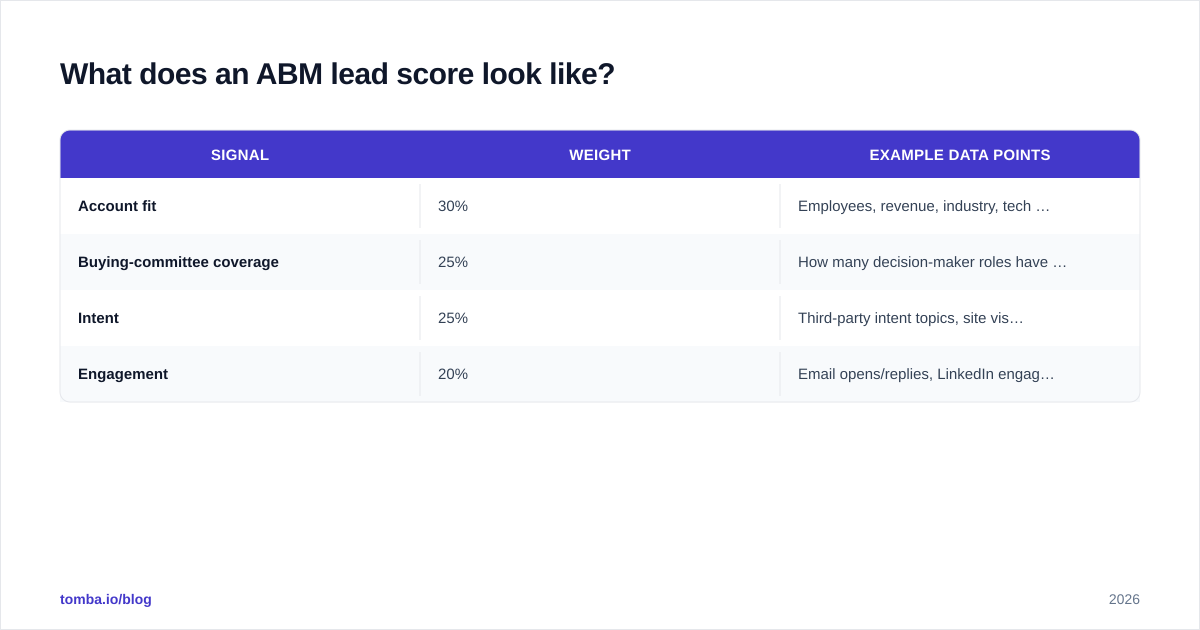
Account-level scoring beats lead-level scoring every time. The score is a weighted sum across four dimensions:
| Signal | Weight | Example data points |
|---|---|---|
| Account fit | 30% | Employees, revenue, industry, tech stack |
| Buying-committee coverage | 25% | How many decision-maker roles have verified contacts |
| Intent | 25% | Third-party intent topics, site visits, content engagement |
| Engagement | 20% | Email opens/replies, LinkedIn engagement, meeting attendance |
A common rookie mistake is over-weighting intent. Bombora-style topic signals are noisy. They're great as a trigger — "this account is researching CDP migration this week" — but they're a weak primary score. Fit + committee coverage predicts revenue more reliably across a year.
For a deeper dive on scoring mechanics, see our glossary entry on marketing qualified lead and the win rate glossary — the math is identical, just at account grain.
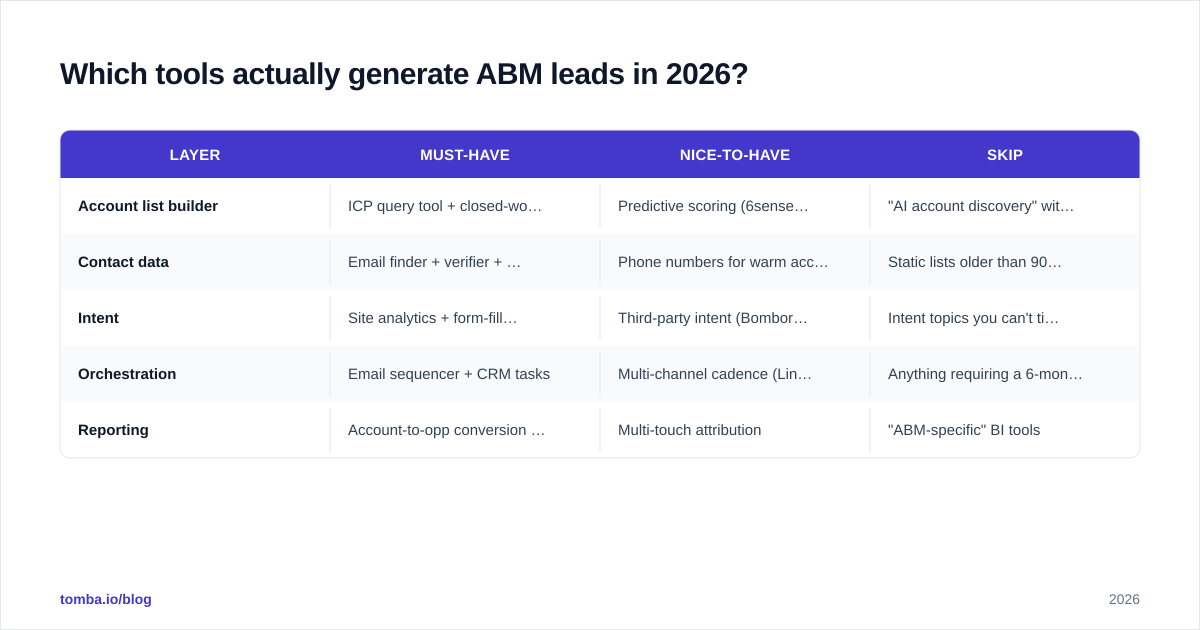
Which tools actually generate ABM leads in 2026?#
The ABM tool category is bloated. Most of it is repackaged ad targeting. Here's what you actually need versus what vendors will try to sell you.
| Layer | Must-have | Nice-to-have | Skip |
|---|---|---|---|
| Account list builder | ICP query tool + closed-won analysis | Predictive scoring (6sense, Demandbase) | "AI account discovery" with no methodology disclosed |
| Contact data | Email finder + verifier + LinkedIn bridge | Phone numbers for warm accounts | Static lists older than 90 days |
| Intent | Site analytics + form-fill tracking | Third-party intent (Bombora, G2) | Intent topics you can't tie to a play |
| Orchestration | Email sequencer + CRM tasks | Multi-channel cadence (LinkedIn, ads, direct mail) | Anything requiring a 6-month implementation |
| Reporting | Account-to-opp conversion dashboard | Multi-touch attribution | "ABM-specific" BI tools |
The reason a smaller stack works in 2026: APIs got good. A pipeline of Tomba API for discovery, your CRM for orchestration, and a sequencer like Instantly or Outreach for sends can replace a $60k/year ABM platform. The trade-off is you build the dashboards yourself.

What does a real ABM lead workflow look like?#
A working weekly cadence for a 2-person ABM pod (one SDR, one AE):
Monday — research and tier review. SDR pulls the Tier 1 list, checks for intent triggers from the prior week, updates account scores. Anything that jumped a tier moves into active sequence. Promotions and demotions are documented in the CRM.
Tuesday — contact discovery. SDR identifies missing buying-committee roles per Tier 1 account. Runs domain + title searches via a bulk email finder, verifies, syncs to CRM. Target: 100% buying-committee coverage on Tier 1 within 30 days.
Wednesday — sequence builds. AE drafts the 1:1 message for the top 5 accounts. SDR builds 1:few sequences for Tier 2. Subject lines run through a subject line tester before launch.
Thursday — multi-channel send. Emails go out with staggered timing across the buying committee. LinkedIn messages follow 48 hours later. Calls reserved for accounts that opened but didn't reply.
Friday — pipeline review. Pod reviews replies, meetings booked, account-score changes. Decisions on promotions, demotions, and exit (accounts that go cold for 90 days drop out of active rotation).
How do you measure ABM lead performance?#
Three metrics matter. Everything else is noise.
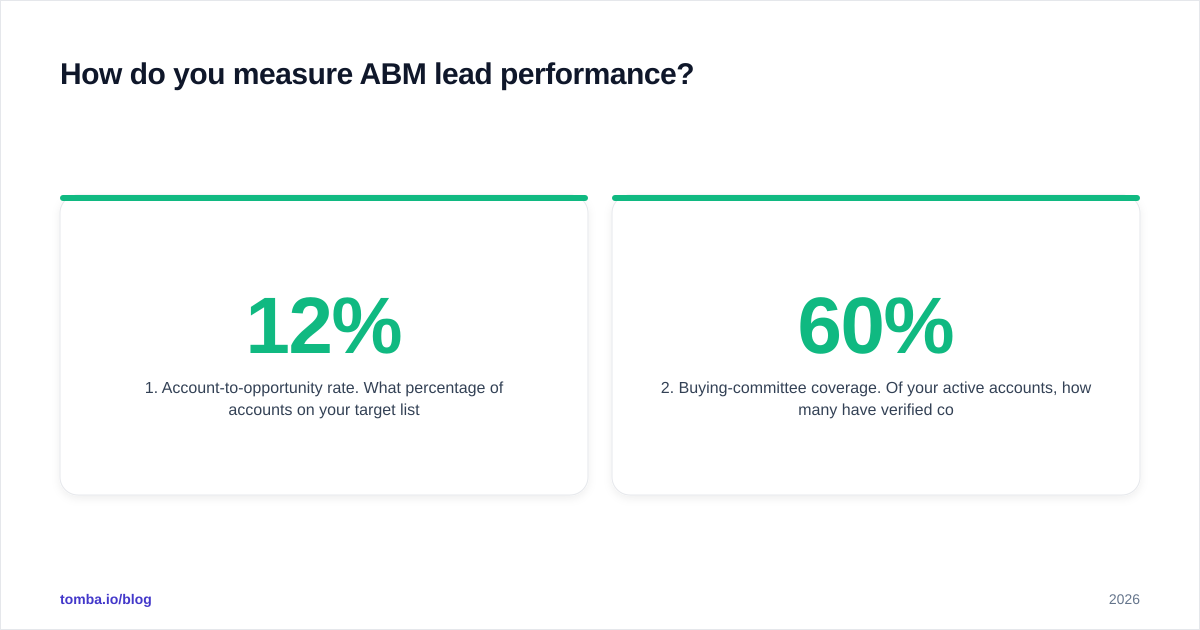
- Account-to-opportunity rate. What percentage of accounts on your target list become qualified opportunities within the quarter? Strong programs hit 8-12%. Weak ones sit at 2-4%.
- Buying-committee coverage. Of your active accounts, how many have verified contacts across all required buying roles? Below 60% means your discovery layer is the bottleneck.
- Time to first meeting. From the day an account enters Tier 1, how many business days until first meeting booked? Below 30 days is good. Above 60 means your sequencing is broken.
Skip vanity metrics like email open rates and LinkedIn impressions. They flatter the pod and predict nothing. For more on this, see HubSpot's ABM measurement framework and Salesforce's ABM guide.
What's the biggest mistake teams make with ABM leads?#
Treating ABM as a tooling decision instead of an operating-model decision.
You can't bolt ABM onto an inbound-only org. Sales has to commit to working accounts, not leads. Marketing has to fund account-level campaigns, not gated whitepapers. RevOps has to build dashboards at account grain. If any one of those three pieces is missing, the program quietly degrades back into outbound prospecting wearing an ABM badge.
The second-biggest mistake is starting too broad. Eighty accounts is plenty for a first ABM motion. Teams that start with 500 accounts inevitably under-resource each one, the program produces mediocre results, and leadership concludes "ABM doesn't work for us." It works. The pod was just spread across six times the surface area it could handle.
How do you start an ABM lead program from zero?#
Four weeks of focused work, no extra hires:
- Week 1 — Pull closed-won data, define ICP, build a 50-account Tier 1 list. Get sales leader sign-off on the list.
- Week 2 — Run contact discovery. Aim for 8-12 verified contacts per Tier 1 account using a combined email finder and verifier workflow. Sync everything to the CRM with account-level tagging.
- Week 3 — Build the first 1:1 sequences for the top 10 accounts. Build a 1:few sequence template for the remaining 40. Wire up basic reporting (account-to-opp dashboard, buying-committee coverage report).
- Week 4 — Launch. Send first wave Monday. Daily standups Tuesday-Friday to triage replies and meeting requests. Iterate sequences based on reply rates by Friday EOD.
You'll know it's working when the AE stops asking "what should I work on today" and starts asking "which of these 12 accounts gets my attention first." That shift, from lead-by-lead triage to account-by-account focus, is the entire point.
Ready to source higher-quality ABM leads?#
The fastest way to test an ABM motion is to start with one Tier 1 account and find every decision-maker inside it within an hour. The Tomba Email Finder does exactly that — feed it a company domain, get back verified contacts with titles, ready to sync to your CRM. No contracts, no minimums, and a free tier that covers your first proof-of-concept account list.
Build your list, find the committee, send the first wave. ABM works when the discovery layer is solid. Start there.
// get started
Find, verify and enrich your first contacts today
Start on the free plan with 25 searches a month, then scale when your team is ready.
Free plan · No credit card required · GDPR & CCPA
// about the author