How to Build an ABM List That Actually Closes Deals in 2026
A practical guide to building an ABM list that sales actually works. ICP scoring, intent signals, contact enrichment, and the tools that beat spray-and-pray.
TL;DR#
- An ABM list is a tightly scoped set of named accounts your revenue team commits to win — not a lead list you blast.
- The best lists in 2026 combine three layers: firmographic fit (ICP), behavioral intent (research signals), and contact-level access (verified decision-makers).
- 50-200 accounts per rep per quarter is the sweet spot. More than that and you're back to spray-and-pray.
- Enrichment quality beats list size every time. A 100-account list with verified emails and intent signals outperforms a 10,000-row CSV.
- Tooling stack: ICP scoring (Clearbit/HubSpot Breeze), intent (6sense, Bombora), contact discovery (Tomba, LinkedIn), orchestration (HubSpot, Salesforce).
What is an ABM list?#
An ABM list is the list of named accounts — companies, not contacts — that your sales and marketing teams agree to pursue with personalized, coordinated campaigns. It is the operating document of an account-based motion. Everything downstream (ad targeting, sales sequences, custom landing pages, gifting) is filtered through this list.
The analogy: a fishing trawler casts a net over a square mile of ocean and keeps whatever falls in. An ABM list is a spearfisher with five trophy fish identified before getting in the water. Same protein, very different effort per kilogram.
Three things separate an ABM list from a regular lead list:
- Account-level, not contact-level. The unit is a company. Contacts are looked up after the company is on the list.
- Bounded and committed. Reps work the same accounts for a quarter or more, not whatever lands in the CRM that week.
- Multi-threaded. Every account on the list has 4-10 named buying committee members enriched and ready.
If your "ABM list" is 50,000 contacts in a marketing automation platform, it is a lead list with a new sticker. Call it what it is.
Why do most ABM lists fail?#
The dirty secret of account-based marketing is that the average ABM program produces worse results than a competent inbound funnel for the first 12 months. The reason is almost always the list.
Common failure patterns:
- Too many accounts. A rep with 800 "target accounts" runs the same outbound playbook they always did. The list adds work, not focus.
- No tiering. All accounts treated equally. The $5M ARR target gets the same five-touch sequence as the $50K customer.
- Stale firmographics. Built once from a 2023 export, never refreshed. Companies got acquired, laid off, or pivoted.
- No contacts. Marketing handed sales a list of company names. Sales spends 60% of its time on lead generation instead of selling.
- Disconnected from intent. Account is on the list because someone on the leadership team likes the logo. No signal that the account is actively buying.
The fix is structural: build the list with explicit tiers, refresh it quarterly, enrich at the contact level before sales sees it, and tie every account to a measurable signal.
How do you build an ABM list step by step?#
Five steps. Skip any of them and the list will leak.
Step 1: Define your Ideal Customer Profile#
Pull your last 50 closed-won deals. Find the firmographic and technographic patterns:
- Industry (NAICS or your own bucket)
- Employee count band
- Revenue band
- Tech stack (do they use Salesforce? Snowflake? a specific competitor?)
- Geography
- Funding stage (if applicable)
The ICP is not a wish. It's a regression on what actually paid you. If your top 10 customers are 200-800 employee SaaS companies in North America running Salesforce, your ICP is 200-800 employee SaaS companies in North America running Salesforce — not "enterprise."
Step 2: Generate the candidate universe#
Now you cast a wider net to find lookalikes. Sources:
- B2B databases — Tomba's B2B database,
ZoomInfo, Apollo, Cognism
- LinkedIn Sales Navigator with the saved-search export
- Crunchbase/Pitchbook for funding-stage signals
- Built-with/Wappalyzer for tech-stack signals
- Existing CRM data filtered by closed-lost (still good ICP fit, wrong timing)
You're looking for 2,000-5,000 candidates at this stage. Don't trim yet.
Step 3: Score and tier#
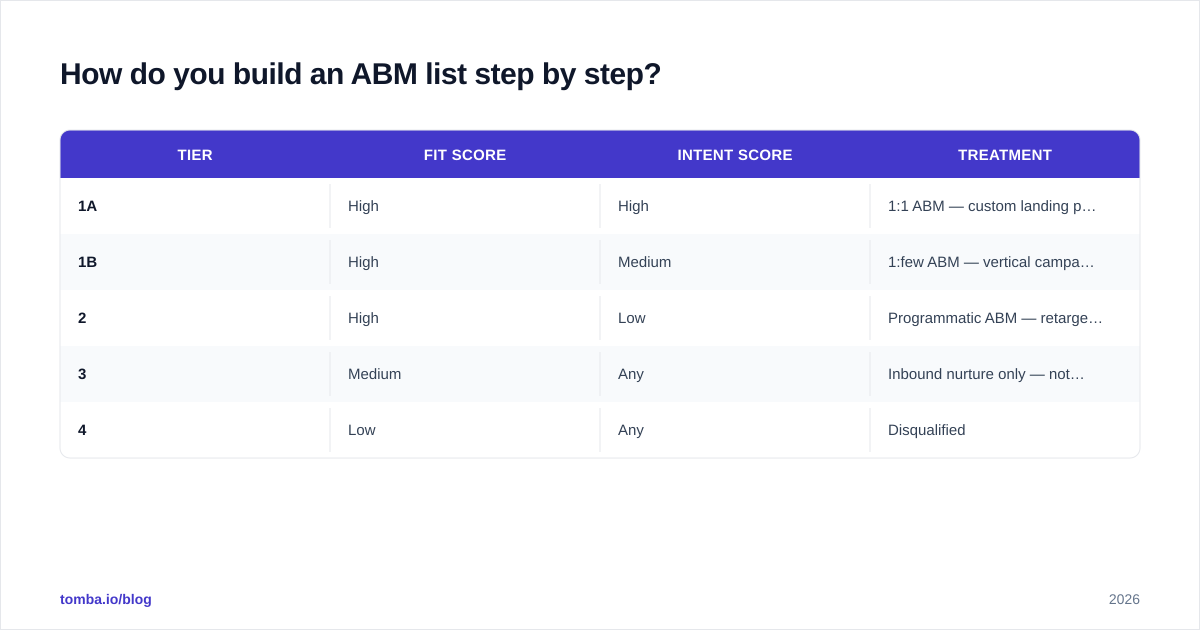
Score each candidate on fit (firmographic match) and intent (behavioral signals). A simple 1-3 scale on each axis gives you a 3x3 matrix:
| Tier | Fit score | Intent score | Treatment |
|---|---|---|---|
| 1A | High | High | 1:1 ABM — custom landing pages, exec-to-exec, gifting |
| 1B | High | Medium | 1:few ABM — vertical campaigns, named-account ads |
| 2 | High | Low | Programmatic ABM — retargeting, content syndication |
| 3 | Medium | Any | Inbound nurture only — not on the ABM list |
| 4 | Low | Any | Disqualified |
Tier 1A is small on purpose: 20-50 accounts per rep. Tier 1B is 50-100. Tier 2 fills the rest of the universe.
Step 4: Enrich contacts#
For every account on the list, you need 4-10 named contacts from the buying committee. At minimum: the economic buyer, the technical buyer, the day-to-day user, and one champion candidate.
This is where most lists die quietly. Marketing ships 200 accounts; sales finds two contacts each because the rest are gated. Use a verified email finder with the Tomba LinkedIn finder extension to pull emails from Sales Navigator searches, then run them through an email verifier before they hit the sequencer.
Step 5: Add intent data#
Layer intent on top. Sources:
- First-party intent — your own site visits (via website visitor reveal), demo requests, content downloads
- Third-party intent — Bombora, 6sense, G2 Buyer Intent
- Trigger events — funding rounds, exec changes, job postings, M&A
An account moves from Tier 2 to Tier 1B when intent spikes. The list is a living document.
What does a good ABM list look like in practice?#
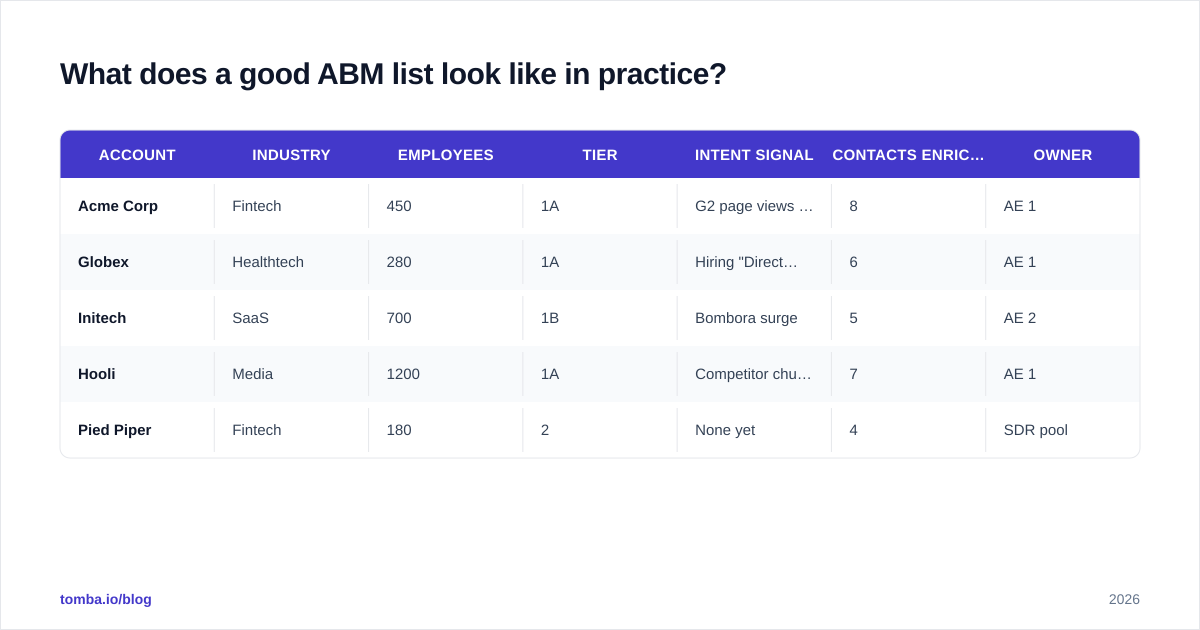
Here's a real example structure for a 100-account Tier 1 list at a mid-market SaaS company:
| Account | Industry | Employees | Tier | Intent signal | Contacts enriched | Owner |
|---|---|---|---|---|---|---|
| Acme Corp | Fintech | 450 | 1A | G2 page views + RFP | 8 | AE 1 |
| Globex | Healthtech | 280 | 1A | Hiring "Director of Ops" | 6 | AE 1 |
| Initech | SaaS | 700 | 1B | Bombora surge | 5 | AE 2 |
| Hooli | Media | 1200 | 1A | Competitor churn signal | 7 | AE 1 |
| Pied Piper | Fintech | 180 | 2 | None yet | 4 | SDR pool |
Each row is reviewed in a weekly account-pod meeting between the AE, the SDR, and the demand-gen marketer. Accounts move tiers based on engagement. Stale accounts (no engagement after 90 days of touches) get cycled out and replaced.
Which tools do you actually need to build an ABM list?#
You don't need the full $300K stack. You need one tool from each layer.
| Layer | Purpose | Examples | Starting point |
|---|---|---|---|
| ICP & firmographics | Build candidate universe | Tomba, Apollo,ZoomInfo, Cognism | Tomba from $49/mo |
| Intent | Detect in-market accounts | 6sense, Bombora, G2 | 6sense free trial / G2 Buyer Intent |
| Contact discovery | Find verified emails + phones | Tomba Email Finder, LinkedIn SN | Tomba Email Finder Free tier 25 searches |
| Verification | Reduce bounce rate | Tomba Verifier, ZeroBounce | Tomba Email Verifier |
| Orchestration | Run plays, track engagement | HubSpot, Salesforce, Outreach | HubSpot integration |
| Enrichment | Fill firmographic gaps | Clearbit, Tomba enrichment | Tomba enrichment |
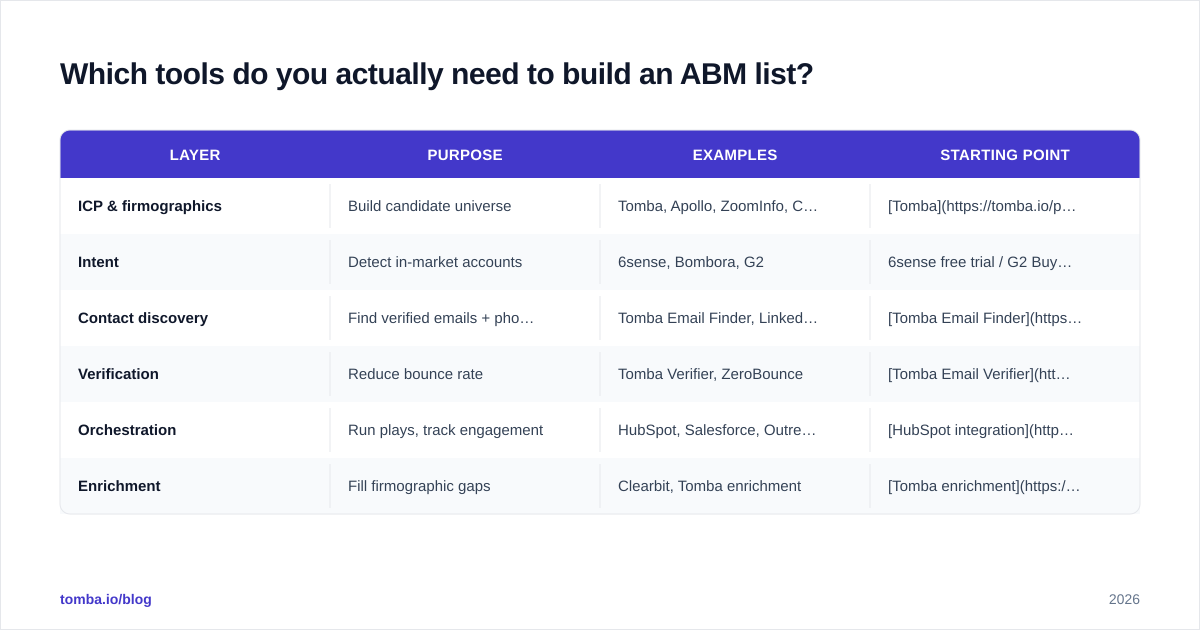
A lean stack runs about $500-1,500/mo for a team of 3-5 reps. The expensive stuff (6sense, Demandbase) only pays back at 10+ AEs or six-figure ACVs.
How big should your ABM list be?#
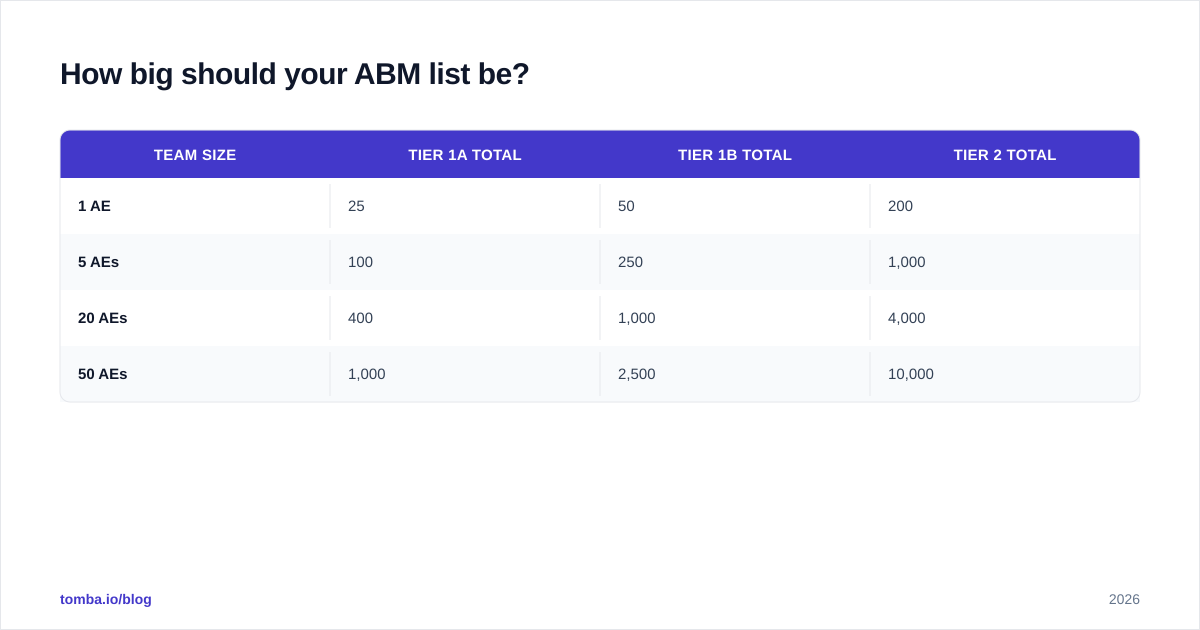
The math is simple. Work backward from rep capacity.
A B2B AE can meaningfully work 30-50 accounts at any moment. "Meaningfully" means: knows the buying committee by name, has a hypothesis on the pain, has a touch cadence running, and can recall the last conversation without checking notes.
Stretch goal: 75 accounts per rep across all tiers (Tier 1A capped at 25, Tier 1B at 50). Anything beyond that becomes inbox triage.
| Team size | Tier 1A total | Tier 1B total | Tier 2 total |
|---|---|---|---|
| 1 AE | 25 | 50 | 200 |
| 5 AEs | 100 | 250 | 1,000 |
| 20 AEs | 400 | 1,000 | 4,000 |
| 50 AEs | 1,000 | 2,500 | 10,000 |
Notice Tier 1A doesn't scale linearly with headcount past 20 reps — your TAM caps it.
How often should you refresh the ABM list?#
Three cadences run in parallel:
- Daily — intent signal updates flow in automatically. Accounts get promoted/demoted between Tier 1B and Tier 2 without a meeting.
- Monthly — contact data refreshed. Re-verify emails on accounts that received touches. Re-enrich contacts who changed jobs.
- Quarterly — full list review. Cycle out stale Tier 1As, promote winners from Tier 2, refresh the candidate universe with new lookalikes.
Stale lists are the #1 reason ABM programs decay. A 2024 list run in 2026 is mostly fiction — companies got acquired, contacts left, intent signals went cold.
Set a calendar event. Refresh on the dot.
Common ABM list mistakes to avoid#
A short list of things that look smart but quietly destroy programs:
- Letting sales pick the list alone. You get the reps' existing pipeline rebranded as ABM. No new logos.
- Letting marketing pick the list alone. You get a beautiful list of brand-name logos no rep will ever touch.
- Not capping tiers. "Everyone is Tier 1" means no one is.
- Missing the buying committee. Single-threaded accounts churn at 3x the rate of multi-threaded ones, per Forrester research.
- Ignoring competitor churn signals. Customers leaving a competitor are the highest-converting ABM segment that exists. Track G2 review patterns and Glassdoor sentiment.
- Not feeding the list back to ads. Your paid social, programmatic display, and LinkedIn ads should all be filtered by the same account list. If they aren't, you're paying to advertise to everyone.
How do you measure if your ABM list is working?#
Forget MQLs. The metrics that matter for an ABM list:
- Account engagement rate — % of accounts on the list that touched anything (visited site, opened email, accepted a meeting) in the last 30 days. Healthy: 60%+.
- Multi-threading depth — average # of contacts engaged per account. Healthy: 3+.
- Pipeline coverage from the list — what share of your sourced pipeline comes from named accounts. Healthy: 50%+ for a real ABM motion.
- Velocity uplift — deal cycle on ABM accounts vs non-ABM. Healthy: 20-30% faster.
- Win rate uplift — close rate on ABM accounts vs non-ABM. Healthy: 1.5-2x.
If after two quarters the metrics aren't moving, the list is wrong before the playbook is wrong. Rebuild from Step 1.
How does ABM list-building compare to traditional lead gen?#
| Dimension | ABM list | Traditional lead list |
|---|---|---|
| Unit | Account (company) | Contact (person) |
| Size per rep | 30-100 | 500-2,000 |
| Update cadence | Daily/monthly/quarterly | One-time pull |
| Enrichment depth | 4-10 contacts per account | Whatever was on the form |
| Sales-marketing alignment | Required | Optional |
| ACV fit | $25K+ ACV | <$10K ACV |
| Time to first deal | 60-180 days | 7-30 days |
| Win rate | 1.5-2x baseline | Baseline |
ABM isn't better than inbound in all cases. It's a deliberate trade: higher upfront effort and longer cycles for higher contract values and stickier customers. If your ACV is under $10K, an ABM list is overkill — run inbound and PLG.
Sample ABM list template you can copy#
The minimum viable schema in a spreadsheet (or your CRM custom fields):
account_id | company_name | domain | industry | employees | revenue_band
| tier (1A/1B/2) | fit_score (1-3) | intent_score (1-3) | intent_source |
| --- | --- | --- | --- |
| owner_ae | owner_sdr | contacts_enriched (count) | last_touched |
| last_engaged | stage | next_action | notes |
Pull this every Monday morning. Reps sort by last_engaged DESC to find accounts that went quiet. Marketing sorts by intent_score DESC, tier ASC to find promotion candidates.
Final word — start small, refresh often#
The single best decision a new ABM program can make is to start with 50 accounts, not 500. You'll learn what your real ICP looks like in 90 days. Then you scale.
The second best decision is to invest in contact-level enrichment before the first email goes out. A list of company names is not a list — it's a wish list.
If you're ready to build, start by finding the right contacts at the accounts you already know you want. Tomba's Email Finder gives you 25 free searches per month, scales to verified bulk discovery on the Starter plan at $49/mo, and plugs into HubSpot, Salesforce, and Pipedrive so enriched contacts land in your ABM list automatically. Build the list once, refresh it relentlessly, and let the playbook compound.
Ready to find emails that actually work?
Join 150,000+ professionals who stopped guessing and started sending. Free credits on signup — no credit card required.
Get the Tomba newsletter
Practical outbound tactics and product updates — once every two weeks.
About the author