ABM Objectives in 2026: 7 Goals That Drive Pipeline
Most ABM programs fail because the objectives are vague. Here are the seven measurable ABM objectives that actually move pipeline, revenue, and retention in 2026.
ABM Objectives in 2026: 7 Goals That Drive Pipeline
TL;DR
- Most ABM programs fail because the objectives are copied from demand-gen playbooks — lead volume, MQLs, form fills — instead of account-level outcomes.
- The seven ABM objectives that matter in 2026 are account coverage, engagement depth, pipeline velocity, average contract value, win rate on named accounts, net revenue retention, and dark funnel influence.
- One-to-one, one-to-few, and one-to-many tiers need different KPIs. Treating them the same is the fastest way to kill a program.
- Skip the "leads generated" metric. ABM is measured in accounts engaged, opportunities created on named lists, and revenue per target account.
- A working measurement stack pairs intent data, CRM opportunity stages, and verified contact data so attribution survives a 9-month enterprise cycle.
What are ABM objectives, really?#
Account-based marketing objectives are the specific, measurable outcomes a go-to-market team commits to at the account level — not the lead level. The point of ABM is to compress sales cycles inside a small, hand-picked set of companies. Your objectives have to reflect that, or you're just running demand generation with a fancier name.
A useful test: if you can swap "leads" for "accounts" in your goal statement and the metric still works, you have an ABM objective. If you can't, you have a demand-gen objective wearing an ABM jersey.
The shift looks like this:
- "Generate 500 MQLs" → "Engage 50 of 200 target accounts at 3+ stakeholders each"
- "Book 30 demos" → "Open opportunities in 20 named accounts with a verified champion identified"
- "Hit $2M sourced pipeline" → "Hit $2M sourced pipeline from the 200-account target list, with 60% of accounts touched by both marketing and sales within 30 days"
ABM is a small-N game. The same 200 accounts you obsess over this quarter will be the same 180 accounts you obsess over next quarter. Your objectives need to survive that continuity.
Why do most ABM objectives fail?#
Three failure modes show up over and over when we audit ABM programs.
Failure 1: Vanity at the top of the funnel. Teams set goals like "increase target account web traffic by 40%." That sounds account-y, but it tells you nothing about whether the right people from those accounts visited, or whether they did anything that mattered. Traffic is not engagement.
Failure 2: No tier separation. A one-to-one program for 10 strategic accounts and a one-to-many program for 2,000 accounts cannot share the same KPI. The first is measured in pipeline per account ($500K+). The second is measured in coverage and engagement rate (40%+ of accounts touched per quarter).
Failure 3: Marketing-only ownership. ABM objectives that live only in the marketing OKR doc die at the sales handoff. The objectives have to be co-owned by an account executive, an SDR, and a marketer for each tier, or attribution becomes a finger-pointing exercise.
Look at the metrics on your last ABM QBR slide. If three or more of them are leads, clicks, or impressions, you're not running ABM — you're running paid media against a list.
What are the 7 ABM objectives that actually drive revenue?#
Here are the seven objectives we see consistently in programs that hit their numbers. Pick four or five — not all seven. Programs that try to optimize for everything optimize for nothing.
1. Account coverage rate#
The percentage of target accounts where you have verified contact data on at least 3 buying-committee personas. Gartner's research on B2B buying groups puts the average enterprise committee at 6 to 10 people. If you only know two contacts at an account, you're not running ABM — you're running named-account lead-gen.
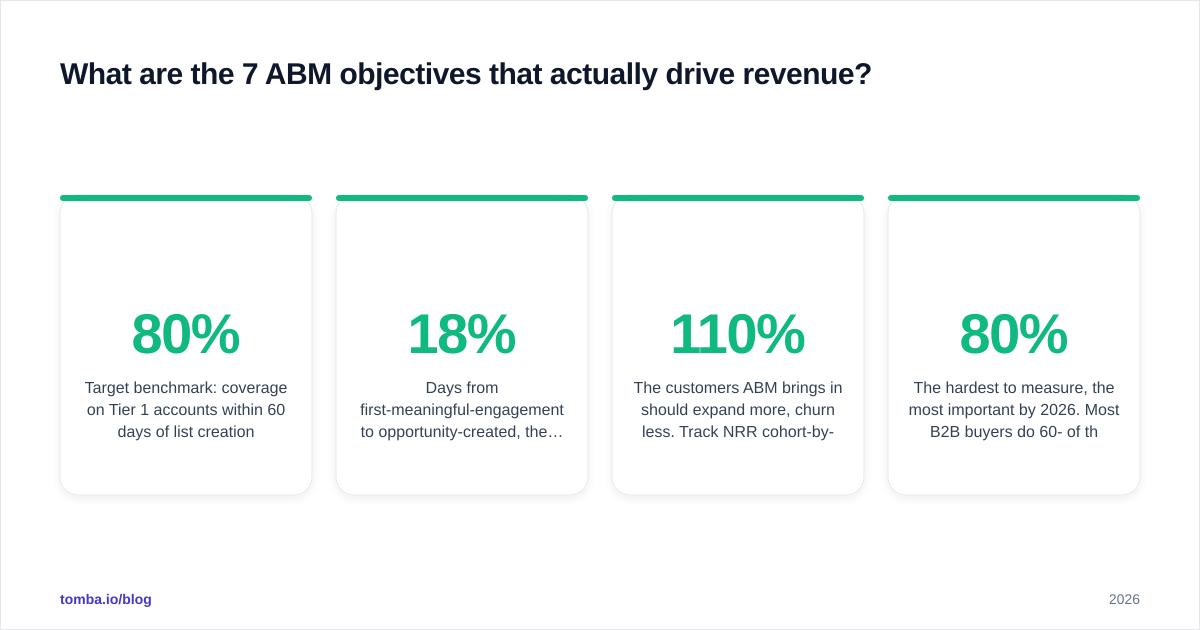
Target benchmark: 80% coverage on Tier 1 accounts within 60 days of list creation.
To hit this, you need a reliable email finder and enrichment workflow. Tools like the Tomba Email Finder or data enrichment APIs let you backfill missing decision-maker contacts on a fixed account list without paying per record on a seat-based platform.
2. Engagement depth per account#
Not "did someone from Acme click the email" but "how many people from Acme engaged with how many touchpoints in the last 30 days." A score above 8 (across web visits, email opens, ad impressions, content downloads, event attendance) on a single account in a single month is the threshold where most ABM teams see opportunity creation lift.
3. Pipeline velocity on named accounts#
Days from first-meaningful-engagement to opportunity-created, then opportunity-created to closed-won. Most enterprise teams discover their ABM accounts close 18% to 32% faster than their inbound-sourced opportunities. If yours don't, the targeting list is wrong.
4. Average contract value (ACV) uplift#
ABM should produce larger deals. If your average deal size on ABM-sourced accounts is the same as your inbound average, you're selecting the wrong accounts. Healthy programs show 1.4x to 2.2x ACV uplift on Tier 1 versus inbound.
5. Win rate on named accounts#
Win rate on the named list should run 5 to 15 points higher than your overall win rate. If it doesn't, the sales team isn't getting enough air cover from marketing — or the list is full of accounts that were never going to buy in the first place.
6. Net revenue retention (NRR) on ABM-acquired logos#
The customers ABM brings in should expand more, churn less. Track NRR cohort-by-cohort separately for ABM-acquired versus inbound-acquired logos. A 110%+ NRR gap is what justifies the program's cost.
7. Dark funnel influence#
The hardest to measure, the most important by 2026. Most B2B buyers do 60-80% of their research before they ever fill a form. Surface this with intent data, anonymous visitor identification, and self-reported "how did you hear about us" data from sales-accepted opportunities.
How do you set ABM objectives by tier?#
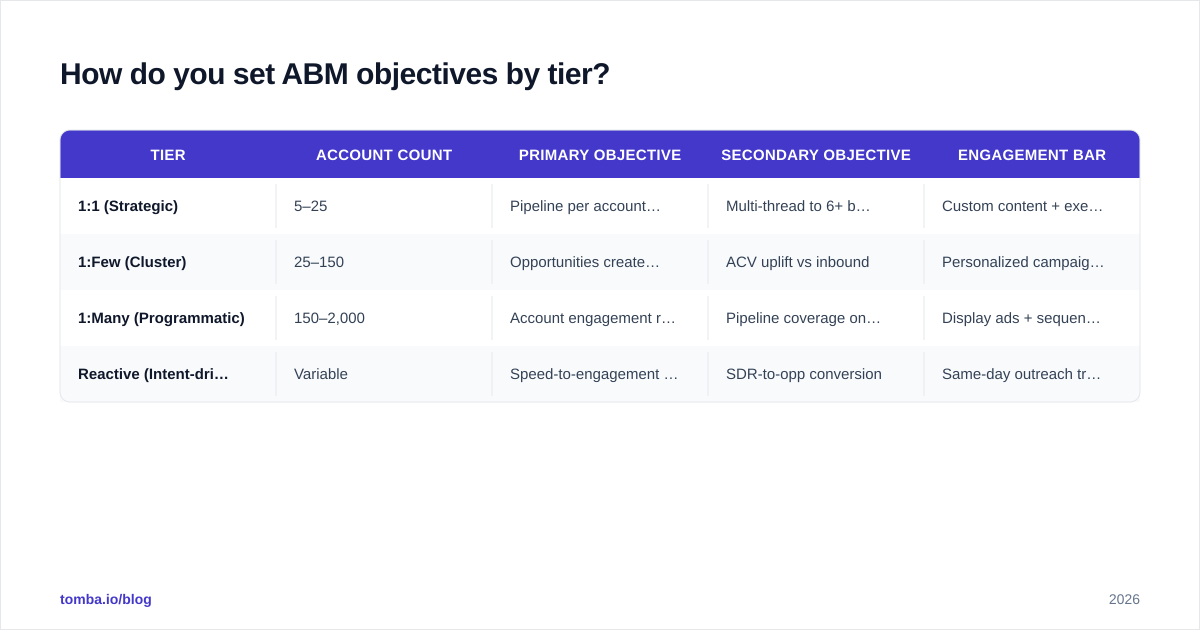
The three classic tiers — 1:1, 1:few, 1:many — each need their own scorecard.
| Tier | Account count | Primary objective | Secondary objective | Engagement bar |
|---|---|---|---|---|
| 1:1 (Strategic) | 5–25 | Pipeline per account ($500K+) | Multi-thread to 6+ buying personas | Custom content + exec engagement |
| 1:Few (Cluster) | 25–150 | Opportunities created per industry vertical | ACV uplift vs inbound | Personalized campaign per 5-10 accounts |
| 1:Many (Programmatic) | 150–2,000 | Account engagement rate | Pipeline coverage on the named list | Display ads + sequenced outbound |
| Reactive (Intent-driven) | Variable | Speed-to-engagement on surging accounts | SDR-to-opp conversion | Same-day outreach trigger |
Two anti-patterns to avoid: running 1:1 plays at 1:many scale (you'll burn out the team), and running 1:many plays on 1:1 accounts (you'll lose the deal to a competitor doing real personalization). Forrester's "B-to-B Revenue Waterfall" and its account-engagement model both reinforce that tier mismatches are the most common reason ABM programs miss goals.
How do you measure ABM objectives without losing your mind?#
Three layers. Don't skip any of them.
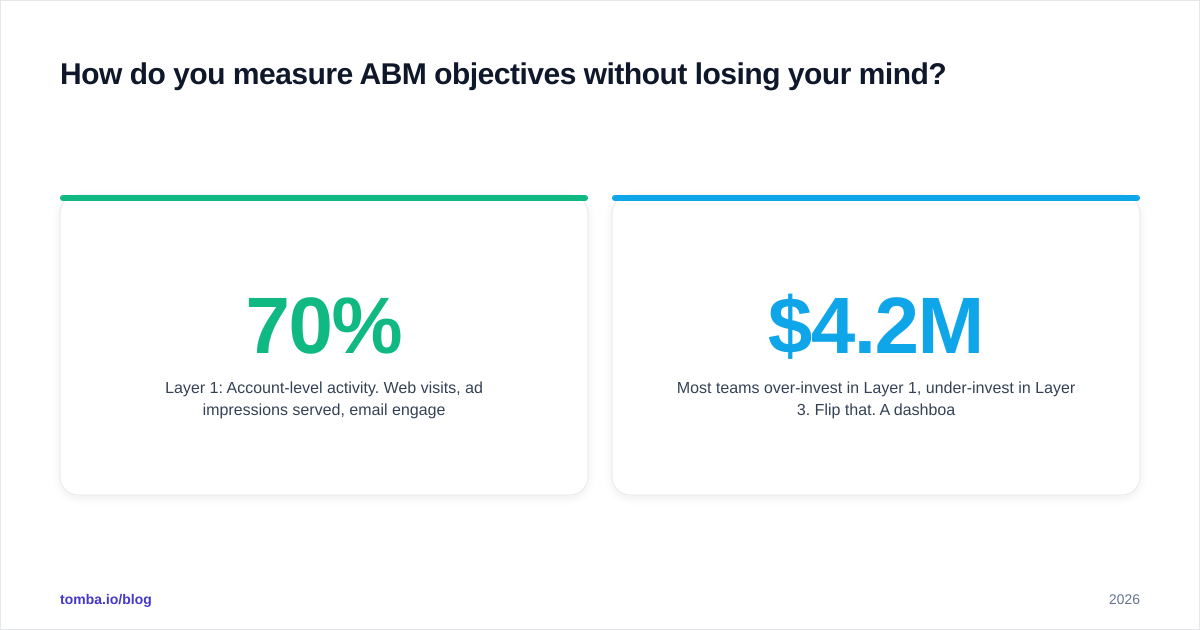
Layer 1: Account-level activity. Web visits, ad impressions served, email engagement, content consumption — all rolled up to the account, not the contact. This is where most marketing automation platforms fall short and where ABM platforms (6sense, Demandbase, RollWorks) earn their keep. If you can't afford an enterprise ABM platform, a combination of website visitor reveal, intent feeds, and a well-instrumented CRM gets you 70% of the way there for 10% of the cost.
Layer 2: Pipeline movement. Opportunities created on named accounts, stage progression, average deal size on the list. This lives in the CRM. The mistake here: not tagging opportunities with their source ABM program at creation time. If you can't filter "all opportunities from Q1 financial-services 1:few campaign" with one click, your reporting will die at the QBR.
Layer 3: Revenue and retention. Closed-won revenue, NRR, gross retention, expansion ARR. Tracked per ABM cohort, with a 12-month lookback minimum.
Most teams over-invest in Layer 1, under-invest in Layer 3. Flip that. A dashboard that shows "Q3 financial-services 1:few cohort: 12 logos closed, $4.2M ARR, 118% NRR at month 12" beats a slide of impression counts every quarter.
How do ABM objectives differ from demand gen?#
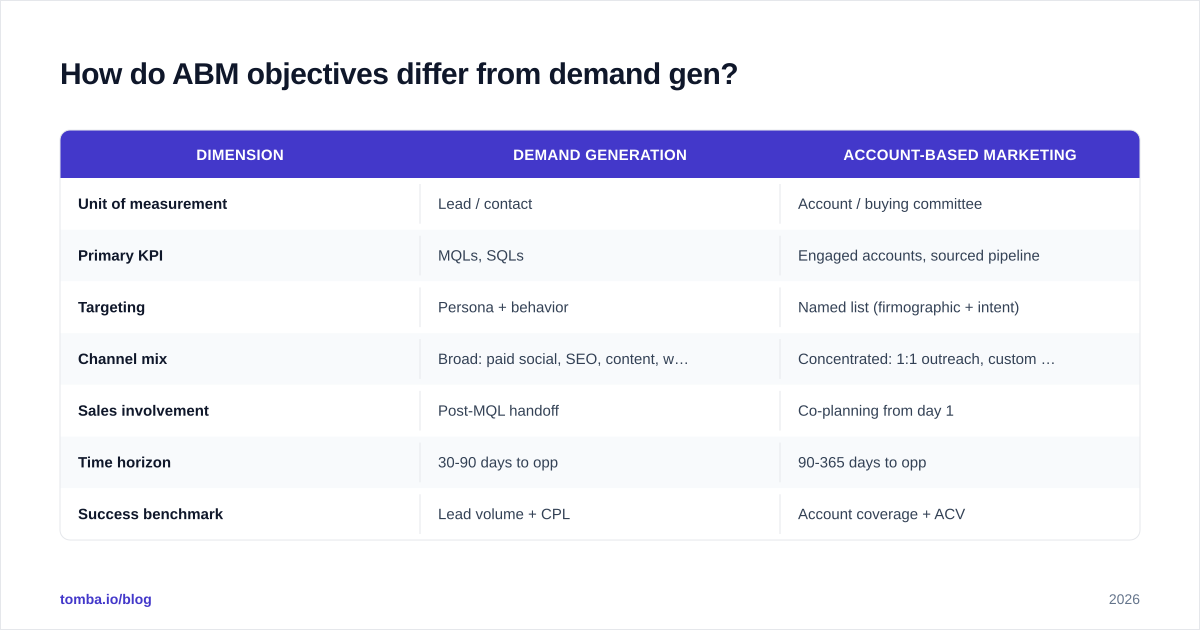
This is the single most useful comparison to internalize. The shift is structural, not cosmetic.
| Dimension | Demand generation | Account-based marketing |
|---|---|---|
| Unit of measurement | Lead / contact | Account / buying committee |
| Primary KPI | MQLs, SQLs | Engaged accounts, sourced pipeline |
| Targeting | Persona + behavior | Named list (firmographic + intent) |
| Channel mix | Broad: paid social, SEO, content, webinars | Concentrated: 1:1 outreach, custom content, executive events |
| Sales involvement | Post-MQL handoff | Co-planning from day 1 |
| Time horizon | 30-90 days to opp | 90-365 days to opp |
| Success benchmark | Lead volume + CPL | Account coverage + ACV |
| Funnel shape | Wide top, narrow bottom | Wide bottom, narrow top (flipped) |
| Tool stack | MAP + CRM | MAP + CRM + ABM platform + intent + enrichment |
| Win condition | High volume at low CPL | High win rate at high ACV on named accounts |
If your "ABM program" is mostly chasing the left column metrics with a target-account filter on top, you have a named-account demand-gen program. That's not bad — it's just not ABM, and it won't deliver ABM economics.
What tools support these ABM objectives?#
You need four pillars in the stack. You can buy them as one suite or assemble them from point tools.
1. Intent + account identification. 6sense, Demandbase, Bombora, or G2 buyer-intent. This tells you which accounts are actively researching your category. Without this, your "named account list" is a guess.
2. Contact data + enrichment. Email finder, domain search, and data enrichment keep your account contact records complete and verified. ABM dies when 40% of your decision-maker emails bounce.
3. CRM + opportunity tagging. Salesforce, HubSpot, Pipedrive. Required for Layer 2 measurement. The CRM is where the program's ROI gets proven or disproven.
4. Orchestration + outreach. Outreach, Salesloft, or a homegrown stack. This is where 1:1 sequences and personalized cadences actually run.
Tomba sits in pillar 2 — making sure that once you've identified an account and a persona, you can actually reach them with a deliverable email. See the B2B database and pricing pages for how the data layer plugs in.
What does a good ABM objective look like written down?#
Bad: "Increase target account engagement."
Better: "Increase target account engagement by 25%."
Good: "By end of Q3 2026, achieve 80% account coverage (3+ verified contacts per account) and 45% engagement rate (8+ engagement points per month) across the 150-account Tier 1 financial-services list, sourcing $6M in pipeline at 1.6x our inbound ACV, with 60% of opportunities co-touched by marketing and sales within 30 days of creation."
That last one is a contract. It's measurable, time-bound, tier-specific, co-owned, and ties activity to revenue. You can run a QBR off it. You can fire or promote against it.
Two more examples by tier:
- 1:1 strategic: "Open one $1M+ opportunity per Tier 1 account (n=15) within 9 months, with executive engagement from the CFO and VP of Operations on at least 60% of accounts."
- 1:Many programmatic: "Engage 35% of the 1,200-account mid-market list with 5+ engagement points each per quarter, producing $4M in marketing-sourced pipeline at our average ACV."
What's the biggest mistake teams make when reviewing ABM objectives?#
Reviewing them quarterly when the sales cycle is 9 months. By the time the QBR rolls around, the accounts you "engaged" in January are still mid-cycle in April, and you have no closed-won data yet — so you optimize the program based on Layer 1 vanity metrics and ruin the back-half.
The fix: track Layer 1 monthly, Layer 2 quarterly, Layer 3 annually. Don't make program decisions on a 30-day window when your customer takes 270 days to decide. HubSpot's research on enterprise sales cycles and G2's buyer-behavior reports both back this — enterprise B2B is slow, and patience is part of the program design.
Bringing it together#
ABM objectives only work when they are tier-specific, account-level, co-owned by sales and marketing, and measured across all three layers — activity, pipeline, and revenue. The seven goals above (coverage, depth, velocity, ACV, win rate, NRR, dark funnel) are the durable shortlist. Pick four. Write them down with the precision of the good example in the previous section. Review the right ones on the right cadence.
And whatever the strategy says about the buying committee, none of it ships if you can't reach the people on the list. That's the boring, foundational part — and it's where most programs break first.
Ready to make sure every named account on your list has verified, deliverable contact data for every persona that matters? Try the Tomba Email Finder free for 25 searches a month, or scale up on the Starter or Growth plan when your ABM list crosses the 200-account mark. Your strategy is only as good as the inbox it lands in.
Ready to find emails that actually work?
Join 150,000+ professionals who stopped guessing and started sending. Free credits on signup — no credit card required.
Get the Tomba newsletter
Practical outbound tactics and product updates — once every two weeks.
About the author