ABM One-to-Many in 2026: Scale Account-Based Marketing
ABM one-to-many lets you run account-based plays across hundreds of accounts at once. Here's how to structure tiers, content, and tooling in 2026.
ABM One-to-Many in 2026: How to Scale Account-Based Marketing Without Losing the Plot
TL;DR
- ABM one-to-many runs account-based plays across 200–2,000 accounts using cluster-level personalization, not per-account creative.
- It sits below one-to-one (5–50 named accounts) and one-to-few (50–200 clustered accounts) in the standard ITSMA tiering.
- The model works when you have clean firmographic data, intent signals, and a media surface — ads, email, and outbound — that can be segmented by industry, persona, or trigger.
- Stack essentials in 2026: an intent platform (6sense, Demandbase, ZoomInfo), a contact-data layer for the long tail (Tomba, Apollo), ad orchestration, and a CRM that respects account-level objects.
- The trap: most teams call list-based marketing "one-to-many ABM" when they're really doing demand-gen with extra steps. The test is whether sales and marketing share the same account list and the same scoreboard.
What is ABM one-to-many?#
ABM one-to-many is the high-volume tier of account-based marketing, designed to surround hundreds or thousands of target accounts with relevant, segment-level messaging without producing per-account creative. Instead of a custom landing page for Microsoft, you build a landing page for "enterprise fintech with 1,000+ employees showing intent on data residency."
The ITSMA framework that popularized ABM splits programs into three flavors:
- One-to-one — 5 to 50 named accounts, bespoke creative, executive sponsorship, six-figure ACV deals.
- One-to-few — 50 to 200 accounts grouped into clusters of 5–15, with light personalization per cluster.
- One-to-many — 200 to 2,000+ accounts, segmented by firmographics or intent, with templated personalization.
One-to-many is where ABM stops being a high-touch art and starts behaving like programmatic marketing with an account-shaped scoreboard. Done right, it lets a small team punch above its weight. Done wrong, it's just a contact list with a "tier 3" sticker on it.
How is one-to-many different from one-to-one and one-to-few ABM?#
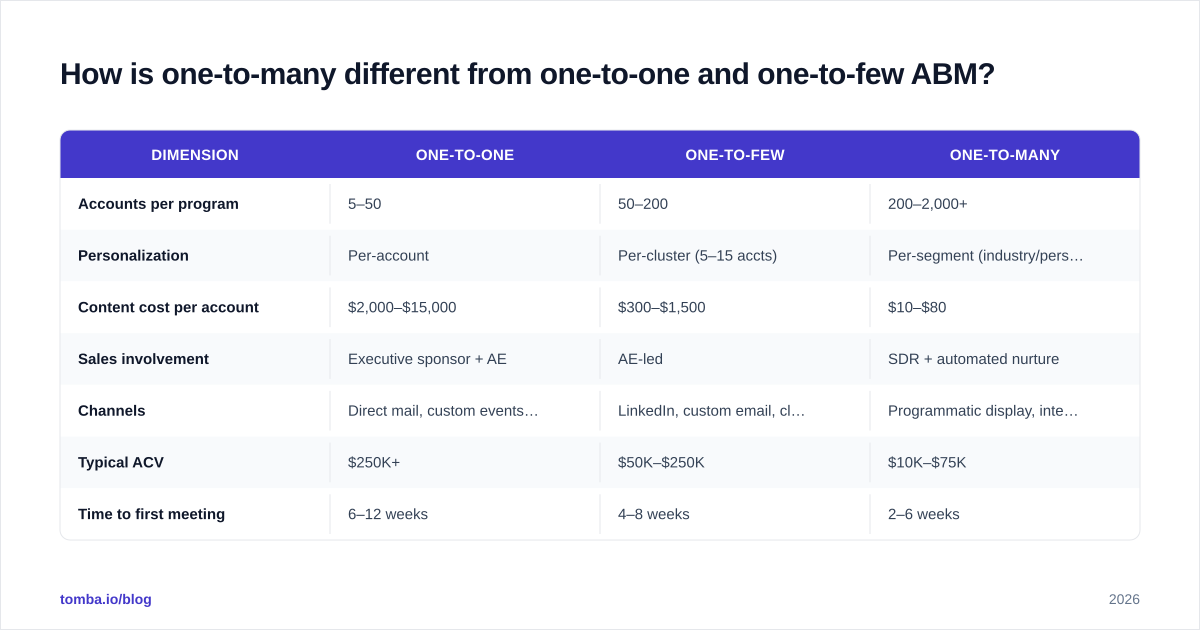
The differences cluster around four axes: account count, personalization depth, channel mix, and economics.
| Dimension | One-to-One | One-to-Few | One-to-Many |
|---|---|---|---|
| Accounts per program | 5–50 | 50–200 | 200–2,000+ |
| Personalization | Per-account | Per-cluster (5–15 accts) | Per-segment (industry/persona) |
| Content cost per account | $2,000–$15,000 | $300–$1,500 | $10–$80 |
| Sales involvement | Executive sponsor + AE | AE-led | SDR + automated nurture |
| Channels | Direct mail, custom events, ABM ads | LinkedIn, custom email, cluster ads | Programmatic display, intent-driven email, retargeting |
| Typical ACV | $250K+ | $50K–$250K | $10K–$75K |
| Time to first meeting | 6–12 weeks | 4–8 weeks | 2–6 weeks |
A useful mental model: one-to-one is sniper rifle, one-to-few is a shotgun, one-to-many is a shotgun loaded with smart shells. You're still firing into a defined zone — the target account list — but each pellet steers toward a slightly different persona.
When does ABM one-to-many actually make sense?#
Run one-to-many when at least three of these are true:
- Your TAM is 1,000–50,000 accounts. Smaller than 1,000 and you're better off going one-to-few. Larger than 50,000 and traditional demand-gen wins on cost-per-meeting.
- Average deal size is $10K–$75K ACV. Under $10K and the orchestration overhead eats the margin. Over $75K and per-account research becomes worth it again.
- Your buying committee has 4+ people. ABM exists because B2B buying is a team sport. If one champion can sign, run a lighter motion.
- You can name the trigger. Intent data, hiring signals, funding rounds, tech-stack changes. One-to-many lives on triggers — without them you're just spraying.
- You have account-level reporting in your CRM. If marketing reports on leads and sales reports on opportunities, you can't measure ABM. Period.
If you can't tick three, skip ABM and fix attribution first.
What does the ABM one-to-many tech stack look like in 2026?#
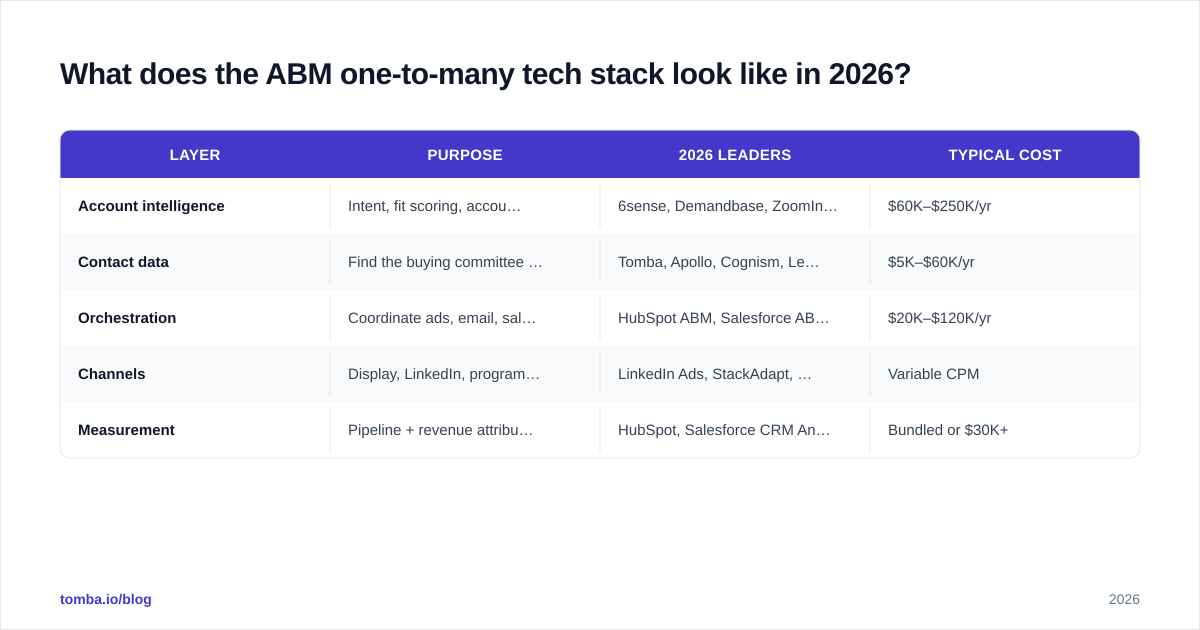
The stack has stratified into five layers. Most teams over-invest in the top two and under-invest in the bottom three.
| Layer | Purpose | 2026 Leaders | Typical Cost |
|---|---|---|---|
| Account intelligence | Intent, fit scoring, account discovery | 6sense, Demandbase,ZoomInfo Copilot | $60K–$250K/yr |
| Contact data | Find the buying committee at each account | Tomba, Apollo, Cognism, LeadIQ | $5K–$60K/yr |
| Orchestration | Coordinate ads, email, sales tasks | HubSpot ABM, Salesforce ABM, RollWorks | $20K–$120K/yr |
| Channels | Display, LinkedIn, programmatic, email | LinkedIn Ads, StackAdapt, Instantly | Variable CPM |
| Measurement | Pipeline + revenue attribution | HubSpot, Salesforce CRM Analytics, Dreamdata | Bundled or $30K+ |
The single most common failure mode: buying 6sense or Demandbase for $150K, then having no clean way to find email addresses for the buying committee at the accounts those platforms flag. Intent without contact coverage is a research report, not a pipeline. That's where a tight email finder layer matters — once 6sense tells you Acme is in-market for your category, you still need the four humans on the buying committee, and you need their work email by Friday.
For long-tail enrichment, most teams pair their intent platform with a high-coverage B2B database plus on-demand lookups for the buying committees flagged each week.
How do you build the account list?#
The list is the program. Get it wrong and no amount of creative or orchestration saves you. The standard approach:
Step 1 — Define the ICP, mathematically. Industry codes, employee bands, revenue bands, tech stack signals, geography. Write it as a SQL-able query, not a slide.
Step 2 — Pull the universe. Export the full TAM from your intent platform or B2B database. You're looking for 5,000–30,000 raw accounts before scoring.
Step 3 — Score against fit + intent. Fit is firmographic match. Intent is behavior (anonymous research, content downloads, hiring posts, funding events). The 2x2 of fit vs intent gives you the four quadrants — high/high goes to one-to-one, high/low goes to one-to-many, low/high goes to demand-gen, low/low gets dropped.
Step 4 — Lock the list for a quarter. Account churn mid-quarter destroys reporting. Add new accounts via a separate "intent surge" list that funnels in only when scores cross a threshold.
Step 5 — Map the buying committee. For every account in the one-to-many tier, you need 3–8 contacts spanning economic buyer, champion, user, and IT/security. Use a domain search to enumerate the relevant titles per company, then verify before any send.
What does the play look like in practice?#
A workable 90-day one-to-many program for a mid-market SaaS company:
Weeks 1–2 — Foundation. Lock 750 accounts, segment into 6 clusters (e.g., "fintech enterprise", "fintech mid-market", "healthtech enterprise", "healthtech mid-market", "industrial mid-market", "industrial enterprise"). Build 6 landing pages, each calling out the segment by name.
Weeks 3–4 — Awareness layer. Launch LinkedIn and programmatic display targeting all 750 accounts. Creative is segment-level. Goal: 30%+ account reach within the buying committee.
Weeks 5–8 — Engagement layer. Trigger 1:1 outbound from SDRs whenever an account shows engagement signal (ad click, page visit, content download). Use sequenced email with personalization at the cluster level — opening line references the segment, the rest is templated.
Weeks 9–12 — Sales handoff. Engaged accounts go to AEs with a one-pager summarizing all signals. AE books discovery. Marketing keeps nurturing the unengaged 60% with new content angles.
The metric stack: Account reach (% with 1+ buying committee impressions) → Account engagement (% with 2+ engaged contacts) → MQA (marketing-qualified account, replaces MQL) → Pipeline → Revenue.
How do you measure ABM one-to-many?#
Forget MQLs. The unit of work is the account. Track these five metrics — anything else is vanity:
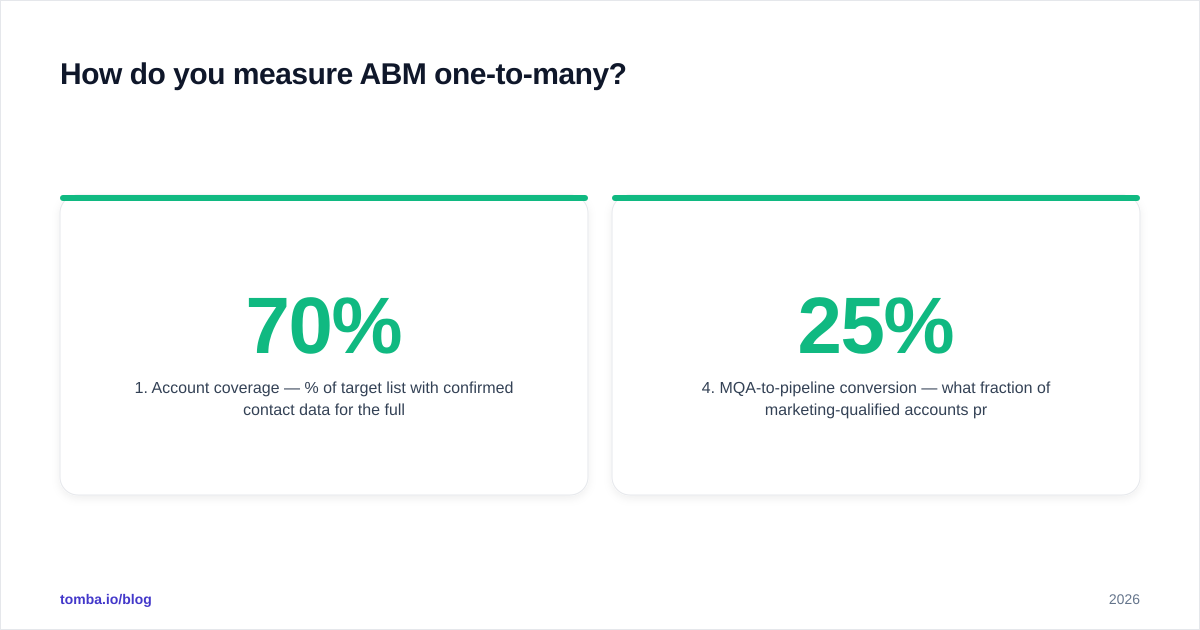
- Account coverage — % of target list with confirmed contact data for the full buying committee. Below 70% and the program is starving.
- Account reach — % of target list where ≥3 buying committee members saw your brand in the last 30 days.
- Account engagement rate — % of reached accounts that took an action (visit, download, reply).
- MQA-to-pipeline conversion — what fraction of marketing-qualified accounts produce a sales opportunity within 60 days. Healthy benchmark: 15–25%.
- Influenced pipeline / target list spend — total pipeline value from target accounts divided by program cost. A mature one-to-many program runs 5–10x.
A solid background read on account-based metrics is worth keeping handy when you set baselines for the first quarter.
What's the most common way ABM one-to-many fails?#
In order of frequency:
- List bloat. Teams pad the list to 3,000+ accounts to "be safe." Result: nothing gets enough touches and the program looks like ordinary demand-gen. Fix: ruthless tiering and a hard cap.
- No buying committee coverage. You target an account but only have one contact — usually marketing or HR, neither of whom buys your product. Fix: enrich every account to a minimum of 4 contacts across the right titles before launch.
- Marketing and sales on different lists. Marketing runs ABM. Sales runs their own outbound from a different list pulled from LinkedIn Sales Navigator. The accounts never overlap. Fix: one shared list, owned jointly, locked quarterly.
- No intent layer. Without intent or trigger signals, you can't tell a hot account from a cold one and you spend the same on both. Fix: invest in intent before scaling channel spend.
- Stale data. B2B contact data decays ~30% per year. By month nine of a flat list, a third of your bounces are people who left. Run a periodic email verifier sweep across the active list every 60 days.
Is ABM one-to-many the same as account-based demand gen?#
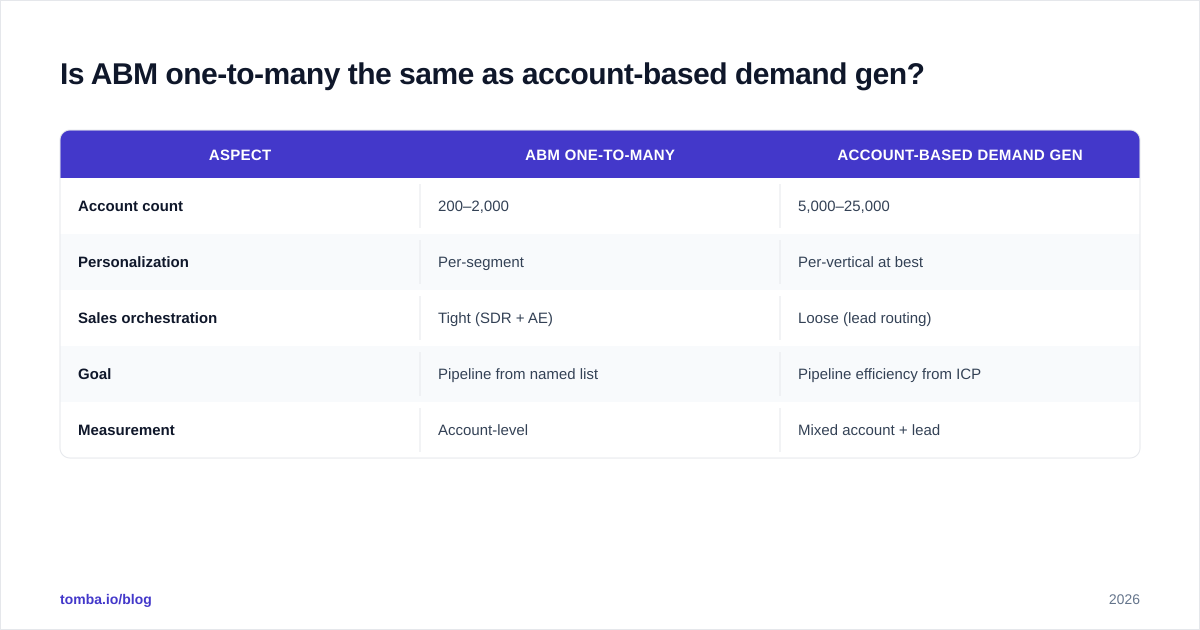
No, but they overlap enough to confuse most teams. Account-based demand gen (the term Gartner started using around 2024) is essentially ABM one-to-many's larger cousin — same idea, but extended to 5,000–25,000 accounts and looser personalization. The practical difference:
| Aspect | ABM One-to-Many | Account-Based Demand Gen |
|---|---|---|
| Account count | 200–2,000 | 5,000–25,000 |
| Personalization | Per-segment | Per-vertical at best |
| Sales orchestration | Tight (SDR + AE) | Loose (lead routing) |
| Goal | Pipeline from named list | Pipeline efficiency from ICP |
| Measurement | Account-level | Mixed account + lead |
Pick one-to-many when sales agrees to work the list. Pick account-based demand gen when sales wants whatever marketing produces but won't commit to a fixed account universe. Most B2B companies eventually run both side by side.
How do AI and intent data change one-to-many in 2026?#
Three shifts to plan around:
Generative segmentation. LLM-driven tools now cluster your account list by behavior patterns, not just firmographics. Instead of "enterprise fintech," you get "fintechs that mentioned compliance fatigue in two of their last three earnings calls." Creative gets sharper per cluster.
Predictive intent. Platforms moved from "this account researched your category this week" to "this account is 60 days from a buying event based on hiring velocity + funding stage + tech-stack changes." That lets one-to-many programs front-load spend before the RFP starts.
Agentic outbound. AI SDRs now write the cluster-level opener, suggest the next-best action, and even draft the meeting brief. The human still picks the account, owns the relationship, and runs the meeting — but the busywork around the relationship is automated. Pair this with a clean email finder API and the discovery-to-first-touch cycle drops from days to hours.
The thing AI doesn't fix: bad data and unclear ownership. Garbage list in, sophisticated garbage out.
What does a healthy ABM one-to-many org structure look like?#
The teams that ship are usually built like this:
- ABM lead — one person, owns the program, reports into marketing but has a dotted line to sales.
- Account researcher / data ops — owns list hygiene, enrichment, intent scoring. Critical and underrated.
- Content / creative — produces segment-level assets (1 landing page, 3 ad sets, 2 email tracks per cluster per quarter).
- Demand / paid — runs the ad orchestration across LinkedIn, programmatic, and retargeting.
- SDRs aligned to the list — not the whole pipeline, just the ABM accounts. Compensated on meetings booked from the target list.
- AEs sponsoring tier 1 and 2 sub-segments — they don't run the program, but they review weekly engagement and know which accounts are warming.
The mistake: making ABM a side project of the demand-gen team. It becomes a tab in someone's spreadsheet and dies on the vine within two quarters.
Get the contact layer right before scaling spend#
The ad budget, the intent platform, the creative — none of it matters if you can't reach the buying committee. Most one-to-many programs collapse because marketing runs out of contact coverage by month two and the AEs lose patience.
Tomba's email finder gives ABM teams the contact layer that intent platforms can't: bulk discovery of the actual buying committee at the actual accounts your fit-and-intent model flagged, verified before send so your sender reputation survives a 750-account launch. Pair it with a quarterly verify pass and you keep the list working long after the kickoff energy fades. See current Tomba pricing for the volume tiers — the Growth plan covers most mid-market ABM programs without forcing you into an enterprise contract.
Ready to find emails that actually work?
Join 150,000+ professionals who stopped guessing and started sending. Free credits on signup — no credit card required.
Get the Tomba newsletter
Practical outbound tactics and product updates — once every two weeks.
About the author