ABM Pipeline in 2026: How to Build One That Actually Closes
Most ABM pipelines stall because teams treat them like inbound funnels with bigger logos. Here's how to build a 2026 ABM pipeline that produces booked revenue, not just hand-raisers.
ABM Pipeline in 2026: How to Build One That Actually Closes
TL;DR
- An ABM pipeline is an account-shaped funnel — stages track buying groups, not individual contacts, and progression requires multi-threaded engagement, not a single MQL.
- Most teams fail because they bolt ABM onto an MQL-era CRM. Stages, scoring, SLAs, and forecasting all need to be re-stated at the account level.
- The 2026 stack is leaner: an ICP scorer, an intent signal, a contact-data layer (email + phone + LinkedIn), a sequencer, and a CRM with account-level reporting.
- Pipeline coverage for ABM should be 4x quota for new logos, 2.5x for expansion. Anything lower and your top-of-funnel is broken; higher and your list is too loose.
- The single highest-leverage move is account list hygiene. A 200-account list you actually research outperforms a 2,000-account list you blast.
What is an ABM pipeline, really?#
An ABM pipeline is a sales pipeline where the unit of progression is the account, not the lead. In a classic MQL funnel, a single person fills out a form and moves through stages. In an ABM pipeline, you track whether the buying group at Acme Corp — 4 to 12 humans across IT, finance, and the line of business — is collectively warming up.
That sounds like a semantic distinction. It is not. It changes:
- Stage definitions. "Demo booked" with one contact at a 5,000-employee enterprise is not the same as "demo booked" with the CIO plus two department heads.
- Scoring. A contact-level lead score is meaningless. You need an account score that aggregates engagement, fit, and intent across the buying group.
- SLAs. "Respond to a lead in 5 minutes" doesn't apply. Your SLA is now "engage 3 personas at a target account within 14 days of the trigger."
- Forecasting. You stop forecasting off MQL→SQL→Opp ratios and start forecasting off account coverage, persona depth, and stage velocity.
If your CRM still reports by lead source and MQL count, you have an MQL funnel with an ABM hat on it. That's the pipeline most teams are running in 2026, and it's why the ABM category on G2 is full of churned customers.
Why do most ABM pipelines stall?#
I've reviewed dozens of these pipelines. The same five failures show up:
- The target list is too long. When a "Tier 1" list has 1,500 accounts, nobody researches anybody. The list becomes a contact dump.
- One contact = an account. SDRs hit a single VP, get a polite no, and mark the account "not interested." That's an MQL move, not an ABM one.
- Intent data is treated as a buying signal. Bombora surges and G2 visits are warming signals, not buying signals. Mistaking the two collapses your stage definitions.
- No buying-group definition. Reps work whoever responds. There's no rule that says "we don't take Acme to demo without IT plus finance."
- The CRM can't report on accounts. Salesforce and HubSpot both support account-level reporting, but most orgs never configured it. So leadership sees lead counts and panics.
What are the stages of a modern ABM pipeline?#
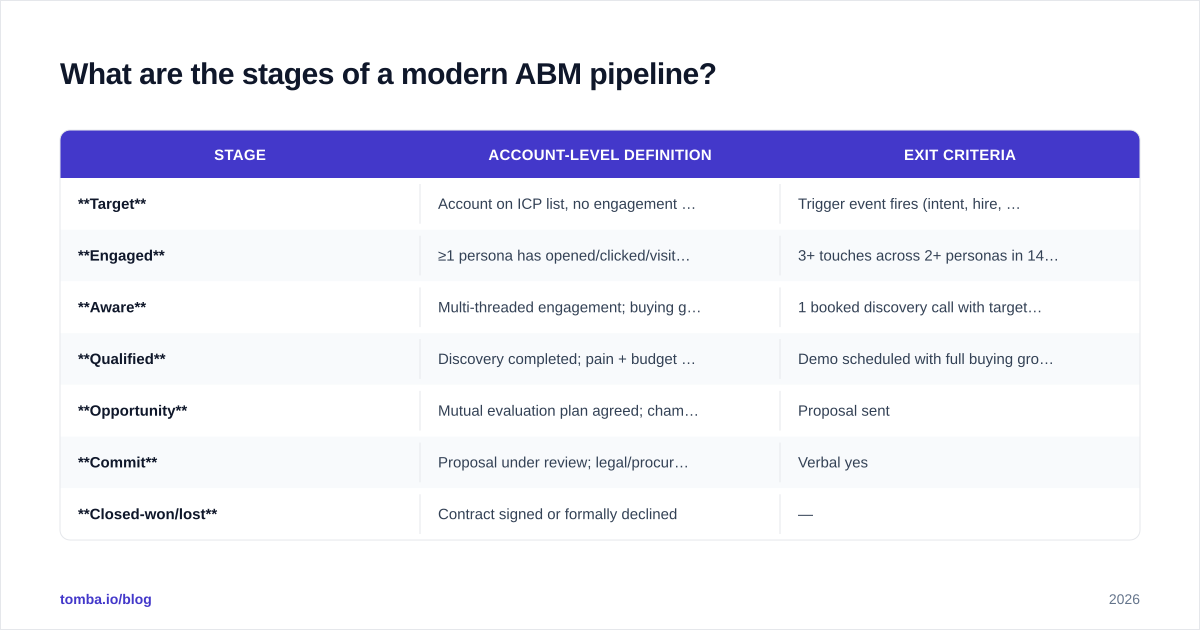
Skip "MQL" and "SQL." They don't translate. Here's the stage set I see working in 2026:
| Stage | Account-level definition | Exit criteria |
|---|---|---|
| Target | Account on ICP list, no engagement yet | Trigger event fires (intent, hire, funding, tech change) |
| Engaged | ≥1 persona has opened/clicked/visited, OR 1+ rep activity logged | 3+ touches across 2+ personas in 14 days |
| Aware | Multi-threaded engagement; buying group identified | 1 booked discovery call with target persona |
| Qualified | Discovery completed; pain + budget + timeline confirmed across ≥2 stakeholders | Demo scheduled with full buying group |
| Opportunity | Mutual evaluation plan agreed; champion identified | Proposal sent |
| Commit | Proposal under review; legal/procurement engaged | Verbal yes |
| Closed-won/lost | Contract signed or formally declined | — |
The non-negotiables: stages must require account-level evidence (multiple personas, multiple touches), and the exit criteria must be observable in the CRM, not vibes-based.
How do you build the target account list?#
This is the unglamorous foundation. Get it wrong and nothing downstream matters.
Step 1 — Define ICP at the firmographic + technographic level. Industry, employee count, revenue band, tech stack signals, geographic constraint. Be ruthless. If your sweet spot is 200–800-employee fintech in NA running Salesforce, that is the ICP — not "B2B SaaS."
Step 2 — Source the universe. Pull from your B2B database, enrich with a vendor like ZoomInfo or Apollo, then layer LinkedIn Sales Navigator for the human signal.
Step 3 — Score each account. A simple 0–100 score with three pillars:
- Fit (firmographic + technographic match): 40 points
- Intent (Bombora, G2, 6sense, or first-party): 30 points
- Engagement history (past touches, opps, churned customers): 30 points
Step 4 — Tier the list. Tier 1: 1:1 (50–150 accounts, named reps). Tier 2: 1:few (300–800, pod-based). Tier 3: 1:many (2,000+, programmatic only). Most teams over-stuff Tier 1.
Step 5 — Refresh quarterly. Accounts age out. Funding rounds, exec hires, and product launches all change scoring.
For the contact-enrichment layer once accounts are tiered, the domain search is the fastest way to map every reachable email at a target without scraping LinkedIn one human at a time.
What does the buying-group map look like?#
Before you touch a sequence, draw the buying-group map for each Tier 1 account. Forrester's research puts the average enterprise B2B buying group at 6 to 10 people. Gartner's number is similar. You need at least 4 of them engaged before you call an account "opportunity."
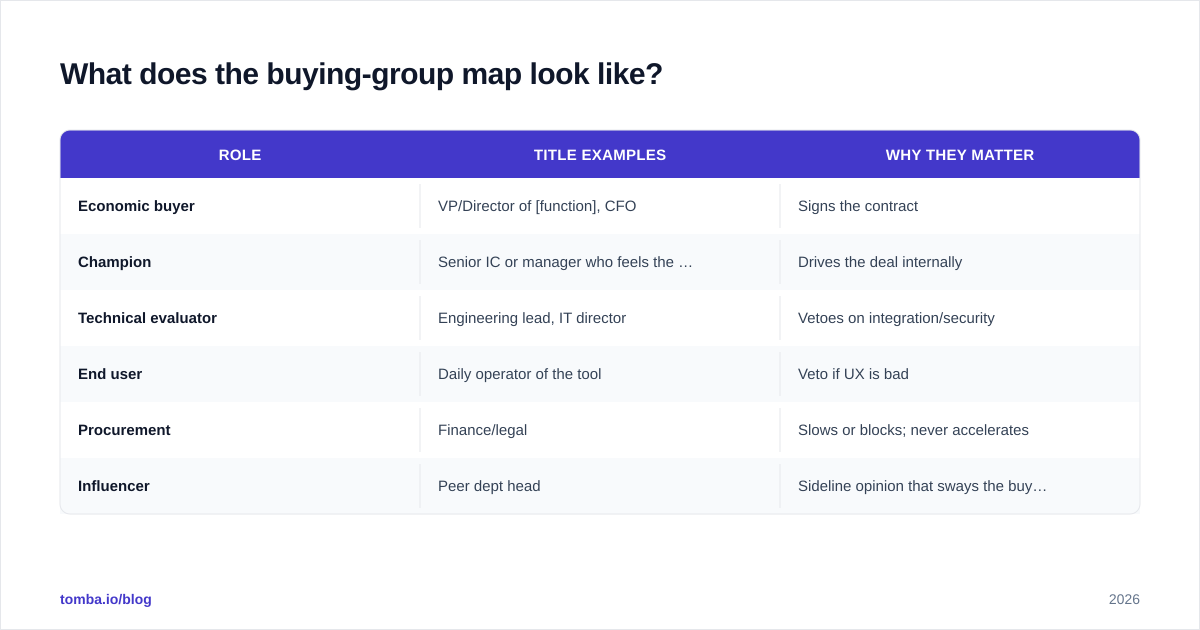
A practical buying-group template for a mid-market SaaS deal:
| Role | Title examples | Why they matter |
|---|---|---|
| Economic buyer | VP/Director of [function], CFO | Signs the contract |
| Champion | Senior IC or manager who feels the pain daily | Drives the deal internally |
| Technical evaluator | Engineering lead, IT director | Vetoes on integration/security |
| End user | Daily operator of the tool | Veto if UX is bad |
| Procurement | Finance/legal | Slows or blocks; never accelerates |
| Influencer | Peer dept head | Sideline opinion that sways the buyer |
For each account, fill in real names. Use a LinkedIn finder to map titles to emails, then validate the addresses with an email verifier before your sequencer touches them. Bad data poisons your sender reputation and your dashboards in one shot.
What tools do you actually need in 2026?#
The ABM tool category is bloated. You do not need a $60k/year platform to start. You need five layers, and each one has a budget version.
| Layer | What it does | Examples |
|---|---|---|
| ICP + scoring | Defines and scores accounts | Clearbit, 6sense, Demandbase, or a spreadsheet |
| Intent | Surfaces in-market signals | Bombora, G2 Buyer Intent, 6sense, LinkedIn Insight Tag |
| Contact data | Emails, phones, LinkedIn URLs | Tomba, Apollo,ZoomInfo, RocketReach |
| Outbound execution | Sequencing + multi-channel | Outreach, Salesloft, Smartlead, Instantly |
| CRM + reporting | Account-level pipeline truth | Salesforce, HubSpot, Pipedrive |
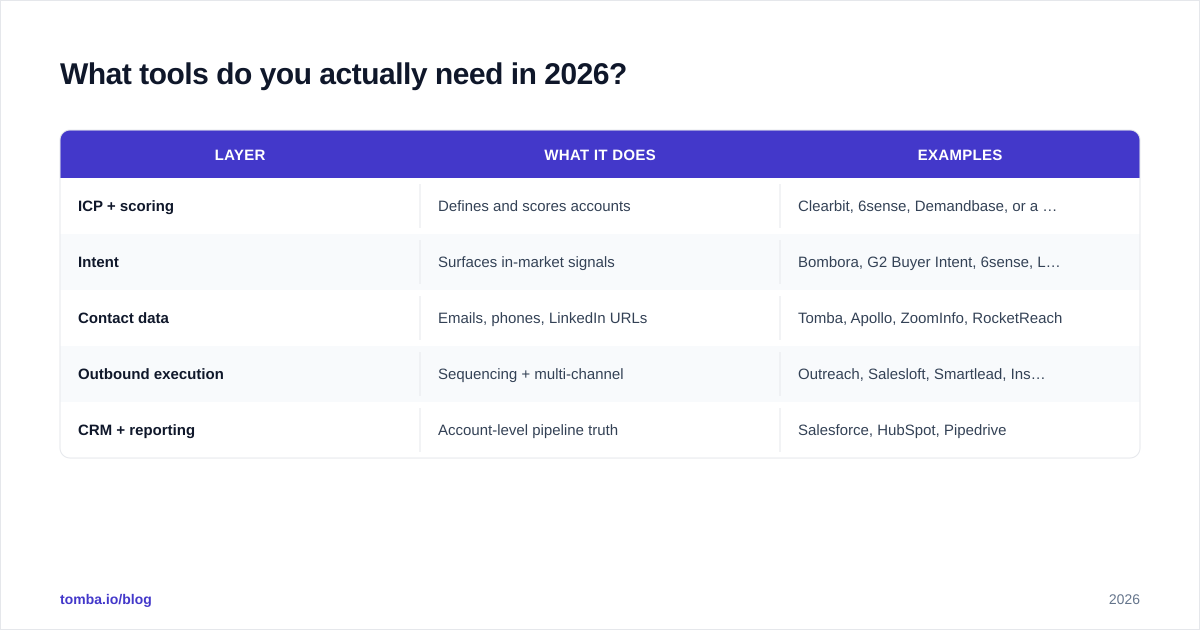
If you're under $5M ARR, you can run a credible ABM motion on: spreadsheet ICP scoring, LinkedIn Sales Navigator for intent-by-proxy, Tomba's email finder and phone finder for contact data, Smartlead or Salesloft for sequencing, and HubSpot for the CRM. That's roughly $800/month total versus the $5k–8k/month enterprise stack.
How do you score ABM pipeline health?#
Forget MQL volume. The four metrics that matter:
- Account coverage. % of Tier 1 accounts with ≥1 engaged buying-group member. Target: 60%+ within 90 days.
- Persona depth. Average # of personas engaged per opportunity account. Target: 4+.
- Stage velocity. Median days per stage. If "Engaged → Aware" takes more than 21 days, your sequences aren't multi-threaded enough.
- Pipeline coverage. Pipeline value ÷ quota. ABM new-logo: 4x. Expansion: 2.5x.
Track these weekly in a single dashboard. If your CRM can't produce them, the CRM is the problem, not the strategy.
A useful sanity check from HubSpot's research: ABM programs with 4+ engaged personas per deal close at 2–3x the rate of single-threaded deals. The number isn't magic — it's just what multi-threading does when you actually do it.
How does intent data plug into the pipeline?#
Intent data is a stage accelerator, not a stage creator. Concretely:
- A Bombora surge on a target keyword bumps a Tier 1 account from "Target" to "Engaged" only when paired with at least one observed action (visit, click, rep activity).
- A G2 category visit promotes the account to a high-priority outreach queue with a 48-hour SLA.
- A repeat surge on the same week (2+ signals) is the trigger for a personalized 1:1 sequence rather than a generic 1:few one.
Do not, under any circumstance, let your CRM auto-progress accounts based on intent alone. That's how reps end up calling people who haven't actually raised their hand and burning the brand. Intent prioritizes the queue; humans progress the pipeline.
What does a working 90-day rollout look like?#
Don't try to build the full thing in week one. A realistic phased rollout:
Days 1–14 — Foundation. Lock ICP. Build the Tier 1 list (start with 100 accounts). Define buying-group personas. Configure account-level pipeline stages in the CRM. Wire up account scoring.
Days 15–45 — Engagement engine. Run bulk email finder on all 100 accounts to map the buying group. Verify everything. Build three sequences: cold (no intent), warm (intent signal), and re-engagement (past opp). Launch.
Days 46–75 — Measurement. Stand up the four-metric dashboard. Run a weekly account review with sales + marketing in the same room. Kill sequences that aren't producing replies after 100 sends.
Days 76–90 — Tune and scale. Promote your best Tier 2 accounts based on observed engagement. Retire dead Tier 1s. Add a second tier of plays (events, direct mail, podcast pitches) for top accounts only.
You'll have one full quarter of clean data by day 90. That's when forecasting actually starts working.
What are the most common pitfalls in 2026?#
A short hit list of what I see breaking right now:
- AI personalization that reads as AI. Generic LLM-generated openers ("I noticed your company is focused on...") have a worse reply rate than no personalization at all. If you use AI for openers, feed it a real research blurb from a human, not just the company website.
- Single-channel outreach. Email-only ABM is dead. The accounts that close are touched on email + LinkedIn + (sometimes) phone within the same week.
- Sales and marketing don't share the list. Marketing runs ads to one list, sales calls a different list. The ABM motion only compounds when both motions hit the same accounts.
- No exit criteria for "interested but not buying." Champions leave. Accounts go dark. Without a recycle path, opportunities rot in pipeline and inflate coverage falsely.
- Treating ABM as a marketing program. ABM is a revenue operations function. If it lives only in marketing, it'll never get sales adoption.
How does this fit with the rest of your GTM motion?#
ABM doesn't replace inbound or PLG. It complements them. A balanced 2026 GTM looks like:
- Inbound — captures hand-raisers, feeds the lower-cost-to-acquire segment
- PLG — drives bottom-up adoption, identifies usage signals that promote accounts into ABM Tier 1
- ABM — the named-account top-down motion, owns the strategic logos and expansion
The signal you've struck the right balance: your PLG signups flag accounts that get pulled into the ABM motion, and your ABM-won deals seed PLG land-and-expand on adjacent teams. If those two loops don't exist yet, that's the integration work.
For prospecting workflow specifically — when you've identified a target account and need contact paths fast — combine the Chrome extension for LinkedIn-side capture with HubSpot integration so verified contacts land in the CRM with the right account association already attached.
Build your 2026 ABM pipeline with the right contact data#
A good ABM pipeline is 30% strategy and 70% execution discipline. The strategy fits on one page. The execution is whether your reps can actually reach the 6-person buying group at every Tier 1 account within 14 days of the trigger — and whether the data they're working from is current.
If contact data is the bottleneck, start there. Tomba's email finder and phone finder are built for exactly this: map the buying group at a target account, verify the addresses before your sequencer burns reputation, and push the clean records into your CRM with the right account association. The Free tier (25 searches/month) is enough to test the workflow on a handful of Tier 1 accounts. The Starter plan at $49/month covers a 100-account Tier 1 list with room for expansion mapping. See Tomba pricing for the full breakdown.
Build the list right, work the buying group, and the pipeline math takes care of itself.
// get started
Find, verify and enrich your first contacts today
Start on the free plan with 25 searches a month, then scale when your team is ready.
Free plan · No credit card required · GDPR & CCPA
// about the author