Best ABM Platforms in 2026: Honest Buyer's Guide
A neutral 2026 buyer's guide to ABM platforms — what they actually do, how the top vendors compare, and how to avoid paying for features your team won't use.
Best ABM Platforms in 2026: Honest Buyer's Guide
TL;DR
- ABM platforms in 2026 cluster into three tiers: full-stack orchestration (6sense, Demandbase), intent + signal layers (Bombora, G2 Buyer Intent), and ad/display layers (RollWorks, Terminus).
- Expect $40K–$150K/year for a real ABM platform. Anything cheaper is usually account list management plus retargeting in a trench coat.
- Most teams under 200 reps don't need a full ABM platform — they need clean firmographic data, a tight ICP list, and an outbound motion that actually runs.
- Intent data sounds magical, but vendors disagree on the same accounts more than half the time. Treat it as a tiebreaker, not a trigger.
- The fastest ABM wins in 2026 come from pairing accurate contact data with sharp human outreach — not from buying the biggest dashboard.
What are ABM platforms, in plain English?#
Account-based marketing platforms are the air-traffic-control tower for a B2B revenue team that has decided to focus on a finite list of accounts instead of casting a wide net. They tell you which accounts are in-market, which buyers inside those accounts are paying attention, and how to coordinate ads, email, sales touches, and chat so the same message reaches the same people without contradiction.
Think of it like a wedding planner. Cold outbound is throwing flyers at a stadium. ABM is hand-delivering invitations to a curated guest list, then making sure the venue, the band, the caterer, and the toast all match the couple. The platform is the planner who keeps everyone in sync.
Technically, an ABM platform usually bundles four things:
- Account selection — firmographic + technographic data to build target lists.
- Intent signals — third-party signals (publisher consortium data, ad bid stream, G2/Capterra activity) and first-party signals (your site, your product).
- Orchestration — workflows that fire ads, alerts, tasks, and emails when an account hits a threshold.
- Measurement — account-level attribution, pipeline influence, and engagement scoring.
If a tool only does #1 and #4, it's a marketing-qualified-lead reporter dressed in fancier clothes.
Who actually needs an ABM platform in 2026?#
The honest answer: fewer companies than the category vendors would like you to believe.
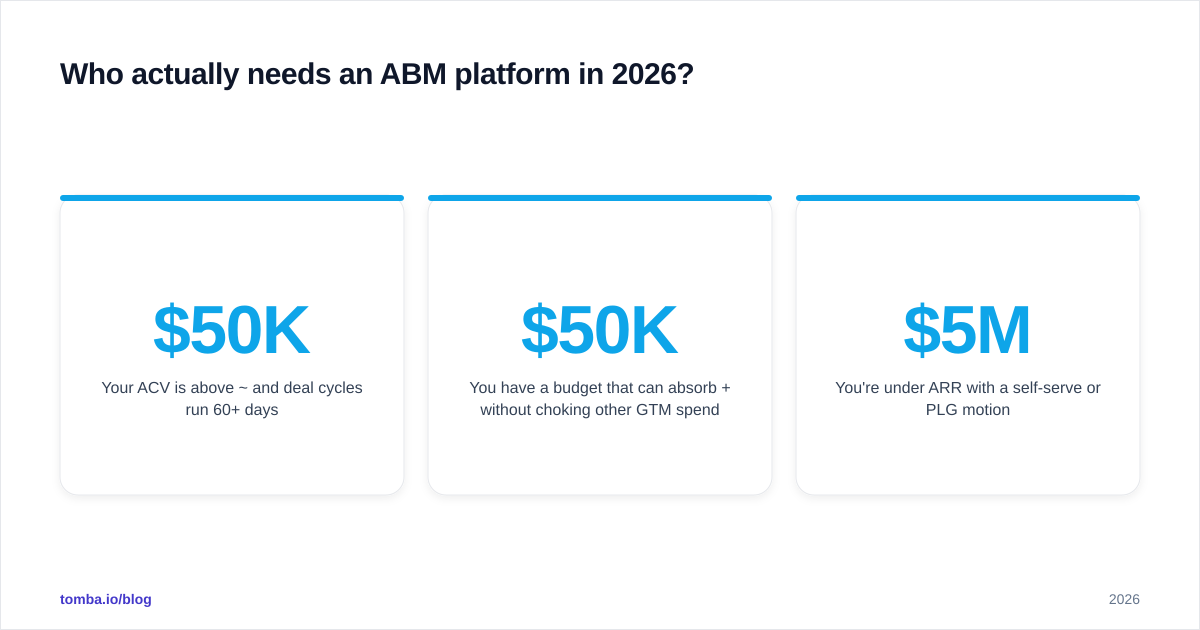
You probably do need an ABM platform if:
- Your ACV is above ~$50K and deal cycles run 60+ days.
- Your TAM is small and finite (under 10,000 accounts).
- You have at least 8–10 SDRs/AEs who can act on signals quickly.
- Marketing and sales already share a CRM and pipeline definition.
- You have a budget that can absorb $50K+/year without choking other GTM spend.
You probably don't need one — yet — if:
- You're under $5M ARR with a self-serve or PLG motion.
- Your ICP is still shifting quarter to quarter.
- Your sales team can't follow up on existing inbound leads inside 24 hours.
- Your CRM data is dirty (duplicate accounts, stale contacts, no enrichment).
For that second group, the sequence is data first, then ABM. Get your accounts and contacts clean with proper data enrichment, validate emails with an email verifier, and run a deliberate outbound program before you spend on orchestration.
Which ABM platforms matter in 2026?#
The category has consolidated. Here are the names you'll see on every shortlist and what each one actually leans into.
6sense#
The category's gravity well. 6sense built its reputation on its own intent model (Sales Intelligence Network) layered over Bombora data. Strong at predictive scoring and account journey staging. Best fit for enterprise teams with mature RevOps and a willingness to pay six figures. Pricing is opaque and usually quote-only.
Demandbase#
The other heavyweight. Demandbase pushes harder on advertising and account-based engagement — its own DSP, IP-targeted display, and a strong identity graph. Better than 6sense if you genuinely run paid display campaigns at scale. Worse if you mostly want signal-to-outbound workflows.
RollWorks#
NextRoll's ABM arm. More accessible pricing than 6sense or Demandbase, and a cleaner UX. Skews toward mid-market. Its ad network and journey stages are solid; intent depth is thinner than the enterprise tier.
Terminus#
Has gone through ownership changes and is now narrower. Strong chat-based engagement and email signature marketing through Sigstr. Good for teams that want ABM ads + email-signature reach without committing to enterprise pricing.
Mutiny#
Not a traditional ABM platform — Mutiny personalizes your website for target accounts. It pairs well with whichever ABM platform you pick, rather than replacing one.
Bombora#
Not a platform per se; it's the intent data layer that powers many of the others. You can also license it directly into your CRM if you don't want a full ABM stack.
G2 Buyer Intent#
A first-party intent feed: who's reading your G2 listing, your competitors' listings, and category pages. Worth pairing with any ABM platform because the buying-cycle signal is closer to bottom-of-funnel.
How do ABM platforms compare on price, intent depth, and orchestration?#
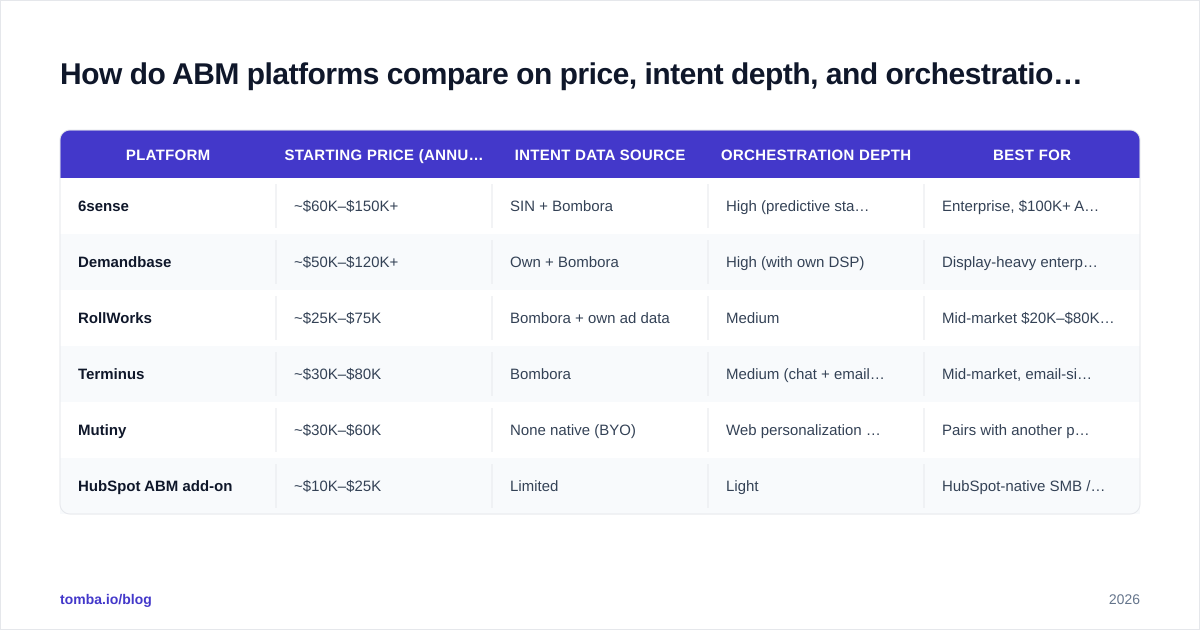
The single most useful table you can build before any demo is a side-by-side of what you'll actually use vs. what's bundled. Here's a 2026 snapshot of the platforms most often shortlisted.
| Platform | Starting price (annual) | Intent data source | Orchestration depth | Best for |
|---|---|---|---|---|
| 6sense | ~$60K–$150K+ | SIN + Bombora | High (predictive stages, alerts, workflows) | Enterprise, $100K+ ACV |
| Demandbase | ~$50K–$120K+ | Own + Bombora | High (with own DSP) | Display-heavy enterprise |
| RollWorks | ~$25K–$75K | Bombora + own ad data | Medium | Mid-market $20K–$80K ACV |
| Terminus | ~$30K–$80K | Bombora | Medium (chat + email-sig) | Mid-market, email-sig native |
| Mutiny | ~$30K–$60K | None native (BYO) | Web personalization only | Pairs with another platform |
| HubSpot ABM add-on | ~$10K–$25K | Limited | Light | HubSpot-native SMB / mid-market |
A few honest caveats. Quoted starting prices are what teams report on G2 and in vendor RFPs in 2026; vendors will negotiate hard at end of quarter. Orchestration depth is judged on what works out of the box, not what's possible with consulting hours. None of these platforms publish list pricing — if a sales rep tells you otherwise, ask for it in writing.
What do ABM platforms actually do that your CRM doesn't?#
This is the question to ask before signing. A modern CRM (Salesforce, HubSpot, Pipedrive) can already store accounts, score them, and route them. ABM platforms earn their seat by adding:
- Third-party intent. Anonymous signals from outside your site — who's researching your category somewhere else on the web.
- Account de-anonymization. Mapping anonymous web visits to companies via reverse IP + identity graphs. This is what website visitor reveal tools do at a smaller scale.
- Cross-channel orchestration. A single trigger ("account hits Stage 3") fires ads, alerts, and tasks in one motion instead of separate Zaps.
- Account-level reporting. Pipeline influenced, engagement minutes, account journey stage — rolled up at the account, not the lead.
If you only need one or two of these, buy them point-by-point. If you need all four and your data hygiene is good, a full ABM platform pays back. If your data hygiene is bad, you're paying $80K to amplify noise.
How does intent data actually work — and how much should you trust it?#
Intent data is the most over-promised piece of the ABM stack. Three honest things to know:
It's probabilistic, not deterministic. Most intent vendors don't observe individual humans. They infer surges from co-op publisher data, IP-resolved sessions, and bid-stream traffic. A "high intent" score means "this account's traffic on related topics is up vs. baseline" — not "Susan in procurement just downloaded your RFP template."
Vendors disagree. Forrester and other analysts have repeatedly noted that overlap between two intent providers on the same account list is often under 50%. That's not a bug — they're sampling different surfaces — but it means you shouldn't treat any one feed as ground truth.
First-party beats third-party. A buyer who visited your pricing page twice in a week and downloaded a competitor comparison is worth more than a Bombora surge. Build your scoring so first-party signals dominate.
The practical playbook: use third-party intent to widen your account list (find accounts you didn't know were looking), then use first-party signals to prioritize within that list.
What does an ABM platform NOT solve?#
A list of things ABM vendors won't put on the slide:
- Bad contact data. If your CRM has the wrong people in your target accounts, an ABM platform can't fix that. You still need an email finder, a verifier, and ideally a domain search to round out org charts.
- A weak ICP. Garbage in, garbage out. If your target account list is "anyone in SaaS over 100 employees," the platform will surface noise.
- Slow follow-up. Intent signals decay in days. If your reps wait a week to act, you've paid for an inbox notification.
- Sales–marketing misalignment. Two teams with different definitions of "engaged account" will fight inside the platform instead of outside it.
- Creative. The platform fires ads, but the ad has to convert. A great DSP can't save a generic banner.
This is why mid-market teams often get more pipeline lift from fixing data and outbound mechanics than from buying a platform. Tighten your contact discovery — find decision-makers by company with a proper domain search — and validate everything before it hits a sequence.
What's the realistic ROI math?#
Vendors quote pipeline-influenced numbers that look enormous because "influenced" includes any account that touched any campaign. The honest math:
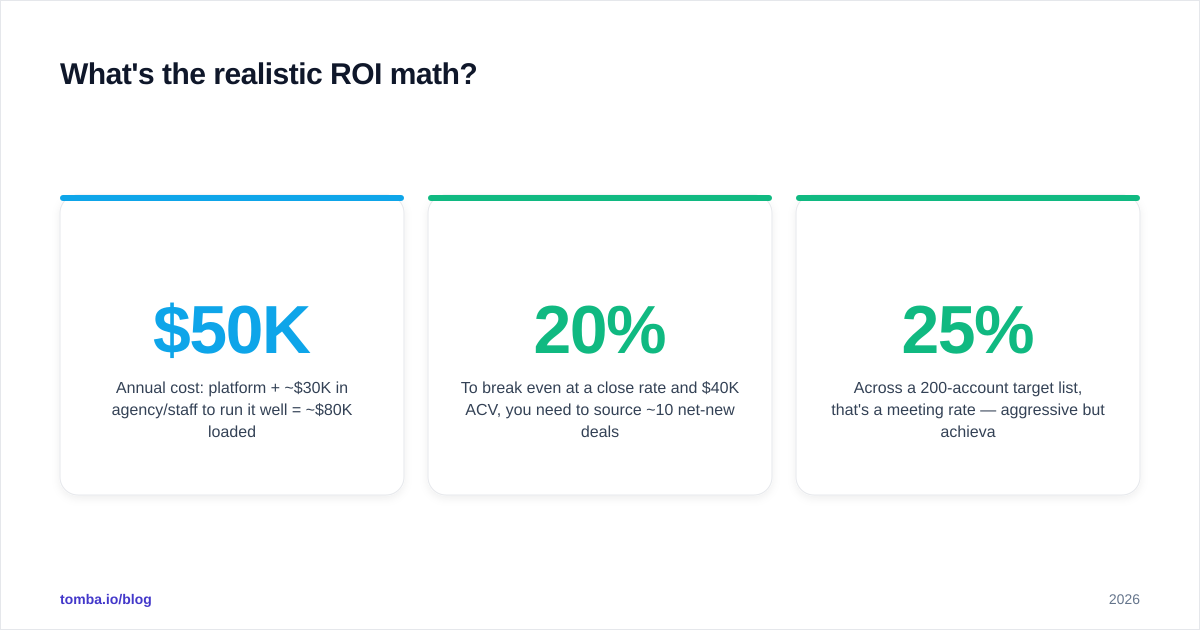
- Annual cost: $50K platform + ~$30K in agency/staff to run it well = ~$80K loaded.
- To break even at a 20% close rate and $40K ACV, you need to source ~10 net-new deals attributable to ABM activity.
- That's roughly 50 sales-accepted opportunities from the platform's signal-to-meeting motion.
- Across a 200-account target list, that's a 25% meeting rate — aggressive but achievable with great execution.
If you can't see a path to those numbers with your current team size, defer the buy.
How should you evaluate ABM platforms — the buyer's checklist?#
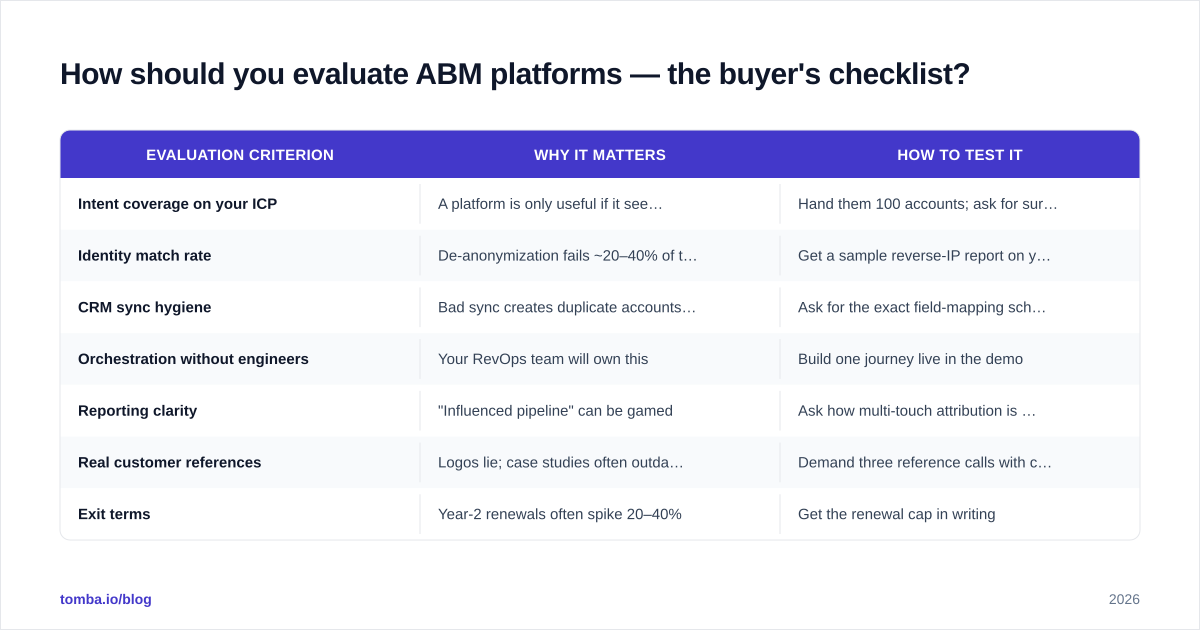
When you sit through three demos in a week, every platform looks great. Score them on these dimensions instead.
| Evaluation criterion | Why it matters | How to test it |
|---|---|---|
| Intent coverage on your ICP | A platform is only useful if it sees your accounts | Hand them 100 accounts; ask for surge data on each |
| Identity match rate | De-anonymization fails ~20–40% of the time | Get a sample reverse-IP report on your last 30 days of traffic |
| CRM sync hygiene | Bad sync creates duplicate accounts and broken attribution | Ask for the exact field-mapping schema and how conflicts resolve |
| Orchestration without engineers | Your RevOps team will own this | Build one journey live in the demo |
| Reporting clarity | "Influenced pipeline" can be gamed | Ask how multi-touch attribution is calculated |
| Real customer references | Logos lie; case studies often outdated | Demand three reference calls with companies your size in your category |
| Exit terms | Year-2 renewals often spike 20–40% | Get the renewal cap in writing |
When is an ABM platform overkill — and what should you do instead?#
If you're early — say, under $10M ARR or under 200 employees — the higher-leverage moves are usually:
- Fix your data layer. Enrich every account and contact in your CRM. Verify emails before send. Pull missing direct dials with a phone finder.
- Build a tight target list manually. 500 accounts you can articulate "why now" for beats 5,000 accounts a model scored at 70.
- Run focused 1:few campaigns. A vertical-specific landing page + a 15-person ad audience + a 5-touch sequence will outperform broad ABM with bad data.
- Layer in intent later. Once your motion works, buy a narrow intent feed (G2 Buyer Intent is a good first step) before committing to a full platform.
This is also the right time to invest in workflow rather than tooling — a HubSpot integration or Salesforce integration that pushes verified contacts into your CRM gives you 80% of the orchestration story for a tenth of the cost.
Frequently asked questions#
Are ABM platforms worth it in 2026? Yes for enterprise teams with high ACVs, mature RevOps, and a finite TAM. Often no for companies under $10M ARR, where data and execution gaps would just be amplified.
What's the cheapest ABM platform? HubSpot's ABM add-on is the cheapest "real" ABM tooling. RollWorks is the cheapest standalone. Below those price points, you're stitching together intent + ads + CRM yourself — which is fine, often better.
Can I run ABM without a platform? Absolutely. The original ITSMA-era ABM playbooks predate every platform on this list. You need clean account data, sharp ICP definition, a contact-finding workflow, and disciplined follow-up — none of which require a six-figure tool.
How long does ABM take to show results? Six months minimum for pipeline, twelve for revenue, given enterprise deal cycles. Anyone promising faster is measuring activity, not outcomes.
Where does Tomba fit in an ABM stack?#
Tomba isn't an ABM platform — it's the contact-data layer that sits underneath one. ABM platforms tell you which accounts to chase; Tomba's email finder tells you exactly who inside those accounts to reach and how. Pair it with the email verifier to keep bounces low and data enrichment to fill in titles, seniority, and direct contact info on every account your ABM platform surges.
For teams not yet ready to commit to a $50K+ ABM platform, that combination — verified contact discovery, clean enrichment, tight ICP — is often the entire program you need. When you're ready to layer orchestration on top, your data will already be in shape for it.
Start with a free Tomba account, build a 100-account test list, and see how many decision-makers you can reach in a week before you sign any ABM contract. If your team can't execute on a small list, no platform will save you on a big one.
// get started
Find, verify and enrich your first contacts today
Start on the free plan with 25 searches a month, then scale when your team is ready.
Free plan · No credit card required · GDPR & CCPA
// about the author