ABM Playbook 2026: How to Build an Account-Based Engine That Closes
A practical 2026 ABM playbook: how to pick target accounts, map buying committees, orchestrate plays across email and LinkedIn, and measure pipeline that actually closes.
TL;DR#
- Account-based marketing wins when you stop chasing leads and start running coordinated plays against a fixed list of accounts.
- A real ABM playbook has five moving parts: ICP scoring, account tiering, buying-committee mapping, multi-channel orchestration, and pipeline-stage measurement.
- Tier 1 accounts get 1:1 treatment (custom landing pages, exec sponsors). Tier 2 runs 1:few clusters. Tier 3 is 1:many automation with personalization tokens.
- The 2026 shift: AI is collapsing the cost of personalization, but list quality and contact data are still the choke point — bad emails and stale titles kill every play.
- Use this playbook as a checklist. Skip account tiering or committee mapping and ABM degrades into expensive cold email.
What is an ABM playbook and why do you need one?#
An ABM playbook is the written contract between marketing, sales, and RevOps about which accounts you pursue, who you contact inside each one, what you say at each stage, and how you measure pipeline. Think of it like an NFL team's offensive playbook — every player knows the call, the formation, and their assignment before the snap. Without one, "doing ABM" usually means a target list in a spreadsheet, a few personalized LinkedIn DMs, and a vague sense that pipeline should be improving.
Account-based marketing has been around since ITSMA coined the term in 2004, but the 2026 version is different. AI agents handle research and first-draft outreach. Intent data is cheaper. LinkedIn signals are richer. The bottleneck has moved from execution capacity to decision quality — which accounts, which contacts, which message, which channel, in what order.
This playbook walks through each decision in order. Use the comparison tables and the framework diagram to pressure-test your current setup.

How is ABM different from lead generation?#
Lead generation pulls individual contacts into a funnel and qualifies them one by one. ABM flips the unit of analysis: the account is the funnel, and individual contacts are signals about where that account sits in the buying journey.
The practical difference shows up in every dashboard. A lead-gen team celebrates a single VP of Engineering downloading a whitepaper. An ABM team celebrates when four people from one target account — VP Eng, two engineers, and a procurement lead — engage with three different assets in the same quarter. The first is noise. The second is a buying committee forming.
| Dimension | Lead Generation | ABM |
|---|---|---|
| Unit of measurement | Individual lead (MQL) | Account engagement score |
| List size | 10,000+ contacts | 50–500 accounts |
| Personalization | Token-based (first name, company) | Account-research-based |
| Sales involvement | Hand off after qualification | Co-owned from day one |
| Primary KPI | MQL → SQL conversion | Pipeline created per target account |
| Time to first deal | 30–90 days | 90–270 days |
| Best for | High-velocity SMB | Mid-market and enterprise |
How do you build the target account list?#
The target account list is the playbook's foundation. Get it wrong and every downstream play wastes cycles. Get it right and your sellers stop complaining about "bad leads."
Start with three inputs:
- Closed-won analysis. Pull your last 24 months of won deals. Find the common attributes — industry, headcount band, tech stack, revenue range, geography. Tools like G2's buyer intent data and Crunchbase fill the gaps.
- Fit scoring. Score every account in your TAM against those attributes. A simple weighted model (industry 30%, size 25%, tech 20%, geography 15%, growth signal 10%) is enough to start.
- Intent overlay. Layer in intent signals — research topic surges, job postings for relevant roles, recent funding. This is where 6sense, Demandbase, and Bombora live. If those budgets are out of reach, even free signals (G2 category traffic, LinkedIn hiring spikes) move the needle.
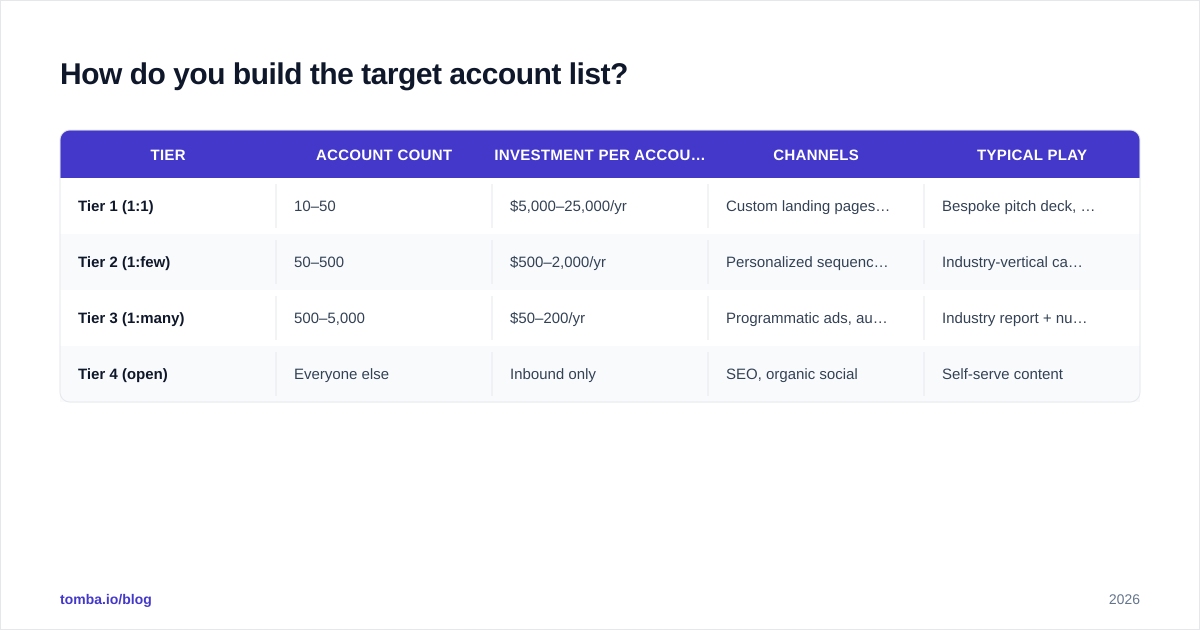
The output is a tiered list. Tier 1 gets 1:1 attention. Tier 2 gets 1:few clusters of 5–20 accounts that share a play. Tier 3 is everything else in your ICP that gets 1:many programs with personalization tokens.
| Tier | Account count | Investment per account | Channels | Typical play |
|---|---|---|---|---|
| Tier 1 (1:1) | 10–50 | $5,000–25,000/yr | Custom landing pages, exec sponsorship, direct mail, ads | Bespoke pitch deck, named-account site |
| Tier 2 (1:few) | 50–500 | $500–2,000/yr | Personalized sequences, retargeting, webinars | Industry-vertical campaign, peer roundtables |
| Tier 3 (1:many) | 500–5,000 | $50–200/yr | Programmatic ads, automated sequences, gated content | Industry report + nurture sequence |
| Tier 4 (open) | Everyone else | Inbound only | SEO, organic social | Self-serve content |
A common mistake: building a Tier 1 list of 500 accounts. If a rep can genuinely run 1:1 plays at scale, those are Tier 2. True Tier 1 is small enough that the AE can name every contact at every account from memory.
How do you map the buying committee?#
Once accounts are tiered, the next job is finding the humans. Gartner's research on B2B buying shows the average enterprise software purchase involves 6–10 stakeholders. Missing even two changes the deal trajectory.
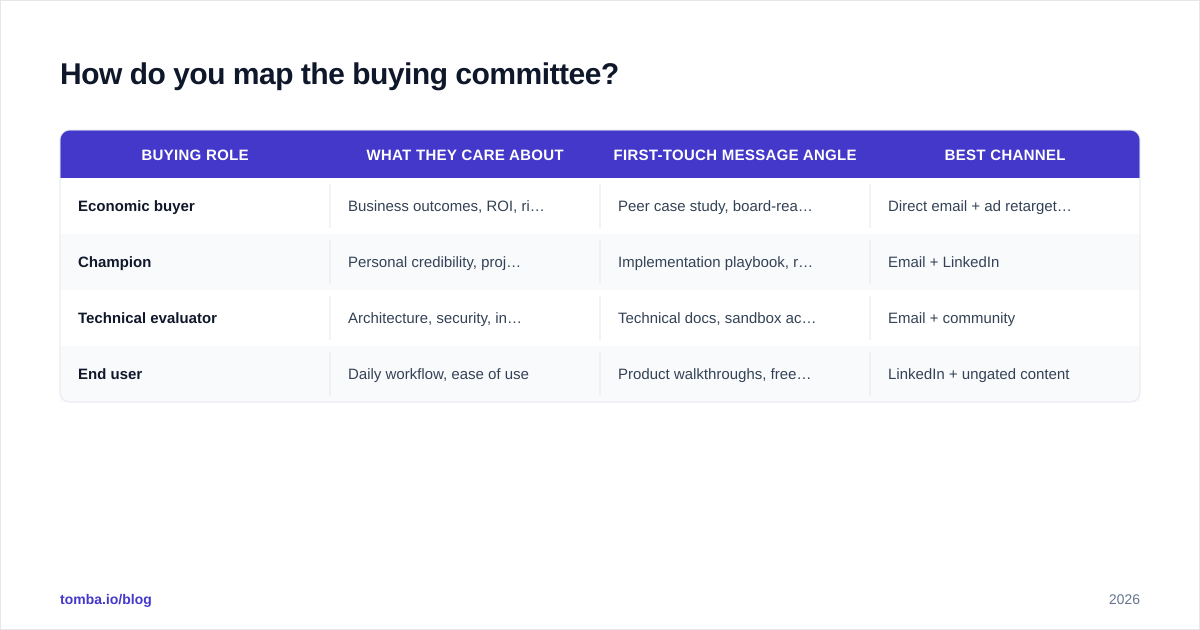
For each Tier 1 account, build a contact map with four roles:
- Economic buyer — signs the contract. Usually VP or C-level in the function you sell into.
- Champion — internal advocate, runs the evaluation, has political capital.
- Technical evaluator — kicks the tires, owns integration risk.
- End user — lives with the product daily, can veto.
The hard part isn't naming roles in a template — it's finding the actual people and their current contact info. Org charts shift quarterly. A LinkedIn search gives you names but stops there. This is where most ABM programs leak: the list is good, the messaging is good, but half the email addresses bounce or hit voicemails for people who left six months ago.
A purpose-built email finder solves the last-mile problem. Tomba's domain search returns every public email at a company organized by department and seniority, with verification confidence scores attached. The LinkedIn finder takes a profile URL and returns a verified work email. For phone outreach, the phone finder covers direct dials when email isn't enough. For larger lists, push the whole tier through bulk email finder and run email verification before any sequence fires — a 95%+ deliverability rate is the floor, not the ceiling.
| Buying role | What they care about | First-touch message angle | Best channel |
|---|---|---|---|
| Economic buyer | Business outcomes, ROI, risk | Peer case study, board-ready deck | Direct email + ad retargeting |
| Champion | Personal credibility, project success | Implementation playbook, references | Email + LinkedIn |
| Technical evaluator | Architecture, security, integration | Technical docs, sandbox access | Email + community |
| End user | Daily workflow, ease of use | Product walkthroughs, free tools | LinkedIn + ungated content |
What plays go in the playbook?#
A play is a named, repeatable sequence of touches with a specific trigger and a specific goal. Good ABM programs have 10–20 plays in active rotation. Here are the workhorses:
The new-funding play. Trigger: target account closes a funding round. Goal: book a meeting with the new exec hires. Touches: congratulatory LinkedIn comment from your CEO, email referencing the round and a specific spend category they'll need to expand, ad retargeting on the account's IPs for 30 days. Best run within 14 days of the announcement.
The tech-shift play. Trigger: BuiltWith or Wappalyzer shows the account installed (or removed) a competing product. Goal: open a migration conversation. Touches: champion-level email with a migration template, technical buyer email with a comparison brief, LinkedIn ad with social proof from a recent switcher.
The hiring-signal play. Trigger: target account posts 3+ roles in your buyer's function within 60 days. Goal: get on the radar before they evaluate. Touches: VP-level email referencing the team-build, content asset on scaling that function, intro to a customer who navigated the same growth stage.
The conference play. Trigger: target account has 2+ employees registered for a relevant industry event. Goal: pre-book a meeting. Touches: pre-event email from the AE, pre-event LinkedIn from the SDR, on-site coffee invite, post-event follow-up with the slides they missed.
The dormant-account revival. Trigger: account engaged 6+ months ago, went silent. Goal: re-open the door with a new contact. Touches: identify a new champion via LinkedIn outreach, reference the prior conversation, lead with an industry insight, not a pitch.
How do you orchestrate across channels?#
The mistake most teams make is running channels in silos — the SDR does email, the marketer does ads, the AE does LinkedIn, and nobody coordinates. The buyer sees a chaotic stream of touches that feel automated and impersonal. The fix is orchestration: every channel in a play runs from one timeline, owned by one person (usually the AE for Tier 1, the SDR for Tier 2).
A typical 30-day Tier 1 orchestration looks like:
- Day 1: Account selected. Marketing turns on display ads to the office IP range. SDR researches the committee.
- Day 3: First email from AE to economic buyer. Reference a specific business event (funding, leadership change, product launch).
- Day 5: LinkedIn connection request from AE to champion. No pitch in the request.
- Day 7: Second email to economic buyer. Different angle (peer case study). SDR sends first email to technical evaluator.
- Day 10: AE comments thoughtfully on champion's recent LinkedIn post. Marketing serves a retargeting ad with relevant case study.
- Day 14: SDR phone call to champion. Voicemail + immediate follow-up email referencing the voicemail.
- Day 18: AE sends value-add — industry report, peer intro, or executive briefing invitation. No CTA to "hop on a call."
- Day 24: SDR sends breakup-style email to whole committee. "Should I close the loop on this?"
- Day 30: Account either advanced to opportunity or moved to long-term nurture.
The same orchestration logic compresses for Tier 2 (14 days, fewer touches) and stretches for Tier 1 strategic (90+ days for accounts where you're playing the long game).
If your CRM is HubSpot or Salesforce, every touch should sync to a single account view so the next rep can pick up where the last one left off. Tomba syncs natively via the HubSpot integration and Salesforce integration, so contact discovery doesn't break the audit trail.
How do you measure ABM that actually closes?#
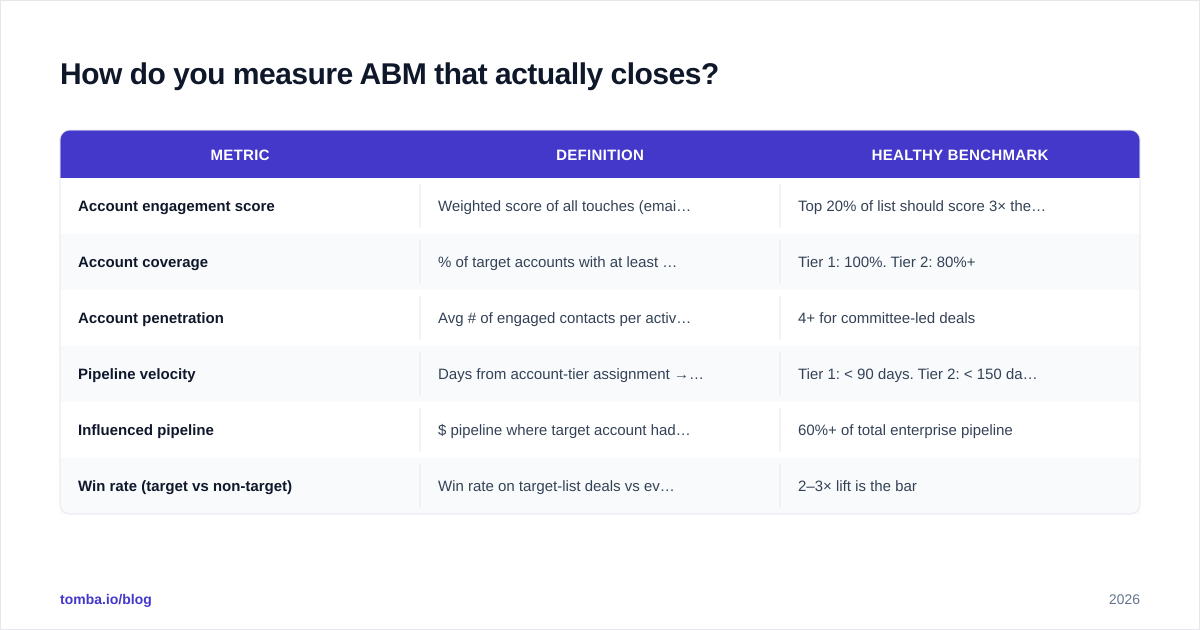
Lead-gen metrics (MQLs, MQL→SQL%, cost per lead) don't translate. ABM measurement is account-shaped and time-shifted — pipeline often shows up 60–180 days after the play runs. Track these instead:
| Metric | Definition | Healthy benchmark |
|---|---|---|
| Account engagement score | Weighted score of all touches (email opens, ad clicks, site visits, content downloads) per account | Top 20% of list should score 3× the median |
| Account coverage | % of target accounts with at least 3 contacts identified and verified | Tier 1: 100%. Tier 2: 80%+ |
| Account penetration | Avg # of engaged contacts per active account | 4+ for committee-led deals |
| Pipeline velocity | Days from account-tier assignment → SQO | Tier 1: < 90 days. Tier 2: < 150 days |
| Influenced pipeline | $ pipeline where target account had 2+ ABM touches before opp creation | 60%+ of total enterprise pipeline |
| Win rate (target vs non-target) | Win rate on target-list deals vs everything else | 2–3× lift is the bar |
The single most useful chart you can build: account engagement score on the x-axis, days-since-first-touch on the y-axis, dot color = stage. You'll see accounts moving up the engagement curve, and you'll see the dead zones where plays stop working. That chart drives the next quarter's playbook revision.
For data quality across this stack, your B2B database and data enrichment are the foundation. Every measurement above assumes the contact data is current and accurate. It usually isn't — that's the work.
What tools belong in the 2026 ABM stack?#
You don't need every category to start. A minimum viable stack is: a CRM, a contact-finding tool, an outbound sequencer, and a way to run targeted ads. Bigger programs layer on intent data and orchestration platforms.
| Layer | What it does | Examples |
|---|---|---|
| CRM | Single source of truth for accounts and deals | Salesforce, HubSpot, Pipedrive |
| Contact data | Find and verify decision-maker emails and phones | Tomba, |
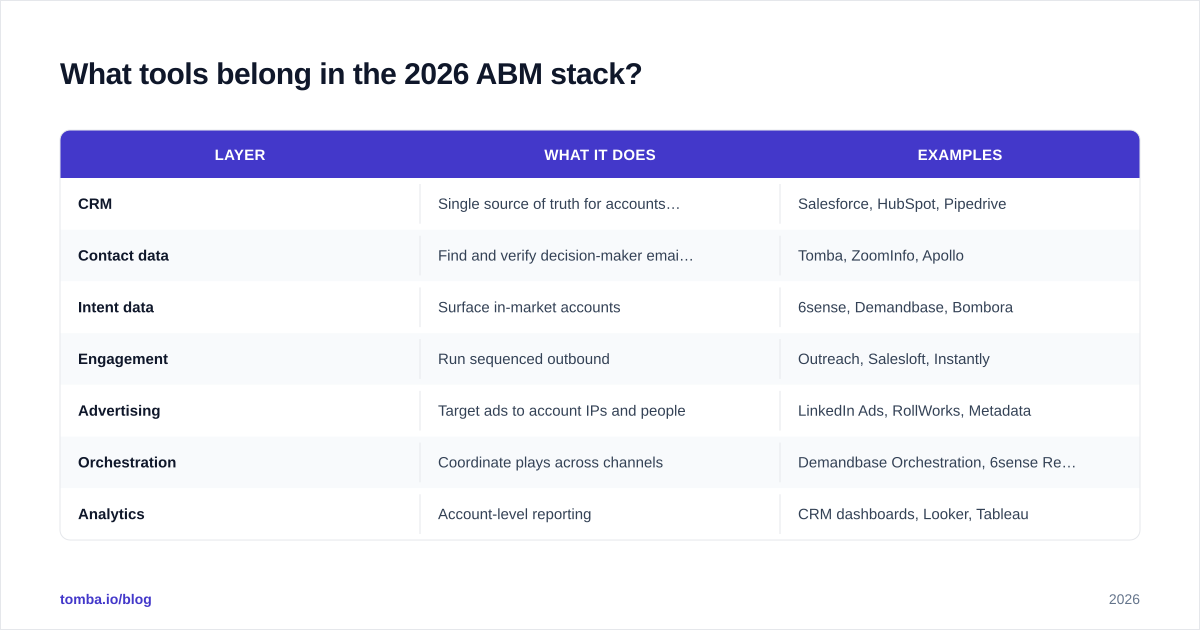
ZoomInfo, Apollo | | Intent data | Surface in-market accounts | 6sense, Demandbase, Bombora | | Engagement | Run sequenced outbound | Outreach, Salesloft, Instantly | | Advertising | Target ads to account IPs and people | LinkedIn Ads, RollWorks, Metadata | | Orchestration | Coordinate plays across channels | Demandbase Orchestration, 6sense Revenue AI | | Analytics | Account-level reporting | CRM dashboards, Looker, Tableau |
The contact-data layer is where most ABM programs quietly fail. Lists go stale within 90 days. Job changes, role changes, company moves — by the time your six-month nurture sequence reaches the champion, they're at a different company. Real-time email and phone discovery via Tomba's API keeps the data fresh inside the sequence itself, not on a quarterly refresh cadence.
How do you roll out the playbook in 90 days?#
Don't try to launch all four tiers, ten plays, and full orchestration in the first quarter. Sequence the rollout:
- Days 1–30: Build the Tier 1 list (10–20 accounts). Map committees. Run two plays end-to-end against five accounts each. Measure everything manually in a shared doc — no automation yet.
- Days 31–60: Codify what worked. Build Tier 2 list (100–250 accounts). Set up the engagement scoring in CRM. Launch retargeting ads. Move two plays into the sequencer.
- Days 61–90: Add intent data overlay. Build the dashboard. Train the full team on the playbook. Review the first cohort of accounts — which advanced, which died, why.
The 90-day output is a working machine, not a finished one. ABM gets compounded better the longer you run it because the account-engagement history is the asset. Year-two ABM beats year-one ABM by a wide margin if you stay disciplined.
Final play: start with the contact list#
The best ABM playbook in the world fails if half the emails bounce. Before you build tiers or design plays, audit your current contact data — bounce rate, job-title accuracy, phone connect rate. That single audit usually exposes the bottleneck.
Run your target account list through the Tomba Email Finder to get verified, role-tagged contacts for every account in minutes. Free tier covers 25 searches a month so you can pressure-test the data before committing. Pricing starts at $49/month on the Starter plan and scales to enterprise — see the full Tomba pricing breakdown. Once the contact layer is solid, the rest of the playbook compounds.
Get the Tomba newsletter
Practical outbound tactics and product updates — once every two weeks.
About the author