ABM Prospecting in 2026: The Complete Playbook for Targeted B2B Growth
ABM prospecting flips the funnel: you pick the accounts first, then build a buying committee around each one. Here's how to run the play in 2026 without burning your list.
ABM Prospecting in 2026: The Complete Playbook for Targeted B2B Growth
TL;DR
- ABM prospecting starts with a tightly defined account list (50-500 companies) and then maps a buying committee of 5-9 contacts per account before any outreach.
- The 2026 stack pairs intent data, firmographic enrichment, and email/phone verification — spray-and-pray lists are a fast way to torch your domain reputation.
- Multi-thread plays beat single-contact outreach: tier-1 accounts get 8+ touches across email, LinkedIn, and phone over 4-6 weeks.
- Measurement shifts from open rate to account engagement score — meetings booked per target account, pipeline created, and influenced revenue.
- Tooling matters less than discipline. The teams winning at ABM in 2026 spend 60% of their time on list quality and personalization, not sending volume.
What is ABM prospecting and why does it matter in 2026?#
Account-based prospecting is the practice of selecting a finite list of high-fit companies first, then identifying and contacting the right humans inside each one. It flips traditional outbound on its head. Instead of building a giant list of titles and emailing everyone with a pulse, you decide that ACME Corp, Globex, and 48 other companies are the only logical buyers for the quarter, and you build personalized outreach around each.
The shift matters more in 2026 than ever because three forces are squeezing traditional outbound:
- Inbox protection has gotten aggressive. Google, Microsoft, and Yahoo now penalize senders with low engagement and high complaint rates. Generic mass sends crash through reputation thresholds in days.
- Buyers are pre-educated. B2B buyers complete 60-80% of their research before talking to a vendor, per Gartner. Generic pitches read like noise to people who already know the category.
- Data is cheap, attention is not. Anyone can pull 50,000 leads from a B2B database. What separates teams that hit pipeline targets is which 200 of those 50,000 they actually call, and how.
ABM prospecting solves all three by trading volume for fit.
How is ABM prospecting different from traditional outbound?#
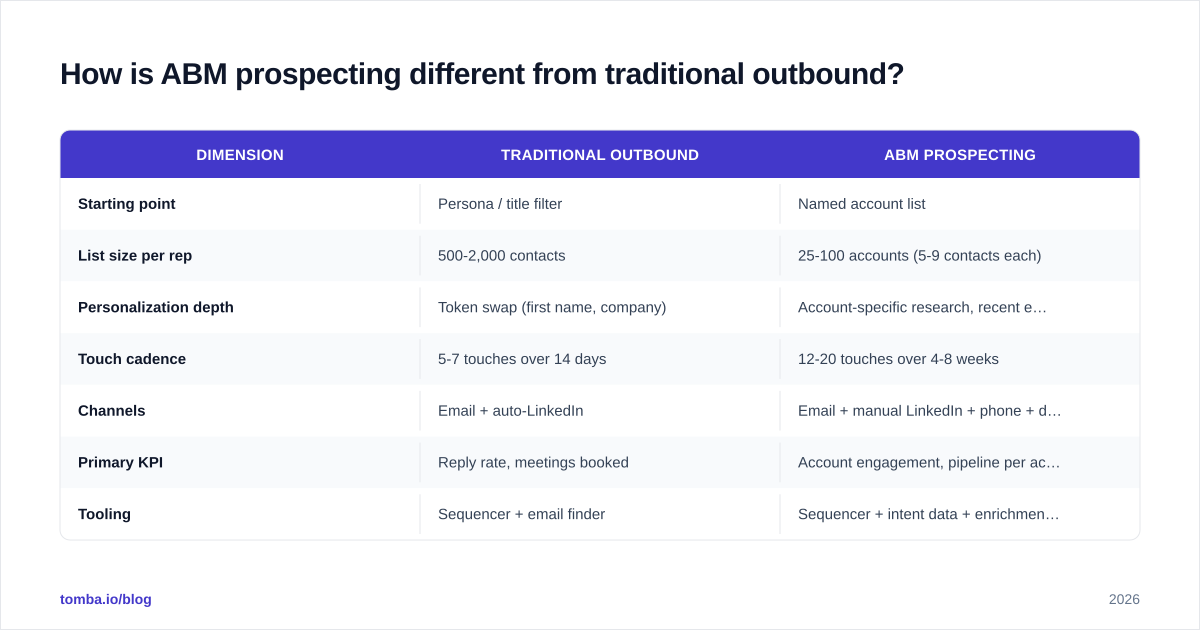
The mechanical difference is sequencing. Traditional outbound starts with personas ("VP of Engineering at SaaS company, 50-200 employees"), pulls a list against those filters, and sends a sequence. ABM starts with named accounts and works backward to find the right people.
| Dimension | Traditional outbound | ABM prospecting |
|---|---|---|
| Starting point | Persona / title filter | Named account list |
| List size per rep | 500-2,000 contacts | 25-100 accounts (5-9 contacts each) |
| Personalization depth | Token swap (first name, company) | Account-specific research, recent events, tech stack |
| Touch cadence | 5-7 touches over 14 days | 12-20 touches over 4-8 weeks |
| Channels | Email + auto-LinkedIn | Email + manual LinkedIn + phone + direct mail |
| Primary KPI | Reply rate, meetings booked | Account engagement, pipeline per account, win rate |
| Tooling | Sequencer + email finder | Sequencer + intent data + enrichment + sales engagement |
The difference shows up in win rates. ABM-led pipeline closes at roughly 2-3x the rate of generic outbound in most B2B sales orgs I've seen, but you spend more time per account to get there.
What are the building blocks of an ABM prospecting motion?#
Five layers, in order. Skip one and the whole thing wobbles.
1. Define the ideal customer profile (ICP)#
Not a persona — a company profile. Industry, employee count, revenue band, geography, tech stack, growth signals (recent funding, hiring spikes, new exec hires). Keep it ruthless. Most ICPs are too broad to be useful. If your ICP returns 50,000 companies, it's a market description, not an ICP.
A working 2026 ICP usually has:
- 2-4 industries (NAICS or SIC codes)
- A revenue or headcount range (e.g., 200-2,000 employees)
- A region (NA, EMEA, APAC — or specific countries)
- 1-2 disqualifiers (e.g., "not currently using competitor X")
- 1-2 triggers (e.g., "raised Series B in last 12 months", "hiring 5+ SDRs")
2. Build the target account list (TAL)#
From the ICP, generate a finite list. Tier them:
- Tier 1 (T1): 25-50 accounts. Highest fit + active intent. Get full ABM treatment: research, custom assets, multi-thread.
- Tier 2 (T2): 100-200 accounts. Good fit, no intent signal yet. Lighter-touch plays.
- Tier 3 (T3): 300-1,000 accounts. Fit but cold. Programmatic plays, nurture.
3. Map the buying committee#
For each T1 account, identify 5-9 people: economic buyer, champion, technical evaluator, end users, blockers. Pull verified emails using an email finder, enrich with LinkedIn, and confirm titles against the org chart.
4. Layer in signals#
Intent data, technographics, hiring signals, funding events, news mentions, and website visits. Signals tell you when an account is in market, not just whether they fit.
5. Run plays, not sequences#
A "play" is a coordinated set of touches across channels, timed to a signal, personalized to the account. Plays beat sequences because they react to what's actually happening at the account.
How do you build a target account list that actually converts?#
Start with your closed-won customers from the last 18 months. Look for patterns: industry, size, tech stack, what triggered the deal. Build the ICP from that data, not from a whiteboard exercise.
Then layer three sources to generate candidates:
- Firmographic database — Pull companies matching the ICP from a B2B database. This is your baseline universe.
- Intent data — Bombora, G2, 6sense, or built-in platform intent. Filter for accounts showing surge activity on relevant topics.
- Trigger events — Funding rounds (Crunchbase), exec hires (LinkedIn), tech adoption (BuiltWith). Use these to prioritize within the universe.
The output is a ranked list. Tier it. Assign accounts to reps. Lock the list for the quarter — don't let reps "discover" new accounts mid-quarter, that's how focus collapses.
A sanity check I use: every account on the T1 list should be a company a rep can describe in 30 seconds — what they do, who buys, why they'd care about your product. If they can't, the list is too big or the research is too thin.
What does a buying committee look like in B2B SaaS?#
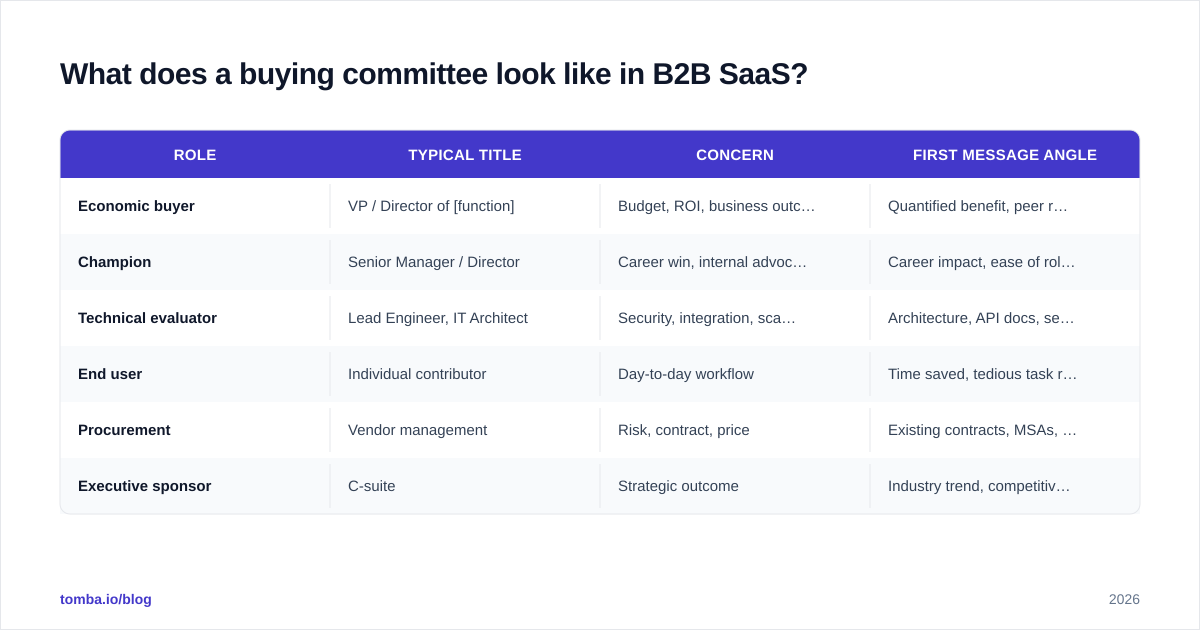
Forrester and Gartner both peg the average B2B buying committee at 6-10 people. For an ABM motion you need to identify and contact most of them.
| Role | Typical title | Concern | First message angle |
|---|---|---|---|
| Economic buyer | VP / Director of [function] | Budget, ROI, business outcome | Quantified benefit, peer reference |
| Champion | Senior Manager / Director | Career win, internal advocacy | Career impact, ease of rollout |
| Technical evaluator | Lead Engineer, IT Architect | Security, integration, scale | Architecture, API docs, security |
| End user | Individual contributor | Day-to-day workflow | Time saved, tedious task removed |
| Procurement | Vendor management | Risk, contract, price | Existing contracts, MSAs, security review |
| Executive sponsor | C-suite | Strategic outcome | Industry trend, competitive risk |
You will not contact every role in the first wave. Start with champion and economic buyer; bring in technical and end users in week 2-3 when you've earned the meeting.
To build the committee, run a domain search on each target company to surface every email pattern and known contact, then cross-reference LinkedIn to fill role gaps.
Which signals should trigger an ABM play?#
Signals divide into two buckets: fit signals (does this account match the ICP?) and intent signals (is this account in market right now?).
Fit signals are static or slow-moving — industry, size, tech stack. They're table stakes; every account on your TAL should pass these.
Intent signals are the actual trigger. The strongest ones in 2026:
- First-party: pricing page visits, demo requests from a TAL account, content downloads, repeat sessions from the same IP
- Third-party intent: Bombora/G2/TrustRadius surge data on relevant topics
- Hiring: open roles for the persona you sell to (e.g., 3+ SDR openings if you sell sales tools)
- Funding: Series B+ raise in the last 6 months
- Tech adoption / churn: BuiltWith or Wappalyzer signal that they just added or dropped a relevant tool
- Executive change: new VP/Director in the buying function (90-day honeymoon window)
A "hot account" is one with 2+ intent signals firing in the same 30-day window. Those go to the front of the queue.
How do you write personalized ABM outreach at scale?#
The honest answer: you don't write personalization "at scale" the same way you'd write generic outbound at scale. ABM personalization is per-account, often per-contact, and there's no shortcut that doesn't leak fluency.
But you can layer the work:
- Account research block — 10-15 minutes per T1 account. Pull recent news, exec changes, 10-K mentions of relevant priorities (if public), recent product launches. Save as a one-paragraph "account brief" in your CRM.
- Persona snippets — Pre-written 2-3 sentence blocks per persona that you adapt to the account.
- Hook lines — Per-contact: something specific about the person (recent LinkedIn post, podcast appearance, conference talk).
- Body and CTA — Templated. Yes, templated. The personalization lives in the hook and the relevance to the account; the body can be a proven pattern.
This is why ABM reps cover fewer accounts. A T1 contact gets 5-10 minutes of writing, not 20 seconds. The math still works because conversion is dramatically higher.
If you've already nailed your generic templates, the cold email AI tool can give you a fast first draft to edit — but never send raw AI output to a T1 account. The whole point is that this email could only have been written to this person.
What's the right cadence for an ABM play?#
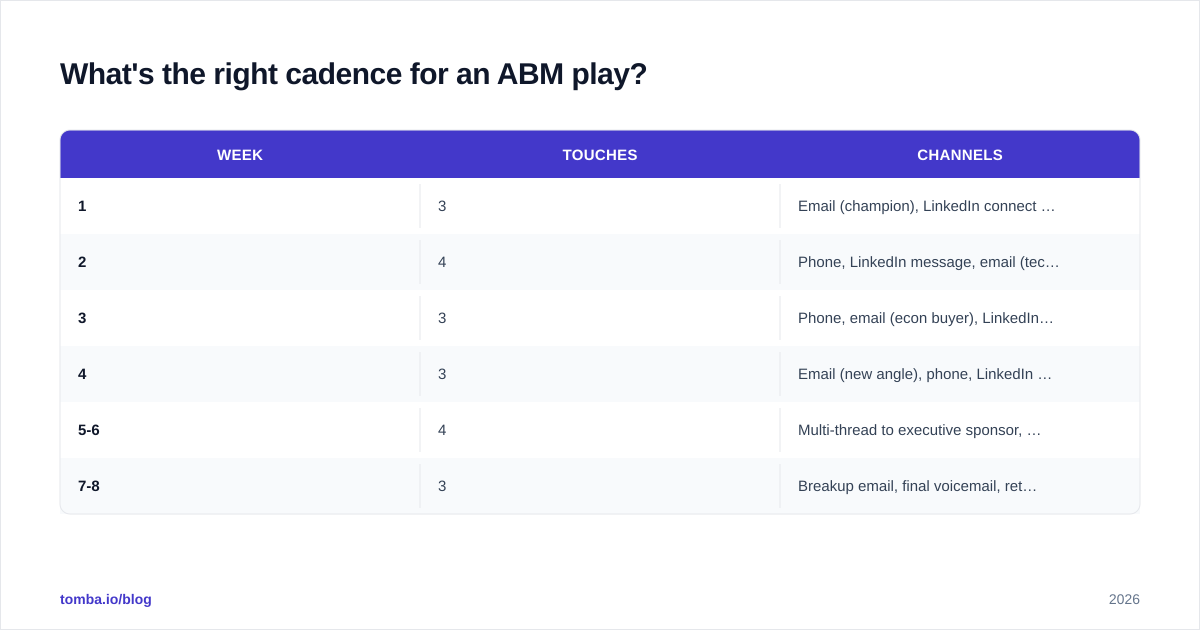
For a tier-1 account, plan for 12-20 touches across 4-8 weeks. Spread across at least three channels.
| Week | Touches | Channels |
|---|---|---|
| 1 | 3 | Email (champion), LinkedIn connect (champion), email (econ buyer) |
| 2 | 4 | Phone, LinkedIn message, email (tech evaluator), value asset send |
| 3 | 3 | Phone, email (econ buyer), LinkedIn engage (like/comment) |
| 4 | 3 | Email (new angle), phone, LinkedIn voice note |
| 5-6 | 4 | Multi-thread to executive sponsor, content reference, peer intro |
| 7-8 | 3 | Breakup email, final voicemail, retargeting |
A few non-obvious rules:
- Stagger contacts. Don't email five people at the same company on the same day. Stagger by 2-3 days so it feels like a campaign, not a swarm.
- Reference your other touches. "I left you a voicemail Tuesday" — buyers respect persistence when it's coordinated.
- Mix asks. Not every touch is "book a meeting". Share a relevant report, comment on their LinkedIn post, send a hand-written note. The point is presence, not constant asks.
- Verify before sending. Bounce a single T1 contact and you've trained their MX server to filter your domain. Run every contact through an email verifier before adding them to a cadence.
What does the ABM prospecting tech stack look like in 2026?#
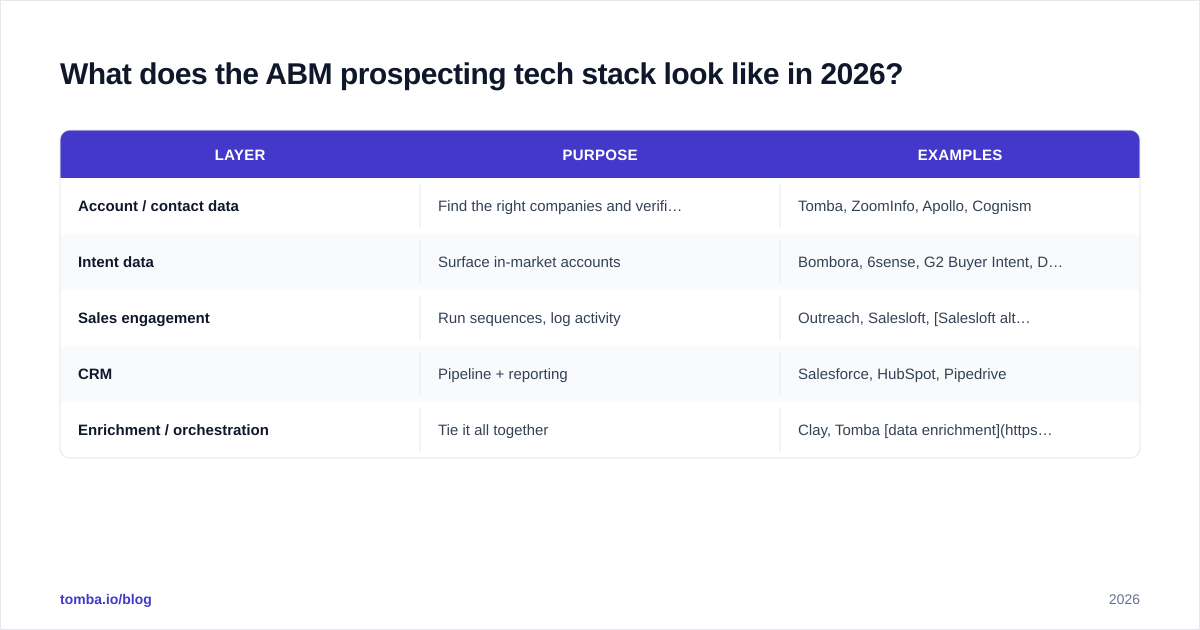
You can run a credible ABM motion on five categories of tooling:
| Layer | Purpose | Examples |
|---|---|---|
| Account / contact data | Find the right companies and verified emails | Tomba,ZoomInfo, Apollo, Cognism |
| Intent data | Surface in-market accounts | Bombora, 6sense, G2 Buyer Intent, Demandbase |
| Sales engagement | Run sequences, log activity | Outreach, Salesloft, Salesloft alternative options, Reply.io |
| CRM | Pipeline + reporting | Salesforce, HubSpot, Pipedrive |
| Enrichment / orchestration | Tie it all together | Clay, Tomba data enrichment, Clearbit |
For most teams under 50 reps, you do not need all five categories as separate vendors. A consolidated stack with one data provider, one engagement tool, and a CRM gets 80% of the value.
For the data layer specifically, focus on accuracy over breadth. The largest "databases" are the noisiest. I've found that high-precision providers like Tomba (with a verified-email guarantee and a permanent free tier) outperform broad-but-stale vendors in actual delivery rates. See Tomba's data sources for how the verification chain works.
How do you measure ABM prospecting performance?#
Stop measuring open rate. It was always a vanity metric; in 2026 with Apple Mail Privacy Protection and similar protections, it's borderline useless.
Measure these instead:
- Account engagement score — composite of email replies, meetings, web sessions, content downloads per account
- Meetings booked per target account — total meetings in the quarter ÷ TAL size
- Pipeline per target account — opportunity value created ÷ TAL size
- Account penetration — % of buying committee contacted at each engaged account
- Win rate on ABM pipeline vs. inbound vs. generic outbound — proves the motion is worth the per-rep cost
- Cycle time on ABM deals — should compress over 2-3 quarters as multi-thread maturity grows
A realistic year-one benchmark for a focused B2B SaaS team: 12-18% of TAL accounts produce a sales-qualified opportunity within two quarters of activation. Pipeline-to-close runs 18-25% from ABM-sourced opps, vs. 8-12% from generic outbound, in most teams I've worked with.
What are the most common ABM prospecting mistakes?#
I see the same five failure modes repeatedly:
- TAL is too large. If you have 2,000 "target accounts", you have a market, not a list. Cut it to 200 and watch focus return.
- Skipping the committee map. Reps email the champion, get no reply, give up. The economic buyer was never contacted. Always map at least 3 contacts before launching.
- Treating intent as a verdict, not a signal. A surge score is a hint. Pair it with research; don't fire a templated email at every "hot" account.
- Burning the domain on day one. Adding 500 unverified contacts to a new sending domain crushes deliverability before the play starts. Warm up, verify, and tier sending volume.
- No exec sponsor on either side. ABM works when your CRO and the customer's exec sponsor are both engaged. Without that, deals stall at champion level.
Internally, the fix usually isn't a new tool. It's deciding the list is sacred, the research is mandatory, and the reps are accountable for account-level outcomes — not activity volume.
Is ABM prospecting worth it for smaller teams?#
Yes, with a caveat: the smaller the team, the smaller the TAL. A two-person SDR team should not be working a 500-account list. They should be running 50 T1 accounts and doing it well.
The math: at 50 T1 accounts × 7 contacts × 12 touches = 4,200 manual touches over the quarter. That's already a full-time job for two people if you want quality. Triple the list size and quality collapses to template-spam, which defeats the purpose.
Use a bulk email finder to build the contact set up front, then move to manual mode for the actual outreach. The data work scales; the relationship work doesn't.
How does Tomba fit into an ABM prospecting workflow?#
Tomba is the data layer. You bring the account list (from your CRM, your intent platform, or your TAM exercise); Tomba turns each company into a verified buying committee.
The pieces that map to ABM:
- Email Finder — Single-contact lookup when you already know the name and company
- Domain Search — Pulls every known employee at a target domain, with verified emails and roles. The first thing to run on a new T1 account.
- Bulk lookup — Upload your TAL as a CSV, get a verified contact set back
- Email Verifier — Last-mile check before adding any contact to a cadence
- Data enrichment — Job titles, LinkedIn URLs, company firmographics to feed the buying committee map
- Tomba API — Hook directly into your sales-ops automation in Clay, Make, or your CRM
Pricing starts at the free tier (25 searches/month, useful for testing), with paid plans from $49/mo Starter to $249/mo Pro. The full breakdown is on the Tomba pricing page.
For a deeper read on the broader category, HubSpot's guide to account-based marketing and Gartner's research on B2B buying behavior are both worth bookmarking.
Ready to run ABM prospecting that actually converts?#
The hardest part of ABM isn't picking the framework — it's having a clean, verified contact set you can act on the moment a signal fires. Stale data on a hot account is worse than no data at all.
Try Tomba's Email Finder free for 25 searches a month. Drop in your top 25 target accounts, pull the full buying committee, verify the emails, and run your first real ABM play this week. When you outgrow the free tier, plans start at $49/mo — see Tomba pricing for the full breakdown.
ABM prospecting is a discipline, not a tool. The teams that win in 2026 are the ones who treat every account on the list like it matters, because at 50 accounts a quarter, every account does.
// get started
Find, verify and enrich your first contacts today
Start on the free plan with 25 searches a month, then scale when your team is ready.
Free plan · No credit card required · GDPR & CCPA
// about the author