ABM Social Media in 2026: The Complete Playbook for Account-Based Reach
ABM social media turns LinkedIn, X, and Meta into precision targeting tools instead of broadcast channels. Here's how to run named-account programs that actually convert in 2026.
ABM Social Media in 2026: The Complete Playbook for Account-Based Reach
TL;DR
- ABM social media flips the funnel: instead of casting wide and hoping a buyer self-identifies, you start with a named list of 50-500 accounts and surround them on LinkedIn, X, and Meta.
- LinkedIn Matched Audiences with a company-list upload is still the backbone in 2026, but newer features like Predictive Audiences, Document Ads, and Connected TV change the channel mix.
- The four pillars are list quality, contact resolution, sequenced creative, and committee-level measurement. Skip any one and the program leaks budget.
- Pair social with email and direct outreach. Social alone converts; social plus an enriched contact stack converts roughly 2-3x as often in our benchmarks.
- This playbook covers list building, ad sequencing, organic amplification, and the metrics that matter — engaged accounts, not impressions.
What is ABM social media?#
ABM social media is the practice of running paid and organic social activity against a pre-defined list of target accounts rather than a broad demographic audience. Instead of buying "VP of Marketing, US, SaaS," you upload a CSV of 200 named companies and serve every piece of media exclusively to people who work there.
It sits inside the broader account-based marketing discipline that Gartner and Forrester have been formalizing since the mid-2010s, but the social-specific tactics have matured a lot. In 2016 you could upload a list to LinkedIn and call it ABM. In 2026 you need to layer first-party intent, contact-level enrichment, and multi-channel orchestration on top.
The shift matters because B2B buying committees now average 9-11 people (per the latest Gartner research), and any one of them can veto a deal. Reaching only the economic buyer is not enough. ABM social media exists to surround the whole committee with relevant messages at the same time.
Why does ABM social media work better than broad targeting in 2026?#
Three reasons.
Signal quality. When you target by job title across an industry, LinkedIn and Meta have to guess who is in-market. When you target a named account list you've already done that filtering. Every impression hits an account you've already qualified as worth pursuing.
Committee coverage. A named-account audience inside a 500-person company will surface 30-60 employees on LinkedIn. That gives you a chance to reach the champion, the user, the budget holder, and the procurement gatekeeper without paying for impressions outside the target set.
Sales-marketing alignment. When sales hands marketing a list of 100 accounts they want to crack, and marketing runs a 90-day social program against exactly those 100 accounts, attribution conversations get short. You can show influence per account, not vanity reach.
How do you build the target account list?#
The list is the program. Get this wrong and no amount of creative will save the budget.
A defensible list starts with three filters stacked together: ideal customer profile fit (firmographics — industry, size, revenue, tech stack), intent signal (G2 category views, Bombora topic surge, branded search lift), and sales priority (current pipeline status, existing relationships, expansion potential).
Most teams overweight firmographics and underweight intent. The accounts that close are usually the ones already researching the category, not the ones that merely fit the ICP on paper.
Once the list exists, you need to resolve it into actionable contact data. Account names alone won't run an email follow-up or a LinkedIn InMail sequence. This is where a bulk email finder or domain search earns its keep — feed the 200 company domains in, get back verified contacts mapped to roles and seniority, then push that table into your CRM, ad platform, and outreach tool.
What channels belong in an ABM social media mix?#
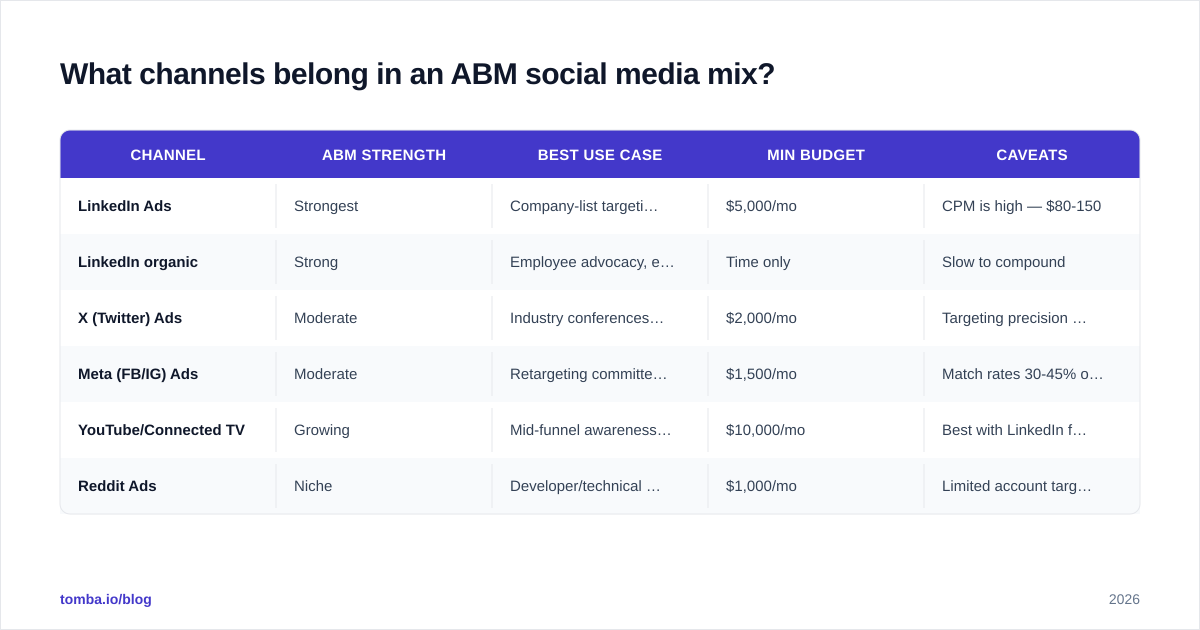
Not every social channel is built for account-based work. Here's how the major platforms stack up in 2026.
| Channel | ABM strength | Best use case | Min budget | Caveats |
|---|---|---|---|---|
| LinkedIn Ads | Strongest | Company-list targeting, Document Ads, Conversation Ads | $5,000/mo | CPM is high — $80-150 |
| LinkedIn organic | Strong | Employee advocacy, executive thought leadership | Time only | Slow to compound |
| X (Twitter) Ads | Moderate | Industry conferences, real-time response | $2,000/mo | Targeting precision degraded since 2023 |
| Meta (FB/IG) Ads | Moderate | Retargeting committee members off-hours | $1,500/mo | Match rates 30-45% on B2B lists |
| YouTube/Connected TV | Growing | Mid-funnel awareness for enterprise accounts | $10,000/mo | Best with LinkedIn for measurement |
| Reddit Ads | Niche | Developer/technical buyer personas | $1,000/mo | Limited account targeting |
LinkedIn does most of the heavy lifting in any ABM social program because it's the only platform with native company-level targeting and clean job-title data. Treat the others as supporting cast.
How do you set up LinkedIn Matched Audiences for ABM?#
The mechanic is straightforward but the details matter.
- Export your target list with company name, website domain, and (optionally) LinkedIn URL. Domain matches better than name.
- Upload as a CSV in Campaign Manager under Audiences → Create → Company list. LinkedIn needs 1,000+ matched records to run, so very small lists need to be batched with sister accounts.
- Layer a job-function or seniority filter on top — usually "Manager and above" within target functions (Marketing, RevOps, Sales, IT depending on your buyer).
- Build mirror audiences for retargeting: website visitors from those companies, video viewers, lead form opens.
- Exclude existing customers and competitors so you're not wasting impressions.
The biggest mistake teams make is uploading the list and stopping there. The list is 30-40% of the work. Sequencing creative against the list is the other 60%.
What does a sequenced ABM social media campaign look like?#
A campaign that runs the same ad to the same accounts for 90 days will fatigue and burn budget. Sequencing rotates creative against the buying stage signal.
A simple three-stage sequence:
Stage 1 — Awareness (weeks 1-3). Educational content that frames the problem. Carousel ads, Document Ads with a downloadable report, short-form video. No "book a demo" CTA yet. Goal: get 30%+ of the target list to engage at least once.
Stage 2 — Consideration (weeks 4-7). Social proof against the engaged subset. Customer logos, case study videos, competitive comparison content. Retarget anyone who watched 50%+ of stage 1 video or opened a Document Ad. Goal: drive engaged accounts to view pricing or competitor-alternative pages.
Stage 3 — Conversion (weeks 8-12). Direct response to a hot subset. Lead Gen Forms, Conversation Ads to specific decision-maker titles, executive InMail. Pair this with SDR outreach so the ad and the email arrive within 48 hours of each other.
The sequencing logic is the same one HubSpot has been teaching in their ABM playbooks for years, but the creative formats — Document Ads, Connected TV, AI-generated variants — are 2026-specific.
How do you measure ABM social media performance?#
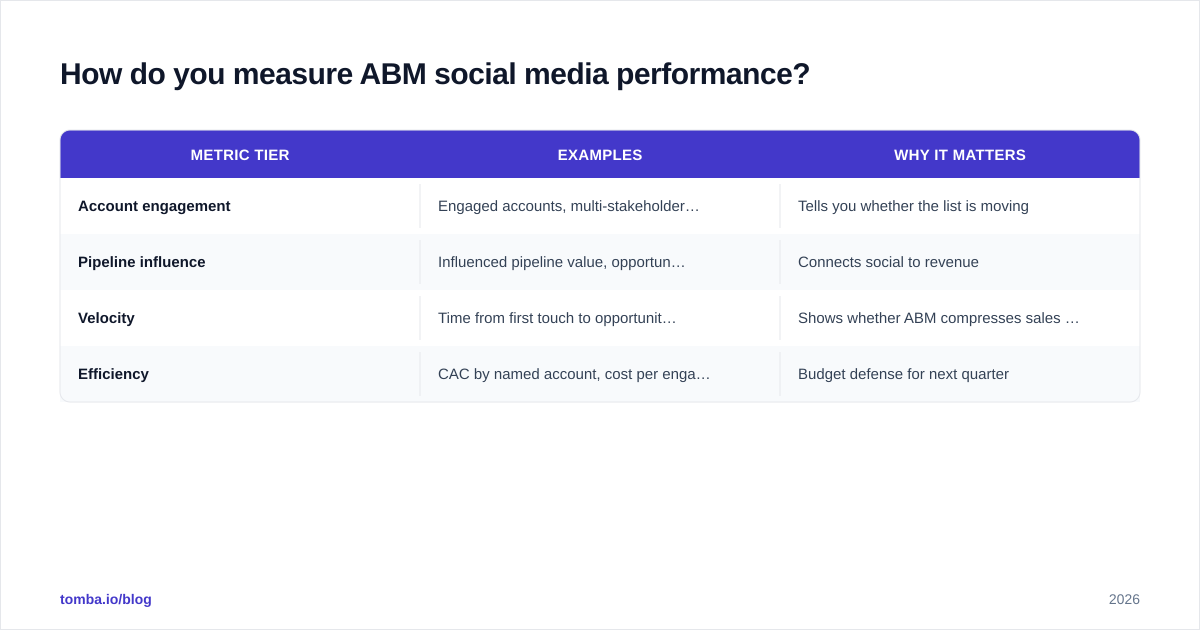
Vanity metrics break ABM faster than any other discipline. Impressions and clicks tell you whether the ad served — they tell you nothing about whether an account moved.
Use a layered scorecard:
| Metric tier | Examples | Why it matters |
|---|---|---|
| Account engagement | Engaged accounts, multi-stakeholder reach, account journey depth | Tells you whether the list is moving |
| Pipeline influence | Influenced pipeline value, opportunity creation by source account | Connects social to revenue |
| Velocity | Time from first touch to opportunity, deal cycle delta | Shows whether ABM compresses sales cycles |
| Efficiency | CAC by named account, cost per engaged account | Budget defense for next quarter |
LinkedIn's Company Engagement Report inside Campaign Manager rolls up most of the engagement metrics natively. Pipeline influence requires CRM integration — at minimum a closed-loop tag from your CRM back to the ad platform via a HubSpot or Salesforce sync.
Should organic social play a role?#
Yes, and most teams under-invest here.
Paid ABM gets you reach into the target list. Organic ABM — executive thought leadership, employee advocacy, customer co-marketing — builds the credibility that converts reach into trust. A LinkedIn ad from an unknown vendor has limited pull. The same ad following three weeks of the CEO posting useful industry analysis in the target buyer's feed pulls a lot harder.
A workable organic ABM rhythm:
- CEO or category leader posts 2-3x per week with original perspective, not company news
- Three account executives post 1-2x per week, each owning a vertical
- Customer logos are tagged in posts twice a month so target accounts see peer adoption
- Sales team comments on target-account employees' posts as a social selling signal, with a LinkedIn finder routing high-priority contacts back to outreach
This is slow to compound but it lowers paid CPMs over time because brand familiarity drives click-through.
How does ABM social media connect to outbound?#
The mistake is running them in parallel and pretending they're separate programs. They're not.
A target account on the ABM list should be:
- Inside the LinkedIn Matched Audience
- Enriched with verified contact data via an email finder
- Receiving a 4-7 step email sequence to the 3-5 most likely committee members
- Tracked in the CRM with a shared "ABM Q1" tag so sales and marketing see the same view
When all four are running, the email sees the ad, the ad reinforces the email, and the SDR call references both. Reply rates on cold email roughly double when the recipient has been pre-warmed with 3+ social impressions in the prior 14 days, per several published vendor studies. That compounding effect is the whole point.
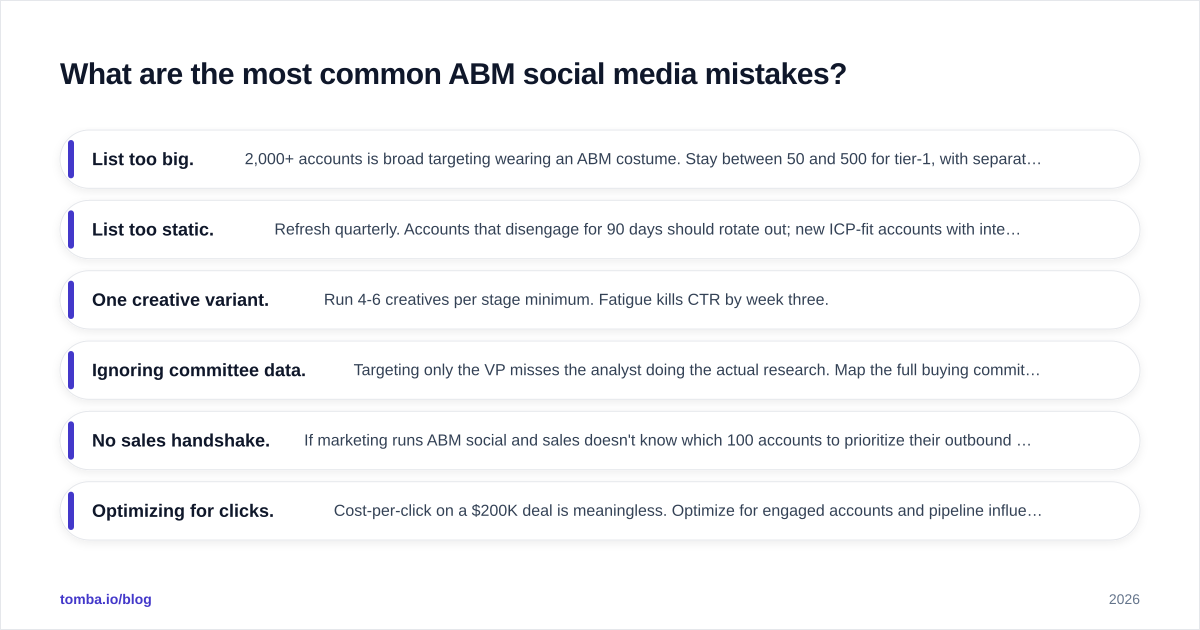
What are the most common ABM social media mistakes?#
- List too big. 2,000+ accounts is broad targeting wearing an ABM costume. Stay between 50 and 500 for tier-1, with separate motions for tier-2 and tier-3.
- List too static. Refresh quarterly. Accounts that disengage for 90 days should rotate out; new ICP-fit accounts with intent signals rotate in.
- One creative variant. Run 4-6 creatives per stage minimum. Fatigue kills CTR by week three.
- Ignoring committee data. Targeting only the VP misses the analyst doing the actual research. Map the full buying committee per account.
- No sales handshake. If marketing runs ABM social and sales doesn't know which 100 accounts to prioritize their outbound on, the program is half-built.
- Optimizing for clicks. Cost-per-click on a $200K deal is meaningless. Optimize for engaged accounts and pipeline influence.
What tools do you need to run ABM social media well?#
A workable stack has five layers, and most teams already own pieces of it.
| Layer | Purpose | Examples |
|---|---|---|
| List building | ICP + intent + sales priority | 6sense, Demandbase,ZoomInfo |
| Contact resolution | Verified emails, phones, LinkedIn URLs | Tomba, Apollo, Cognism |
| Ad platforms | Paid reach into accounts | LinkedIn Ads, Meta, Connected TV |
| Outreach orchestration | Email + LinkedIn + call sequencing | Outreach, Salesloft, Apollo |
| Measurement | Engagement to pipeline attribution | HubSpot, Salesforce, native ad reporting |
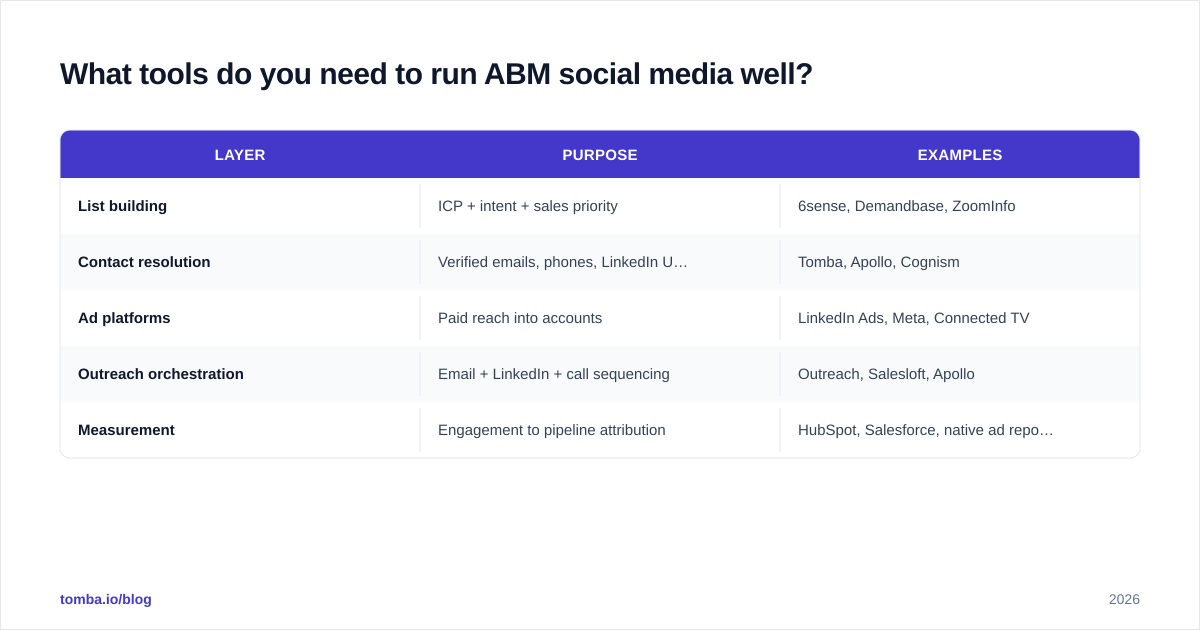
The contact resolution layer is the one most teams underestimate. You can have a perfect list and great creative, but if you can't reach the actual decision makers with a follow-up email or call, social impressions stay as impressions.
Putting it all together: a 90-day ABM social media plan#
Week 1-2: Build the list. ICP filter, intent overlay, sales priority. Resolve contacts via data enrichment and load into CRM, LinkedIn, and your outreach tool.
Week 3-4: Set up audiences and creative. Three sequenced stages, 4-6 creatives per stage, tracking pixels live on landing pages.
Week 5-7: Awareness flight. Educational content only. Measure engaged accounts, not clicks.
Week 8-10: Consideration flight. Social proof and competitive content to engaged subset. Sales begins prospecting the most engaged 30% of the list.
Week 11-13: Conversion flight. Direct response, Lead Gen Forms, Conversation Ads. SDR + AE outbound aligned to the ad calendar.
End of 90 days: Account engagement review with sales, pipeline influence report, list refresh for next quarter.
Run your ABM program with cleaner data#
The hardest part of ABM social media is not the ad copy or the platform settings — it's making sure every account on your list resolves to real people with real verified emails. That is exactly what Tomba is built for. Upload 500 target domains, get back validated contacts mapped to roles in minutes, then sync them into LinkedIn, HubSpot, or your outbound tool. Tomba's free tier covers 25 searches a month, the Starter plan is $49/mo, and the bulk finder handles enterprise account lists in a single job. Start the list, run the social program, and stop guessing whether the right people saw your ads.
// get started
Find, verify and enrich your first contacts today
Start on the free plan with 25 searches a month, then scale when your team is ready.
Free plan · No credit card required · GDPR & CCPA
// about the author