ABM Strategy in 2026: A Practical Playbook for B2B Teams
Most ABM programs stall because they confuse a target list with a strategy. Here's how to build an ABM strategy in 2026 that actually moves pipeline — covering tiers, data, plays, and measurement.
ABM Strategy in 2026: A Practical Playbook for B2B Teams
TL;DR
- An ABM strategy is not a target list — it's an operating model where marketing, sales, and RevOps commit to a finite set of accounts and orchestrate plays across them.
- The three tiers (1:1, 1:few, 1:many) each demand different data depth, content effort, and measurement windows. Picking one without understanding the trade-offs is the most common failure mode.
- 2026 ABM is signal-driven: intent data, technographics, hiring triggers, and product usage now determine which accounts get attention this week — not a static annual list.
- The unsexy mechanics matter most. Clean contact data, fast research-to-outreach loops, and shared pipeline definitions outperform any single tool.
- Measure ABM by account engagement, pipeline velocity, and deal size — not MQL count. The whole point is fewer, bigger, faster deals.
What is an ABM strategy in 2026?#
An account-based marketing (ABM) strategy is a B2B go-to-market approach where you select a defined set of high-value accounts, then concentrate marketing and sales resources on engaging the specific buying committees inside those accounts. Instead of generating broad demand and qualifying it down, you start with the company you want and work backwards into its stakeholders.
In 2026, three things have changed since the early ITSMA-era definition:
- Signal data is cheap and abundant. First-party intent (your site), third-party intent (G2, Bombora, TrustRadius), hiring data, funding rounds, and tech-stack changes are all queryable in near real-time. The "annual target list" model is dead.
- AI compresses the research phase. Drafting account briefs, ICP scoring, and personalized email variants — work that took an SDR a full day — now takes minutes. The bottleneck moved from "can we personalize at scale" to "do we know what to say."
- Buying committees grew, then fragmented. Gartner's research still pegs the average B2B buying group at 6-10 people, and most of them never raise their hand. ABM is the only sane response: stop waiting for inbound, go find the committee.
If you want a deeper baseline definition, HubSpot's ABM hub and Salesforce's ABM glossary are reasonable starting points. The rest of this post assumes you've gotten past "what is it" and want a playbook that works in 2026.
Which ABM tier should you pick — 1:1, 1:few, or 1:many?#
The biggest strategic decision in ABM is tier selection. It dictates your budget, headcount, content effort, and measurement cadence. Most teams pick a tier emotionally ("let's do 1:1 for our top 10 logos!") and then fail to fund it.
Here is the honest trade-off:
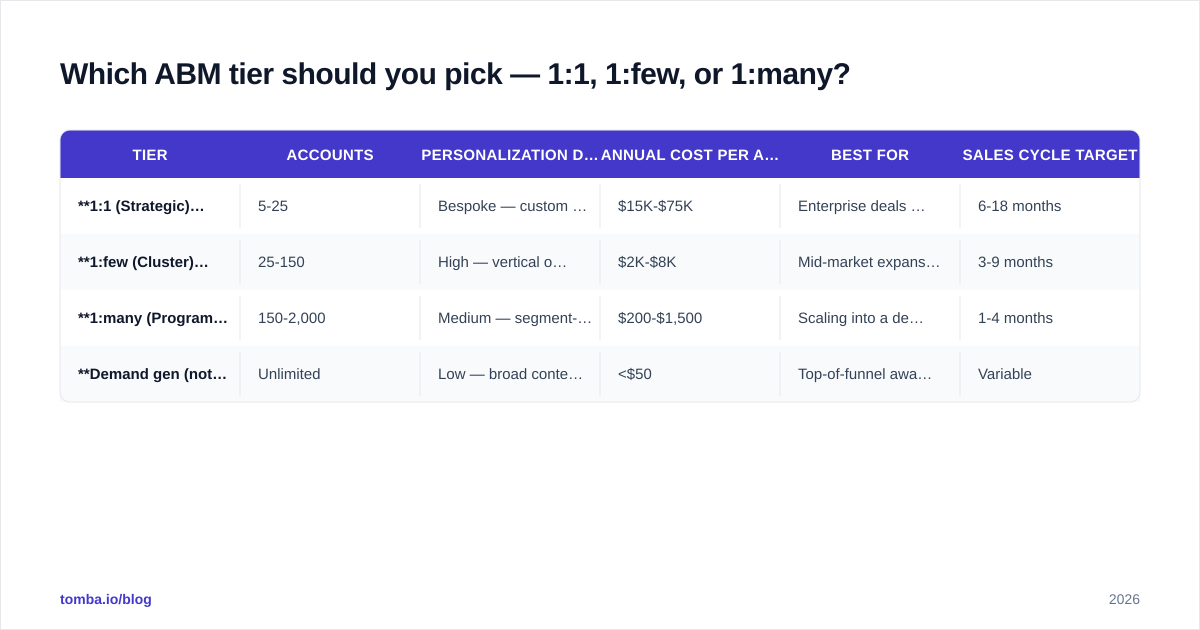
| Tier | Accounts | Personalization depth | Annual cost per account | Best for | Sales cycle target |
|---|---|---|---|---|---|
| 1:1 (Strategic) | 5-25 | Bespoke — custom microsites, exec gifts, custom research reports | $15K-$75K | Enterprise deals > $250K ACV, known whitespace, exec sponsorship | 6-18 months |
| 1:few (Cluster) | 25-150 | High — vertical or persona-themed campaigns, named-account ads, tailored offers | $2K-$8K | Mid-market expansion, vertical plays, competitive displacement | 3-9 months |
| 1:many (Programmatic) | 150-2,000 | Medium — segment-based dynamic content, intent-triggered sequences | $200-$1,500 | Scaling into a defined ICP, post-funding hiring waves, demand acceleration | 1-4 months |
| Demand gen (not ABM) | Unlimited | Low — broad content, paid social, SEO | <$50 | Top-of-funnel awareness, SMB self-serve | Variable |
The tiers are not a ladder you climb. A mature program runs all three in parallel — 15 strategic accounts on 1:1, 80 expansion targets on 1:few, and 800 ICP-matching accounts on 1:many — with different teams, content, and KPIs for each.
If you only have budget for one, start at 1:few. It's the tier where most teams see the cleanest pipeline ROI within two quarters.
How do you build the target account list?#
The list is the strategy. A bad list cannot be rescued by good plays, but a good list survives mediocre execution. Build it in three passes:
Pass 1 — Ideal Customer Profile (ICP). Look at your last 50 closed-won deals over $30K ACV. What do they share? Industry, employee count, tech stack, geography, funding stage, ownership type. Express it as a set of filterable attributes, not a paragraph.
Pass 2 — Total Addressable Accounts (TAA). Apply that filter to a B2B database. You will get a list of, say, 4,000 accounts that match the ICP shape. This is your universe.
Pass 3 — Tier assignment by signals. Score each TAA account on three signal layers:
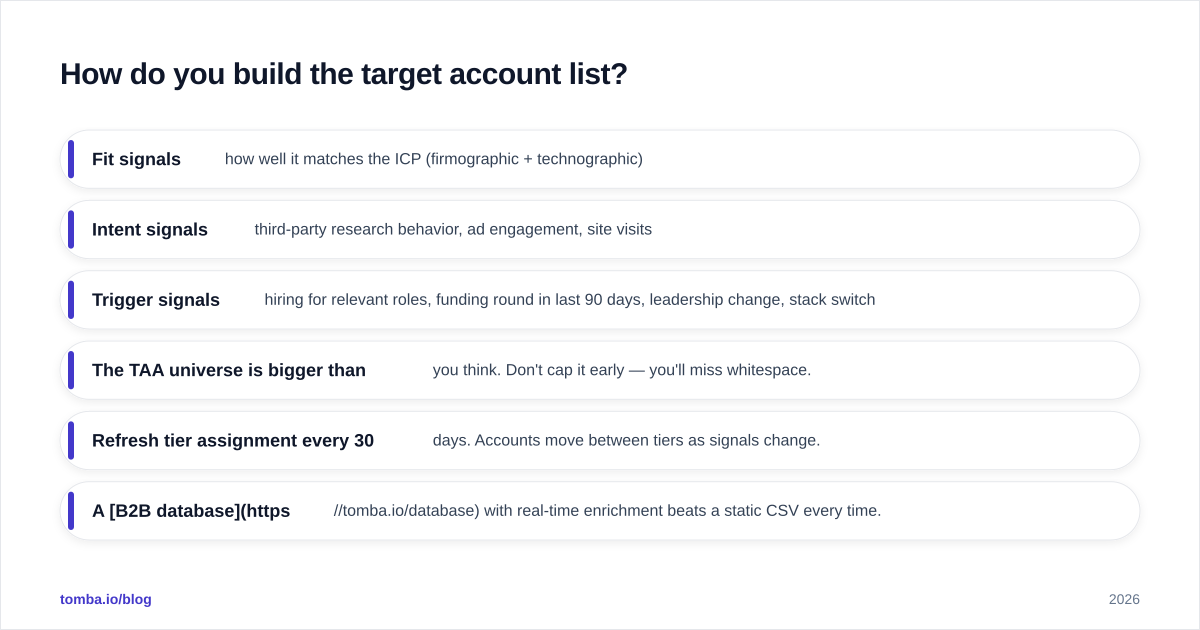
- Fit signals — how well it matches the ICP (firmographic + technographic)
- Intent signals — third-party research behavior, ad engagement, site visits
- Trigger signals — hiring for relevant roles, funding round in last 90 days, leadership change, stack switch
Accounts that fire on all three move to 1:1 or 1:few. Fit + intent without triggers go to 1:many. Fit-only goes to nurture.
A few practical notes from running this loop:
- The TAA universe is bigger than you think. Don't cap it early — you'll miss whitespace.
- Refresh tier assignment every 30 days. Accounts move between tiers as signals change.
- A B2B database with real-time enrichment beats a static CSV every time.
What data do you actually need for ABM?#
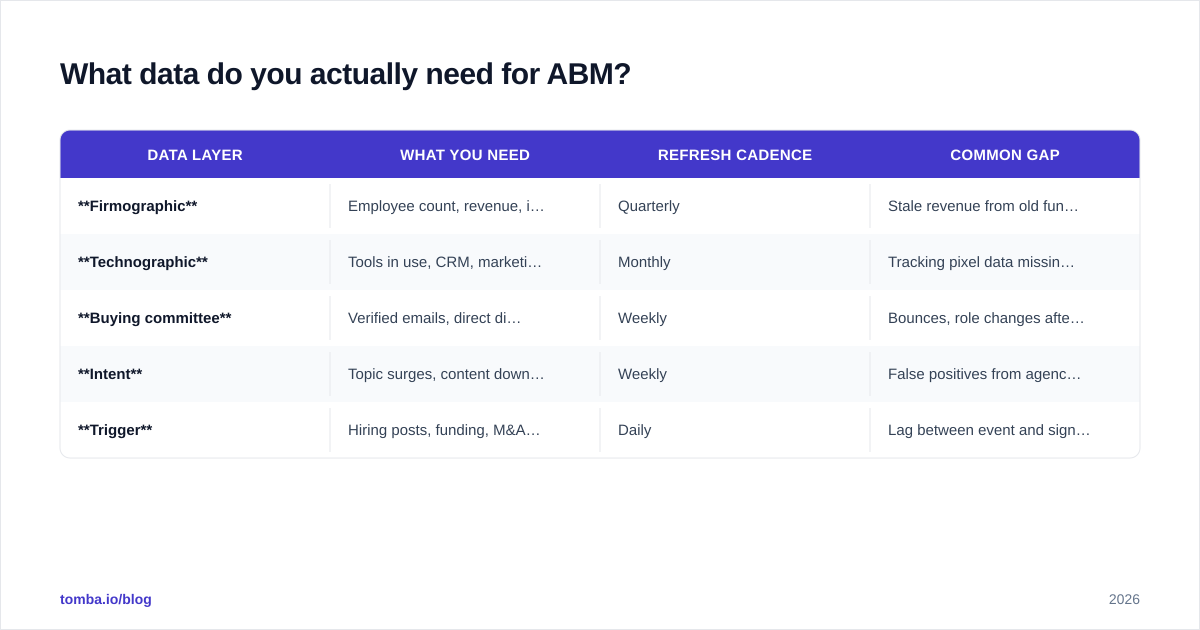
The unglamorous truth about ABM in 2026: data quality determines everything downstream. You can have the best plays, the best tools, the best AEs — none of it survives a 30% bounce rate or stale job titles.
The minimum data stack per account:
| Data layer | What you need | Refresh cadence | Common gap |
|---|---|---|---|
| Firmographic | Employee count, revenue, industry, HQ | Quarterly | Stale revenue from old funding data |
| Technographic | Tools in use, CRM, marketing stack, hosting | Monthly | Tracking pixel data missing private tools |
| Buying committee | Verified emails, direct dials, LinkedIn URLs, role, seniority | Weekly | Bounces, role changes after 90 days |
| Intent | Topic surges, content downloads, ad engagement | Weekly | False positives from agency IPs |
| Trigger | Hiring posts, funding, M&A, leadership change | Daily | Lag between event and signal |
Most teams get the firmographic layer right and fall apart on the buying committee layer. Verified contact data is the difference between a play that runs and a play that 404s. Tools like the Tomba Email Finder and domain search close that gap by pulling verified emails for named accounts, and the Tomba HubSpot integration keeps the data flowing into your CRM without manual exports.
For the technographic and intent layers, BuiltWith, G2 Buyer Intent, and Bombora are the usual suspects. The triggers layer is where most teams under-invest — set up Google Alerts or a [
Zapier integration](https://tomba.io/integrations/zapier) that watches for hiring posts on your target accounts and pipes them into Slack.
What plays should an ABM program actually run?#
Plays are the unit of execution. A play is a small, repeatable workflow that fires when an account hits a defined condition. Stop thinking in campaigns; think in plays.
Here are six plays every 2026 ABM program should run:
Play 1 — New trigger detected. Account fires a hiring signal for a relevant role. SDR sends a hyper-specific email within 24 hours referencing the job post and the gap it implies. Connection request to the hiring manager and one peer.
Play 2 — Engaged but ghosted. Account had 3+ site visits in 14 days, then went quiet. Marketing fires a retargeting sequence with a vertical case study, AE sends a "saw you stopped by" note with no ask.
Play 3 — Competitor displacement. Account installs or renews a competitor. SDR sends a side-by-side comparison and a switching-cost offer. Marketing serves comparison ads to the IP range.
Play 4 — Champion change. Champion or buyer leaves the account. AE pauses outbound for 2 weeks, then opens a new conversation with the successor framed as "continuity check," not a re-pitch.
Play 5 — Buying committee expansion. Once one stakeholder responds, the SDR maps and reaches out to the other 5-9 committee members within 7 days. Coordinated, not staggered.
Play 6 — Quarterly executive touch. Top-tier 1:1 accounts get a custom research artifact (industry benchmark, exec-curated content) every quarter from a VP-level sender. No ask.
Each play needs: a trigger definition, an owner, content assets ready to go, and a 48-hour SLA from trigger to action. Plays that take a week to execute aren't plays — they're projects.
How do you measure ABM without lying to yourself?#
ABM measurement is where most programs get politically captured. Marketing reports "engaged accounts," sales reports "sourced pipeline," and neither number ties to revenue. Fix this with a shared dashboard built on four layers:
Layer 1 — Coverage. What percentage of your target list has a known buying committee with verified contact data? Target: 90%+. This is a pure data-quality metric and the only one marketing fully owns.
Layer 2 — Engagement. Account engagement score combining site visits, content consumption, ad impressions, email replies, and meeting acceptance. Track the trend per account, not the absolute number. The right question: "are accounts trending up or flat?"
Layer 3 — Pipeline. Pipeline created from target accounts, by tier. Track velocity (days from first touch to opportunity), not just dollar value.
Layer 4 — Revenue. Closed-won from target accounts, average deal size, win rate vs. non-target accounts. The whole reason ABM exists is the delta on win rate and deal size — if it isn't there, the program isn't working.
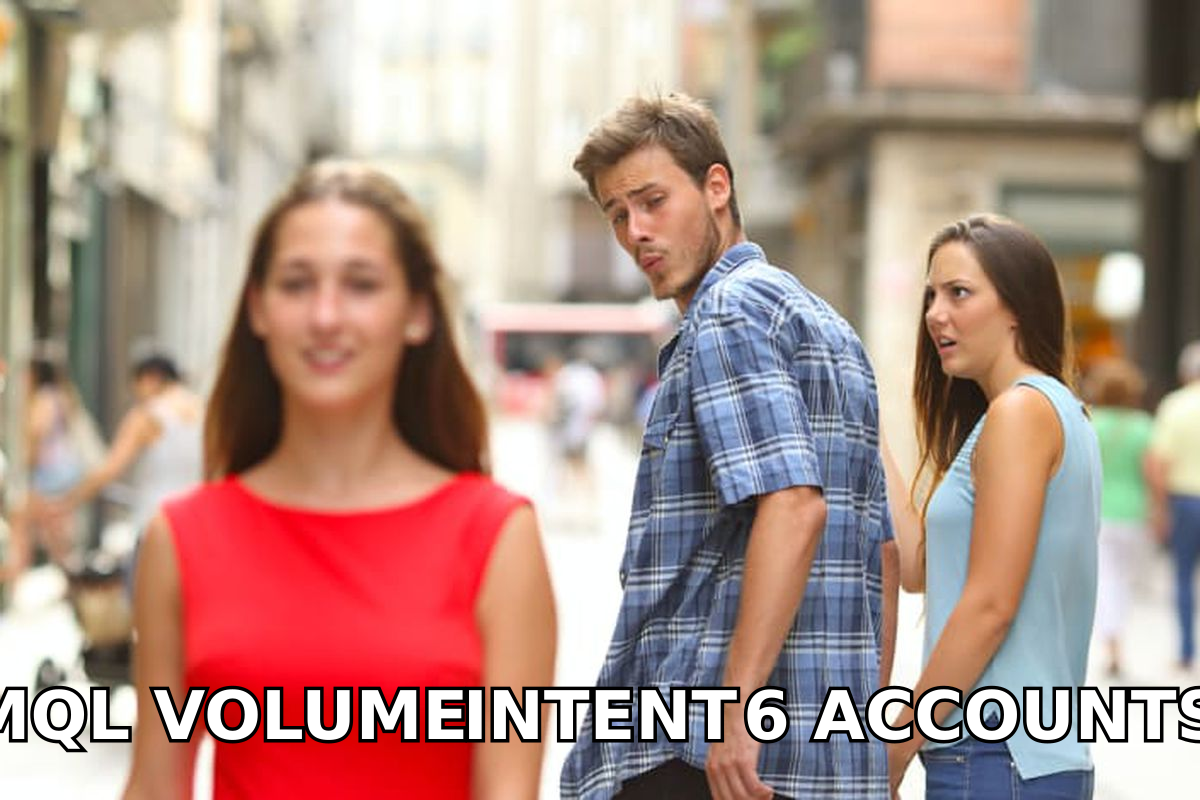
What to stop measuring: MQL volume, raw lead count, cost per lead, form fills from target accounts in isolation. They tell you nothing about whether your accounts are getting closer to a buying decision.
Gartner's research and the Forrester B-to-B Summit materials both publish reasonable ABM benchmarks if you want external reference points.
What tools does an ABM program need?#
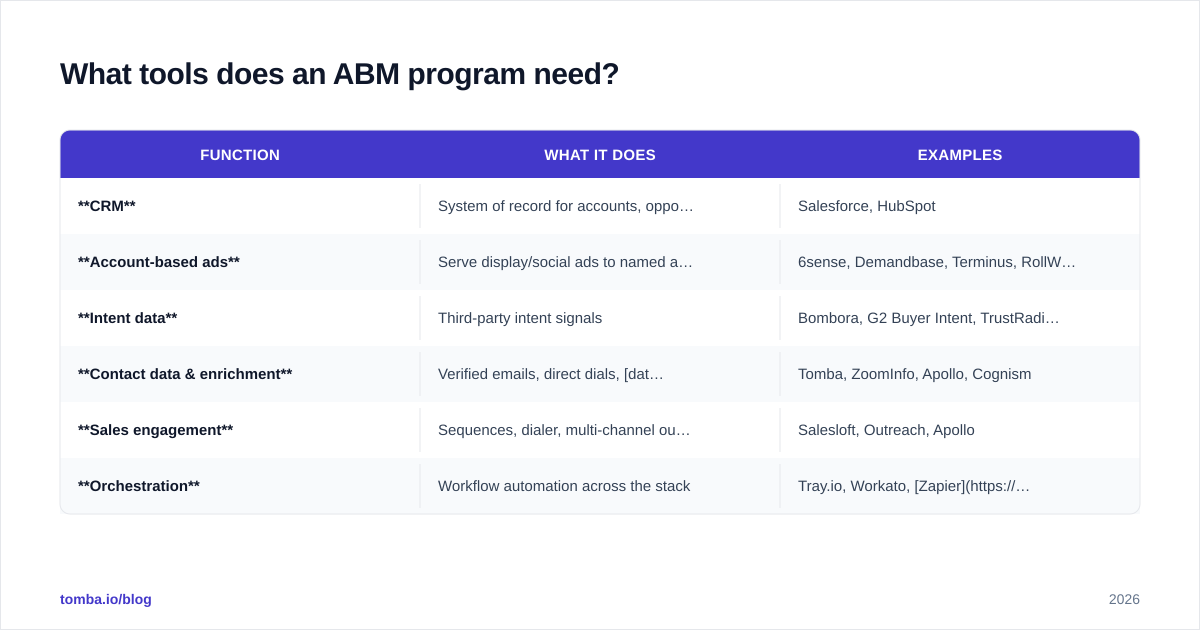
The "ABM platform" category has consolidated. In 2026 the practical stack looks like this:
| Function | What it does | Examples |
|---|---|---|
| CRM | System of record for accounts, opportunities, activities | Salesforce, HubSpot |
| Account-based ads | Serve display/social ads to named accounts and IPs | 6sense, Demandbase, Terminus, RollWorks |
| Intent data | Third-party intent signals | Bombora, G2 Buyer Intent, TrustRadius |
| Contact data & enrichment | Verified emails, direct dials, data enrichment, buying committee mapping | Tomba,ZoomInfo, Apollo, Cognism |
| Sales engagement | Sequences, dialer, multi-channel outreach | Salesloft, Outreach, Apollo |
| Orchestration | Workflow automation across the stack | Tray.io, Workato, Zapier |
Beware buying a "full ABM suite" before you've validated the program manually. The pattern that works: prove the motion with three SDRs, a CRM, and verified contact data. Add the orchestration platform once you have plays running consistently and a person whose job is to run them.
What are the most common ABM strategy mistakes?#
After watching dozens of ABM programs, the failure modes are remarkably consistent:
- Treating the target list as the strategy. A list is a noun; ABM is a verb. Without plays, content, and SLAs the list is just a spreadsheet.
- Marketing-only ABM. If sales doesn't commit to the same account list with the same definitions, you have an account-based ad campaign, not an ABM program.
- Over-tiering at 1:1. Picking 100 "strategic" accounts is the same as picking none. The constraint is the point.
- Ignoring buying committee mapping. Reaching only the original champion is fragile. The other 5-9 members move deals or kill them.
- No exit criteria. Accounts sit in tiers forever. Set a rule: 1:1 accounts that don't open pipeline in 6 months drop to 1:few or get rotated out.
- Measuring ABM with demand-gen metrics. MQL targets on an ABM program will produce demand-gen behavior. The metric defines the motion.
How do you start an ABM strategy in the next 30 days?#
If you're starting from scratch, here's a defensible 30-day plan:
Week 1 — Definition. Lock the ICP from your last 50 closed-won deals. Get marketing and sales leadership to sign off on the same definition.
Week 2 — List. Build the TAA universe. Pick 50-150 accounts for a 1:few pilot. Don't try to launch 1:1 and 1:many in parallel yet.
Week 3 — Data. Map the buying committee on each pilot account — minimum 5 verified contacts per account with role, email, and LinkedIn. Tools like the LinkedIn finder and bulk email finder make this a one-day job, not a one-month job.
Week 4 — First play. Pick one play from the six above. Build the assets, define the trigger, set the 48-hour SLA, and run it on 20 accounts. Measure engagement and pipeline created at day 30, 60, and 90.
You will get the second tier and the other plays online in months two and three. Resist the urge to launch everything at once.
Closing thoughts#
ABM in 2026 is less about the brand and the airdrops and more about a tight loop: signal in, play out, committee engaged, pipeline created. The teams winning at it are obsessive about data freshness and ruthless about tier discipline.
The starting point — every time — is verified contact data on the buying committees inside your target accounts. Without it, the rest of the strategy collapses. Try the Tomba Email Finder on your top 50 target accounts and see how many verified buying-committee contacts you can pull in an afternoon. The free tier is enough to test the workflow before you commit to a paid plan; if it works, Tomba pricing starts at $49/mo for the volume most pilot programs need.
The list is the strategy. Make sure yours is built on real data.
Ready to find emails that actually work?
Join 150,000+ professionals who stopped guessing and started sending. Free credits on signup — no credit card required.
Get the Tomba newsletter
Practical outbound tactics and product updates — once every two weeks.
About the author