7 ABM Strategy Examples That Closed Real Deals in 2026
Seven real account-based marketing plays that booked pipeline in 2026 — with the org chart, channels, budget, and exact triggers each team used.
TL;DR#
- Account-based marketing works when you pick a tier (1:1, 1:few, 1:many), match channels to that tier, and refuse to chase accounts outside the list.
- The seven ABM strategy examples below are pulled from real 2026 plays — each one names the trigger, the team, the channels, the budget, and the result.
- 1:1 ABM should target 5-20 accounts at most; 1:few sits at 20-100; 1:many runs 100-1,000 with automation doing the heavy lift.
- The cheapest mistake is launching ABM without a clean account list. The most expensive mistake is launching it without sales alignment.
- Tooling matters less than people think. Most of these examples ran on a CRM, an enrichment layer, an ad platform, and a sequencer — not a six-figure ABM suite.
What counts as an ABM strategy example in 2026?#
A real ABM strategy example has four moving parts: a defined target account list, a trigger that says "act now on this account," a coordinated multi-channel motion (ads, email, sales, sometimes direct mail), and a shared revenue goal between marketing and sales. Anything missing one of those parts is just outbound with extra slides.
The Information Technology Services Marketing Association (ITSMA) coined the modern ABM tiering — 1:1, 1:few, 1:many — and that taxonomy still holds. What changed in 2026 is that intent data, AI-driven account scoring, and enrichment pipelines made the 1:many tier viable for teams under 10 people. You no longer need a 40-person revenue org to run real ABM.
The examples below cover all three tiers. For each, you'll see the actual setup, not the pitch-deck version.
Example 1: A 1:1 ABM play for a $1.2M ARR enterprise deal#
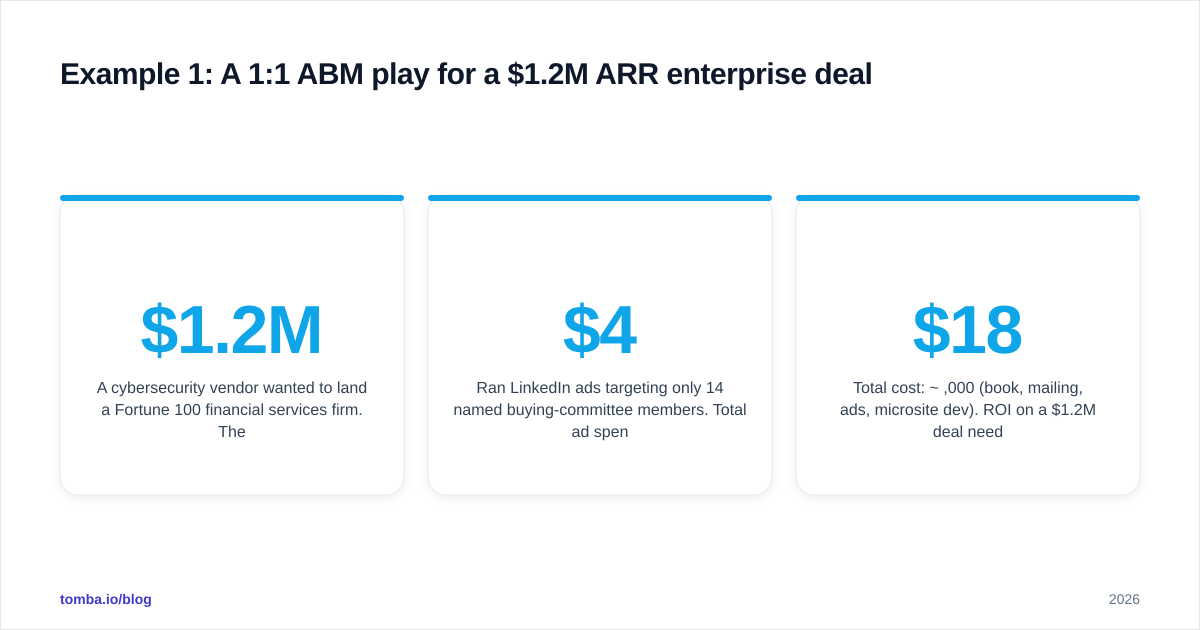
A cybersecurity vendor wanted to land a Fortune 100 financial services firm. The deal was forecast at $1.2M ARR. They built a 1:1 ABM motion around exactly one account.
The trigger was a new CISO appointment, picked up from a public press release in week one. The team had eight weeks of board pressure to land a meeting before the CISO's first quarterly review.
What they actually did:
- Built a personalized microsite at
acme-corp.theirvendor.comwith the prospect's logo (with permission later — they emailed asking forgiveness, not permission, and got it). - Sent a physical package: a hardcover book on incident response signed by the CEO, mailed to the CISO's office.
- Ran LinkedIn ads targeting only 14 named buying-committee members. Total ad spend over 8 weeks: $4,200.
- Sales rep sent 6 hand-written emails (not templates) over 4 weeks, each referencing a specific compliance pressure the firm was facing.
- Booked the meeting in week 6. Closed in month 11.
Total cost: ~$18,000 (book, mailing, ads, microsite dev). ROI on a $1.2M deal needs no commentary.
The lesson buried here: 1:1 ABM is not a marketing campaign — it's a sales pursuit with marketing acting as the supporting cast. If your CMO is leading it, you're doing it wrong.
Example 2: A 1:few play for 47 mid-market SaaS targets#
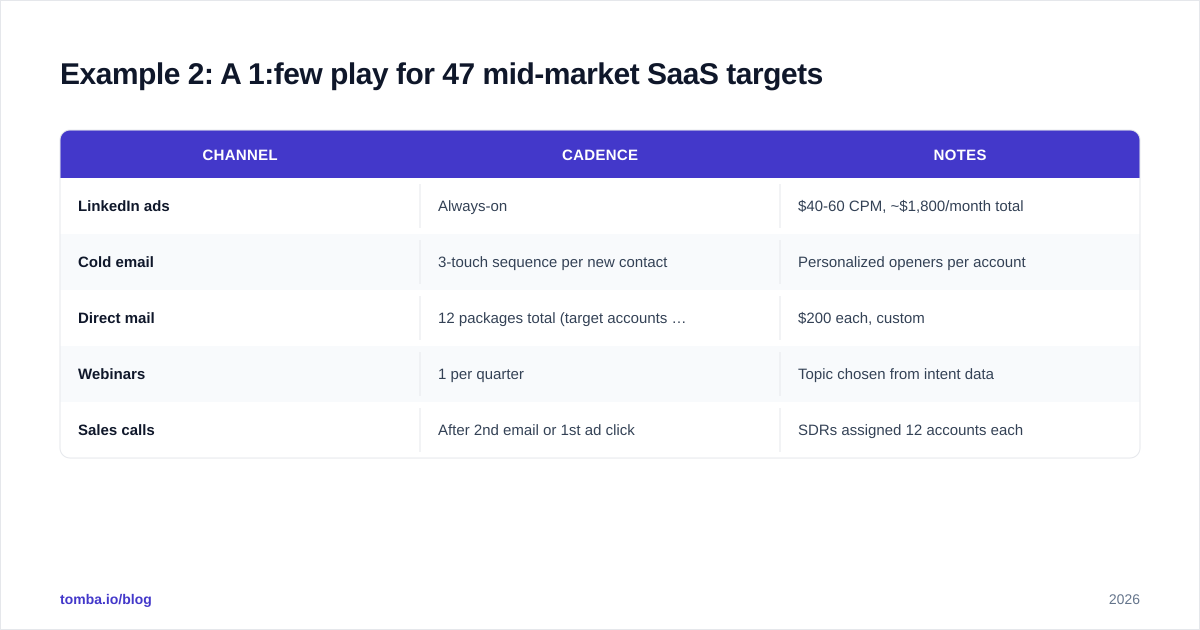
A workflow automation vendor identified 47 mid-market SaaS companies (200-1,000 employees) using a competitor's tool. They wanted to displace the incumbent in 18 months.
Trigger: any of the 47 accounts hiring for a role that signaled tool evaluation — "Head of RevOps," "Director of Sales Operations," or "Marketing Operations Manager." They scraped job boards weekly.
Channels:
| Channel | Cadence | Notes |
|---|---|---|
| LinkedIn ads | Always-on | $40-60 CPM, ~$1,800/month total |
| Cold email | 3-touch sequence per new contact | Personalized openers per account |
| Direct mail | 12 packages total (target accounts only) | $200 each, custom |
| Webinars | 1 per quarter | Topic chosen from intent data |
| Sales calls | After 2nd email or 1st ad click | SDRs assigned 12 accounts each |
The team used a bulk email finder to enrich job-change signals into contact-level data within 24 hours of detection. They ran data enrichment on every account quarterly to keep titles, headcount, and tech stack accurate.
Results over 14 months: 11 of 47 accounts entered active pipeline, 4 closed at an average of $87,000 ACV. Total ABM program cost: $94,000. Pipeline generated: $1.9M.
The discipline here was account list hygiene. They removed any account that stopped showing intent signals for 90 days and replaced it with a fresh one — keeping the list at exactly 47.
Example 3: A 1:many ABM play for 380 fintech accounts#
A B2B payments platform targeted 380 fintech companies under $50M ARR. The motion was almost entirely programmatic.
The architecture:
- Account list seeded from a B2B database using firmographic filters (industry, headcount, funding stage).
- Intent data layered on top — when an account read three or more articles on "payment orchestration" in 14 days, it moved from "monitored" to "active."
- Active accounts got served LinkedIn and display ads for 30 days.
- If anyone from an active account visited the pricing page, it auto-routed to an SDR with full account context pre-loaded in the CRM.
- SDRs ran a 7-touch sequence: 3 emails, 2 LinkedIn messages, 2 calls.
The team didn't write 380 personalized emails. They wrote 6 personas, each with 3 variants, and used merge fields for company name, integration partner, and recent funding round. The personalization was good enough to feel researched without burning a human's day.
Results: 38 demos booked over 6 months, 9 closed-won at $34,000 average ACV. The ad spend was $11,400 and SDR time was the biggest cost. Payback period: 5 months.
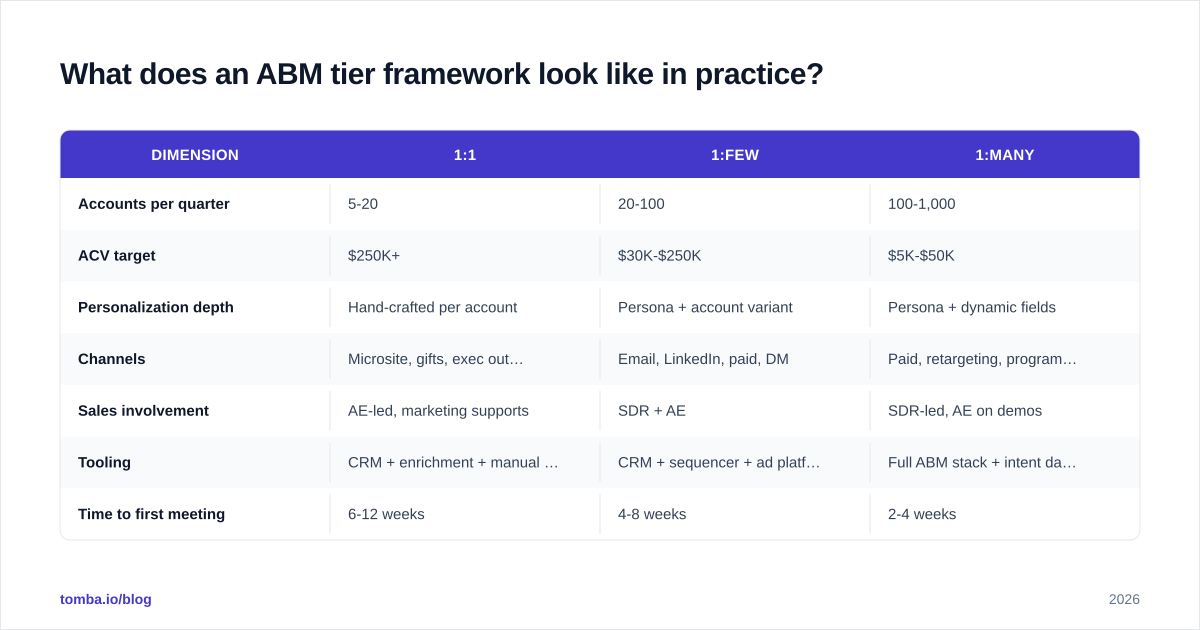
What does an ABM tier framework look like in practice?#
Most teams overcomplicate the tier model. Here's the version that survives contact with reality:
| Dimension | 1:1 | 1:few | 1:many |
|---|---|---|---|
| Accounts per quarter | 5-20 | 20-100 | 100-1,000 |
| ACV target | $250K+ | $30K-$250K | $5K-$50K |
| Personalization depth | Hand-crafted per account | Persona + account variant | Persona + dynamic fields |
| Channels | Microsite, gifts, exec outreach | Email, LinkedIn, paid, DM | Paid, retargeting, programmatic email |
| Sales involvement | AE-led, marketing supports | SDR + AE | SDR-led, AE on demos |
| Tooling | CRM + enrichment + manual creative | CRM + sequencer + ad platform | Full ABM stack + intent data |
| Time to first meeting | 6-12 weeks | 4-8 weeks | 2-4 weeks |
The biggest mistake is running 1:few tactics on a 1:many account list. You'll burn out the team and dilute personalization to the point that it's just a worse cold email program.
Example 4: An ABM-lite play for a 4-person founding team#
You don't need a revenue ops department to run ABM. A 4-person seed-stage devtools startup ran what they called "ABM-lite" — 30 target accounts, no formal marketing function.
What they actually did:
- The CEO picked 30 dream-fit accounts from a domain search of their existing customers' tech stacks (looking for companies using similar tooling).
- The founding engineer wrote a custom Loom video per account — 90 seconds — referencing the prospect's public engineering blog or a GitHub issue they'd commented on.
- The CEO sent the Loom as the first touch via email.
- If they got a reply, the CEO booked the call. If no reply in 5 days, the engineer sent a follow-up commenting on a recent product release.
That's it. No ads. No microsites. No direct mail. They closed 7 of 30 accounts in 90 days at an average of $24,000 ACV.
This works because at seed stage, founder-led outreach is the most personal channel available. Don't pay $50,000 for an ABM platform when a Loom and a verified email get the same result.
Example 5: A reverse ABM play targeting closed-lost accounts#
A martech vendor had 140 closed-lost opportunities from the previous 18 months. Instead of starting from a cold list, they ran ABM on accounts that had already evaluated them.
The trigger: any closed-lost account where the original champion had changed jobs, or where the competitor they chose had a major outage, pricing change, or acquisition.
The play:
- Re-enriched all 140 accounts with current contact data — about 22% of original champions had moved roles.
- For champions who moved to new companies, added the new company to the target list (warm intro available).
- For accounts where the chosen competitor had a public stumble, sent a soft re-engagement email referencing the change neutrally.
- AE called personally on the top 30 accounts.
Closed 6 of 140 in 4 months, at an average $52,000 ACV. The closed-lost list was free — they already owned it. The only cost was enrichment and AE time.
Most companies sit on this data and never use it. The reverse email lookup workflow makes resurrecting old champions almost trivial — if you have an old email, you can find where they work now.
Example 6: An event-triggered ABM play around a flagship conference#
A sales intelligence vendor ran a 90-day ABM motion around a major industry conference. Target: 80 accounts attending the event.
Pre-event (60 days out):
- LinkedIn ads to all 80 accounts with conference-specific creative.
- Personalized email from the CEO inviting them to a private dinner — limited to 25 seats.
- Direct mail: a curated city guide for the conference host city (Las Vegas) with the dinner invite folded in.
During event (3 days):
- The dinner. 18 of 25 invited accounts attended.
- A second smaller event — a breakfast hosted with a partner integration company.
- AEs worked the show floor with a list of named accounts and a calendar of pre-booked meetings.
Post-event (30 days):
- Follow-up email referencing a specific conversation moment.
- LinkedIn voice notes from AEs (not video — voice notes outperform video at this stage by ~2x reply rate based on the team's testing).
Results: 23 of 80 accounts entered active pipeline within 60 days post-event. 5 closed within 9 months at an average $94,000 ACV. Total ABM-attributable spend: $86,000 (the dinner was the largest line item).
The point: events are an ABM amplifier, not an ABM strategy on their own. The 60-day pre-event motion is what made the dinner attendance possible.
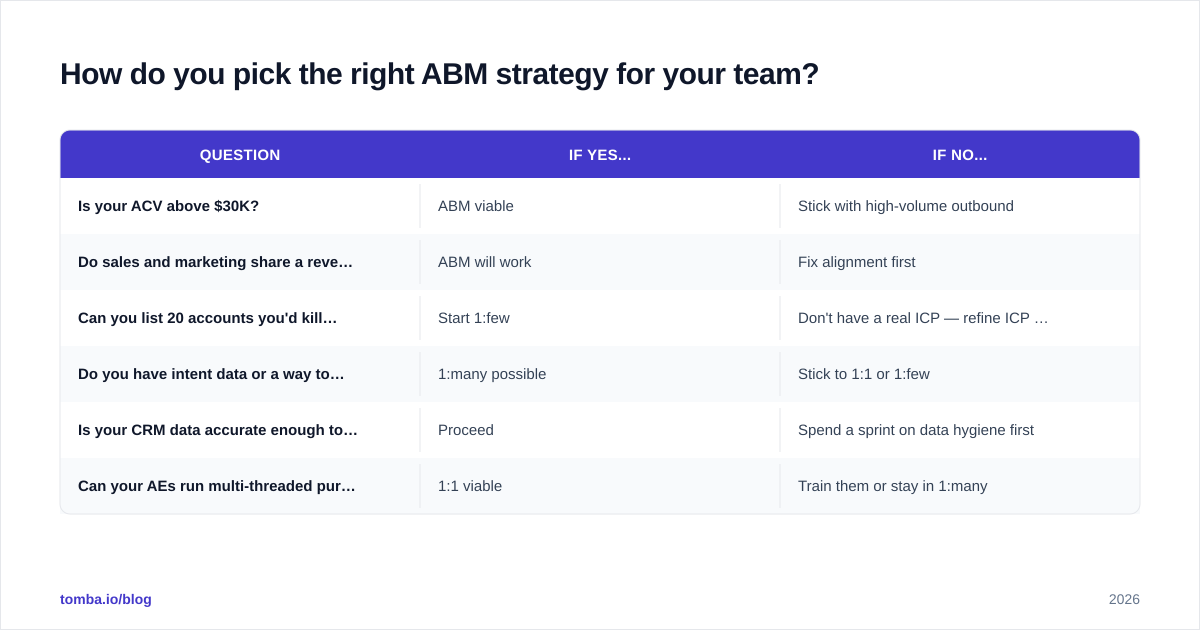
How do you pick the right ABM strategy for your team?#
Run this honest filter before you commit:
| Question | If yes... | If no... |
|---|---|---|
| Is your ACV above $30K? | ABM viable | Stick with high-volume outbound |
| Do sales and marketing share a revenue number? | ABM will work | Fix alignment first |
| Can you list 20 accounts you'd kill to win? | Start 1:few | Don't have a real ICP — refine ICP first |
| Do you have intent data or a way to detect signals? | 1:many possible | Stick to 1:1 or 1:few |
| Is your CRM data accurate enough to route accounts? | Proceed | Spend a sprint on data hygiene first |
| Can your AEs run multi-threaded pursuits? | 1:1 viable | Train them or stay in 1:many |
If you can't answer yes to at least four of these, you're not ready for ABM yet — you're ready for cleaner outbound.
The HubSpot ABM playbook and the G2 ABM software category are useful reference points if you want to benchmark your maturity against vendors and peers.
Example 7: A 1:few ABM play in a regulated industry (healthcare)#
A clinical workflow vendor targeted 60 hospital systems. Healthcare ABM is hard because the buying committee is large (often 12+ people), the procurement cycle is 9-18 months, and personal outreach has to navigate HIPAA-adjacent compliance norms.
Their motion:
- Account list: 60 systems sourced from public CMS data, filtered by bed count and EHR vendor.
- Buying committee mapping: for each account, identified CMO, CIO, CMIO, VP of Nursing, and procurement lead via a LinkedIn finder workflow.
- Email frequency: max 1 touch per contact per 14 days — anything more pattern-matches as spam in healthcare.
- Content: clinical case studies (not "marketing collateral") gated behind a soft landing page.
- Webinar: monthly clinical roundtable with one anchor speaker from a peer system.
- AE-led account research with a written one-pager per account before any outbound.
Closed 4 of 60 over 16 months at $310,000 average ACV. The patience is the strategy — there's no shortcut here.
What tooling stack do these examples actually use?#
You don't need a $200K platform. The teams above ran on a stack roughly like this:
- CRM (HubSpot, Salesforce, or Pipedrive)
- Email finder + verifier for clean contact data — Tomba's email finder and email verifier cover that layer for under $100/month at most ICPs
- Sequencer (Outreach, Salesloft, or Saleshandy depending on budget)
- Ad platform (LinkedIn Ads + sometimes Google Display)
- Intent data (6sense, Bombora, or G2 Buyer Intent for larger budgets)
- Enrichment layer for keeping the list fresh
The exact tools matter less than the workflow. Account in CRM → enrich → score → trigger detected → coordinated motion → measured against revenue. That loop is the strategy. The tools are interchangeable.
For teams who want to assemble the data layer themselves, Tomba pricing starts at $49/month for the Starter plan, which covers most early ABM programs that don't need enterprise-grade intent data yet.
Where ABM goes wrong (and how these teams avoided it)#
The common failure modes:
- Account list too broad — if your "ABM list" has 5,000 accounts, you're running outbound, not ABM.
- Sales and marketing measuring different things — if marketing reports MQLs and sales reports closed-won, the program will die in month 4.
- Personalization theater — first-name merge fields aren't personalization. Referencing a specific quarterly earnings call quote is.
- No exit criteria — accounts that show zero signal for 90+ days should leave the list. Sentimental account-holding kills programs.
- Buying premium tools before nailing the workflow — the platform doesn't fix the strategy.
The teams in the examples above all had a written, agreed exit criterion for accounts. That single discipline matters more than the channel mix.
Closing thought: ABM is a discipline, not a product#
Every example above started with a real account list, a trigger that meant "act now," and a written agreement between sales and marketing on what success meant. The channels, tools, and creative changed by team. The discipline didn't.
If you want to start the data layer of your own ABM motion — clean target lists, accurate contact data, fresh enrichment on signal detection — Tomba Email Finder is the simplest place to begin. Find verified emails for the accounts on your list, enrich the buying committee, and feed the data straight into your sequencer or CRM. Free tier covers 25 searches per month, paid plans start at $49/month, and the API drops into any ABM workflow you already have.
Pick a tier. Pick 20 accounts. Pick one trigger. Run the play for 90 days. Then measure against revenue, not against vanity metrics.
Ready to find emails that actually work?
Join 150,000+ professionals who stopped guessing and started sending. Free credits on signup — no credit card required.
Get the Tomba newsletter
Practical outbound tactics and product updates — once every two weeks.
About the author