ABM Strategy Template: The 2026 Playbook for B2B Teams
A no-fluff ABM strategy template for 2026: tier your accounts, align sales and marketing, pick channels, and measure pipeline impact — with examples you can copy today.
TL;DR#
- An ABM strategy template is a one-page operating plan that ties accounts, plays, channels, and metrics together — not a slide deck or a wish list.
- The 2026 version has three tiers (1:1, 1:few, 1:many), a shared sales+marketing scorecard, and a clear handoff between marketing-sourced and sales-sourced motions.
- Stop measuring MQLs. Measure engaged accounts, pipeline created, and revenue closed inside your named-account list.
- Most teams fail at ABM because of bad data, not bad strategy. Lock down firmographics, contacts, and intent signals before you build plays.
- Use the template below — tiering, plays, tech stack, and scorecard — as the starting skeleton. Adjust ratios, channels, and budget to your motion.
What is an ABM strategy template?#
An ABM strategy template is a structured plan that tells your revenue team which accounts to pursue, how to engage them, who owns what, and how you'll know it worked. Think of it like a flight plan: pilots don't take off without one, and neither should a B2B revenue team running account-based marketing.
The mistake most teams make is treating ABM like a campaign. ABM is an operating model. A template makes that operating model concrete — accounts, owners, plays, channels, frequency, budget, and metrics on a single page that any rep, marketer, or exec can read in 60 seconds.
This guide gives you that template, plus the inputs needed to fill it in for your business. You can find foundational definitions on Gartner and a deeper academic take on Wikipedia's account-based marketing entry, but the rest of this article focuses on execution.
Why do most ABM strategies fail in 2026?#
Three reasons, in order:
- No tiering. Teams treat 800 accounts the same way — sending a generic "personalized" email to everyone and calling it ABM. It isn't.
- Bad account data. Wrong domains, dead contacts, stale firmographics. If your CRM thinks the CFO of Stripe is still at Box, no play will work.
- Sales and marketing aren't aligned on the list. Marketing runs ads against one ICP. Sales prospects against another. Pipeline leaks at every handoff.
The fix isn't a new platform — it's a written template that forces those decisions before any campaign launches. The Forrester B2B Revenue Waterfall gives a useful framework for thinking about engaged accounts vs. opportunities, but you still need to make the calls yourself.
What does a complete ABM strategy template look like?#
Here's the skeleton. Every section should fit on one page when filled in. If it doesn't, you're overcomplicating it.
Section 1: Ideal Customer Profile (ICP)#
Define your ICP using firmographic, technographic, and behavioral criteria. Be specific.
- Firmographic: industry (NAICS or your own taxonomy), employee count band, revenue band, geography, funding stage
- Technographic: what they use today — CRM, marketing automation, data warehouse, the competitor product you'd replace
- Behavioral: signals that indicate readiness — hiring sales ops, recent funding round, leadership change, technology migration
A good ICP eliminates 95% of the addressable market. If yours doesn't, you'll spread ABM budget too thin.
Section 2: Account tiers#
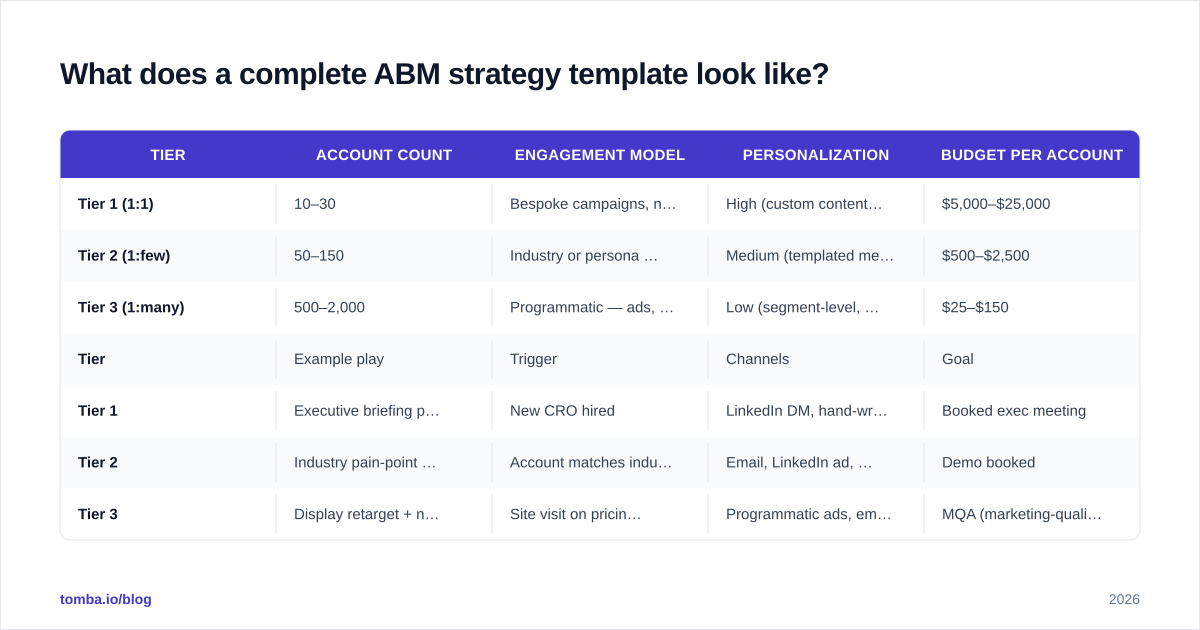
Three tiers, each with its own engagement model.
| Tier | Account count | Engagement model | Personalization | Budget per account |
|---|---|---|---|---|
| Tier 1 (1:1) | 10–30 | Bespoke campaigns, named owner, custom assets | High (custom content, gifting, exec events) | $5,000–$25,000 |
| Tier 2 (1:few) | 50–150 | Industry or persona pods of 5–15 similar accounts | Medium (templated messaging with account-level inserts) | $500–$2,500 |
| Tier 3 (1:many) | 500–2,000 | Programmatic — ads, sequenced emails, retargeting | Low (segment-level, not account-level) | $25–$150 |
The ratios scale with company size. A 50-person seed-stage startup runs 10/50/500. A Series C runs 30/150/2,000. Enterprise teams run 50/300/5,000+.
Section 3: Plays and channels per tier#
A play is a repeatable sequence of touches across channels with a defined trigger and goal. The template should list 2–4 plays per tier.
| Tier | Example play | Trigger | Channels | Goal |
|---|---|---|---|---|
| Tier 1 | Executive briefing program | New CRO hired | LinkedIn DM, hand-written note, founder email, 1:1 dinner | Booked exec meeting |
| Tier 2 | Industry pain-point sequence | Account matches industry + size | Email, LinkedIn ad, BDR call | Demo booked |
| Tier 3 | Display retarget + nurture | Site visit on pricing page | Programmatic ads, email | MQA (marketing-qualified account) |
Section 4: Data and tooling#
Before any play runs, the data layer has to be clean. This is where most teams underinvest.
- Account list: firmographic data from a B2B database, deduped against CRM
- Contact data: decision-maker emails and phone numbers verified for deliverability. Use an email finder for direct lookups and an email verifier to keep bounce rates under 2%.
- Intent signals: third-party intent (G2, Bombora) plus first-party signals (web visits, form fills, content views)
- Enrichment: automated data enrichment on every new account and contact entering the funnel
- CRM hygiene: clear account-owner mapping, no orphaned contacts, deduplicated domains
If you're staffing a team, the data-layer owner reports to RevOps, not marketing. Treat it like infrastructure.
Section 5: Sales and marketing alignment#
Both teams sign off on the same one-page document. The template includes:
- The named-account list (frozen for the quarter, reviewed monthly)
- Who owns each account (AE primary, BDR secondary, marketer assigned to tier)
- Service-level agreements — e.g., marketing commits to 50 engaged accounts per quarter; sales commits to 5 touches per Tier 1 account per month
- Weekly sync cadence and the dashboard everyone watches
This is where the revenue operations function earns its keep. RevOps owns the source of truth.
Section 6: Metrics and scorecard#
Drop MQLs. Replace them with account-level metrics.
| Metric | Definition | Target (example) |
|---|---|---|
| Engaged accounts | Accounts with ≥3 meaningful touches received and ≥1 reciprocated | 30% of Tier 1, 15% of Tier 2, 5% of Tier 3 |
| Pipeline created | New opportunities sourced from named accounts | $X per quarter |
| Pipeline velocity | Days from first touch → opportunity | <60 for Tier 1 |
| Win rate | Closed-won / closed in named accounts | 25%+ on Tier 1 |
| Account penetration | Contacts engaged per account | ≥3 per Tier 1 |
Run the scorecard weekly. Kill plays that don't move the needle within two months.
How do you build the account list?#
The list is the foundation. If you get this wrong, no playbook will save you.
Start top-down:
- Pull every account in your CRM that closed in the last 24 months. Cluster by industry, size, and use case.
- Identify the top 3 clusters by ACV × win rate. These are your "lookalike" segments.
- Use a B2B database to pull all companies in those clusters. A B2B database query for "SaaS, 200–1,000 employees, North America, using Salesforce" returns your raw universe.
- Filter by intent and recency signals. Strip companies your AEs already worked and lost in the last 12 months.
- Score and tier. Top 30 go to Tier 1, next 150 to Tier 2, rest into the Tier 3 programmatic pool.
Then build the contact map. Each Tier 1 account needs 5–10 named contacts across decision-makers, champions, and blockers. A domain search pulls every email on a company domain in one call. Verify each one before it enters a sequence.
Refresh the list quarterly. ABM lists rot at roughly 2–3% per month — people leave, companies pivot, signals expire.
What tools belong in the ABM stack?#
You don't need to buy 12 platforms. A lean 2026 stack looks like this:
| Layer | Purpose | Examples |
|---|---|---|
| Data foundation | Account, contact, enrichment | Tomba, Clearbit,ZoomInfo |
| Intent | First- and third-party signals | Bombora, G2 Buyer Intent, 6sense |
| Engagement | Email + LinkedIn + ads | Outreach, Salesloft, LinkedIn Ads |
| Orchestration | Trigger plays from signals | Demandbase, RollWorks, custom in HubSpot/Salesforce |
| CRM + RevOps | System of record | HubSpot, Salesforce |
| Reporting | Pipeline + account scorecard | Native CRM dashboards, Looker, native ABM tool |
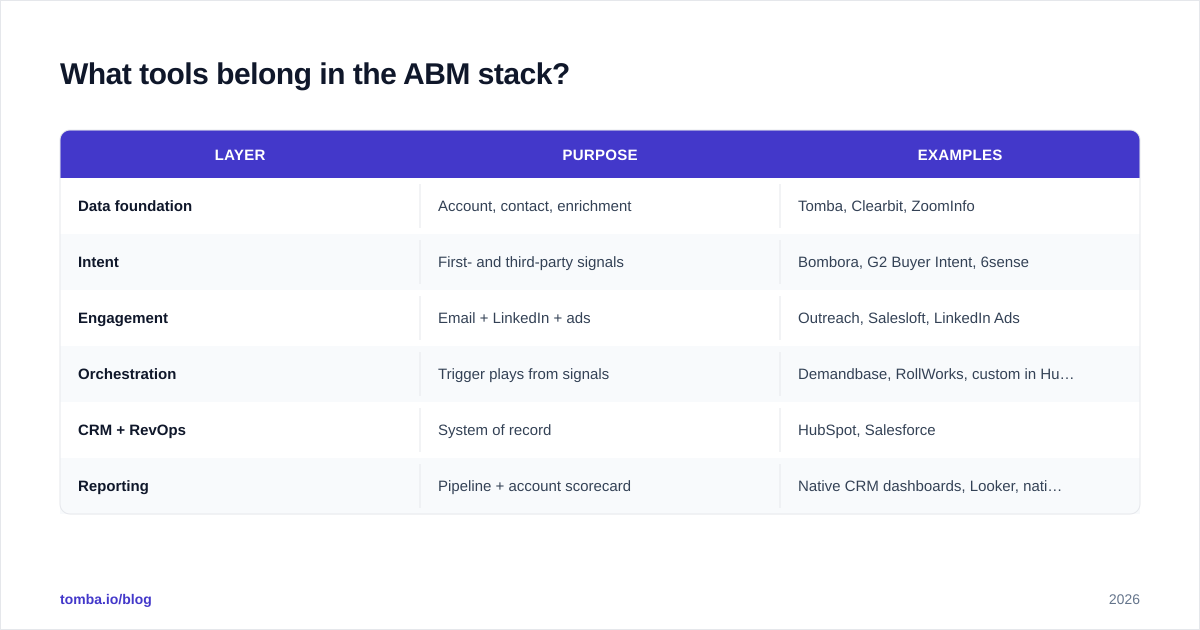
Big-budget teams pay for an end-to-end ABM platform (Demandbase, 6sense, Terminus) that bundles intent + ads + orchestration. Lean teams stitch HubSpot or Salesforce + a data tool + LinkedIn ads + an email engagement tool, and get 80% of the value at 20% of the cost. HubSpot and Salesforce both publish reference architectures.
How do you launch the ABM strategy in 90 days?#
Don't try to build the whole machine on day one. Launch in three phases.
Days 1–30: Foundation
- Lock the ICP. Get sales, marketing, and the CEO to sign off in writing.
- Build the named-account list (300–500 accounts to start). Tier them.
- Stand up the data layer. Enrich, verify emails, map contacts.
- Pick one tier-1 play and one tier-3 play. Ignore tier 2 until tier 1 is producing.
Days 31–60: Execution
- Launch the tier-1 play against 10 named accounts. Track every touch in CRM.
- Launch the tier-3 programmatic motion — display retargeting + email nurture.
- Run a weekly sync. Review the scorecard. Kill or iterate plays.
Days 61–90: Scale
- Add tier 2. Build pods of 10–15 accounts grouped by industry or persona.
- Layer intent signals — wire third-party intent to your CRM, trigger BDR outreach on score spikes.
- Expand the list to 800–1,500 accounts if pipeline is healthy. Hold steady if not.
Most teams skip the foundation phase and wonder why no plays land. The data layer is 60% of ABM success.
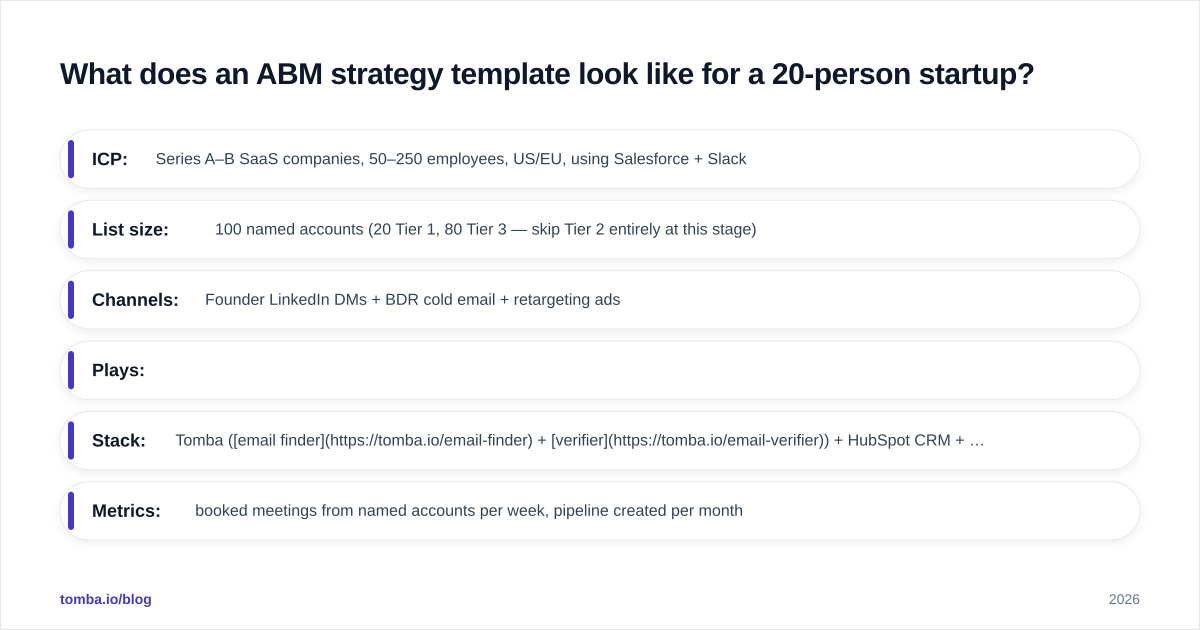
What does an ABM strategy template look like for a 20-person startup?#
Smaller and tighter. Here's a one-pager.
- ICP: Series A–B SaaS companies, 50–250 employees, US/EU, using Salesforce + Slack
- List size: 100 named accounts (20 Tier 1, 80 Tier 3 — skip Tier 2 entirely at this stage)
- Channels: Founder LinkedIn DMs + BDR cold email + retargeting ads
- Plays:
- Tier 1: founder-led 1:1 outreach with custom Loom + a free audit
- Tier 3: 7-step email sequence triggered by content download or pricing-page visit
- Stack: Tomba (email finder + verifier) + HubSpot CRM + LinkedIn Sales Navigator + a sequencer
- Metrics: booked meetings from named accounts per week, pipeline created per month
- Owner: the founder owns Tier 1, the BDR owns Tier 3, RevOps (or the ops-savvy founder) owns the list
That's the entire plan. No 40-slide deck, no $80k platform, no consultancy. It works because the constraints force focus.
How do you measure ABM success without MQLs?#
Three rules.
- Measure accounts, not leads. A single account with 4 engaged contacts beats 4 random MQLs every time.
- Tie every metric to revenue. Pipeline sourced from named accounts, win rate inside the list, ACV uplift vs. inbound.
- Compare cohorts. Named accounts vs. non-named. ABM-touched vs. ABM-untouched. If the gap isn't material, ABM isn't working.
Build the dashboard in your CRM. It should show, weekly:
- Engaged accounts by tier
- Pipeline generated by tier and play
- Win rate inside named accounts vs. baseline
- Cost per opportunity inside the program
Run a quarterly business review where sales, marketing, and finance look at the same numbers. The first time you do this, you'll find at least one play that costs more than it returns. Cut it.
What are the biggest ABM mistakes to avoid?#
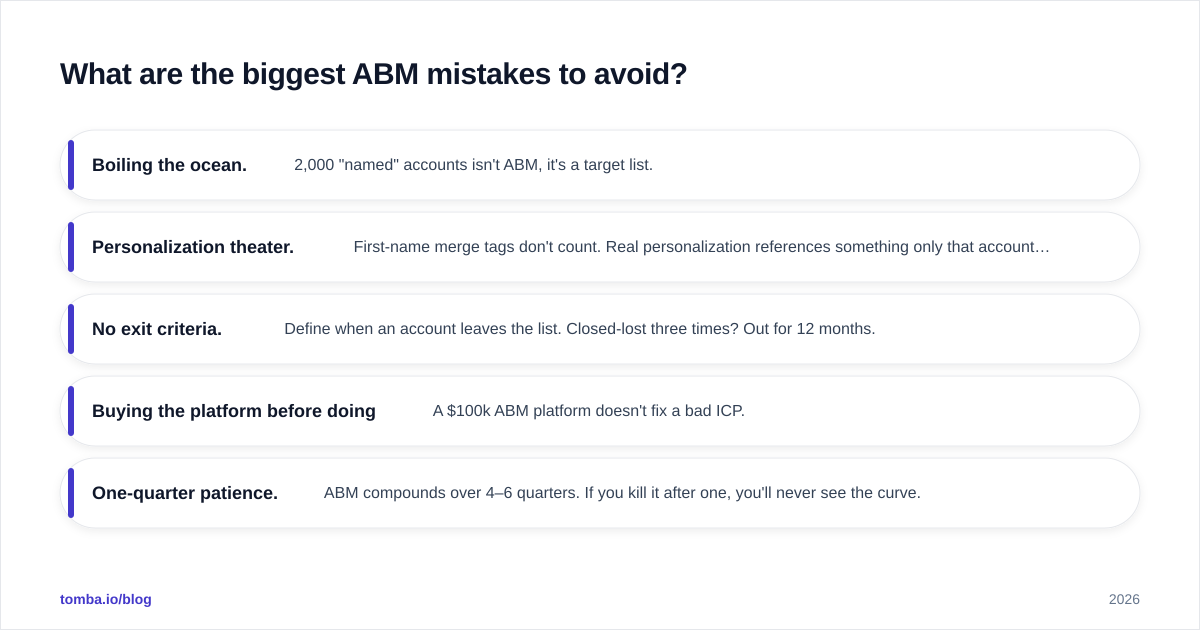
- Boiling the ocean. 2,000 "named" accounts isn't ABM, it's a target list.
- Personalization theater. First-name merge tags don't count. Real personalization references something only that account would know.
- No exit criteria. Define when an account leaves the list. Closed-lost three times? Out for 12 months.
- Buying the platform before doing the strategy. A $100k ABM platform doesn't fix a bad ICP.
- One-quarter patience. ABM compounds over 4–6 quarters. If you kill it after one, you'll never see the curve.
Putting it all together#
ABM is not magic. It's a disciplined operating model where sales and marketing point at the same accounts, run defined plays, and measure account-level outcomes. The template above is the operating system. Adapt the numbers to your motion — but keep the structure.
The single most leveraged thing you can do before any of this is fix your data layer. Wrong domains, dead emails, and missing decision-makers kill more ABM programs than bad strategy ever will.
Tomba's email finder is built for exactly this work — find verified decision-maker emails across your named-account list, run a domain search to map every contact at a target company, and enrich the data so your CRM stays current. The Free tier covers 25 searches/month to test on a sample, and the Starter plan at $49/mo is enough for most small-team ABM programs. See full Tomba pricing for larger lists. Get the data right, then run the plays.
Ready to find emails that actually work?
Join 150,000+ professionals who stopped guessing and started sending. Free credits on signup — no credit card required.
Get the Tomba newsletter
Practical outbound tactics and product updates — once every two weeks.
About the author