ABM Tactics That Actually Close Deals in 2026
The ABM playbook has changed. Here are the 2026 tactics that move pipeline — account selection, multithreaded outreach, intent signals, and the metrics that actually matter.
TL;DR#
- ABM in 2026 is account-first, multithreaded, and intent-driven — not "personalized cold email at scale."
- The winning teams pick fewer accounts (50-200 tier-1), map 5-9 stakeholders each, and run synchronized email + LinkedIn + ad plays.
- Intent signals (G2 visits, job changes, funding, tech installs) decide when to strike — not your sequence cadence.
- Measure pipeline-by-account and engaged-account velocity, not opens or MQLs.
- Tooling stack is converging: a data engine (Tomba, Clearbit), an orchestration layer (HubSpot, Salesforce), and a signal layer (6sense, Demandbase).
What are ABM tactics in 2026?#
Account-based marketing tactics are the specific, repeatable plays sales and marketing run against a fixed list of target accounts. The point is not to "do ABM" as a philosophy — it's to win named logos by treating each one as a market of one.
The 2026 version differs from the 2019 version in three ways:
- Account lists are smaller. Sub-200 tier-1 accounts per rep is the new normal. Five years ago teams ran 1,000+ "ABM lite" lists that were just demand-gen in costume.
- AI handles personalization at scale. Researching a CFO's last earnings call, their tech stack, and their hiring page used to take an SDR 20 minutes per account. It now takes 90 seconds.
- Buying committees are bigger. Gartner pegs the average B2B buying group at 11+ stakeholders for enterprise deals. Single-threaded ABM is dead.
Run ABM the old way and you'll see the gap immediately.
How do you build an ABM target account list?#
Bad account selection kills more ABM programs than bad copy ever will. You can write a perfect sequence to the wrong company and get zero meetings.
A defensible target list combines three filters:
- Firmographic fit — revenue band, employee count, geography, industry. The non-negotiables of your ICP.
- Technographic fit — what they already run. If you sell a Salesforce-native app, accounts on HubSpot are noise.
- Behavioral / intent fit — are they actively in-market? Hiring for the role you sell into? Posting on G2? Just raised a round?
Score each account 1-3 on each filter, multiply the three, and only accounts scoring 18+ make tier-1. The math forces ruthlessness.
For the data layer, you need a B2B database that gives you firmographic + contact data in one pull. Pair it with data enrichment so every new account that lands in your CRM gets auto-filled with employee count, tech stack, and key contacts.
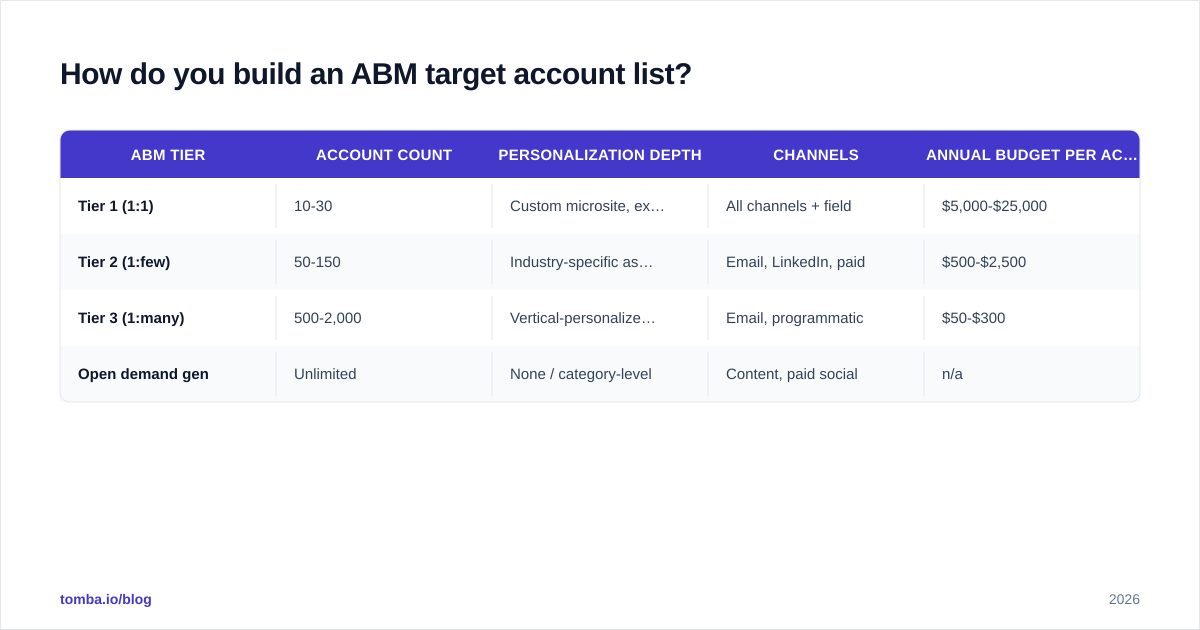
| ABM tier | Account count | Personalization depth | Channels | Annual budget per account |
|---|---|---|---|---|
| Tier 1 (1:1) | 10-30 | Custom microsite, exec gifting, named SDR | All channels + field | $5,000-$25,000 |
| Tier 2 (1:few) | 50-150 | Industry-specific assets, account-named ads | Email, LinkedIn, paid | $500-$2,500 |
| Tier 3 (1:many) | 500-2,000 | Vertical-personalized email + retargeting | Email, programmatic | $50-$300 |
| Open demand gen | Unlimited | None / category-level | Content, paid social | n/a |
Most teams should run tiers 1 and 2 only for the first six months. Tier 3 is the place programs go to die — it looks like scale but performs like batch-and-blast.
What ABM tactics actually generate pipeline?#
Here's the punch list of plays that earn their seat in 2026. Each one is concrete enough to run on Monday.
1. The multithreaded six-pack#
For every tier-1 account, find and engage 5-9 people across three functions: economic buyer, champion, technical evaluator, end user, and influencer. Single-threaded ABM dies the second your one contact changes jobs — which, per LinkedIn's data, happens to roughly 1 in 5 B2B contacts every year.
Use a domain search to pull every relevant contact on the target domain, then triage by title and seniority. A 200-account program should be working a 1,200-1,800 person list, not 200.
2. Job-change triggers#
When your champion changes companies, you get two assets: a warm intro at their new shop and a vulnerability at the old one. Set up a weekly job-change report on every contact in your CRM and route hits to the rep who owned the relationship.
3. Synchronized email + LinkedIn + ads#
The "surround sound" play. Same week, three channels, same message:
- Day 1: LinkedIn connection request from rep
- Day 2: Outbound email with specific account insight
- Day 3-7: Account is in retargeting audience seeing case-study ads
- Day 8: LinkedIn message referencing the ad (yes, they noticed)
- Day 10: Second outbound email with new angle
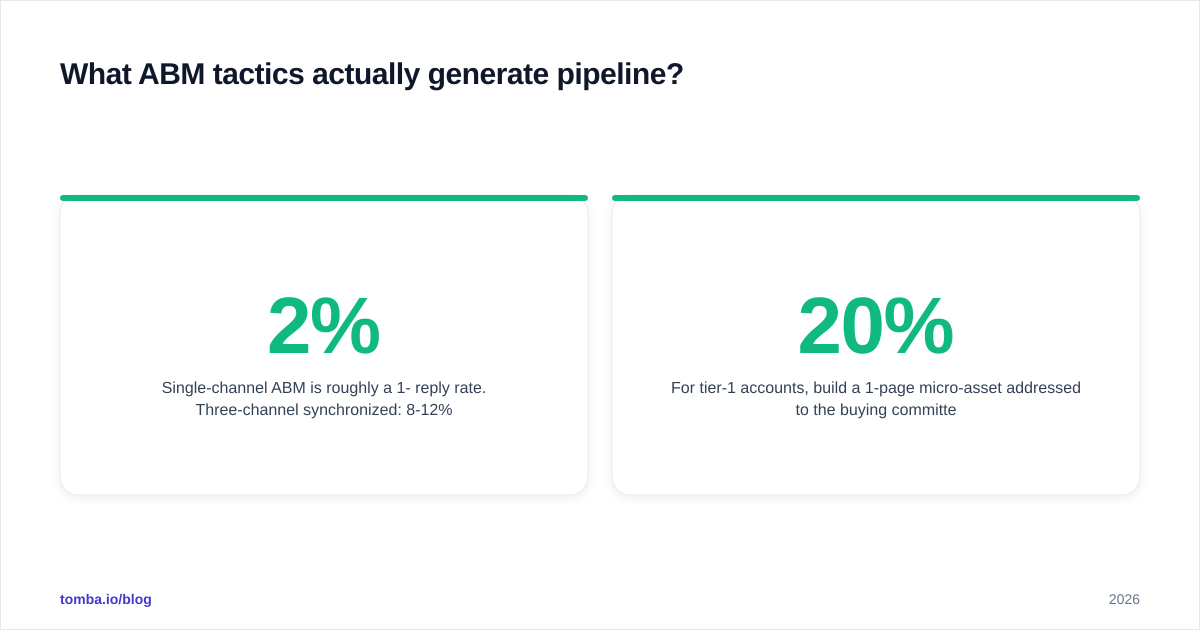
Single-channel ABM is roughly a 1-2% reply rate. Three-channel synchronized: 8-12% in our customer benchmarks.
4. Intent-based sequence triggers#
Don't start a sequence on a calendar. Start it when an account does something:
- Visits your pricing page twice in a week
- Three employees view your G2 profile
- Posts a job for a role your product enables
- Announces funding
- Shows up on a third-party intent platform (6sense, Bombora,
ZoomInfo)
Calendar-triggered sequences are spam wearing a tuxedo. Behavior-triggered sequences are sales.
5. Reverse-IP visitor reveal#
Anonymous traffic from a tier-1 account is gold you're throwing away. A website visitor reveal tool maps anonymous IPs back to company domains so your team can act on accounts that visited the pricing page yesterday — without waiting for a form fill.
6. The "buying committee" content drop#
For tier-1 accounts, build a 1-page micro-asset addressed to the buying committee by name. Not a generic case study — an actual "Here's how we'd help [Company] specifically, in three slides." It takes 30 minutes with AI and converts at meeting rates north of 20% when delivered with a personalized Loom.
7. Champion-led referral plays#
Your strongest signal is a happy customer who just moved to a target account. A simple monthly query against your CRM + LinkedIn data surfaces these. They convert at 5-10x cold outbound.
What's the right ABM tech stack?#
Stop buying tools first. Map the work, then buy what fills the gaps.
The minimum viable ABM stack has four layers:
| Layer | Job | Examples |
|---|---|---|
| Data / contacts | Find accounts, get accurate emails + phones, enrich records | Tomba, Apollo, Clearbit,ZoomInfo |
| Intent / signals | Tell you when accounts are in-market | 6sense, Demandbase, Bombora, G2 Buyer Intent |
| Orchestration | Sequences, ads, CRM workflows, attribution | HubSpot, Salesforce, Outreach, Salesloft |
| Activation channels | Where the play happens | Email, LinkedIn, paid social, direct mail |
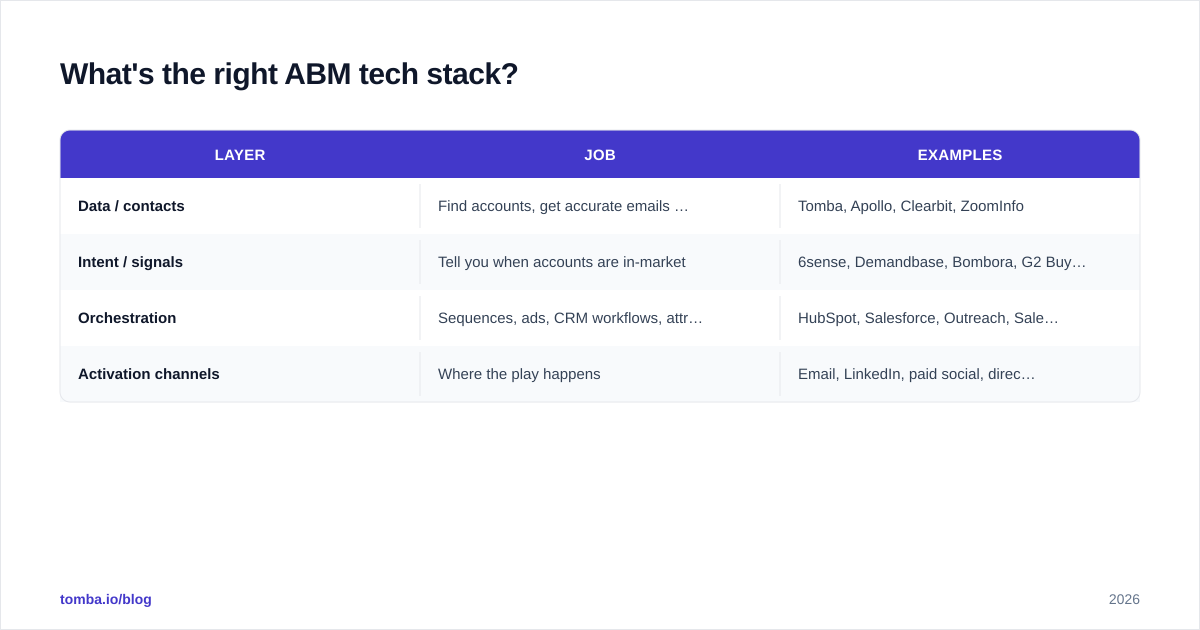
Tomba sits in layer one as the email finder and verification engine — the contacts you push into the orchestration layer are only as good as the source data. A 95%+ deliverable rate at the data layer is the difference between a working sequence and a bounce-fest that torches your domain reputation.
For orchestration, pick based on where your team already lives. Sales-led orgs default to Salesforce integration; marketing-led orgs lean HubSpot integration. Don't fight the existing CRM gravity.
External authoritative reading: Gartner's CMO Spend Survey consistently shows ABM-active programs reporting higher pipeline-to-spend ratios than pure demand-gen peers, and HubSpot's ABM guide is still the most accessible primer if you're stakeholder-educating internally.
How do you measure ABM tactics?#
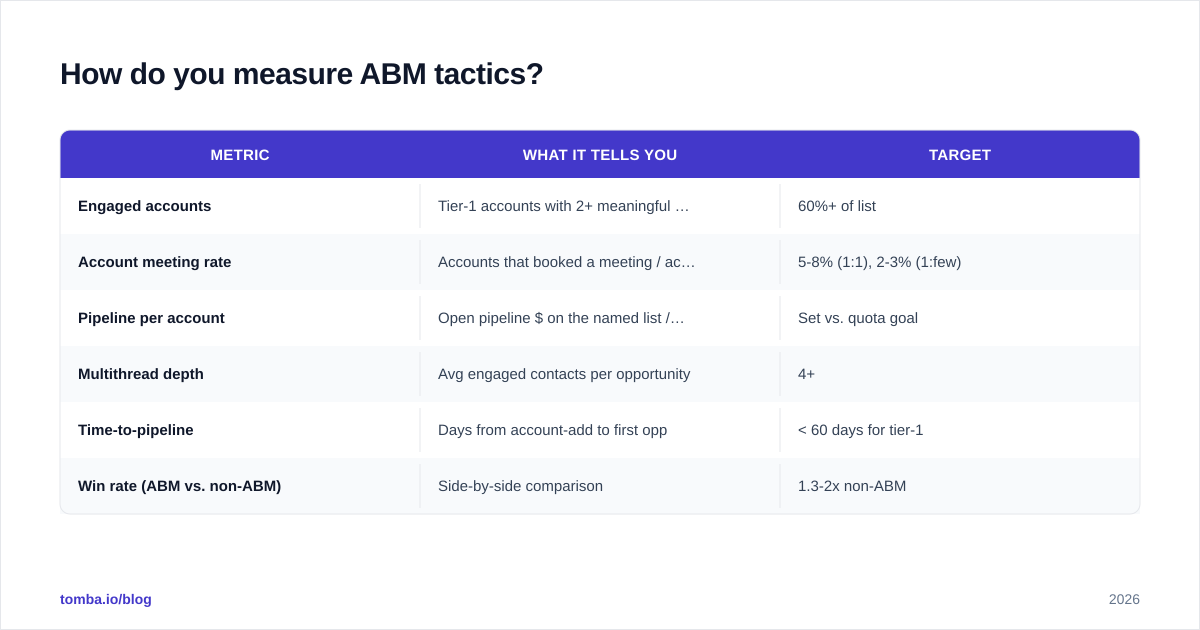
The wrong metrics will kill an ABM program faster than bad copy. Throw away your MQL dashboard and replace it with these.
| Metric | What it tells you | Target |
|---|---|---|
| Engaged accounts | Tier-1 accounts with 2+ meaningful touches in last 30 days | 60%+ of list |
| Account meeting rate | Accounts that booked a meeting / accounts contacted | 5-8% (1:1), 2-3% (1:few) |
| Pipeline per account | Open pipeline $ on the named list / account count | Set vs. quota goal |
| Multithread depth | Avg engaged contacts per opportunity | 4+ |
| Time-to-pipeline | Days from account-add to first opp | < 60 days for tier-1 |
| Win rate (ABM vs. non-ABM) | Side-by-side comparison | 1.3-2x non-ABM |
If your ABM motion isn't producing at least a 30% higher win rate than your inbound or general outbound channels, you don't have ABM. You have a list. There's a difference.
Are ABM tactics worth it for SMB-targeting teams?#
Honestly? Often no. Or at least, not the full enterprise playbook.
ABM economics work when:
- ACV is north of $25K (gives you budget room per account)
- Sales cycles are 30+ days (you need time for plays to compound)
- Buying committees have 3+ people (multithreading pays off)
- Your TAM is bounded — a finite set of named logos worth pursuing
If you sell a $99/mo SaaS to solo founders, run good content + paid social + a sharp email finder-driven outbound. Don't try to run microsites. The math doesn't pencil.
A middle path for SMB-targeting teams: borrow the tactics (multithreading, intent triggers, channel synchronization) without the infrastructure (microsites, dedicated SDR pods, custom reporting). You get 70% of the lift at 10% of the cost.
For verifying the contacts you're committing budget to, an email verifier at the top of the funnel prevents your sequences from burning sender reputation on dead inboxes — a particular killer when you're running synchronized multichannel plays where domain health compounds.
What are the most common ABM tactics mistakes?#
The same five mistakes show up in every ABM post-mortem I've seen:
- Account list too big. 500+ "tier-1" accounts is not tier-1. It's a worse demand-gen list.
- Single-threaded outreach. One contact per account = one job change away from dead pipeline.
- Calendar-triggered sequences. Sending day-3 cadence whether the account is hot or cold ignores half your data.
- No alignment on definitions. Marketing's "engaged" is opens. Sales's "engaged" is replies. Pick one and stand on it.
- Quitting at month four. ABM compounds. Most programs need 6-9 months to show pipeline lift and 12+ months for revenue. The teams that quit at month 4 always conclude "ABM doesn't work."
The fix is boring: smaller list, more contacts per account, behavior-triggered sequences, weekly alignment between sales and marketing, and a 12-month minimum runway before you judge the program.
Closing — Where to start this week#
Pick one tier-1 account. Just one. Map five contacts on it using Tomba's email finder, build a three-channel synchronized play across email, LinkedIn, and a retargeting audience, and run it for 14 days. Measure replies, meetings booked, and pipeline created.
If it works on one account, you can scale to 50. If it doesn't, you've spent two weeks instead of two quarters learning the lesson.
Start your ABM data layer free at Tomba — 25 searches a month is enough to map your first 5-10 tier-1 accounts before you commit to a paid plan. See full Tomba pricing when you're ready to scale the program.
Ready to find emails that actually work?
Join 150,000+ professionals who stopped guessing and started sending. Free credits on signup — no credit card required.
Get the Tomba newsletter
Practical outbound tactics and product updates — once every two weeks.
About the author